 by Tom Gurney
Tom Gurney BSc (Hons) is an art history expert with over 20 years experience
Published on June 19, 2020 / Updated on September 28, 2026
Email: tomgurney1@gmail.com / Phone: +44 7429 011000
About the painting
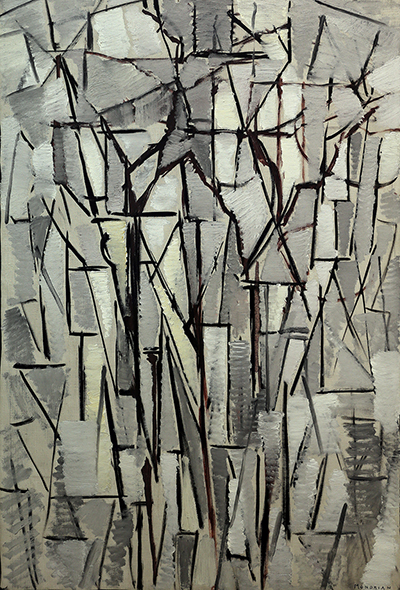
Piet Mondrian's Composition Trees 2 turns a stand of trees into a dense structure of dark trunks, branches and pale intersecting planes. Some tree forms are still legible, especially the upright stems and branching lines near the centre, but the image no longer presents a conventional view of a particular place. Kunstmuseum Den Haag dates this oil-on-canvas painting to 1912–13, measures it at 98 × 65 cm, and lists it as object 0334316 from the Salomon B. Slijper bequest. An independent University of Edinburgh catalogue identifies the work as Joosten B24, matching the RKD sequence. The existing picture on this page is of that tall, black-and-grey tree composition.[1][2][3]
At a glance
- ArtistPiet Mondrian (Piet Mondriaan, 1872–1944)
- TitleComposition Trees 2; also written Composition Trees II
- Date1912–13
- MediumOil on canvas
- Dimensions98 cm high × 65 cm wide
- CollectionKunstmuseum Den Haag, The Hague; Salomon B. Slijper bequest
- Object number0334316 in the museum's current record
- Catalogue numberJoosten/RKD B24[1][2][3]
Composition Trees 2 in Mondrian's tree sequence
Contents
- What does the painting show?
- How does it relate to Mondrian's earlier trees?
- What do the catalogue and museum records establish?
- Is it the same as Study trees 2?
What does the painting show?
At first glance the work can look like a near-monochrome tangle. Look for the two dark upright forms just left and right of centre. Branches spread from them into a web of shorter diagonals and crossbars. The thin strokes at the top suggest more distant or fragmented limbs, while the lower half is crowded with verticals that could be trunks, trunks seen through other branches, or dark edges of abstract planes. There is enough tree structure to justify the title without requiring each mark to describe one botanical detail.
The canvas is filled with off-white, grey and restrained brownish or blue-grey tones. Painted planes cut across the branches; some seem to sit behind the black lines, while others interrupt a line and bring a pale surface forward. The layered effect makes it hard to fix a single depth order. Is the tall dark stroke in front of a light trunk, or is it an edge that divides the picture into neighbouring shapes? Mondrian lets both readings compete.
The middle and lower parts are busier than the corners. In the upper left, pale blocks are large enough for the eye to pause; then a branch sends it toward the next narrow interval. Near the bottom, vertical strokes become a more regular rhythm but still do not make an even grid. The title directs the eye toward trees, yet the painting increasingly asks viewers to pay attention to the relation of line, area and tone. This is a close reading of the existing image, not a claim to identify the actual species or site.
At almost a metre high, the original has a bodily scale that a small web image conceals. Its 98 × 65 cm format is notably vertical. That format helps the trunks hold the image together even when the surrounding branches and light spaces fracture into many parts.[1]
How does it relate to Mondrian's earlier trees?
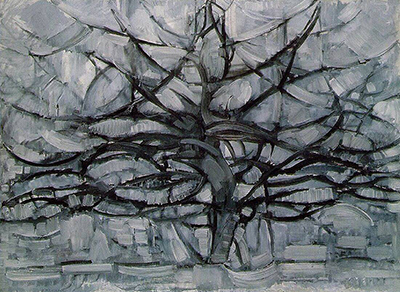
Mondrian had already made trees into vehicles for formal experiment before this canvas. In the site's Gray Tree, dated 1911 and catalogued B4, a central trunk and spreading crown remain comparatively easy to follow. In Composition Trees 2, verticals and branches multiply and overlap; the viewer must work harder to decide where one tree ends and another begins. The change is visible in the paintings themselves, while their dates and catalogue positions are confirmed in the RKD sequence.[3]
The difference from the earlier Flowering Apple Tree is also instructive. Mondrian retained a tree motif but gave the interlocking spaces between branches increasing importance. Here the pale intervals feel as active as the dark stems. The work remains tied to an observed type of subject; it also shows how the subject could supply a framework for composition rather than simply be represented.
That distinction avoids a misleading straight-line story in which a realistic tree suddenly became a pure grid. Mondrian worked through several paintings and drawings, and he did not erase all clues to the tree at once. Composition Trees 2 occupies one identifiable stage: a tree structure persists, while the painter treats the spaces around it as shapes in their own right. RKD's neighbouring 1912–13 entries show that this was a sustained investigation rather than a single isolated experiment.[3]
Watch: Piet Mondrian
See his studio, the move toward geometric abstraction and the rhythms of his New York paintings.
Piet Mondrian: Abstract Painting as We Know It
Curator Michael White explores the paintings and Mondrian’s studio as an abstract space.
Watch on YouTubeWhat do the catalogue and museum records establish?
The Kunstmuseum Den Haag collection page provides the firm object facts: title, 1912–13 date, oil on canvas, 98 cm height and 65 cm width, museum object 0334316, and the Slijper bequest credit. The University of Edinburgh History of Art Image Library records the same title, date, measurements and Hague collection and explicitly includes Joosten B24. Its older catalogue number is written 158-1971; the current museum page uses 0334316. These are identifiers from different records, not evidence of two paintings with the same title.[1][2]
RKD places B24 in its Paris 1912–14 catalogue group. This is a catalogue period, not proof that the painting depicts a specific Paris street or garden. The visible branches do not establish a named site. The museum's public record also does not say that the picture is on display today. It confirms that the original belongs to the collection, which is the reliable location claim for this page.[3][1]
Is it the same as Study trees 2?
No. The museum also catalogues Study trees 2: study for Tableau No. 2 / Composition No. VII. That is a 1913 charcoal-on-paper work, object 0557347, with a broad format reported as approximately 66 × 82–84 cm. Composition Trees 2 on this page is the oil canvas, 98 × 65 cm, object 0334316. Their similar names refer to Mondrian's related tree investigations, but the material, size, title and museum numbers identify separate objects.[1][4]
The distinction matters because a search for “Mondrian trees 2” can return both the finished canvas and studies for other compositions. In the painting here, the standing dark stems and grey planes cover a tall canvas. The charcoal study has another purpose stated in its museum title: preparation for Tableau No. 2 / Composition No. VII. Keeping the two records apart lets the viewer follow Mondrian's sequence without attaching the wrong study to the wrong finished work.
Mondrian artworks directory
Frequently asked questions
When was Composition Trees 2 painted?
Where is the original painting?
It is in the Kunstmuseum Den Haag collection as object 0334316, credited to the Salomon B. Slijper bequest. The collection record does not establish a current display location.[1]
How large is it, and what is it made of?
The original is oil on canvas, 98 cm high by 65 cm wide.[1]
What is its catalogue number?
Is this a drawing called Study trees 2?
Discussion
Which dark trunk or pale plane first holds your eye in the tree network?
Reader Insights
Follow one branch across the pale planes. Where does it become difficult to trace?
Which grey or white interval most strongly alters the sense of a tree?
How does this B24 canvas differ from the separate charcoal Study trees 2?
Join the Conversation
Share what you notice in this painting below.
References
- Kunstmuseum Den Haag, collection record for Composition Trees 2, object 0334316, with medium, size, date and Slijper bequest. View source.
- University of Edinburgh History of Art Image Library, Mondrian, Composition Trees 2, 1912–13, identifying Joosten B24 and older catalogue number 158-1971. View source.
- RKD – Netherlands Institute for Art History, digital Mondrian catalogue raisonné, Paris 1912–14 sequence including B24. View source.
- Kunstmuseum Den Haag, record for the distinct Study trees 2: study for Tableau No. 2 / Composition No. VII, charcoal on paper, object 0557347. View source.
- Lead image credit. Piet Mondrian, Composition Trees 2, 1912–13, oil on canvas, 98 × 65 cm, RKD B24; Kunstmuseum Den Haag 0334316, Salomon B. Slijper bequest.
 The Red Tree Piet Mondrian.jpg)