 by Tom Gurney
Tom Gurney BSc (Hons) is an art history expert with over 20 years experience
Published on June 19, 2020 / Updated on September 28, 2026
Email: tomgurney1@gmail.com / Phone: +44 7429 011000
About the painting
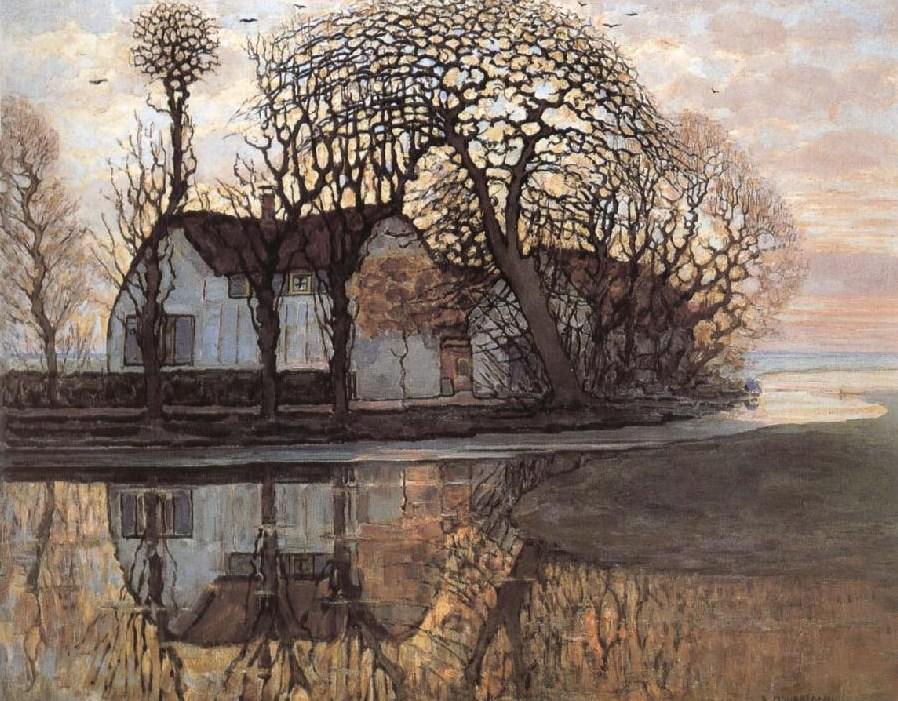
A low farmhouse stands behind bare trees beside still water in Piet Mondrian's Farm near Duivendrecht. The tangled branches spread against a pink and gold sky; the building and trunks return as broken reflections below. This is the circa 1916 painting in the Art Institute of Chicago, not one of Mondrian's earlier pictures of the same farm. The museum records it as oil on canvas, 86.3 × 107.9 cm, reference 2001.479, a gift of Dolly J. van der Hoop Schoenberg. The RKD catalogue identifies the Chicago painting as C8. The existing image on this page matches the Chicago composition.[1][2]
At a glance
Farm near Duivendrecht in Mondrian's changing practice
Contents
- What does the painting show?
- Why did Mondrian return to this farm?
- Which Farm near Duivendrecht is pictured here?
- What is known about its ownership and exhibitions?
What does the painting show?
The farm sits near the centre of a broad landscape. Its white and grey walls, low red-brown roof and small openings give it a simple, compact shape. Dark, leafless trees stand in front of it. One slim trunk on the left rises into a tight rounded crown; larger branches on the right form a dense web that partly covers the roof and upper walls. The trees turn a quiet building into an intricate pattern of lines.
 The Red Tree Piet Mondrian.jpg)
Behind them, the sky shifts through soft blue, peach, pink and gold. Near the right edge the open horizon creates a breathing space after the crowded tree canopy. A small dark shape in the sky and short accents elsewhere prevent the broad background from feeling empty. The image suggests fading light, but the published museum record does not give an exact hour or season. “Twilight” is a reasonable description of its effect rather than a measured fact about when Mondrian worked.
A narrow land bank divides the farm and trees from the foreground water. The line is almost horizontal, but its edges are uneven. Below it, the house appears again as a pale block and the trunks as dark, broken verticals. The reflection is not a perfect mirror. Ripples and paint marks stretch or interrupt forms, making the lower half both recognisable and more abstract. The contrast between the steady bank and restless reflected shapes gives the composition much of its tension.
The picture balances a solid building with organic branches, and a visible scene with its doubled image. The contrast between the comparatively flat building and the bare, branching forms is especially apparent where dark trunks cross the light walls. The painting invites close inspection of how a line can be both a branch and a structural mark on the canvas.
At 86.3 × 107.9 cm, the original is more than a small study. Its width lets the farm, trees, water and open right-hand distance coexist without crowding every part equally. The dense middle draws attention first, then the reflection pulls it downward and the open sky releases it toward the right.[1]
Why did Mondrian return to this farm?
Mondrian first sketched the farm around 1905. The Art Institute says that nine of twenty known related paintings and drawings were made later, during the First World War. Fondation Beyeler's 2022 exhibition list groups the Chicago canvas with other circa 1916 farm pictures from The Hague, Dallas and Otterlo. Their varied depictions of the building and water show Mondrian returning to a familiar place after he had already pursued Cubist and increasingly abstract compositions.[1][3]
The Art Institute proposes a qualified explanation: he likely revisited this naturalistic subject partly because his wartime patrons preferred earlier-looking landscape works to his Cubist experiments. “Likely” matters. The museum presents this as an interpretation, not a statement documented in the painting itself. The farm also offered a formal problem he had explored for years: how to arrange horizontal ground and water, vertical trees, a stable building and a shifting reflection in one image.[1]
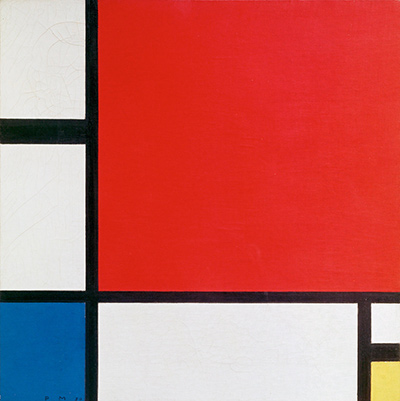
That return is a useful correction to a simple one-way story about Mondrian's career. Around 1916 he could work with recognisable landscape while also making paintings built from line and colour. Fondation Beyeler sets the Chicago farm painting alongside Composition No. II of 1913 to make that point. A later date does not automatically mean a more abstract appearance. Mondrian's choices of subject, patron and experiment overlapped.[3]
The farm was near Duivendrecht, south of Amsterdam. The series does not record one fixed view in one fixed light. Trees, roof and water change in emphasis across versions. In the Chicago canvas the canopy and reflection dominate; the building remains legible, yet the branches and their doubled forms complicate its clear geometry. The result is a landscape with both observed detail and deliberate pictorial structure.
Watch: Piet Mondrian
See his studio, the move toward geometric abstraction and the rhythms of his New York paintings.
Piet Mondrian: Abstract Painting as We Know It
Curator Michael White explores the paintings and Mondrian’s studio as an abstract space.
Watch on YouTubeWhich Farm near Duivendrecht is pictured here?
RKD separates several paintings with very similar titles. Its late naturalistic sequence lists C1–C9 as farm works around 1916–17. C7 is in Kunstmuseum Den Haag as object 0334321; C8 is the Art Institute of Chicago painting, 2001.479. RKD also has an earlier Duivendrecht group, including A390, a circa 1905–06 painting in The Hague as object 0334249. These are not interchangeable catalogue records.[2][4]
The site image matches the Chicago C8 work: a white farmhouse under an extensive bare canopy, a glowing sky opening at right, a long dark bank and water reflection filling the foreground. The Art Institute's official image displays that arrangement, and its object facts attach it to 2001.479. This page therefore uses circa 1916, the Chicago museum's 86.3 × 107.9 cm measurement and its gift credit. It does not borrow the 1905 date or Slijper bequest from the earlier Hague painting.[1][4]
Another potential confusion is the Farm near Duivendrecht, in the Evening title in the RKD sequence. Several evening versions belong to Dallas or the Kröller-Müller Museum. They share the farm motif, but the location and C-number differ. The safest way to identify the work shown here is the combined C8 / Art Institute 2001.479 record.[2]
What is known about its ownership and exhibitions?
The Art Institute's published provenance begins with the artist and records Dr. Eduard and Lea van der Hoop in Amsterdam at about 1916, based on notes in the later gift file. The painting passed by descent to Dolly J. van der Hoop, then through her marriage to Isaac Schoenberg, and was given to the Art Institute in 2001. The museum explicitly states the basis for the first approximate transfer, so the page should not turn that “about 1916” into an exact sale date.[1]
Its exhibition history also extends beyond one recent showing. The Art Institute lists Mondrian presentations in Amsterdam in 1946, Philadelphia in 1963, Toronto and Philadelphia in 1966, and the travelling Serial Imagery exhibition beginning in Pasadena in 1968. It was included in the Mondrian Evolution exhibition at Fondation Beyeler in 2022, followed by Kunstsammlung Nordrhein-Westfalen in Düsseldorf. Those records show the painting's later public life, while the museum's object page remains the authority for its current collection identity.[1]
The museum marks the artwork image as CC0 public domain. The existing site image is retained here; no replacement is required to present the correct object. The public-domain indication is useful if a future, straightforward quality upgrade is wanted, but it does not change the artwork facts or justify confusing this canvas with another farm variant.[1]
Mondrian artworks directory
Frequently asked questions
When did Mondrian paint Farm near Duivendrecht?
Where is the original?
It belongs to the Art Institute of Chicago, reference 2001.479, a gift of Dolly J. van der Hoop Schoenberg. Consult the museum for current display details.[1]
What is the size and medium?
It is oil on canvas, 86.3 cm high by 107.9 cm wide.[1]
Is it the circa 1905 farm painting in The Hague?
Why did Mondrian paint a farm after making abstract works?
He returned to the subject repeatedly. The Art Institute suggests that wartime patrons likely favoured naturalistic pictures. The several 1916 farm variants also show continued work with trees, water and reflection. The published evidence does not establish a single certain reason for his return to the motif.[1][3]
Discussion
Which branch first catches your eye against the pale sky?
Reader Insights
Follow a tree trunk into its reflection. Where does the shape break?
Which part of the reflected building most changes the scene above it?
How does this Chicago C8 canvas differ from the early Hague A390 farm painting?
Join the Conversation
Share what you notice in this painting below.
References
- Art Institute of Chicago, Farm near Duivendrecht, c. 1916, object 2001.479; object facts, curatorial description, provenance, exhibition history and CC0 image designation. View source.
- RKD – Netherlands Institute for Art History, digital Mondrian catalogue, late naturalistic landscapes C1–C20, including C8 at the Art Institute of Chicago and separate C7 and evening variants. View source.
- Fondation Beyeler, Mondrian Evolution 2022 list of works, Room 4, grouping the Chicago canvas with the 1913 Composition No. II and other circa 1916 farm variants. View source.
- RKD – Netherlands Institute for Art History, earlier Duivendrecht landscape sequence A387–A396a, including A390, c.1905–06, Kunstmuseum Den Haag 0334249. View source.
- Lead image credit. Piet Mondrian, Farm near Duivendrecht, c. 1916, oil on canvas, 86.3 × 107.9 cm, RKD C8; Art Institute of Chicago 2001.479, gift of Dolly J. van der Hoop Schoenberg.