 by Tom Gurney
Tom Gurney BSc (Hons) is an art history expert with over 20 years experience
Published on June 19, 2020 / Updated on September 28, 2026
Email: tomgurney1@gmail.com / Phone: +44 7429 011000
About the painting
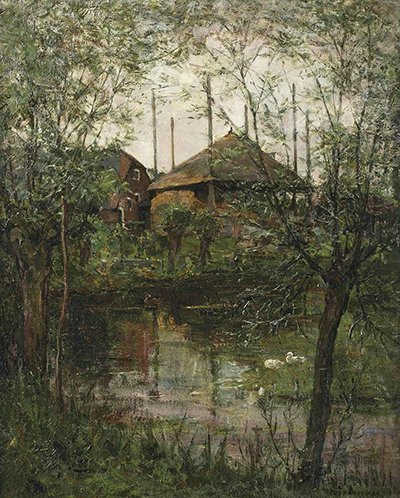
Willow trees frame a quiet waterway, with farm buildings and a steep-roofed haystack beyond it, in Piet Mondrian's Haystack with Willow Trees. The image on this page matches the early landscape identified as A151 in RKD's digital catalogue. RKD dates it 1897–98 and places it among Mondrian's countryside subjects from near Amsterdam. Simonis & Buunk, the gallery that previously offered the painting, also identifies it as A151 in Robert P. Welsh's catalogue raisonné. Its direct object record gives oil on canvas, 63.3 × 51.9 cm, and records a lower-right signature. The existing site image is retained.[1][2]
At a glance
- ArtistPiet Mondrian (Piet Mondriaan, 1872–1944)
- TitleHaystack with Willow Trees; dealer title A Haystack with Willow Trees
- Catalogue numberRKD / Welsh A151
- Date1897–98
- MediumOil on canvas
- Dimensions in the dealer's object record63.3 cm high × 51.9 cm wide
- SignatureLower right, according to the dealer
- Recorded locationRKD names art dealer Simonis & Buunk, Ede; the dealer says the work was previously for sale, so this is not a claim about its current owner[1][2]
Haystack with Willow Trees among Mondrian's landscapes
Contents
- What is visible in the landscape?
- Where does this painting fit in Mondrian's work?
- What is documented about its history?
- How is it different from similar haystack scenes?
What is visible in the landscape?
The view looks across a narrow stretch of water toward low farm buildings. A steep roof or haystack occupies the centre, partly screened by the trees. Willow trunks stand near both sides of the image, while their fine branches and leaves form a loose canopy above. Between them, a pale patch of sky gives the middle distance some light. In the water, blurred reflections bring the darker bank and the structures back into the foreground.
 The Red Tree Piet Mondrian.jpg)
The trees do much of the compositional work. The thicker trunks at left and right act as a frame, but their leaves do not make a neat border. They cross the sky and partly conceal the farm. The haystack's triangular top remains readable through this network. A viewer first sees a dense green-brown surface, then slowly separates individual trunks, roof shapes, bank and reflection. This gradual reading is a striking part of the picture's effect.
The foreground is dark and textured. Short marks of green, brown and grey suggest plants at the water's edge. The water itself is smoother and lighter. Its reflections soften the hard division between near bank and distant farm. Mondrian thus holds the scene together through a narrow tonal range while varying the density and direction of his marks. These are observations about the reproduction; the exact time of day or weather is not recorded in the catalogue sources.[1]
Where does this painting fit in Mondrian's work?
RKD places A151 among its A146–A164 group, “Countryside near Amsterdam 1897–1901.” Nearby entries include A148, Haystack and Farm Sheds in a Field; A149, Haystack in Farmyard with Chickens and Ducks; and A150, Haystack. Their neighbouring catalogue positions and dates show that farm and haystack subjects occupied Mondrian repeatedly during these years, but they are four separate paintings. A151 combines the farm motif with a water view and foreground willows.[1]
The composition is naturalistic: its farm, trees, water and sky remain recognisable. It uses layered leaves and reflections rather than the clean orthogonal divisions of Mondrian's later abstract paintings. Still, the picture is carefully organised. The strong near-vertical trunks, the horizontal waterline and the central triangular form set up a structure beneath the foliage. Reading those relationships does not require claiming that Mondrian had already planned his later grid paintings in 1897–98.
Kunstmuseum Den Haag's biography places Mondrian in Amsterdam for artistic training from 1892, and says that by 1900 he was painting landscapes, windmills and farmhouses in the Gein area. That broad chronology helps locate this early landscape within his practice. It does not identify the exact waterway or farm in A151. Without a source linking the picture to a named site, the scene should remain a countryside subject near Amsterdam rather than a confidently named Gein location.[3]
Watch: Piet Mondrian
See his studio, the move toward geometric abstraction and the rhythms of his New York paintings.
Piet Mondrian: Abstract Painting as We Know It
Curator Michael White explores the paintings and Mondrian’s studio as an abstract space.
Watch on YouTubeWhat is documented about its history?
Simonis & Buunk's object record says that collector Sal Slijper bought the painting directly from Mondrian in 1919. It then records private ownership in Switzerland from 1949 to 1998. Those are significant steps, but they are not a complete chain of ownership through the present. The gallery describes the work as previously for sale, while RKD's current public listing names the gallery in Ede. Neither statement by itself proves that the gallery still owns it or that the painting is on public display.[1][2]
The dealer also cites a series of exhibitions, including the Mondriaanhuis in Amersfoort in 1997, Villa Mondriaan in Winterswijk in 2017–19, and Museum Flehite in Amersfoort in 2022–23. It records a loan to Villa Mondriaan through October 2022. These listings show that this early landscape has been treated as an exhibition object, but past display dates should not be read as a current viewing schedule. The dealer cites Welsh's Catalogue Raisonné of the Naturalistic Works, page 216, number A151, which agrees with the RKD identification.[2]
A reused Commons image description gives 70 × 58 cm, whereas the dealer's direct object record gives 63.3 × 51.9 cm. The difference is too large to silently treat as rounding. This page uses the dealer's object measurement in its quick facts and notes the conflicting image metadata here. A physical examination or updated object record would be needed to settle what each measurement includes.[2][4]
How is it different from similar haystack scenes?
The title is easy to confuse with other Mondrian works. RKD's A150 is titled simply Haystack, dated 1897–98 and listed at Kunstmuseum Den Haag. A148 shows a haystack and farm sheds in a field. A149 has chickens and ducks in a farmyard. A151, the work shown here, puts the haystack or steep-roofed structure behind willow trees across water. Those visible features and the A151 catalogue number offer a stronger identification than the word “haystack” alone.[1]
The site also has a Farm Near Duivendrecht page for a much later circa 1916 Chicago painting. Both works involve rural buildings and trees, but their dates, catalogue identities and images are different. Keeping them separate gives a clearer view of how often Mondrian returned to landscape subjects while changing his approach over time.
Mondrian artworks directory
Frequently asked questions
When did Mondrian paint Haystack with Willow Trees?
What is its catalogue number?
What are its material and size?
Where is the original painting?
Is it the same as Mondrian's Haystack A150?
No. RKD lists A150 Haystack and A151 Haystack with Willow Trees as separate works.[1]
Discussion
Which willow trunk first draws your eye?
Reader Insights
Follow the water toward the haystack. Where does your eye stop?
How do the dark reflections change the pale sky?
Why should A151 be kept separate from the neighbouring A150 Haystack?
Join the Conversation
Share what you notice in this painting below.
References
- RKD – Netherlands Institute for Art History, digital Mondrian catalogue, “A146–A164 (Countryside near Amsterdam 1897–1901),” entries A148–A151 and current listed location for A151. View source.
- Simonis & Buunk, object record, “A haystack with willow trees”: oil, 63.3 × 51.9 cm, signature, provenance, exhibitions and Welsh A151 reference. View source.
- Kunstmuseum Den Haag, “Biography,” early Amsterdam training and landscape chronology. View source.
- Wikimedia Commons, RKD-sourced image file information for A151, including a different size in reused metadata. View source.
- Lead image credit. Piet Mondrian, Haystack with Willow Trees, 1897–98, oil on canvas, RKD A151. Dealer object record: 63.3 × 51.9 cm; current owner unverified.