 by Tom Gurney
Tom Gurney BSc (Hons) is an art history expert with over 20 years experience
Published on June 19, 2020 / Updated on September 28, 2026
Email: tomgurney1@gmail.com / Phone: +44 7429 011000
About the painting
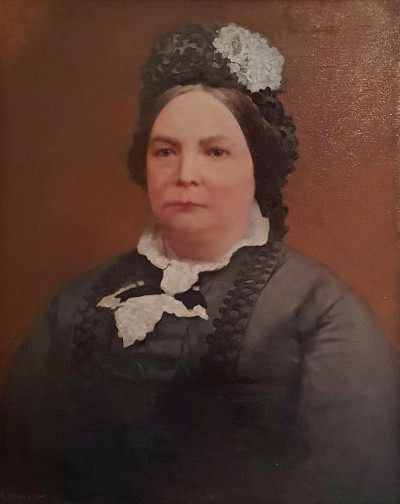
A woman in dark dress faces the viewer against a warm brown ground in Piet Mondrian's H.H. van Aalst-Haagedoorn. White lace at her throat and a light ornament in her hair draw attention to her face. The inherited image on this page corresponds to A633 in RKD's Mondrian catalogue. RKD dates the portrait circa 1910, lists it in a private collection, and places it beside A632, S.J.C. van Aalst. The pairing matters: Mondrian painted likenesses of the two spouses decades after their deaths, using photographs, according to scholar Marty Bax. The image can be read closely without turning its circa 1910 painting date into a claim that the sitter posed for Mondrian.[1][2]
At a glance
- ArtistPiet Mondrian (Piet Mondriaan, 1872–1944)
- Title and sitterH.H. van Aalst-Haagedoorn
- Catalogue numberRKD / Welsh A633
- Painting datecirca 1910
- Sitter's dates1806–1891, as given by Marty Bax
- Related portraitS.J.C. van Aalst, circa 1910, A632; her husband's dates are given as 1806–1879
- CollectionPrivate collection in RKD's public catalogue
- Medium and dimensionsNot established by the public sources used for this page; no precise size is asserted[1][2]
Van Aalst-Haagedoorn among Mondrian's portraits
Contents
- What does the portrait show?
- Who was H.H. van Aalst-Haagedoorn?
- Why did Mondrian make a traditional portrait around 1910?
- How does it relate to S.J.C. van Aalst?
What does the portrait show?
The sitter is shown from roughly the waist upward. Her body turns a little to one side, while her face looks directly out of the picture. A wide, dark dress fills most of the lower half. The background is a restrained reddish brown, with no furniture or room detail to locate her. Mondrian has instead concentrated on the head, the white collar and the accents of her clothing.
 The Red Tree Piet Mondrian.jpg)
White fabric rises at the neck and falls across the chest in an irregular shape. A pale cluster sits high in her dark hair. These light areas create a visual path toward her face. The rounder forms of the cheeks and hair contrast with the dark, broad mass of the dress. The background remains soft enough that the figure's outline does not become a hard silhouette. In the existing reproduction, the face is modelled with warmer tones than the clothing, making it the natural focus.
The portrait is formal, but its details are specific. A black band or trim runs diagonally down the front of the dress, and small dark rounded accents repeat along it. The image does not establish the material or social meaning of each accessory. Describing what is visible is more reliable than claiming a particular fashion, occasion or mood without evidence. Her steady outward gaze gives the picture its quiet directness; whether that expression came from a photograph, a family preference or Mondrian's own choices is not documented in the catalogue entry.[1]
Who was H.H. van Aalst-Haagedoorn?
Marty Bax identifies the sitter as H.H. van Aalst-Haagedoorn (1806–1891) and her husband as S.J.C. van Aalst (1806–1879). Bax describes him as a Hague banker and records the two portraits together. Their initials and married names are securely connected to the paintings in RKD's adjacent entries, but the cited research does not give a fuller first name for H.H. The page therefore retains the name used by the scholarly and catalogue records rather than expanding it speculatively.[1][2]
The sitter died about nineteen years before the portrait's approximate 1910 date. Her husband had died even earlier. Bax says that Mondrian sometimes worked from photographs in portrait commissions, as he did for the Van Aalst couple. The image is therefore a posthumous likeness. It should not be described as a record of a live sitting around 1910 or as proof that Mondrian personally knew H.H. van Aalst-Haagedoorn.[2]
Bax mentions a possible connection between the portraits and the family of physician Abraham van de Velde, who knew Mondrian, but presents the proposed family relationship as a possibility and says it was not further researched. No documented commissioner is named in RKD's brief public entry. This article does not turn a tentative family link into a confirmed commission story. What the sources establish is the sitter's identity, the paired portrait, the retrospective timing and the use of photographs.[1][2]
Watch: Piet Mondrian
See his studio, the move toward geometric abstraction and the rhythms of his New York paintings.
Piet Mondrian: Abstract Painting as We Know It
Curator Michael White explores the paintings and Mondrian’s studio as an abstract space.
Watch on YouTubeWhy did Mondrian make a traditional portrait around 1910?
This painting can surprise readers who know Mondrian chiefly through his later grids. Around 1910, however, RKD's catalogue places the Van Aalst pair among portraits, figure studies and self-portraits. The immediately following A634 depicts Arda Ruhwandl, while A635 and A636 concern a girl in red. A637–A639 are self-portrait studies. The Van Aalst picture belongs to this documented range of figurative work rather than representing an isolated exception.[1]
Bax's research describes portrait commissions and teaching as parts of Mondrian's early working life. She says some traditional portraits were made from photographs. Her account helps explain how a posthumous family likeness could be painted in the same period as his more experimental work. It does not prove the fee paid for A633, the identity of its commissioner, or exactly how Mondrian translated a particular source photograph into paint. Those details remain outside the public evidence used here.[2]
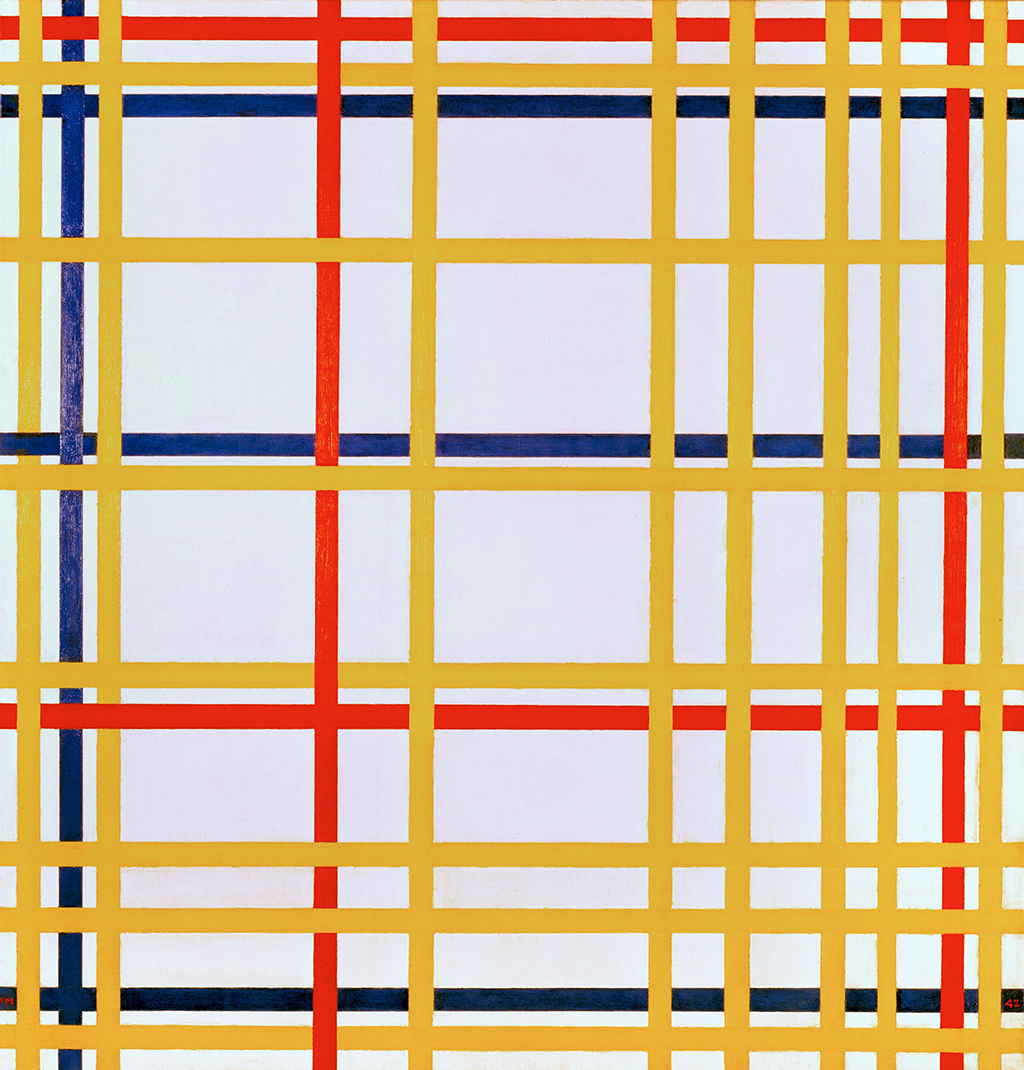
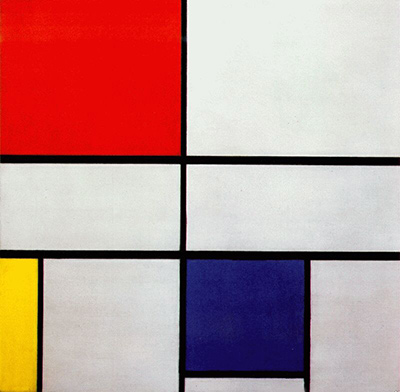
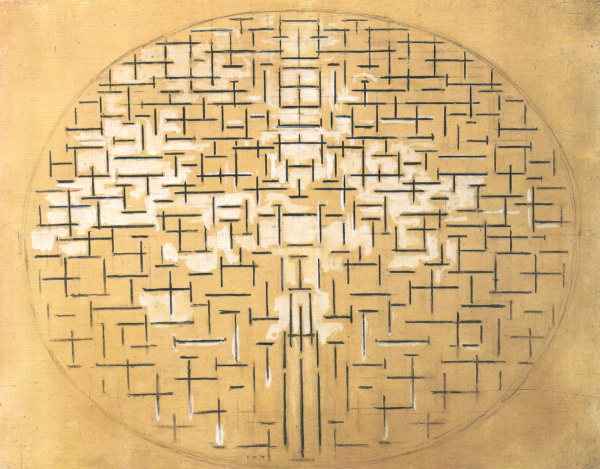
The picture's restrained colours and frontal presentation serve the task of likeness. Dark clothing, warm ground and selected white details keep attention on the sitter. This is different from the heightened colour in Mondrian's nearby flower and dune pictures, and different again from the later compositions for which he became famous. Looking across these works makes the range of his practice visible without forcing the portrait to predict abstraction or inventing a symbolic role for the white collar.
How does it relate to S.J.C. van Aalst?
RKD lists S.J.C. van Aalst as A632 and H.H. van Aalst-Haagedoorn as A633, both circa 1910 and both in private collections. Bax explicitly treats them as portraits of a married couple. The site's S.J.C. van Aalst page covers the husband separately. The pair should be linked for context, while each image, sitter and catalogue number remains distinct.[1][2]
Bax cites Sotheby's Amsterdam, 1988, lot 224 for the married couple. That citation shows a later documentary trace, but the public material reviewed here does not provide a verified sale price or a full ownership chain. RKD's private-collection description is the sound public-level location statement. Readers looking for a current display should not infer one from the 1988 catalogue reference.[1][2]
Mondrian artworks directory
Frequently asked questions
When was the portrait painted?
RKD dates A633 to circa 1910. The date is approximate, not an inscription establishing a precise day or year.[1]
Did H.H. van Aalst-Haagedoorn sit for Mondrian?
No live sitting around 1910 is possible on the dates given by Marty Bax: the sitter died in 1891. Bax says Mondrian used photographs for the Van Aalst portraits.[2]
Is this a pair with S.J.C. van Aalst?
Where is the painting now?
RKD lists it in a private collection. The public catalogue excerpt does not identify the owner or a place to see the work.[1]
What are its medium and dimensions?
The RKD public entry and Bax passage cited here do not give a verified medium or size. This page leaves those fields open rather than borrowing measurements from a different portrait.
Discussion
Which part of the portrait first draws your eye?
Reader Insights
Follow the white collar toward the face. Where does your eye stop?
How does the warm brown ground change the dark dress?
How does A633 relate to the separate portrait of her husband, A632?
Join the Conversation
Share what you notice in this painting below.
References
- RKD – Netherlands Institute for Art History, digital Mondrian catalogue, “Portraits (A632–A639),” entries A632 and A633, approximate dates and private-collection listings. View source.
- Marty Bax, Mondrian's Passions: People, Painting, Principles, “Mondrian and his friends,” pp. 42–43, on the married Van Aalst sitters, dates, use of photographs and 1988 Sotheby's catalogue reference; PDF hosted by RKD. View source.
- Lead image credit. Piet Mondrian, H.H. van Aalst-Haagedoorn, c. 1910, RKD A633. Private collection in RKD’s catalogue.