 by Tom Gurney
Tom Gurney BSc (Hons) is an art history expert with over 20 years experience
Published on June 19, 2020 / Updated on September 28, 2026
Email: tomgurney1@gmail.com / Phone: +44 7429 011000
About the painting
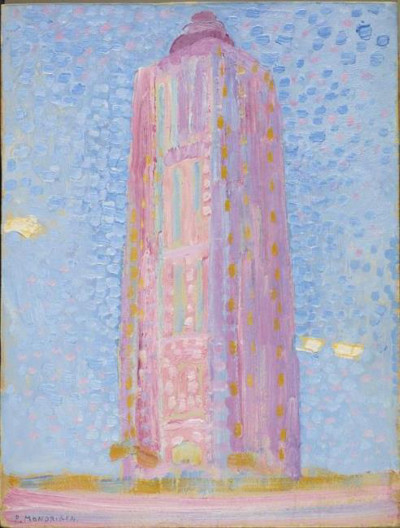
A pink tower stands against a blue sky broken into small coloured marks in Piet Mondrian's Lighthouse at Westkapelle in Pink. The inherited image on this page is the work catalogued as RKD A684, linked to Kunstmuseum Den Haag object 0334295. The museum dates it 1909, records oil on cardboard, and gives its size as 39 × 29.5 cm. Those facts distinguish this compact study from the brown oil canvas A683 and the much larger multicolour oil canvas A687. RKD's colour title is especially useful because the museum calls several distinct paintings simply Lighthouse at Westkapelle.[1][2]
At a glance
- ArtistPiet Mondrian (Piet Mondriaan, 1872–1944)
- Catalogue titleLighthouse at Westkapelle in Pink
- Catalogue numberRKD / Welsh A684
- Museum titleLighthouse at Westkapelle
- Museum object numberKunstmuseum Den Haag 0334295
- Date1909
- MediumOil on cardboard
- Dimensions39 cm high × 29.5 cm wide
- Collection creditKunstmuseum Den Haag, bequest of Salomon B. Slijper[1][2]
The Westkapelle lighthouse sequence
With Clouds (A682)
1908–09In Brown (A683)
1909In Pink (A684)
1909Multicolour (A687)
c. 1910Contents
- What does the painting show?
- Why did Mondrian paint the same tower repeatedly?
- How is the pink version identified?
- What is known about the painting's ownership?
What does the painting show?
The lighthouse rises from a low band of ground and nearly fills the painting's height. Its pink and lilac body is broader at the bottom and tapers visually toward the rounded top. Mondrian marks the architecture with pale vertical strokes, rows of small yellow accents and a few arches and openings. The tower remains recognisable, but no single hard outline contains it. Pink moves into purple at the edges, while light blue slips between the architectural marks.
 The Red Tree Piet Mondrian.jpg)
The sky has a different texture. Many short blue, pink and lilac touches fill it, particularly above and beside the tower. Yellow-white patches near the lower sides interrupt the cool field. The repetition of small marks makes the sky active without describing individual clouds precisely. The ground is a thin, warmer strip. This gives the tower a base while leaving most of the picture to a direct encounter between vertical masonry and light-filled blue space.
At the lower left, the reproduction shows a small dark name-like inscription. The museum's short public record used here does not describe or authenticate it, so it is safer to note its visibility than to make a separate claim about signature history. More securely, the 39 × 29.5 cm cardboard support establishes the work as a small, portable painting. Its concentrated treatment of one tower is very different in physical scale from the 135 × 75 cm A687 canvas, even if both appear at a similar size on a screen.[2][3]
Why did Mondrian paint the same tower repeatedly?
The Mondrian Route, created with Kunstmuseum Den Haag and RKD, explains that the Westkapelle lighthouse began as a late fifteenth-century church tower. It counts five paintings and a drawing of the structure between 1908 and 1910. Repetition gave Mondrian a steady architectural form against which he could test changes in colour, brushwork, viewpoint and scale. The Route notes different uses of short dabs and longer strokes among the versions.[4]
A684 is particularly striking for its light palette and small repeated marks. The tower is pink, but that colour is not isolated: small warm touches appear in the sky and at the ground, while blue and purple interrupt the tower. The eye keeps moving between structure and atmosphere. This is a visible relationship among colours, not a documented symbolic code. Nor can the exact weather or hour be reconstructed from the painting's title.
Kunstmuseum Den Haag's By the Sea exhibition account places Mondrian in the wider Zeeland artistic setting with Jan Toorop and Jacoba van Heemskerck. Dunes, sea and local buildings all became subjects. The lighthouse gave Mondrian a particularly strong upright shape. This page can describe that emphasis without asserting that A684 was finished on one outdoor visit. The Mondrian Route says he often worked on Zeeland paintings after returning to Amsterdam, but does not identify a certain completion site for this particular cardboard.[4][5]
Watch: Piet Mondrian
See his studio, the move toward geometric abstraction and the rhythms of his New York paintings.
Piet Mondrian: Abstract Painting as We Know It
Curator Michael White explores the paintings and Mondrian’s studio as an abstract space.
Watch on YouTubeHow is the pink version identified?
The identity rests on two linked records. RKD assigns Lighthouse at Westkapelle in pink the number A684 and connects it with museum object 0334295. Kunstmuseum Den Haag records 0334295 as a 1909 oil on cardboard, 39 × 29.5 cm, from the Slijper bequest. The museum's shorter title does not by itself distinguish its several lighthouse paintings; the object number completes the match.[1][2]
RKD's neighbouring entries make the distinction clearer. A682, with Clouds, is object 0334285. A683, in Brown, is 0334300. A685, Summer Morning, appears after the pink version, while A686 is a drawing. A687, in Orange, Pink, Purple and Blue, is the large 0334301 canvas. The brown page, clouded page and multicolour page retain separate images and object facts.[1]
The pink painting's stippled sky and many small yellow strokes also distinguish its appearance. The brown A683 shows a browner masonry tower and looser blue-white sky; the large A687 draws the eye along extended vertical strips of orange, pink and blue. These comparisons describe visible differences and recorded sizes. They do not prove a strict step-by-step order of execution from one canvas to the next, since several catalogue dates overlap.
An older Dutch study gives a more precise way to read that sky. A. B. Loosjes-Terpstra illustrated a Westkapelle lighthouse picture measuring 39 × 29.5 cm, which matches A684's recorded size. Discussing pointillist versions of the tower, she observed that large bright dots and little squares of paint close off any distant view through the sky. The observation fits this small painting's dense field of marks: the blue space is active paint as well as a setting for architecture. Her illustration list dates the work 1909–10, whereas today's museum and RKD records give 1909. The historic range helps show how its date has been described, while the current catalogue remains the basis for the page's headline date.[6][7]
What is known about the painting's ownership?
Kunstmuseum Den Haag credits object 0334295 to the bequest of Salomon B. Slijper. That is a reliable collection fact, not a complete history of every owner or a promise that the work is currently hanging in a gallery. The museum's live object record is the right place to check its status before a visit. The existing site image remains adequate for an article about the work; its identity does not depend on obtaining a larger replacement photograph.[2]
Mondrian artworks directory
Frequently asked questions
When did Mondrian paint the pink lighthouse?
What are its material and size?
The museum records oil on cardboard, 39 cm high × 29.5 cm wide.[2]
Where is the original?
It belongs to Kunstmuseum Den Haag, object 0334295, credited to the Slijper bequest.[2]
Is this the same as the large multicolour lighthouse?
Was the lighthouse once a church tower?
Yes. The Mondrian Route identifies it as a former late fifteenth-century church tower.[4]
Discussion
Which yellow or pink mark first draws your eye?
Reader Insights
Follow the small yellow marks up the tower. Where does your eye stop?
How does the blue stippled sky change the pink tower?
How does this pink A684 on cardboard differ from the brown A683?
Join the Conversation
Share what you notice in this painting below.
References
- RKD – Netherlands Institute for Art History, Mondrian digital catalogue, “City scapes (A677–A692),” A684 title/date and museum number 0334295, with neighbouring lighthouse entries. View source.
- Kunstmuseum Den Haag, collection record, Lighthouse at Westkapelle, object 0334295: 1909, oil on cardboard, 39 × 29.5 cm, Slijper bequest. View source.
- Kunstmuseum Den Haag, collection record, large 1910 lighthouse, object 0334301, oil on canvas, 135 × 75 cm. View source.
- Mondrian Route, “Westkapelle lighthouse,” created with Kunstmuseum Den Haag and RKD; site history, series and varied brushwork. View source.
- Kunstmuseum Den Haag, “By the Sea,” exhibition account on Mondrian and other artists in Zeeland. View source.
- A. B. Loosjes-Terpstra, Moderne kunst in Nederland 1900–1914, “Het werk,” p. 79, on the painted dots and squares in pointillist Westkapelle lighthouse versions. View source.
- A. B. Loosjes-Terpstra, Moderne kunst in Nederland 1900–1914, list of illustrations, no. 81, identifying a 39 × 29.5 cm Westkapelle lighthouse painting and its 1909–10 date. View source.
- Lead image credit. Piet Mondrian, Lighthouse at Westkapelle in Pink, 1909, RKD A684, oil on cardboard, 39 × 29.5 cm; Kunstmuseum Den Haag 0334295, Slijper bequest.