 by Tom Gurney
Tom Gurney BSc (Hons) is an art history expert with over 20 years experience
Published on June 19, 2020 / Updated on September 28, 2026
Email: tomgurney1@gmail.com / Phone: +44 7429 011000
About the painting
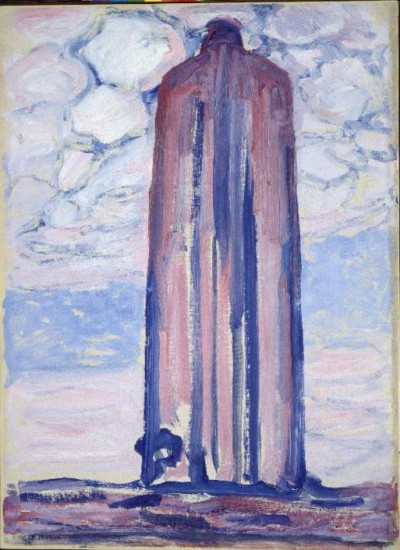
A dark pink and purple lighthouse stands before a sky crowded with white cloud forms in Piet Mondrian's Lighthouse at Westkapelle with Clouds. The painting reproduced here is A682 in RKD's catalogue and 0334285 in Kunstmuseum Den Haag's collection. The museum records oil on canvas, 71 × 52 cm, and dates it 1908. RKD gives 1908–09, allowing a slightly broader period for the work. This is a distinct painting from the smaller brown A683 and pink A684, and from the tall multicolour A687.[1][2]
At a glance
- ArtistPiet Mondrian (Piet Mondriaan, 1872–1944)
- TitleLighthouse at Westkapelle with Clouds
- Catalogue numberRKD / Welsh A682
- Museum object numberKunstmuseum Den Haag 0334285
- Date1908 in the museum record; 1908–09 in RKD
- MediumOil on canvas
- Dimensions71 cm high × 52 cm wide
- Collection creditKunstmuseum Den Haag, bequest of Salomon B. Slijper[1][2]
The Westkapelle lighthouse sequence
With Clouds (A682)
1908–09In Brown (A683)
1909In Pink (A684)
1909Multicolour (A687)
c. 1910Contents
- What does the painting show?
- Why the Westkapelle lighthouse?
- How does the clouded version differ from the others?
- What can the museum record confirm?
What does the painting show?
The lighthouse occupies the middle of a vertical canvas. Its shaft is made from long dark blue and purple strokes surrounded by softer pink and brown. The top is rounded, with relatively few sharply drawn architectural details. A low dark strip marks the base. Behind the tower, broad pale cloud forms move across the upper half of the picture; a calmer blue and pink area opens below them.
 The Red Tree Piet Mondrian.jpg)
The clouds are as active as the building. Pale grey, white and lavender strokes gather into irregular masses on both sides of the tower. Some blue slips between them. Their uneven contours contrast with the lighthouse's insistent upright form. The image does not read as a precise weather report. Mondrian uses clouds to change the balance of the painted surface: loose, billowing shapes surround a simple vertical body.
Near the bottom, a thin horizontal band holds the structure to the ground. Above it, the central dark strokes rise almost without a break toward the top. Long marks carry the eye upward, while pale cloud clusters pull it sideways. This visible meeting of vertical and horizontal movement makes the painting feel larger than its 71 × 52 cm dimensions. It is a close reading of the painting's forms, not a claim that Mondrian already intended a later abstract grid here.[2]
The existing image shows several overlapping layers and exposed-looking strokes. Those appearances are not enough to establish a conservation history or to say exactly how many painting sessions Mondrian used. They do show that he chose a broad, direct handling rather than carefully delineating every stone, window and cloud. The tower remains identifiable through colour and mass as much as through architectural detail.
Why the Westkapelle lighthouse?
The Mondrian Route, developed with Kunstmuseum Den Haag and RKD, explains that Westkapelle's lighthouse had been built as a late fifteenth-century church tower. Its form gave Mondrian an upright architectural subject unlike the nearby low dunes and sea views. The Route counts five paintings and a drawing of the tower across 1908–10. It also says Mondrian restricted himself to a few motifs so he could explore them more fully.[3]
Kunstmuseum Den Haag's By the Sea exhibition account places his early Westkapelle and Zeeland work within encounters with artists such as Jan Toorop. The museum compares the style of Lighthouse at Westkapelle and Little House in Sunlight around 1908 to Toorop's divisionist approach. That context helps explain the separated strokes, but it should not make this picture a copy of Toorop or imply that every mark corresponds to a fixed theoretical rule. The painting is still a specific image of the tower under a clouded sky.[4]
The Mondrian Route says some Zeeland works were revised after Mondrian returned to Amsterdam. It does not demonstrate that A682 was completed in one particular place or on a particular day. Its two public dates also differ slightly: 1908 in the museum, 1908–09 in RKD. The page retains that documented uncertainty rather than turning the year into a precise travel itinerary.[1][2][3]
Watch: Piet Mondrian
See his studio, the move toward geometric abstraction and the rhythms of his New York paintings.
Piet Mondrian: Abstract Painting as We Know It
Curator Michael White explores the paintings and Mondrian’s studio as an abstract space.
Watch on YouTubeHow does the clouded version differ from the others?
RKD lists A682 first among a close group of lighthouse works. A683, in Brown, is linked to museum 0334300; A684, in Pink, to 0334295; A686 is a drawing; and A687, in Orange, Pink, Purple and Blue, to 0334301. The catalogue also includes A685 Summer Morning between A684 and the drawing. Each number belongs to its own object, even when museum titles shorten them all to variants of Lighthouse at Westkapelle.[1]
A682's 71 × 52 cm oil canvas stands between the smaller brown 45 × 35.5 cm and pink 39 × 29.5 cm versions and the much larger 135 × 75 cm A687 canvas. Its image is also distinctive: large pale clouds fill the area around a relatively dark, loosely described tower. In the brown painting, masonry details remain clearer. The pink version has many small marks in its blue sky. The multicolour work stretches the tower into a much taller format.[2][5]
Fondation Beyeler listed A682 and A687 together in the “Vertical compositions” section of its 2022 Mondrian Evolution exhibition. Its checklist gives A682 as 1908, oil on canvas, 71 × 52 cm, on loan from Kunstmuseum Den Haag with the Slijper bequest credit. That exhibition pairing highlights their shared upright subject while leaving their different scale, colours and dates visible. It does not mean one picture must be read as a direct preparatory study for the other.[5]
What can the museum record confirm?
The museum's object number 0334285 connects the painting to its medium, size, 1908 date and Slijper bequest. RKD links A682 to the same number and extends the date to 1908–09. Both records identify the original as part of Kunstmuseum Den Haag's collection. Neither public entry guarantees that it is currently on display, and a visitor should consult the museum's live information before travelling. The existing site image is retained; a larger image is optional and is not needed for this object crosswalk.[1][2]
Mondrian artworks directory
Frequently asked questions
When did Mondrian paint Lighthouse at Westkapelle with Clouds?
Where is the painting?
It belongs to Kunstmuseum Den Haag, object 0334285, credited to the Salomon B. Slijper bequest.[2]
What are its medium and dimensions?
The museum records oil on canvas, 71 cm high × 52 cm wide.[2]
Is this the pink lighthouse painting?
Was the lighthouse once a church tower?
Yes. The Mondrian Route identifies it as a former late fifteenth-century church tower.[3]
Discussion
Which cloud or dark tower stroke first draws your eye?
Reader Insights
Follow the dark vertical strokes up the tower. Where does your eye stop?
How do the pale clouds change the dark tower?
How does the clouded A682 canvas differ from the pink A684?
Join the Conversation
Share what you notice in this painting below.
References
- RKD – Netherlands Institute for Art History, digital Mondrian catalogue, “City scapes (A677–A692),” A682 title/date and crosswalk to 0334285, with neighbouring lighthouse entries. View source.
- Kunstmuseum Den Haag, collection record, Lighthouse at Westkapelle with Clouds, object 0334285: 1908, oil on canvas, 71 × 52 cm, Slijper bequest. View source.
- Mondrian Route, “Westkapelle lighthouse,” developed with Kunstmuseum Den Haag and RKD; tower history, motif sequence and studio-work caveat. View source.
- Kunstmuseum Den Haag, “By the Sea,” exhibition account discussing Mondrian's 1908 lighthouse work and the Zeeland artists' contact. View source.
- Fondation Beyeler, Mondrian Evolution (2022), list of works, “Vertical compositions,” listing A682's 1908, 71 × 52 cm oil canvas and the separate 135 × 75 cm 1910 lighthouse. View source.
- Lead image credit. Piet Mondrian, Lighthouse at Westkapelle with Clouds, RKD A682, oil on canvas, 71 × 52 cm; Kunstmuseum Den Haag 0334285, Slijper bequest. Museum date 1908; RKD 1908–09.