 by Tom Gurney
Tom Gurney BSc (Hons) is an art history expert with over 20 years experience
Published on June 19, 2020 / Updated on September 28, 2026
Email: tomgurney1@gmail.com / Phone: +44 7429 011000
About the painting
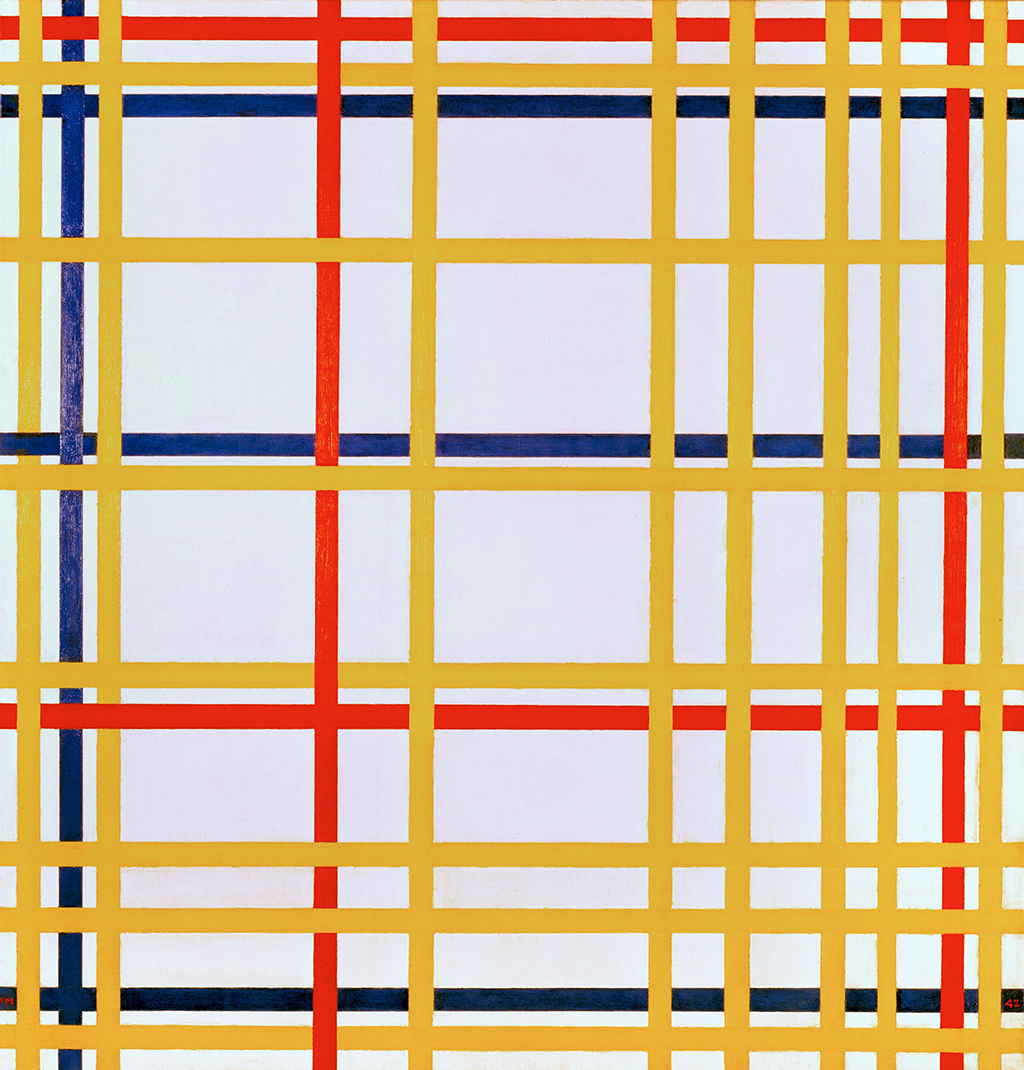
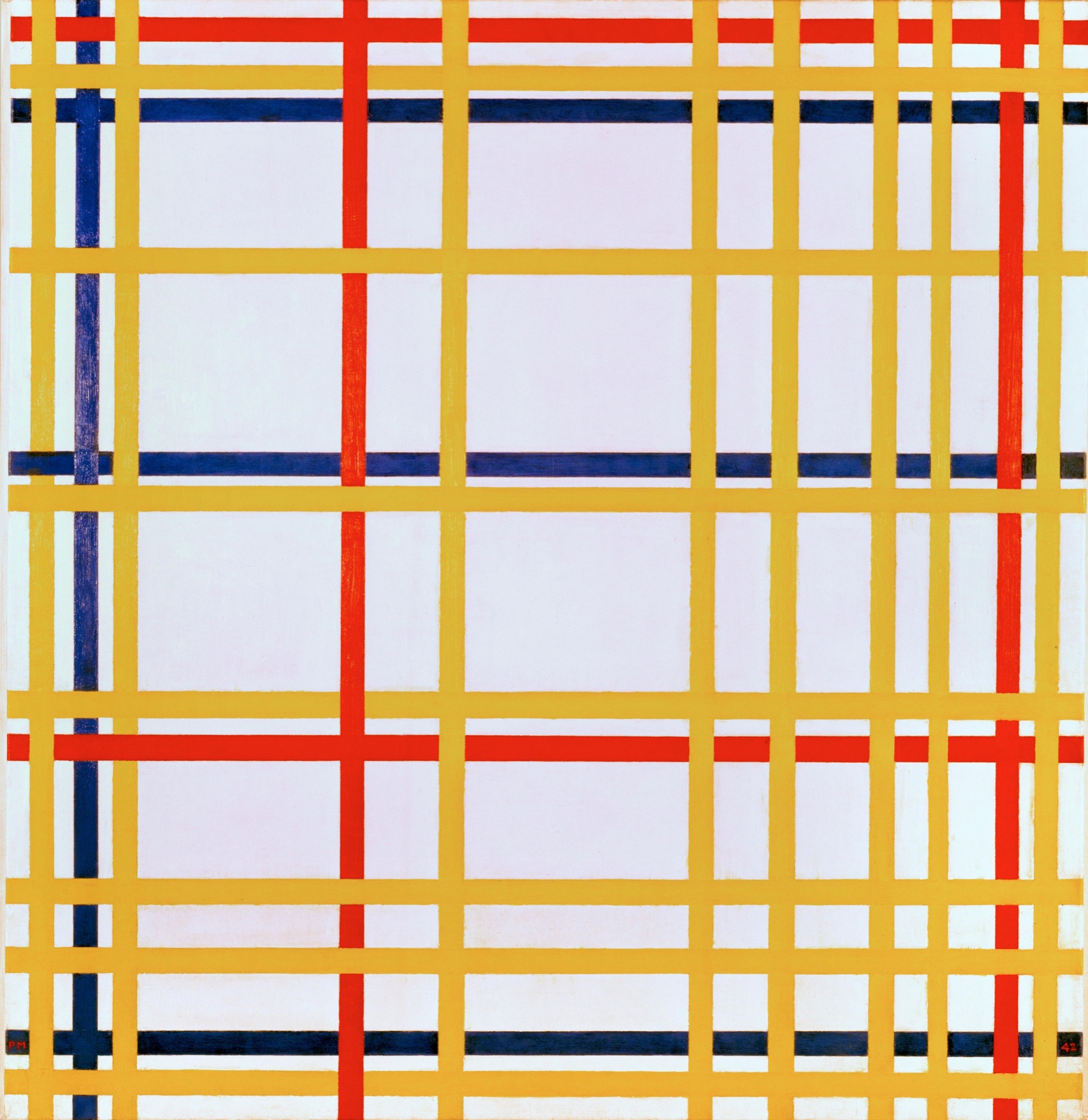
Bands of yellow, red and blue cross the pale surface of Piet Mondrian's New York City. Some run from edge to edge; others stop or pass beneath a line of another colour. The picture feels dense without closing off the broad light spaces between them. The Centre Pompidou identifies this 1942 oil-on-canvas painting as New York City, catalogue B301, in its Paris collection. Crucially, it records “New York City I” as a former title. That explains the established URL of this article, but it must not be confused with the different, unfinished 1941 New York City I in Düsseldorf, catalogue B300.[1][2][3]
At a glance
- ArtistPiet Mondrian (Piet Mondriaan, 1872–1944)
- Current museum titleNew York City
- Former titleNew York City I, according to the Centre Pompidou
- Date1942
- Catalogue numberRKD / Joosten B301
- MediumOil on canvas
- Dimensions119.3 × 114.2 cm
- CollectionMusée national d'art moderne, Centre Pompidou, Paris
- AccessionAM 1984-352 (RKD's list adds the collection suffix “P”)
- Acquired1984, with a special credit and the support of the Scaler Foundation, according to the museum[1][2]
New York City and Broadway Boogie Woogie
Contents
- What does the painting show?
- Annotated details in New York City
- Why is the title confusing?
- How did Mondrian make and develop the grid?
- What does New York contribute to the painting?
- Does the upside-down story apply here?
- How did the Paris work enter the museum?
What does the painting show?
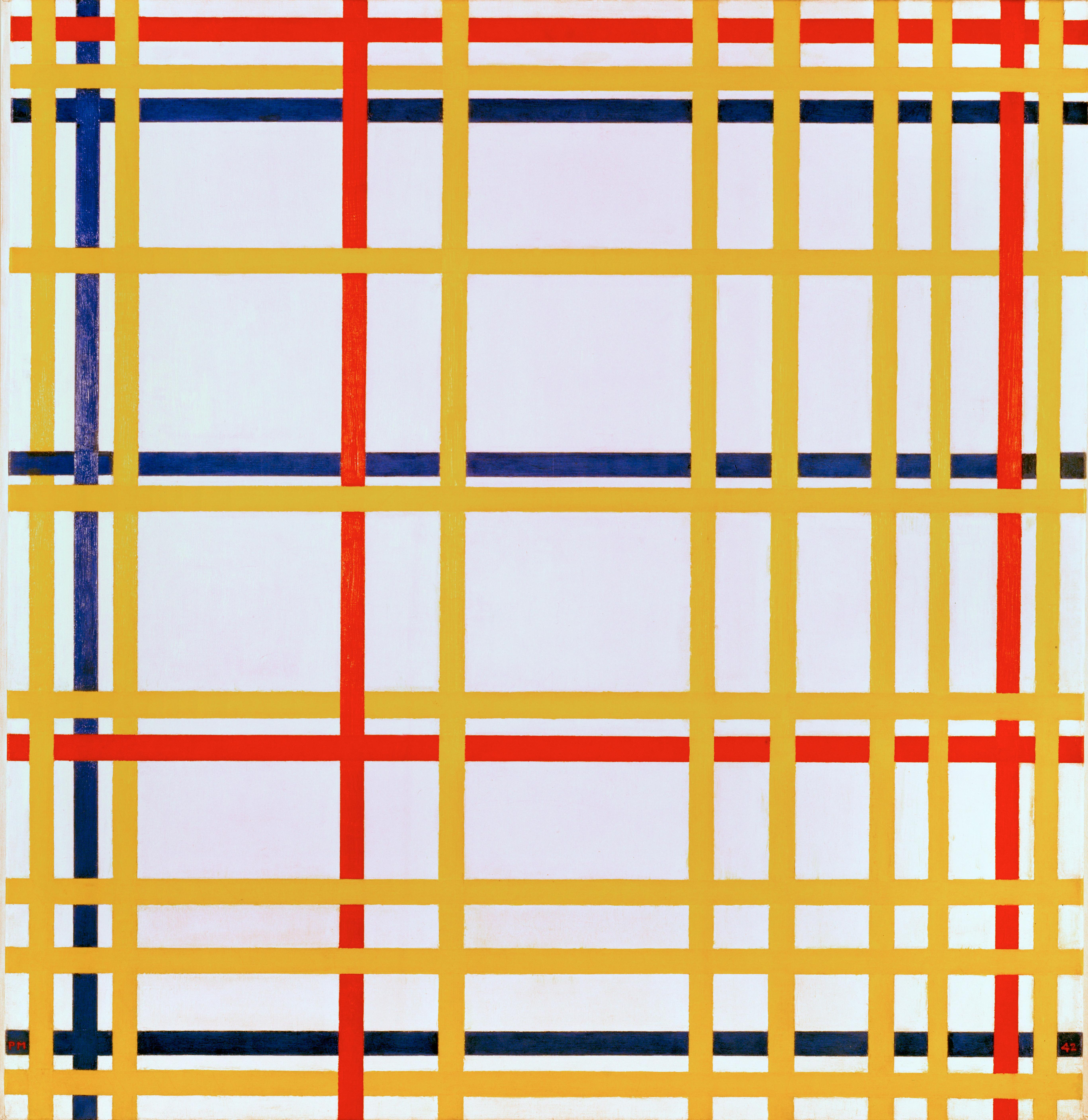
There is no skyline, taxi or building rendered as a recognisable object. The painting is an arrangement of straight vertical and horizontal bands. Yellow appears most often, with red and blue running through the structure in smaller numbers. White or very pale areas remain visible between the bands. The eye can follow one colour until another crosses it, then move to a different path. Near the margins, some strips seem to continue beyond the canvas.
The Centre Pompidou's description counts fifteen yellow lines, four blue and four red. It characterises them as three interwoven painted grids. Their similar widths help the composition read as a connected surface rather than as a foreground object laid over a background. The museum stresses the above-and-below relationships where lines intersect. Even in a digital reproduction, those crossings resist the impression that one colour belongs to a single flat layer placed on top of the others.[1][2]
Yellow is visually dominant because it occurs so often, but the red and blue lines interrupt its continuity. The spacing is not a uniform graph-paper pattern. Narrow intervals sit next to broad light openings; groups of close horizontal bars appear in some places while other regions leave the white ground relatively open. This uneven rhythm makes the painting more active than a perfectly regular lattice would be.
The bands also differ from Mondrian's earlier black dividers. Colour itself carries the structure here. A viewer can begin at the top, move down one vertical, then turn along a horizontal and lose the initial path in another crossing. There is no single central coloured square that dictates where looking starts or ends. The Paris museum describes the work as an all-over arrangement: its movement belongs to the whole canvas.[1]
Annotated details in New York City
These close views follow the yellow, red and blue painted bands in the Centre Pompidou painting, RKD B301. Select a number to jump to a detail.
 1
2
3
4
5
1
2
3
4
5
Choose a number to reach its detail, then select a detail image to open the gallery. Open the full-resolution image.
Details from NEW YORK CITY
Five close views of the painting.
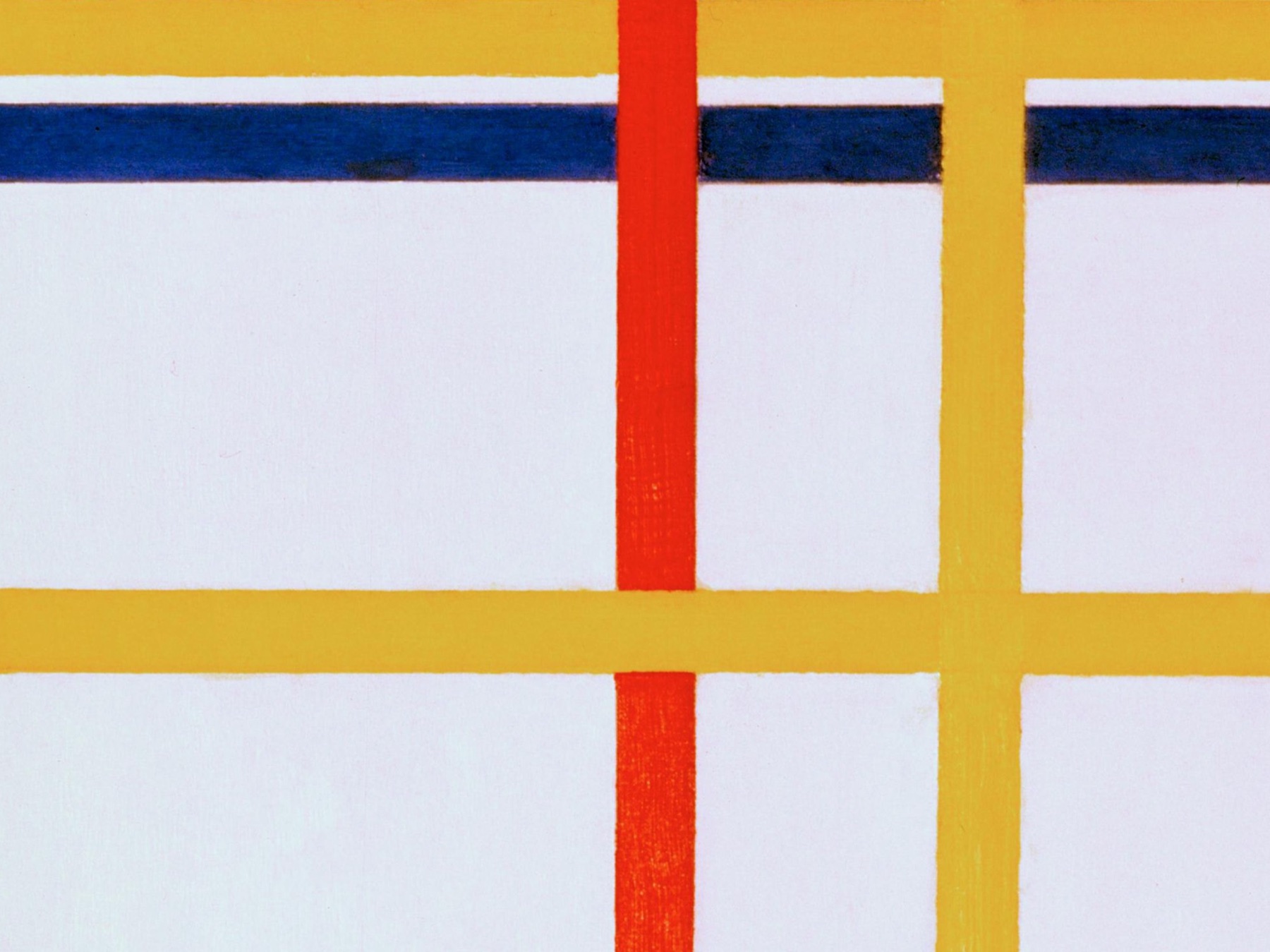
The upper grid changes direction
Several yellow horizontals cross red and blue uprights. Their different lengths and spacing keep the top from reading as a uniform lattice.
Blue interrupts the left side
A dark blue horizontal holds a long interval against closely spaced yellow and red vertical bands.
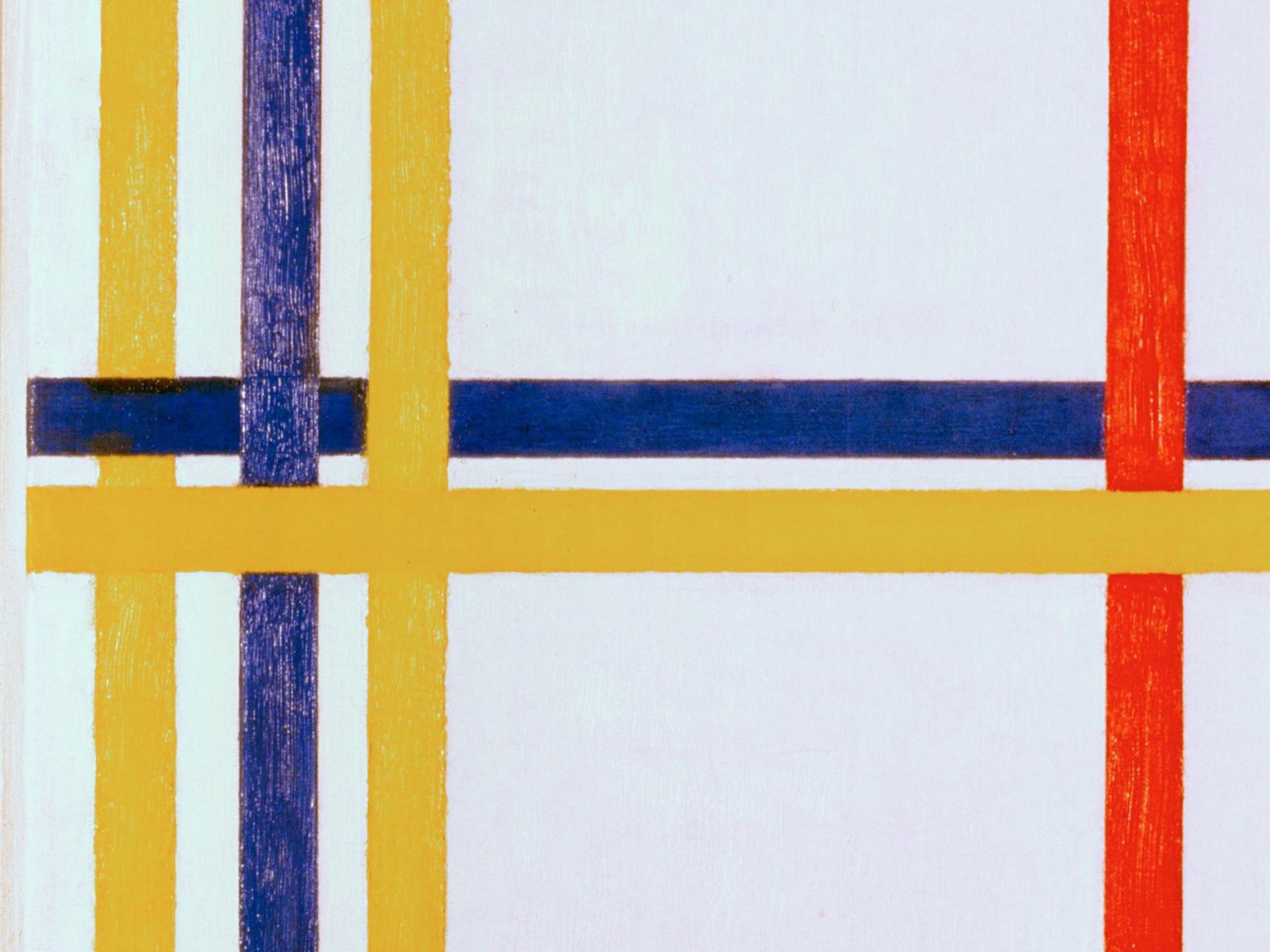
The pale ground has unequal openings
Broad light areas sit between coloured lines. A group of yellow crossings divides the central space without filling it evenly.
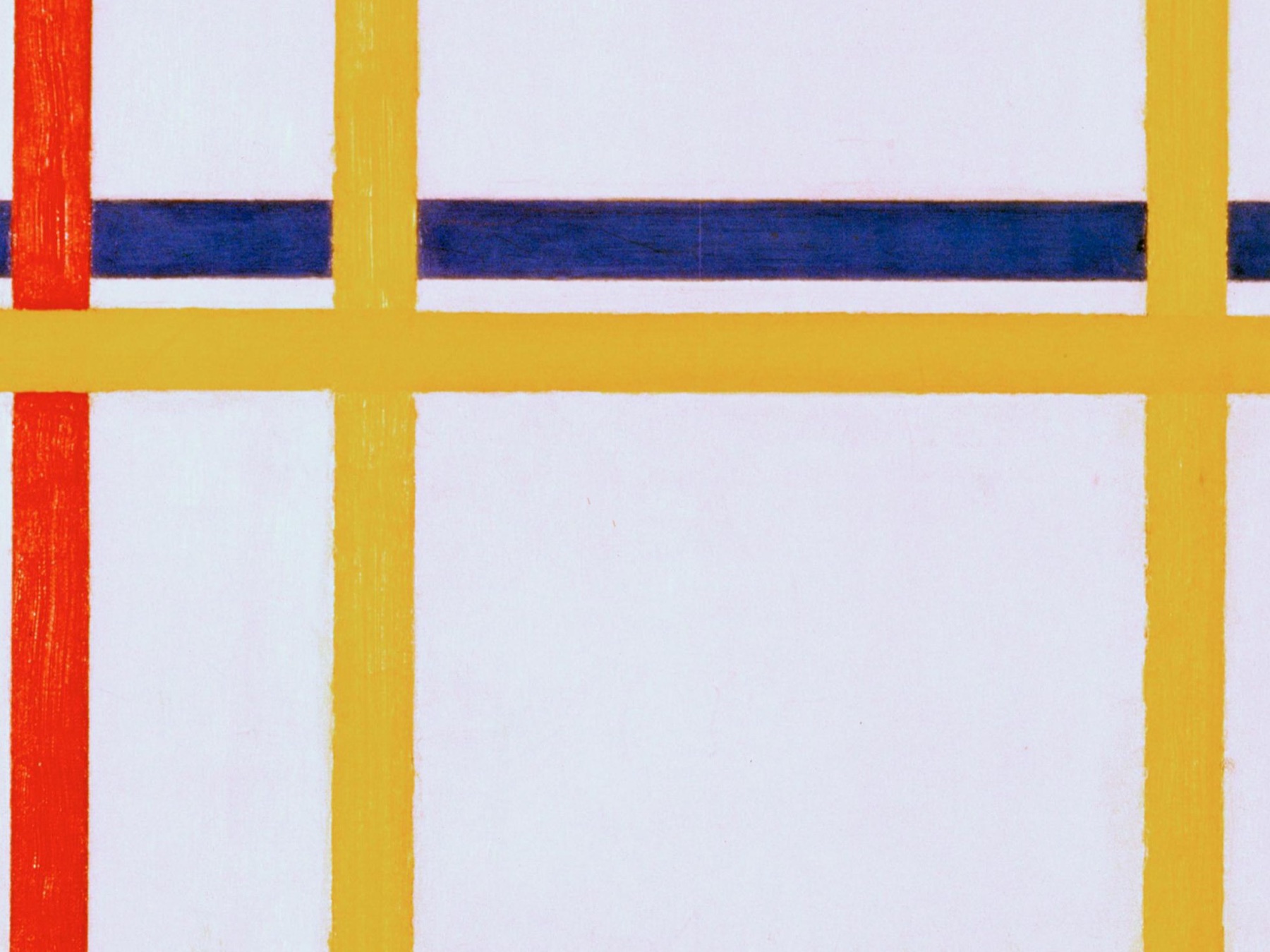
Lines weave at the right
Yellow horizontals pass through red and blue verticals. Some intersections are close together; others leave large pale gaps.
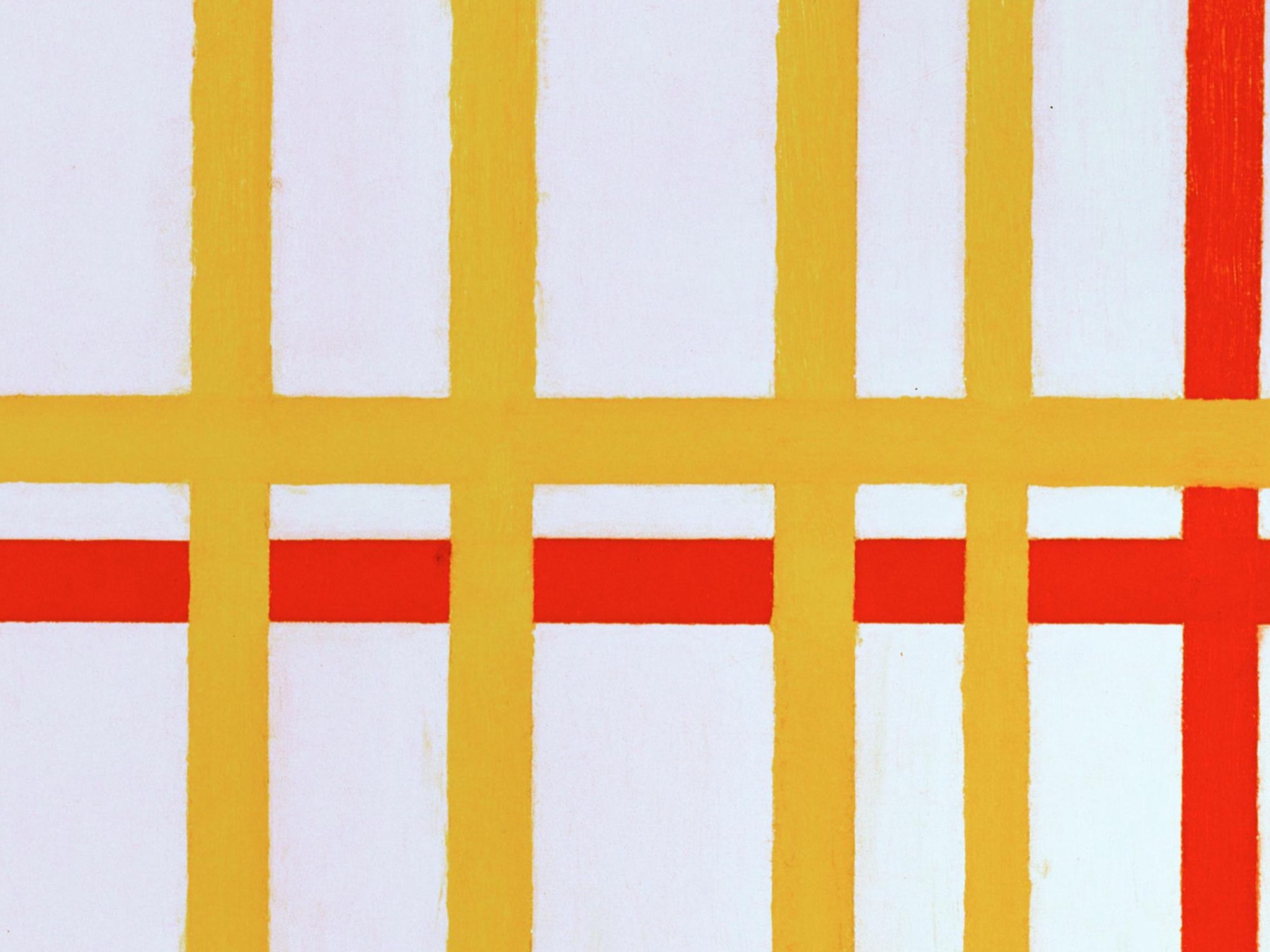
The lower grid grows dense
Near the bottom, several yellow paths gather around blue and red bands. The tightly packed crossings contrast with the more open middle.
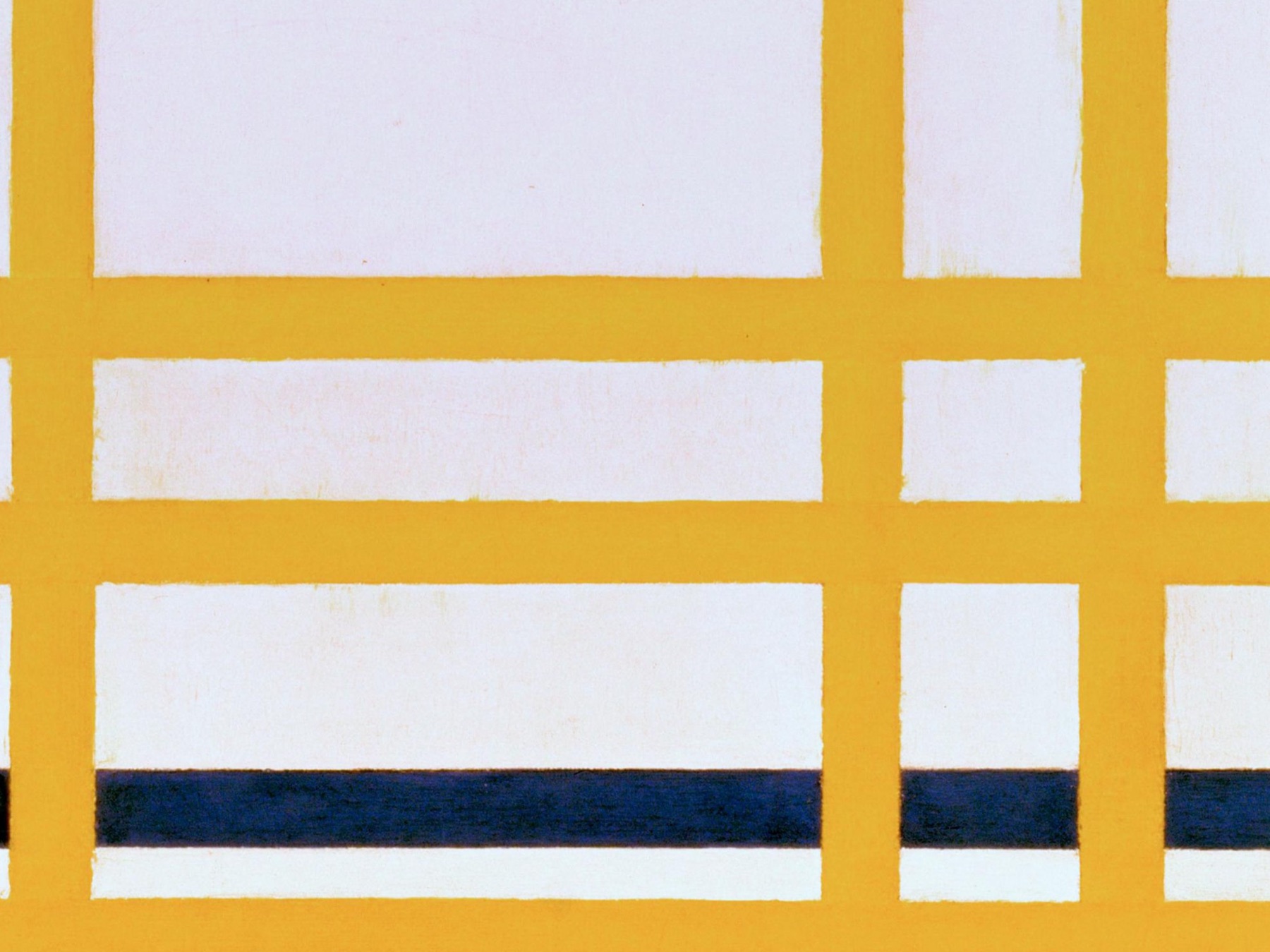
Why is the title confusing?
The Centre Pompidou gives the main title simply as New York City and explicitly lists New York City I as a former title. Its object page identifies the work by B301, 1942, oil on canvas, and Paris accession AM 1984-352. Those facts anchor this article even though the inherited URL still ends in new-york-city-i/. A changed title is not proof of a different painting: museums revise preferred names while the object and catalogue number remain the same.[1]
The Kunstsammlung Nordrhein-Westfalen in Düsseldorf owns a genuinely different work called New York City I or New York City 1. Its current catalogue gives B300, 1941, oil and paper on canvas, 120 × 115.2 cm, accession 0222, and acquisition in 1980. The paper strips remain part of that unfinished painting. It is close to the Paris work in subject and structure, but the two should never exchange a medium, date, collection, image or orientation story.[3][4]
RKD lists the works separately in its New York sequence: B300 is New York City 1 (unfinished) in Düsseldorf, B301 is New York City in Paris, and B302 is another unfinished New York City 2. The museum in Paris also discusses a related New York City 3 in Madrid. Numbering and Roman numerals vary among catalogue and museum titles, so the B number and collection are the most reliable way to check which painting is meant.[1][2]
How did Mondrian make and develop the grid?
The Paris painting is oil paint on canvas, not a work whose visible bands are still loose paper strips. Centre Pompidou explains, however, that Mondrian used coloured paper strips in preparing this group of compositions. By moving and layering strips before committing the arrangement to paint, he could explore which line passed over another and how the intervals changed. The Düsseldorf B300 work retains such paper on the canvas and is considered unfinished; the Paris B301 painting is treated by the museum as the completed version within this group.[1][2][3]
The museum records that Emery Muscetra photographed the Paris painting in Mondrian's 52nd Street studio in October 1941, even though its recorded finished date is 1942. This is not a contradiction: the photograph documents the work in progress before the later date assigned to the finished oil painting. It was first exhibited at the Valentine Gallery in New York in 1942, at a show that ran from 19 January to 7 February according to the Pompidou catalogue entry.[1][2]
Mondrian worked on the canvas horizontally on a table, according to the museum, although it was intended to be viewed upright. That process makes the woven look of the crossings more understandable: each added line can be considered in relation to lines already present. It does not mean the painting is merely a transferred street map or a mechanical pattern. The exact alternation of colours, widths and light spaces is a composed result.[1][2]
Watch: Piet Mondrian
See his studio, the move toward geometric abstraction and the rhythms of his New York paintings.
Piet Mondrian: Abstract Painting as We Know It
Curator Michael White explores the paintings and Mondrian’s studio as an abstract space.
Watch on YouTubeWhat does New York contribute to the painting?
Mondrian arrived in New York in 1940. Centre Pompidou connects New York City with the city's orthogonal street plan, electric light, rapid movement and the syncopated energy of boogie-woogie music. The institution treats these as influences on the work's abstract visual rhythm, not as a key for assigning every yellow bar to a taxi or every crossing to a named street.[1][2]
The museum cites Charmion von Wiegand, who witnessed the work's making, comparing its pattern with the geometric rhythm of city traffic. This is a valuable contemporary response, but it is still a comparison rather than a literal diagram. The picture offers a way of experiencing intersecting routes and repeated interruptions; its power depends on painted relations that remain visible even to someone who has never visited Manhattan.[1][2]
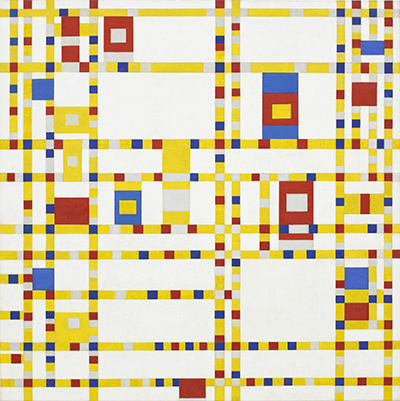
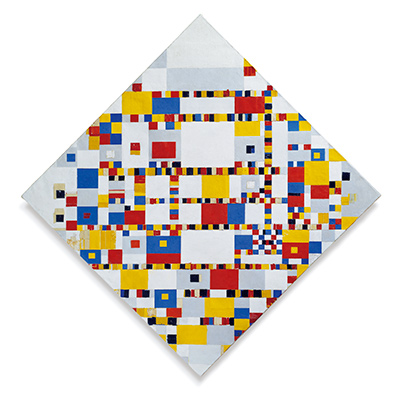
The movement of colour across the full canvas anticipates a different kind of density in Broadway Boogie Woogie, completed in 1942–43 and now at MoMA. Centre Pompidou itself makes that musical comparison. The later work breaks its yellow routes with many smaller units; New York City is held together by longer continuous bands. Looking at both reveals an evolving approach to rhythm rather than a single fixed “New York style.”[2]
Does the upside-down story apply here?
The widely discussed orientation question concerns Düsseldorf's B300 New York City I, not the Paris B301 painting shown on this page. In a 2022 exhibition press kit, the Düsseldorf museum explained that a photograph made shortly after Mondrian's death appears to show B300 turned 180 degrees relative to its long-standing display. The museum also examined where strips seemed to start or taper and compared the denser area with the Paris painting.[4]
That same institutional account was cautious. It said a detailed conservator's study of the tape direction had not yet been carried out and allowed that Mondrian might have turned the work while developing it. A photograph of B300 on an easel cannot settle the orientation of B301, whose signed and dated oil painting has its own museum record. Reporting “Mondrian's New York City I was upside down” without identifying B300 invites exactly the confusion created by the Paris painting's former title.[1][3][4]
The comparison remains illuminating. Düsseldorf's taped surface exposes part of Mondrian's working process; Paris presents the painted outcome of a related investigation. The two are not interchangeable stages of one physical canvas. They are separately catalogued paintings in different collections, with different materials and dates.
How did the Paris work enter the museum?
Centre Pompidou traces New York City from Mondrian's estate to Harry Holtzman after the artist's death, and then to Sidney Janis. The museum acquired it in 1984, using a special credit and support from the Scaler Foundation. The current inventory number is AM 1984-352. These facts establish the Paris collection identity; they do not give a licence to substitute the better-known Düsseldorf reproduction or its conservation story.[1][2]
The Pompidou's catalogue records earlier bibliography under the former New York City I wording, including a 1985 study by Yve-Alain Bois. That helps explain why books, image files and older websites may still use the numeral for the Paris work. Checking the B301 number and Paris accession resolves the ambiguity without pretending the older name never existed.[1]
Its dated signature supplies another object-specific point of reference. The Pompidou records Mondrian's initials and the date 42 on the work. Together with the oil-on-canvas material and museum accession, these details distinguish the Paris painting from the unsigned, paper-bearing Düsseldorf canvas even when older publications use nearly identical names.[1][3]
Mondrian artworks directory
Frequently asked questions
Is New York City I the correct title of this painting?
When was the Paris painting completed?
The Centre Pompidou dates it 1942. Its catalogue also records a studio photograph from October 1941, when the work was still developing.[1]
Is it painted or made with paper strips?
How large is New York City ?
Centre Pompidou records 119.3 × 114.2 cm for the 1942 oil painting.[1]
Was this painting hung upside down?
Discussion
Which coloured line first holds your attention?
Reader Insights
Follow one yellow band until red or blue crosses it. Where do you turn?
How does a narrow space between lines change a broad white opening?
How does painted B301 differ from the unfinished Düsseldorf B300?
Join the Conversation
Share what you notice in this painting below.
References
- Centre Pompidou, official object record for New York City, formerly New York City I, B301, 1942, oil on canvas, 119.3 × 114.2 cm, accession AM 1984-352, including Brigitte Leal's collection analysis and provenance. View source.
- Brigitte Léal, Centre Pompidou, “Focus on... ‘New York City’ by Piet Mondrian,” 31 January 2025, with the 1941 photograph, preparation, line count, New York context and series comparison. View source.
- RKD – Netherlands Institute for Art History, digital Mondrian catalogue, New York group, B300 New York City 1 (unfinished) and B301 New York City, with separate dates and collections; cross-checked with the Kunstsammlung Nordrhein-Westfalen B300 object record. View RKD source.
- Kunstsammlung Nordrhein-Westfalen, Mondrian. Evolution press kit, 27 October 2022, discussion of the possible 180-degree orientation of its separate B300 New York City I and the limits of the evidence. View source.
- Lead and annotated image credit. Piet Mondrian, New York City (formerly New York City I), 1942, oil on canvas, 119.3 × 114.2 cm, Centre Pompidou AM 1984-352, RKD B301. High-resolution reproduction supplied by the site owner as public domain.
 The Red Tree Piet Mondrian.jpg)