 by Tom Gurney
Tom Gurney BSc (Hons) is an art history expert with over 20 years experience
Published on June 19, 2020 / Updated on September 29, 2026
Email: tomgurney1@gmail.com / Phone: +44 7429 011000
About the painting
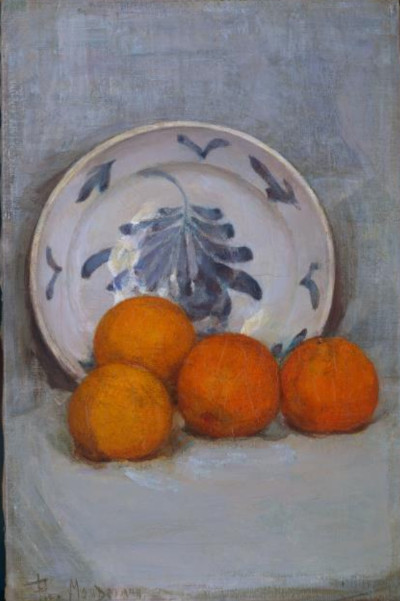
Four oranges sit in front of a blue-and-white decorated plate against a muted grey-blue wall. Their warm colour is the centre of Piet Mondrian's Oranges and Decorated Plate, a still life dated 1900 and catalogued by RKD as A97. The painting is a portrait-format oil on canvas in a private collection in the RKD record. Christie’s documented its later appearance as Still Life with Oranges, with the same A97 catalogue number and a particularly informative history: Mondrian gave it to friends as a wedding present in 1901.[1][2]
At a glance
- ArtistPiet Mondrian (Piet Mondriaan, 1872–1944)
- RKD titleOranges and Decorated Plate; Dutch catalogue title Sinaasappelen
- Other documented titleStill Life with Oranges in Christie’s 1999 catalogue
- Date1900 in RKD; Christie’s says executed about 1900
- Catalogue numberRKD / Joosten A97
- MediumOil on canvas in Christie’s object record
- SizeChristie’s gives 46 × 30 cm; an RKD-derived image record gives 45 × 29 cm, so the measurements are attributed rather than merged
- CollectionPrivate collection in RKD's current public listing[1][2][3]
Amsterdam still lifes around 1900
Contents
- What does the still life show?
- Why did Mondrian paint oranges around 1900?
- What is known about the painting's early history?
- How was Oranges and Decorated Plate made?
- Is it the same as other early still lifes?
- Where is the original now?
What does the still life show?
The arrangement is remarkably direct. Four oranges sit on a pale surface, closely grouped but not stacked symmetrically. A round plate, tilted upright behind them, gives the picture its second large shape. Blue plant-like decoration crosses the plate's white interior. Behind it, the grey-blue wall is quieter and cooler than either the fruit or porcelain. Mondrian makes the oranges vivid by placing them between those two restrained colour zones.
 The Red Tree Piet Mondrian.jpg)
The plate is more than a decorative prop. Its round edge echoes the fruit while its central blue design interrupts a potentially empty white disc. The oranges overlap its lower portion, establishing a simple depth: wall behind plate, plate behind fruit, fruit on the tabletop. Yet the image does not invite a tour around a complicated room. It concentrates attention on a small set of forms and their colour relations.
Look at the fruit individually. Their outlines and tones vary; one orange is higher at the back, while three spread across the lower edge. The right-hand fruit is separated slightly from the central group. The arrangement feels observed rather than mechanically spaced. Its warmth against the cool plate and ground makes the still life immediately legible even in a small reproduction.
Why did Mondrian paint oranges around 1900?
RKD places A97 among Mondrian's Amsterdam still lifes of 1897–1901. The neighbouring catalogue entries include apples with household vessels, another still life with a decorated plate, and flower studies. A97 belongs to a period when Mondrian was testing how ordinary objects could be selected, grouped and lit. It is historically useful precisely because it shows his earlier representational practice in its own right, without needing to read every orange as an anticipation of a later red or yellow rectangle.[1]
The exact reason he chose these oranges and this plate is not documented in the cited object records. We can describe their visual roles, but we should not invent a symbolic programme for the fruit or claim a specific brand of porcelain. Christie’s calls it a decorated plate, and a Museo Reina Sofía publication describes a Chinese porcelain dish. Those descriptions support the impression of blue-and-white ceramic decoration; they do not identify a maker or provenance for the plate itself.[2][4]
The still life also helps widen the familiar account of Mondrian. A 1900 canvas of fruit and crockery may look far from his later abstract compositions, but it reveals a sustained concern with how a limited set of visual elements can be made to balance. Here the elements are observed objects, overlapping in shallow space. Later works would pursue different materials, forms and purposes. The connection is a question of artistic attention, not a claim that A97 is secretly a grid painting.
What is known about the painting's early history?
Christie’s record says Mondrian gave Still Life with Oranges to Dr Lucas Barend Lindeboom and Margaretha Petronella Harrenstein as a wedding gift in 1901. The painting then descended through the family. This is rare, concrete evidence about the original's early ownership. It tells us that the picture was valued as a personal gift soon after Mondrian made it; it does not tell us his exact motive for painting the oranges in the first place.[2]
The auction house further records that it was on loan to the Rijksmuseum, Amsterdam, under inventory SK-C-1638, until 1999. A loan number can be mistaken for a permanent museum accession if lifted out of context. The RKD currently lists the object in a private collection, so this page does not present the Rijksmuseum as its current owner. That distinction is essential for a reader who hopes to see the original in a gallery.[1][2]
Christie’s also records an exhibition at Amsterdam's Stedelijk Museum in 1900, and later exhibitions in Rome and Ontario. The 1900 appearance indicates that the still life circulated in public during Mondrian's own early career. The later exhibitions show continued interest in the representational years after his abstract art became famous. These are catalogue records, not evidence that the work is now on permanent public view.[2]
Watch: Piet Mondrian
See his studio, the move toward geometric abstraction and the rhythms of his New York paintings.
Piet Mondrian: Abstract Painting as We Know It
Curator Michael White explores the paintings and Mondrian’s studio as an abstract space.
Watch on YouTubeHow was Oranges and Decorated Plate made?
Christie’s describes oil on canvas in its original frame, signed at lower left “Piet Mondriaan,” with further signatures and an inscribed title on the frame. Those details belong to the A97 lot because the auction record explicitly cites the Welsh and Joosten catalogue raisonné number. Its measurement is 46 × 30 cm. A Commons file drawing on RKD image metadata instead lists 45 × 29 cm. The difference is small but real, so the page gives the source for each rather than pretending that a single uncontested measurement exists.[2][3]
At this intimate scale, Mondrian could establish a strong contrast without a large composition. The fruit's orange paint is lively but not uniform; yellows and browns give volume. The plate's blues are cool and patterned, and the backdrop is sufficiently restrained to let both objects stand forward. The lower white-grey area gives the oranges a place to sit and allows their shadows to register.
The supplied website image is only 400 px wide, so it is suitable for identifying the composition and its broad colour structure, not for evaluating minute brushwork, signatures or the frame. The exact-subject image matches the A97 catalogue reproduction showing four oranges before the decorated plate. It has been retained; a larger replacement is optional only if a clearly usable public-domain or licensed file is readily available.[3]
Is it the same as other early still lifes?
No. RKD lists A95, apples with a coffee pot and large copper pan, and A96, apples with flowers and a metal pan, alongside A97. A98 then uses apples, a ginger pot and a plate on a ledge. These are distinct works, not alternate descriptions of four oranges. The shared still-life setting can make abbreviated captions confusing, so the fruit, plate and A97 number are the best checks for the present image.[1]
The title variation within A97 is different. Oranges and Decorated Plate, Sinaasappelen and Christie’s Still Life with Oranges all point to the same work because the catalogues connect them explicitly to A97. A title can change or be translated while the object remains the same. By contrast, changing the fruit from oranges to apples and the catalogue number from A97 to A98 means we are looking at another painting.[1][2][3]
Where is the original now?
RKD's public catalogue says private collection. Christie’s 1999 sale record provides earlier provenance and a loan history, but it does not establish a current museum display. A visitor should not assume that a past Rijksmuseum loan means the canvas can be seen there today. If new collection information emerges, the A97 identifier provides a stable way to verify it against the same painting.[1][2]
Mondrian artworks directory
Frequently asked questions
How many oranges are shown?
The image shows four oranges in front of a blue-and-white decorated plate.
Was the painting owned by the Rijksmuseum?
Is Still Life with Oranges another painting?
No. Christie’s uses that title for the same A97 painting and cites the Welsh–Joosten catalogue number.[2]
Discussion
How does the plate frame the oranges?
Reader Insights
Where do the cool blues change the warmth of the fruit?
How does this A97 still life differ from neighbouring apple paintings?
How does this A97 still life differ from neighbouring apple paintings?
Join the Conversation
Share what you notice in this painting below.
References
- RKD – Netherlands Institute for Art History, Mondrian catalogue, Amsterdam still lifes, A93–A111, identifying A97, 1900, private collection. View source.
- Christie’s, original lot record, Still Life with Oranges, citing catalogue A97, medium, size, signature, 1901 wedding gift, Rijksmuseum loan, exhibition history and provenance. View source.
- Wikimedia Commons, RKD-derived A97 image record, with 45 × 29 cm metadata and catalogue reproduction for visual cross-check. View source.
- Museo Reina Sofía, Mondrian publication discussing the early oranges and decorated dish. View source.
- Lead image credit. Piet Mondrian, Oranges and Decorated Plate (also Still Life with Oranges), 1900, oil on canvas, RKD A97. Christie’s records 46 × 30 cm and a private collection.