 by Tom Gurney
Tom Gurney BSc (Hons) is an art history expert with over 20 years experience
Published on June 19, 2020 / Updated on September 29, 2026
Email: tomgurney1@gmail.com / Phone: +44 7429 011000
About the painting
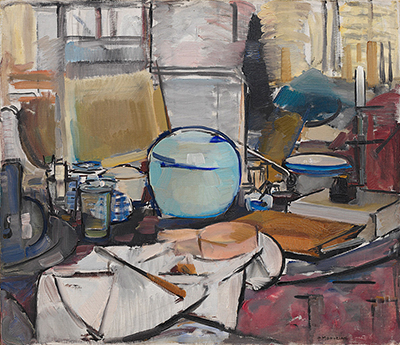
A pale blue ginger pot stands near the centre of a crowded tabletop. Glasses, papers, utensils and other objects gather around it; beyond them, edges of the room and window remain visible. Piet Mondrian painted this first Still Life with Gingerpot in 1911. It is RKD B2, now Kunstmuseum Den Haag 0334312. Its much more fragmented successor, Still Life with Gingerpot II, is a separate 1912 canvas, B18. Seeing both makes the change in Mondrian's treatment of a single subject unusually clear.[1][2][3]
At a glance
Two gingerpot paintings
Contents
- What is in the painting?
- Why is the ginger pot important?
- How does this compare withGingerpot II?
- What was changing in Mondrian's art?
- Why the first painting stands on its own
What is in the painting?
The ginger pot's rounded body and narrow lid hold the centre, but the painting does not isolate it as a conventional still-life specimen. A glass and small vessels sit nearby. Pale folded forms cross the front of the table, while angular boards and frames occupy the space behind. Browns, greys, muted reds and cool blues move between these objects. The varied arrangement asks the eye to travel around the canvas and then return to the pot.
 The Red Tree Piet Mondrian.jpg)
The pot is recognisable because Mondrian preserves its volume and its blue outline. Yet some surrounding edges do not behave like firm boundaries. A patch of colour can appear to continue from one object into the space beside it. The Guggenheim's account calls attention to this passage of brushwork across an object's designated edge and to the looser handling of paint. The effect loosens the tabletop scene without removing its ordinary setting.[3]
Look at the background as well as the named object. Upright and horizontal lines imply a room, window and stacked materials. The viewer can still imagine a workable space around the table. This distinguishes the first gingerpot picture from the second, where most of those surroundings are absorbed into a network of facets.
Why is the ginger pot important?
The pot acts as a point of orientation amid many competing forms. Its cool blue surface is larger and calmer than much of the surrounding paint. Because it remains readable, changes elsewhere in the scene become easier to notice. Mondrian has not simply painted a blue vessel with accessories; he is testing how a central rounded form can hold together a picture whose other boundaries are increasingly uncertain.
The word gingerpot describes a type of lidded ceramic container, but the museum's object record does not identify its maker or contents. It is safest to discuss the pot as the painted motif, without inventing a particular use in Mondrian's studio. The point here is pictorial: a familiar object gives the eye an anchor as the marks around it grow freer.
Watch: Piet Mondrian
See his studio, the move toward geometric abstraction and the rhythms of his New York paintings.
Piet Mondrian: Abstract Painting as We Know It
Curator Michael White explores the paintings and Mondrian’s studio as an abstract space.
Watch on YouTubeHow does this compare with Gingerpot II?
The second gingerpot painting is dated 1912, catalogued B18 and held by the same museum as 0334313. It is also much larger, 91.5 × 120 cm. In that version the pot is still central, but the space around it has become a pale, more continuous field of small angular shapes. The window, glass and other objects that help establish a room here are no longer equally legible.[3][4][5]
The Guggenheim describes the second picture as a substantially more abstract treatment of the motif. It also stresses that the first painting retains traditional perspective and recognisable components. The comparison is useful because it follows a real pair of works rather than a generic claim that Mondrian suddenly stopped painting objects.[3]
Both pictures remain in the collection of Kunstmuseum Den Haag and both museum records mention the Salomon B. Slijper bequest. The Guggenheim also presents the works in its catalogue and has displayed them on long-term loan, so a Guggenheim web entry need not mean that New York owns the canvas. The Hague's object numbers clarify the collection identity.[2][3][4]
A. B. Loosjes-Terpstra's Dutch study described this first still life as a study for the second and found the later painting's rhythm already taking shape in its selected horizontals and verticals. Her account invites a closer comparison than simply counting recognisable objects: follow the window, table edge and other straight lines here, then see how similar directional stresses spread across II. “Study” is the scholar's reading of their relationship; the current museum catalogues retain both as separate finished objects with their own dates and numbers.[7]
What was changing in Mondrian's art?
In this picture Mondrian is still concerned with a directly observed arrangement. He does not suppress the table, containers or surrounding room. At the same time, the unstable edges, overlapping angles and repeated blocks of colour make the canvas less dependent on a single fixed viewpoint. The still life offers a manageable set of forms through which he can test a new visual order.
The two gingerpot paintings are often discussed with Mondrian's encounter with Cubism. A Museum of Modern Art retrospective account highlights the first and second versions as evidence of his growing command of a Cubist vocabulary. That context helps explain the formal change, but the visible details of this 1911 work should not disappear into a simple before-and-after story.[6]
One can notice, for example, that the pot's contour is still continuous enough to read at a glance, while the forms below it are harder to separate. Mondrian allows different degrees of recognition within the same canvas. The result is a picture suspended between the familiar room and a more independent structure of painted shapes.
Why the first painting stands on its own
The first gingerpot canvas is often discussed only as the “before” image in a comparison. It has its own spatial achievement. Pot, glass and papers are crowded, yet enough of the table and surrounding room remains for the viewer to locate them. Brush marks cross boundaries in places, making that order less secure than a conventional still life. The picture is both an account of a studio arrangement and an experiment in how paint can loosen it. Its 1911 date and B2 catalogue number should not be absorbed into the later B18 record.[2][3]
Mondrian artworks directory
Frequently asked questions
What is the catalogue number of Still Life with Gingerpot I ?
When and how was it made?
The collecting museum dates it to 1911 and records oil on canvas, 65.5 × 75 cm.[2]
Is it owned by the Guggenheim?
Is it the same canvas as Gingerpot II ?
Discussion
Where does the pot retain a clear contour?
Reader Insights
Which tabletop objects are easiest to identify?
How does this room differ from the second version?
How does this room differ from the second version?
Join the Conversation
Share what you notice in this painting below.
References
- RKD – Netherlands Institute for Art History, Amsterdam 1911 catalogue, B2. View source.
- Kunstmuseum Den Haag, official Still life with gingerpot 1 record, 0334312, 1911, oil on canvas, 65.5 × 75 cm. View source.
- Solomon R. Guggenheim Museum, Jennifer Blessing, Still Life with Gingerpot II object essay comparing the first and second paintings. View source.
- Kunstmuseum Den Haag, official Still life with gingerpot 2 record, 0334313. View source.
- RKD – Netherlands Institute for Art History, Paris 1912–14 catalogue, B18. View source.
- Museum of Modern Art, 1995 retrospective announcement discussing the two gingerpot versions and Mondrian's Cubism. View source.
- A. B. Loosjes-Terpstra, Moderne kunst in Nederland 1900–1914, “Het werk,” p. 155, comparing the first gingerpot painting with the second and discussing its horizontal and vertical structure. View source.
- Lead image credit. Piet Mondrian, Still Life with Gingerpot I, 1911, oil on canvas, 65.5 × 75 cm, Kunstmuseum Den Haag, 0334312, RKD B2.