 by Tom Gurney
Tom Gurney BSc (Hons) is an art history expert with over 20 years experience
Published on June 19, 2020 / Updated on September 29, 2026
Email: tomgurney1@gmail.com / Phone: +44 7429 011000
About the painting
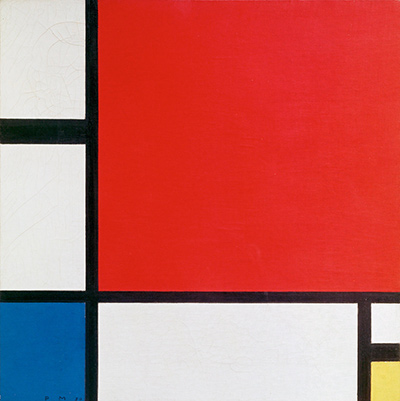
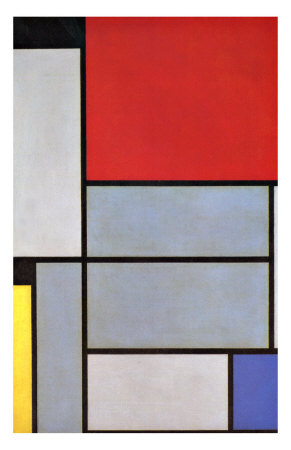
The unusually tall canvas is dominated by a large red field at upper right. Pale blue and gray rectangles extend beneath it; a narrow yellow accent near the lower left answers a deeper blue at the foot. This is the 1921 Museum Ludwig painting, RKD B126, not the nearly square Tableau I in The Hague (B128). Its physical proportions are a practical safeguard against this common title collision.[1]
At a glance
- ArtistPiet Mondrian (1872–1944)
- TitleTableau I
- Catalogue numberRKD B126
- Date1921
- MediumOil on canvas
- Dimensions96.5 × 60.5 cm
- CollectionMuseum Ludwig, Cologne
- Inventory76/3195
Mondrian across periods
Contents
- Why this Tableau I is identifiable
- How does the composition work?
- What happened to the other Tableau I?
- The importance of the tall format
- What does “balance” mean here?
- Numbered titles and collection records
- Reading its edges
Why this Tableau I is identifiable
RKD records two 1921 works called Tableau I. B126 belongs to Museum Ludwig; B128, a nearly square 103 × 100 cm canvas, belongs to Kunstmuseum Den Haag. The existing reproduction on this page is a tall rectangle with a broad red upper field, matching the proportions and design of the Cologne picture. Calling both simply “Tableau I” without a collection and catalogue number invites an incorrect image match.[1][2]
 The Red Tree Piet Mondrian.jpg)
How does the composition work?
The red plane occupies a substantial area but is pressed against the top and right edges. A black vertical to its left and a long horizontal beneath it give the colour a hard boundary. Lower down, the smaller yellow and blue fields are separated by intermediate pale rectangles. The eye therefore has to travel between unequal areas rather than settle on an even checkerboard. Several black lines continue to the canvas edge, suggesting that the arrangement could extend beyond the physical painting.
This is a 1921 work in Mondrian's mature language of horizontal and vertical divisions, primary hues and neutral planes. It still repays close attention to the relative widths of lines and the different whites and grays. The work is an oil painting: the uniform reproduction should not be mistaken for a mechanically printed design.
What happened to the other Tableau I?
The Hague B128 is also dated 1921 but its 103 × 100 cm format is almost square. Centre Pompidou's account describes its asymmetry and the red plane appearing largely cut off by the edge. The B126 on this page is much taller. A further Tableau No. I in the Fondation Beyeler has its own object history, so a roman numeral alone never establishes identity.[1][3]
Watch: Piet Mondrian
See his studio, the move toward geometric abstraction and the rhythms of his New York paintings.
Piet Mondrian: Abstract Painting as We Know It
Curator Michael White explores the paintings and Mondrian’s studio as an abstract space.
Watch on YouTubeThe importance of the tall format
At 96.5 centimetres high and only 60.5 wide, the Cologne painting gives its relationships a pronounced vertical span. A large red field presses into the upper-right corner; the lower accents are far enough away to require a movement of the eye through quieter white and gray compartments. The support's shape is therefore more than an identification clue. It controls the distance across which Mondrian has to balance unequal amounts of colour.[1]
The painting is easy to reduce to a list of red, blue and yellow, but their areas do different work. Red is broad and high, while blue gathers weight near the bottom. Yellow is comparatively small and does not simply mirror the red. Black bars separate some fields decisively, yet several pale boundaries are less emphatic. Looking at the widths and stopping points of individual bars shows why this is an arrangement of measured relationships rather than a preprinted grid.
What does “balance” mean here?
The fields do not repeat in a regular checkerboard. A dominant area on one side is answered by several smaller incidents elsewhere. The upper red plane draws attention immediately; the eye then has to test how the lower colours, the uninterrupted whites and the vertical separators hold their own. If a line runs to an edge, the composition feels open at that point. If a coloured plane is enclosed, it acts more like a local weight. The picture's balance is produced by those different conditions together.
This reading also helps distinguish Mondrian's mature abstraction from a diagram. In a diagram, similar rectangles may simply represent categories. In B126, the exact relative size of a white field, a gray field and a red one is the content of the work. A reproduction can convey the main arrangement, but its uniform screen light may make slight differences among the painted neutrals harder to see.
Numbered titles and collection records
Two 1921 paintings called Tableau I are recorded close together in RKD's catalogue. The Hague picture, B128, is 103 by 100 centimetres; B126 is the tall Museum Ludwig canvas. A reader should use the museum inventory 76/3195 and B126 when citing this work. The distinction matters because conclusions drawn from a nearly square composition—especially the placement of its red plane at an edge—cannot simply be moved onto the tall Cologne picture.[1][3]
Reading its edges
The tall support makes the top and bottom boundaries especially consequential. The red plane meets the upper and right sides, while the deep blue at the foot gives the lower edge a different visual weight. Black lines that reach a boundary invite the eye to imagine continuation, but the painting's exact outer limit also fixes how much red, pale field and blue can be seen. This is why a crop that removes an edge can change the balance. The object should be compared in its full proportions with the nearly square Hague B128, not in isolated colour details.[1]
Mondrian artworks directory
Frequently asked questions
Where is this Tableau I?
Museum Ludwig, Cologne, inventory 76/3195.[1]
When was it painted?
It is dated 1921.[1]
Is it the Hague Tableau I?
No. The Hague painting is RKD B128 and nearly square; this tall Cologne painting is B126.[1]
Discussion
How does the red plane meet the upper edge?
Reader Insights
Which smaller block answers it below?
Why is the tall format useful for identifying B126?
Why is the tall format useful for identifying B126?
Join the Conversation
Share what you notice in this painting below.
References
- RKD – Netherlands Institute for Art History, B126 and B128 in the 1920–21 catalogue. View source.
- Museum Ludwig object crosswalk, Inventory 76/3195, corroborated by RKD. View source.
- Centre Pompidou, Mondrian / De Stijl account of the Hague Tableau I. View source.
- Lead image credit. Piet Mondrian, Tableau I, 1921, oil on canvas, 96.5 × 60.5 cm, Museum Ludwig 76/3195, RKD B126; distinct from Hague B128.