 by Tom Gurney
Tom Gurney BSc (Hons) is an art history expert with over 20 years experience
Published on June 19, 2020 / Updated on September 29, 2026
Email: tomgurney1@gmail.com / Phone: +44 7429 011000
About the painting
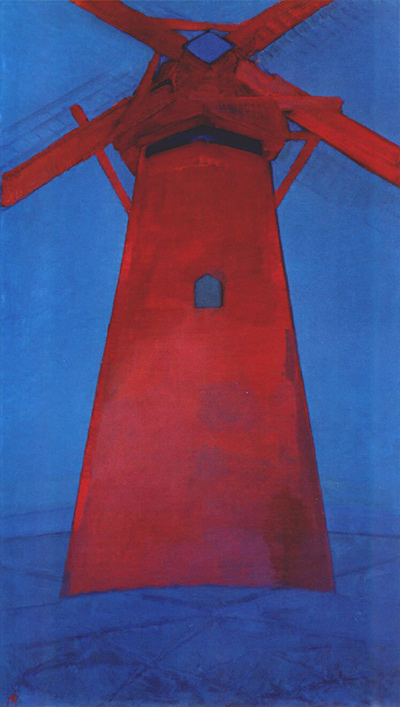
A tall windmill rises almost the full height of this narrow canvas. Its body is an immense red shape against a deep blue sky and ground, while the sails reach beyond the picture's side edges. Piet Mondrian painted The Red Mill in 1911; it is now in Kunstmuseum Den Haag, object 0334305, and is catalogued as A692. The museum connects its making to Mondrian's first visit to Paris and the modern art exhibition he organised in Amsterdam later that year. This is a separate work from the fiery 1908 Winkel Mill in Sunlight, with a different site, date and treatment of colour.[1][2][3]
At a glance
- ArtistPiet Mondrian (1872–1944)
- Museum titleMolen (Mill); The red mill (De rode molen)
- Date1911
- Catalogue numberA692
- MediumOil on canvas
- Dimensions150 × 86 cm
- CollectionKunstmuseum Den Haag, The Hague
- Object number0334305; bequest of Salomon B. Slijper
- Related locationthe Weltevreden mill near Domburg, painted by Mondrian in more than one work[1][3][4]
Windmills under changing light
Oostzijdse Mill in Moonlight
c. 1907Contents
- What does the image show?
- Which real mill did Mondrian paint?
- Why did he make it in 1911?
- What do the colours and viewpoint achieve?
- What do we know about its material and condition?
- How did it fit into the Dutch exhibition scene?
What does the image show?
The mill is seen from a very low viewpoint. Its red tower widens toward the base and narrows toward the cap, so that it appears monumental within the tall format. A small dark window interrupts the red surface. The sails stretch diagonally, with portions cut by the edges of the canvas. Blue fills the spaces around the building and continues below it, separating the red mass from detailed landscape description.
 The Red Tree Piet Mondrian.jpg)
This choice makes the painting feel both simple and forceful. There are not many objects to inspect, and the mill is presented almost straight on. Yet the red is not a mathematically flat block. Tonal variations, darker edges and traces of brushwork keep it a painted structure. The blue is likewise not a featureless backdrop. Look at the lower area, where changes of tone suggest a ground plane without describing every blade of grass.
The contrast is unusually concentrated. The 1908 Windmill in Sunlight uses red, blue, brilliant yellow and orange in short, agitated marks. The Red Mill reduces that variety to an extended red form against broad blue surroundings. The earlier painting emphasises the sensation of glare; this one makes the mill's vertical mass and imposing viewpoint the central event.
Which real mill did Mondrian paint?
The Mondrian Route identifies the subject as the Weltevreden grain mill near the southeastern edge of Domburg in Zeeland. Mondrian painted the mill more than once, including an earlier 1908/09 view and this 1911 red-and-blue canvas. That site identification helps distinguish the Red Mill from the Winkel Mill of Mill in Sunlight and from the Oostzijdse mills near the River Gein.[4]
The low viewing angle is part of how Mondrian transforms a local landmark. The mill seems to loom rather than sit naturally within a broad landscape. As the sails are clipped by the frame, the object can feel larger than the space available to it. The Mondrian Route describes the red-blue contrast and unusually low vantage as a deliberate departure from traditional depiction. The visible image supports that reading, though it does not show an exact point on the ground where Mondrian stood.[4]
Because several of his works are called simply Mill or Red Mill in different sources, the fixed identification is Kunstmuseum 0334305, 1911, 150 × 86 cm and A692. Those identifiers are more dependable than a short translated title by itself.[1][3]
Why did he make it in 1911?
Kunstmuseum Den Haag gives a specific artistic setting. Mondrian founded the Moderne Kunst Kring with Conrad Kickert and Jan Sluijters in November 1910. The group planned an autumn exhibition that would bring more advanced art to an Amsterdam audience. In April 1911 Mondrian resigned from established artist associations and in mid-May visited Paris as the group's secretary to encounter recent developments. The museum says he returned and made The Red Mill for the group's first exhibition in October 1911.[1]
The museum is also careful about what cannot be known: it says exactly what Mondrian saw on that short Paris visit is uncertain. Cubism was under discussion, and Picasso and Braque were central figures in that conversation, but their works were not yet readily visible in the way later accounts sometimes imply. The red mill's flat, saturated colour is compared by the museum with the palette of artists such as Matisse. That is a contextual comparison, not proof that Mondrian copied a particular Matisse painting.[1]
Later in 1911 Mondrian decided that he needed to live in Paris to pursue new art, and he moved there in early 1912. The red mill therefore belongs to a charged interval between Dutch landscape painting and the Paris experiments that followed. It remains an image of a recognisable building, but its scale, limited colours and tightly cropped form push away from descriptive scenery.
Watch: Piet Mondrian
See his studio, the move toward geometric abstraction and the rhythms of his New York paintings.
Piet Mondrian: Abstract Painting as We Know It
Curator Michael White explores the paintings and Mondrian’s studio as an abstract space.
Watch on YouTubeWhat do the colours and viewpoint achieve?
The blue background is a strong partner to the red tower. A pale or clouded sky would soften the contrast; this blue holds the mill in a compact field of colour. The red tower pulls the eye upward, and the crossing sails redirect it horizontally and diagonally. Even the small window matters because it punctuates such a large expanse of red.
The composition is more than a prelude to Mondrian's later primary-colour grids. The mill is an actual subject, and the canvas has a dramatic perspective. Red and blue are not isolated rectangular planes; they cling to a building and its setting. Yet the painting demonstrates how much can be done with few large relationships. That is a useful comparison with his later abstraction without treating this landscape as a disguised grid.
Kunstsammlung Nordrhein-Westfalen includes the painting in its account of Mondrian's interest in spiritual and artistic change around 1908–11. The work's bold colour can invite symbolic interpretations, but its own museum record does not assign a fixed code in which red “means” one abstract idea and blue another. The eye can begin with the observed contrast and the monumental viewpoint.[2]
What do we know about its material and condition?
The Hague museum identifies the painting as oil on canvas, 150 cm high by 86 cm wide. The tall proportion is essential to the mill's upright effect. The museum credits the painting to the bequest of Salomon B. Slijper and notes that it has been restored with financial support from American Express, without supplying a treatment history on its object page.[1]
A separate Kunstmuseum educational sheet provides an unusually concrete conservation observation: small fly droppings were found on The Red Mill. This detail says something about the physical life of a painted surface, beyond what a clean reproduction reveals. The sheet also explains that modern retouching aims to remain reversible. It does not say that those specks changed the composition or identify a specific restoration campaign for this canvas, so neither should be inferred.[5]
The museum's collection record is the best source for the original's current home. A reproduction, however accurate in its red-blue pattern, cannot by itself tell us the present conservation state or display location. The existing page image is useful for the overall composition; the institutional record anchors the size, medium and object history.
How did it fit into the Dutch exhibition scene?
The Red Mill was made for a public test of new art, not just for private reflection. Kunstmuseum Den Haag dates it after Mondrian's short Paris visit and connects it to the October 1911 Moderne Kunst Kring exhibition in Amsterdam. The same museum's history of “Zeeland light” records that his Domburg pictures had already caused a stir at a 1910 St Lucas exhibition at the Stedelijk Museum. Those earlier coastal works put intense colour before Dutch viewers. The 1911 mill then concentrated that colour in a single monumental building and put it into a show explicitly organised for modern art.[1][6]
The museum's exhibition history also warns against calling the painting “Cubist” merely because Mondrian would soon move to Paris. The red tower remains a recognisable site. Its innovation lies in the scale, cropping and flat saturated contrasts, while other works at the Moderne Kunst Kring exhibition pursued Cubist fragmentation more directly. Contemporary critics did not all agree about the meaning of the new work. This is a more accurate setting for the mill than a retrospective claim that it was already a geometric abstraction.[1][6]
The Mondrian Route offers a particularly useful comparison because it identifies two paintings of the same Weltevreden mill. Its 1908/09 view is loosely handled in pale twilight colours, whereas the 1911 work sets intense red against blue and looks up at the tower from a much lower angle. This controls for subject: the altered effect cannot be explained simply by Mondrian choosing a different mill. The site remained, while his choices about colour, scale and viewpoint changed. The Route was developed with Kunstmuseum Den Haag and RKD, and its location evidence supports this comparison more securely than generic online lists of Mondrian's “red mills.”[4]
The work's unusually tall 150 × 86 cm format mattered in that public setting. At room scale, a viewer faces a mill that fills most of the canvas rather than a small landmark receding into a panorama. Its clipped sails and low viewpoint intensify that encounter. These visual observations explain why an ordinary Zeeland subject could register as a challenge to the conventions of landscape painting without ceasing to be a landscape.[1]
Mondrian artworks directory
Frequently asked questions
When was The Red Mill painted?
Kunstmuseum Den Haag dates its canvas 1911 and connects it with the first Moderne Kunst Kring exhibition that October.[1]
Where is it?
It is in Kunstmuseum Den Haag, object 0334305, from the Slijper bequest.[1]
Is it the 1908 Mill in Sunlight ?
How large is the canvas?
The museum gives 150 × 86 cm, oil on canvas.[1]
Discussion
How does the low viewpoint change the mill?
Reader Insights
Why are the sail tips cropped?
How does this red-blue treatment differ from the Winkel Mill?
How does this red-blue treatment differ from the Winkel Mill?
Join the Conversation
Share what you notice in this painting below.
References
- Kunstmuseum Den Haag, official Molen (Mill); The red mill object record, 0334305: 1911 context, first Moderne Kunst Kring exhibition, medium, dimensions and Slijper bequest. View source.
- Kunstsammlung Nordrhein-Westfalen, Mondrian. Evolution digital exhibition, 1908–11 section including the 1911 Red Mill. View source.
- RKD – Netherlands Institute for Art History, Welsh archival inventory identifying The Red Mill as A692. View source.
- Mondrian Route, Weltevreden mill at Domburg and the two Mondrian views of the site. View source.
- Kunstmuseum Den Haag, educational conservation sheet noting fly droppings on The Red Mill and general restoration practice. View source.
- Kunstmuseum Den Haag, “Zeeuws Licht,” on the 1910 reception of Domburg work and the 1911 Moderne Kunst Kring exhibition. View source.
- Lead image credit. Piet Mondrian, Molen (Mill); The Red Mill, 1911, oil on canvas, 150 × 86 cm, Kunstmuseum Den Haag, 0334305, RKD A692.