 by Tom Gurney
Tom Gurney BSc (Hons) is an art history expert with over 20 years experience
Published on June 19, 2020 / Updated on September 29, 2026
Email: tomgurney1@gmail.com / Phone: +44 7429 011000
About the painting
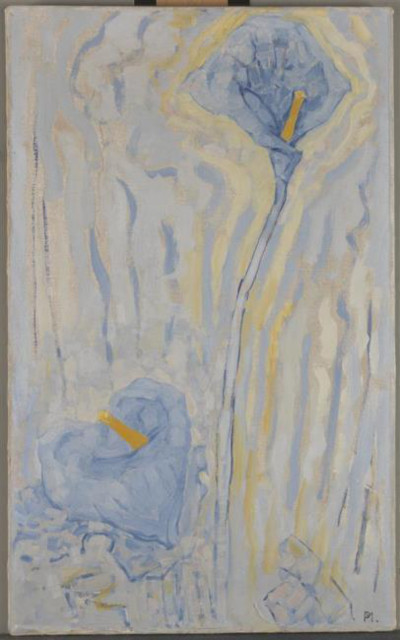
Two tall arum lilies rise through a pale field of blue, cream and grey. This is Mondrian's Two Arum Lilies in Kunstmuseum Den Haag, object 0334322. The museum dates the oil canvas to 1918 and gives its size as 80 × 50 cm. RKD lists it as C43, approximately 1917. Both institutions identify the same physical picture, but their date wording differs. This page uses the museum's 1918 object date while recording the catalogue's earlier approximate date.[1][2]
At a glance
Mondrian across periods
Contents
- What can be seen?
- Which of Mondrian's two-lily works is this?
- Why was Mondrian still painting flowers?
- Two flowers, unequal in height
- A date and title with two records
- An independent late naturalistic work
What can be seen?
The lilies are reduced to long, curving contours and light coloured forms. One flower stands higher; a second opens lower to the left. Their stalks run down the vertical picture. The background is not a neutral blank: washes and strokes of blue and buff surround the pale blooms and make their outlines shift as the eye follows them.
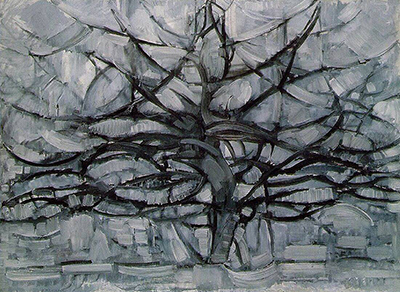
 The Red Tree Piet Mondrian.jpg)
The flowers are recognisable, but they are not described petal by petal. A few strong curves carry their shape. This economy makes the long vertical format important. The stalks and spathes extend through much of the 80 cm height, so the viewer reads the picture upward rather than across a tabletop arrangement.
The pale ground also changes the mood from Mondrian's darker early flower pictures. In Two Chrysanthemum Blossoms, A106, light heads emerge from a brown field. Here the lilies and their surrounding space share light colours. The distinction is visible before one knows any catalogue number.
Which of Mondrian's two-lily works is this?
RKD catalogues two different works with the same short title. C42 is dated c. 1916–17 and belongs to the Hague museum as 0320935, described with a T-series inventory number. C43 is the painting shown here, the museum's 0334322. Its 80 × 50 cm picture has the same tall 5:8 proportions as the retained local image. The title alone does not identify which of the two a reproduction represents.[1][2]
The museum's public record establishes oil on canvas for 0334322. Applying that medium to C42 without checking its own record would be an error. The image, object number, dimensions and medium together make the C43 identification secure.
Why was Mondrian still painting flowers?
RKD groups these works among his late naturalistic flower representations. They coexist with the abstract pictures for which he is famous. A flower study therefore does not automatically signal an early date. Mondrian could keep observing and simplifying a plant while working on very different compositions elsewhere. The catalogue's broad flower section, which includes arum lilies and many chrysanthemums, documents that continued interest.[1]
This particular canvas offers a concise visual question. How much description is needed before two flowers become recognisable? Mondrian retains the long stems, enclosing curves and different heights, while allowing much of the surface to remain open and lightly coloured. That is an observation about the picture, rather than a claim that it was a direct study for any later grid painting.
Watch: Piet Mondrian
See his studio, the move toward geometric abstraction and the rhythms of his New York paintings.
Piet Mondrian: Abstract Painting as We Know It
Curator Michael White explores the paintings and Mondrian’s studio as an abstract space.
Watch on YouTubeTwo flowers, unequal in height
The two blooms do not function as mirrored halves. One rises higher, while the other opens lower and to the left; their stems lead the eye through the long support at different speeds. The pale blue and buff ground is active enough to alter their outlines, but not so dense that it closes the space around them. Mondrian can therefore keep the botanical subject clear with relatively few contours. Look for the points where a curve alone defines a flower and where colour contrast has to complete it.
The work also has a different relation to light from the earlier chrysanthemum studies. In those, white petals often emerge against a dark surrounding field. Here flower and surrounding air share related pale tones. Recognition depends on intervals and direction as much as on dramatic contrast. That makes the painting a useful counterexample to the idea that all naturalistic Mondrian flowers were painted in one early style.
A date and title with two records
The Hague museum dates object 0334322 to 1918, while RKD lists C43 at approximately 1917. The difference need not be forced into a single unsupported day or year. The secure crosswalk is the museum number, medium, dimensions and image. A second two-lily object, C42, is also held in The Hague under a different number. Where a reproduction is labelled only “Two Arum Lilies,” those identifiers protect both works from being merged. The uncertainty is about the exact date of this canvas, not about whether the two catalogue entries are separate.[1][2]
An independent late naturalistic work
This canvas belongs to a period when Mondrian was also developing abstraction. That overlap should not be treated as a contradiction to explain away. The arum lilies let him study a botanical shape through spare curves and light colour, while his nonrepresentational pictures tested other relations. The secure statement is that the Hague museum's 0334322 is a 1918 oil canvas and RKD's C43 is dated approximately 1917; a claim that this specific flower study directly generated a later abstract composition would need evidence absent from the records used here.[1][2]
Mondrian artworks directory
Frequently asked questions
Why do sources give 1917 and 1918?
Is it the same as C42?
No. C42 is another two-lily work under Hague number 0320935.[1]
Discussion
Where do the flower contours remain clear?
Reader Insights
How does the pale ground change the mood?
Why must this C43 be separated from C42?
Why must this C43 be separated from C42?
Join the Conversation
Share what you notice in this painting below.
References
- RKD – Netherlands Institute for Art History, late flower catalogue, separate C42 and C43 entries. View source.
- Kunstmuseum Den Haag, official Two Arum Lilies record, 0334322, 1918, oil on canvas, 80 × 50 cm. View source.
- Lead image credit. Piet Mondrian, Two Arum Lilies, oil on canvas, 80 × 50 cm, Kunstmuseum Den Haag, 0334322, RKD C43; museum dates 1918, RKD c. 1917.