 by Tom Gurney
Tom Gurney BSc (Hons) is an art history expert with over 20 years experience
Published on June 19, 2020 / Updated on September 29, 2026
Email: tomgurney1@gmail.com / Phone: +44 7429 011000
About the painting
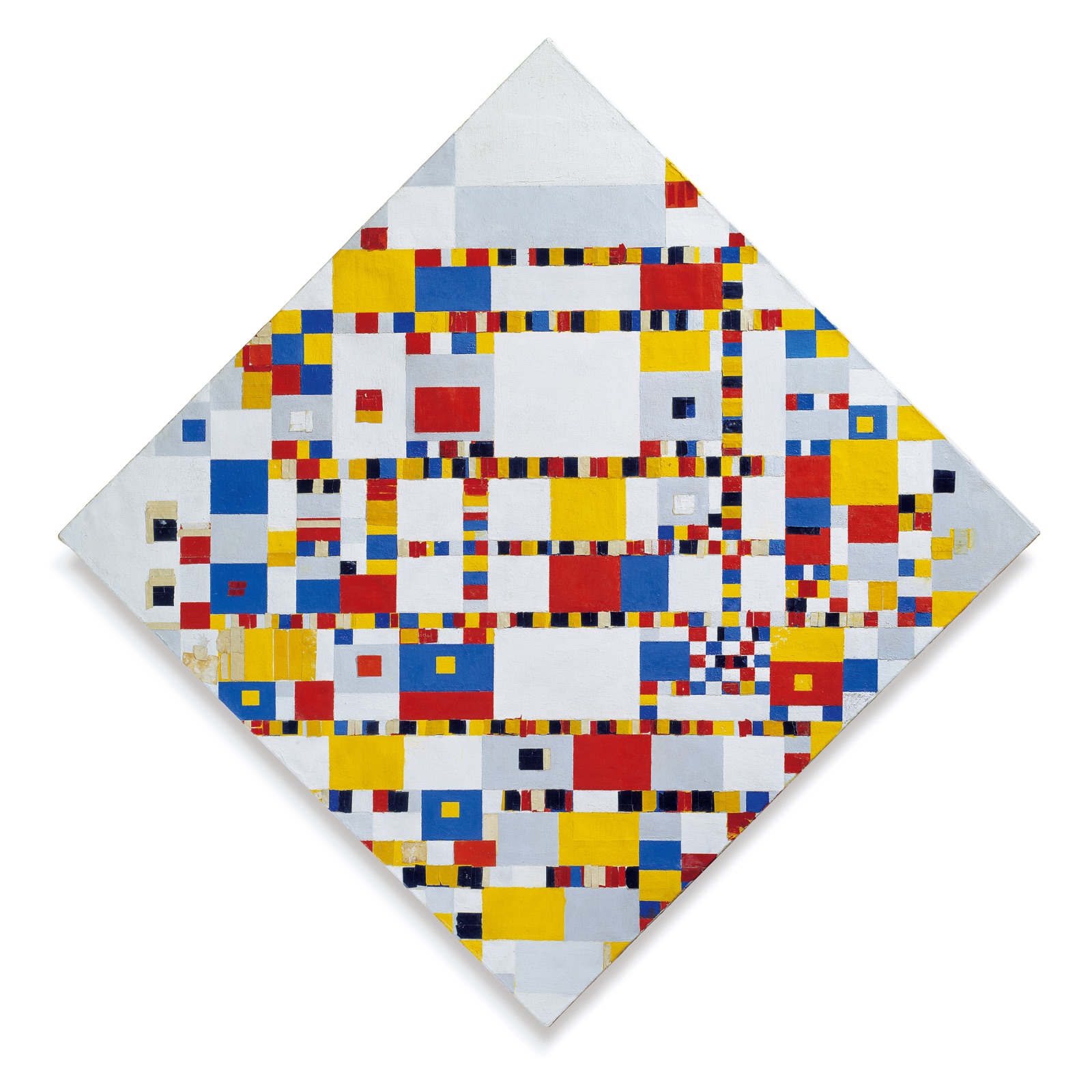
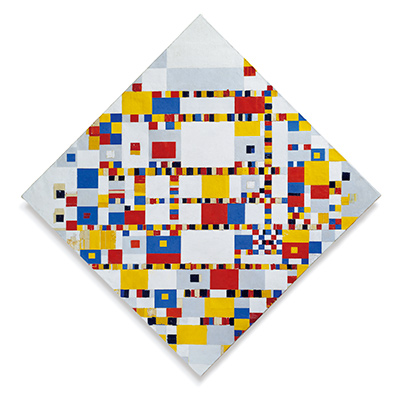
Victory Boogie Woogie was the last painting Piet Mondrian worked on. It remained unfinished when he died in New York on 1 February 1944. The work's diamond orientation, many small blocks of red, blue, yellow, gray and white, and visible pieces of coloured tape give it an energy unlike that of his spare paintings from twenty years earlier. Yet the tape also makes a crucial fact visible: Mondrian was still moving parts of the composition. The painting is not an incomplete version of a settled plan whose final form we can reconstruct with certainty.[1][2]
The original is held by the Dutch state and is on long-term loan to Kunstmuseum Den Haag. The museum dates it 1942–44 and records oil paint, tape, paper, charcoal and pencil on canvas. RKD identifies it as Joosten B324, immediately after Broadway Boogie Woogie (B323), the last painting Mondrian completed. The two works belong to the same New York period, but they have different shapes, materials, histories and states of completion.[1][2][3]
At a glance
- ArtistPiet Mondrian (1872–1944)
- TitleVictory Boogie Woogie
- Date1942–44; unfinished at the artist's death
- MaterialsOil paint, tape, paper, charcoal and pencil on canvas
- Canvas127.5 × 127.5 cm, according to a Kunstmuseum Den Haag publication; displayed as a diamond
- CollectionDutch state; long-term loan to Kunstmuseum Den Haag, object 0810747
- Catalogue raisonnéJoosten B324
- Measurement noteThe museum's object record also lists 178.4 cm as a diagonal stretcher measurement, not a second ordinary side length[1][2][4]
Where this painting sits in Mondrian's career
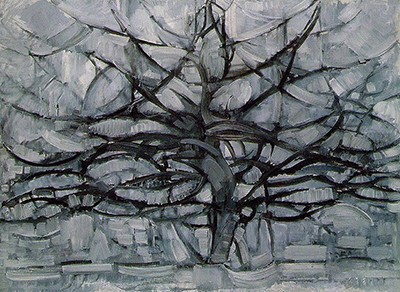
Evening: The Red Tree
1908–10Broadway Boogie Woogie
1942–43Victory Boogie Woogie
1942–44Contents
- What do you see in the painting?
- Annotated details in Victory Boogie Woogie
- Why did Mondrian hang a square as a diamond?
- How does it differ from Broadway Boogie Woogie?
- What was Mondrian still changing?
- Does the title mean victory in the war?
- How did the painting reach The Hague?
- Why does its unfinished state matter?
- What has conservation research added?
What do you see in the painting?
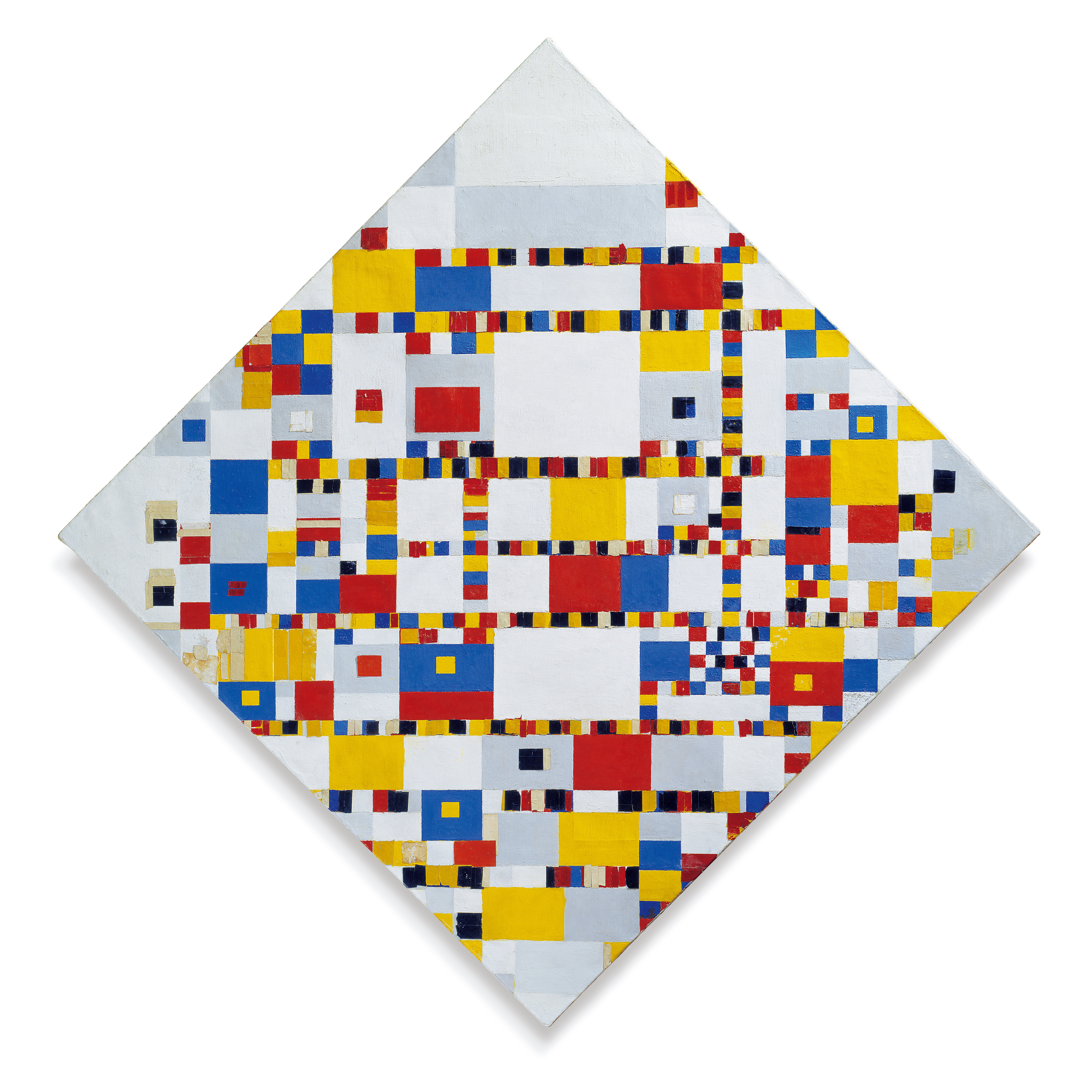
The first surprise is its orientation. The canvas is square, but it hangs on a point, so the edges make a diamond. Horizontal and vertical divisions still run through the painted design. Against the tilted outer shape, however, those directions feel less settled than in a square Mondrian hung with its sides level. The top and bottom points draw the eye toward the centre, while the coloured bands and blocks pull it sideways again.
The picture is dense without being uniform. Small units of yellow, red, blue and gray meet areas of white, sometimes in long interrupted runs and sometimes in compact clusters. Larger coloured shapes hold parts of the composition together, but they do not make a single centre or a simple repeating pattern. The colours do not occupy equal amounts of space. A viewer can follow a line across several blocks, lose it among changing colours and pick up another line elsewhere. That restless way of looking is part of the work's effect.
The existing reproduction is useful for seeing the overall layout. It cannot show every material decision on the original canvas. Kunstmuseum Den Haag lists not just oil paint but tape, paper, charcoal and pencil. Some pieces of tape are conspicuous, while others may be difficult to distinguish from painted edges in a small image. The museum describes Mondrian moving tape and painting over areas as he revised the work. Its unfinished condition is therefore not merely a missing final coat. It preserves a working arrangement in which temporary and more settled decisions coexist.[1][5]
Looking at one cluster at a time helps. Around a broad white space, small bright units seem to speed up. A larger block may slow the eye before another line takes it away. The contrast between wide and narrow, painted and taped, open and crowded areas keeps the painting from becoming a decorative checkerboard. One need not assign each coloured square a fixed symbolic meaning to notice that the pattern is continually adjusted by its neighbours.
Annotated details in Victory Boogie Woogie
Explore five regions of Mondrian's unfinished diamond composition, from its pointed edge to its dense coloured passages. Select a number to jump to a detail.
 1
2
3
4
5
Choose a number to reach its detail, then select a detail image to open the gallery. Open the full-resolution image.
Details from VICTORY BOOGIE WOOGIE
Five close views of the painting.
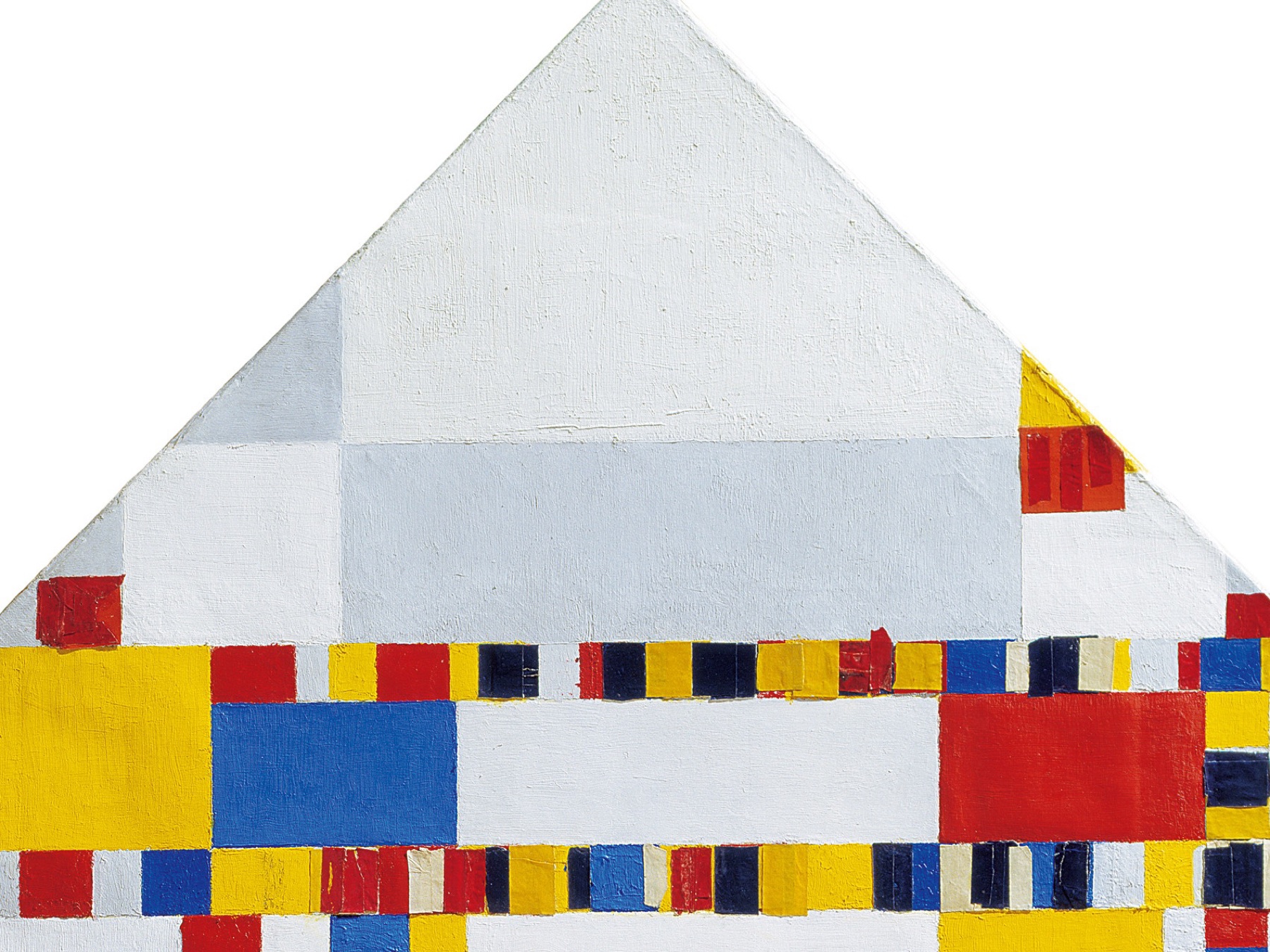
A point frames the grid
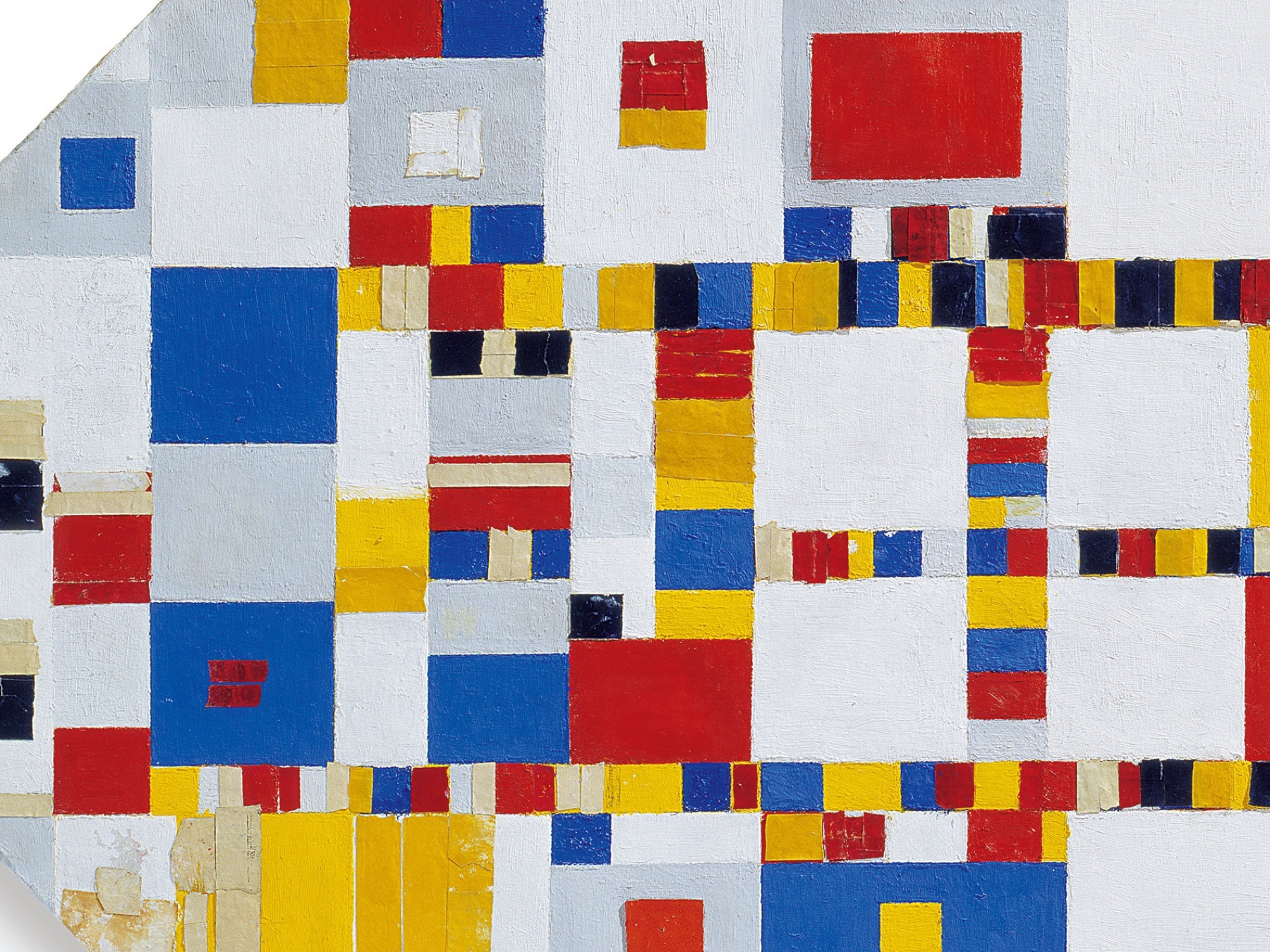
The diamond's upper edges angle inward toward a pale point. Beneath it, short colour units form a horizontal route across the tilted canvas.
Colour gathers on the left
Red, blue and yellow rectangles vary in size. The irregular group makes a strong counterweight to nearby pale areas.
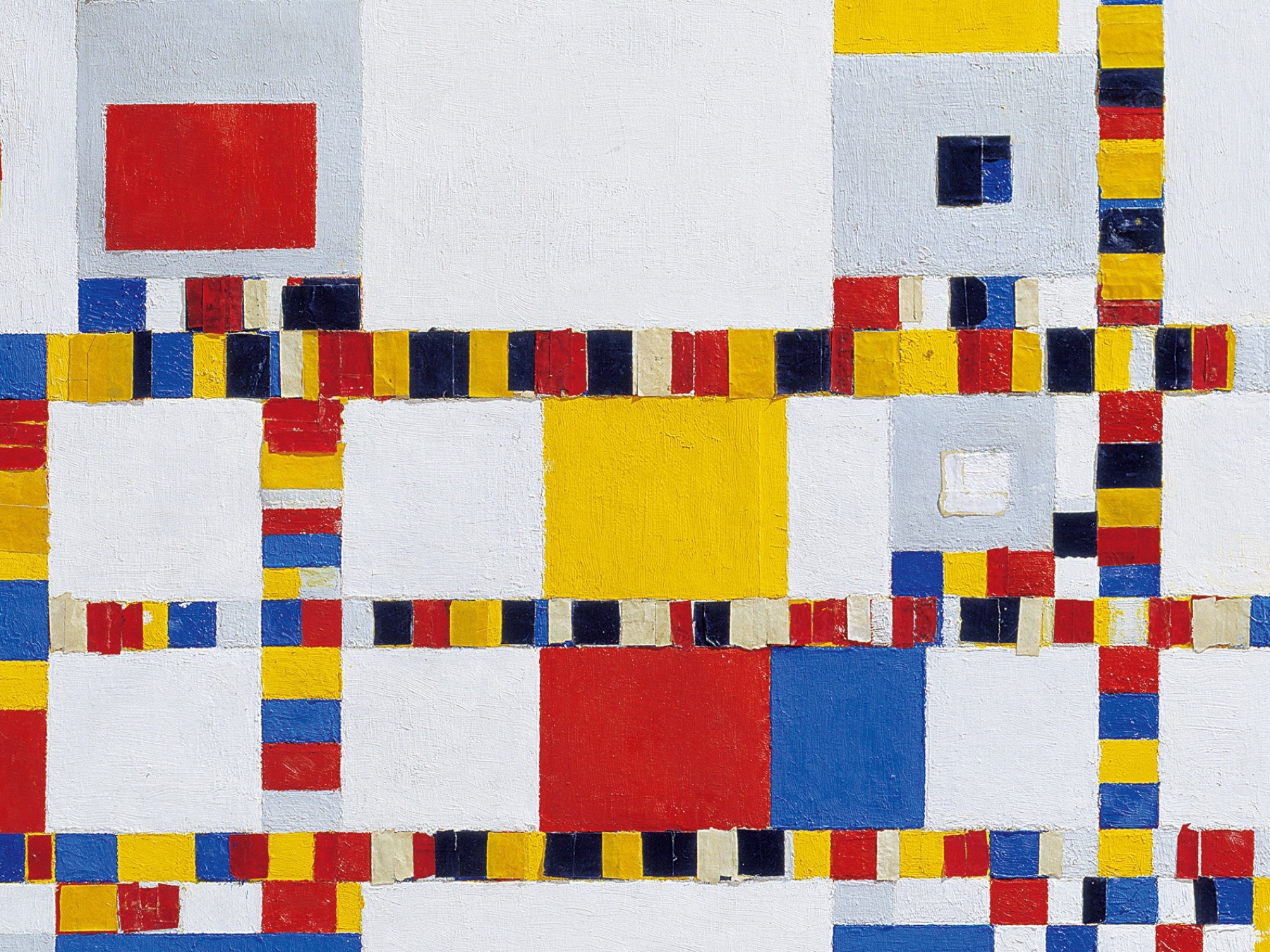
A light interval opens at the centre
A broad pale field interrupts the denser coloured bands. Its edges are crossed and bordered by much smaller units.
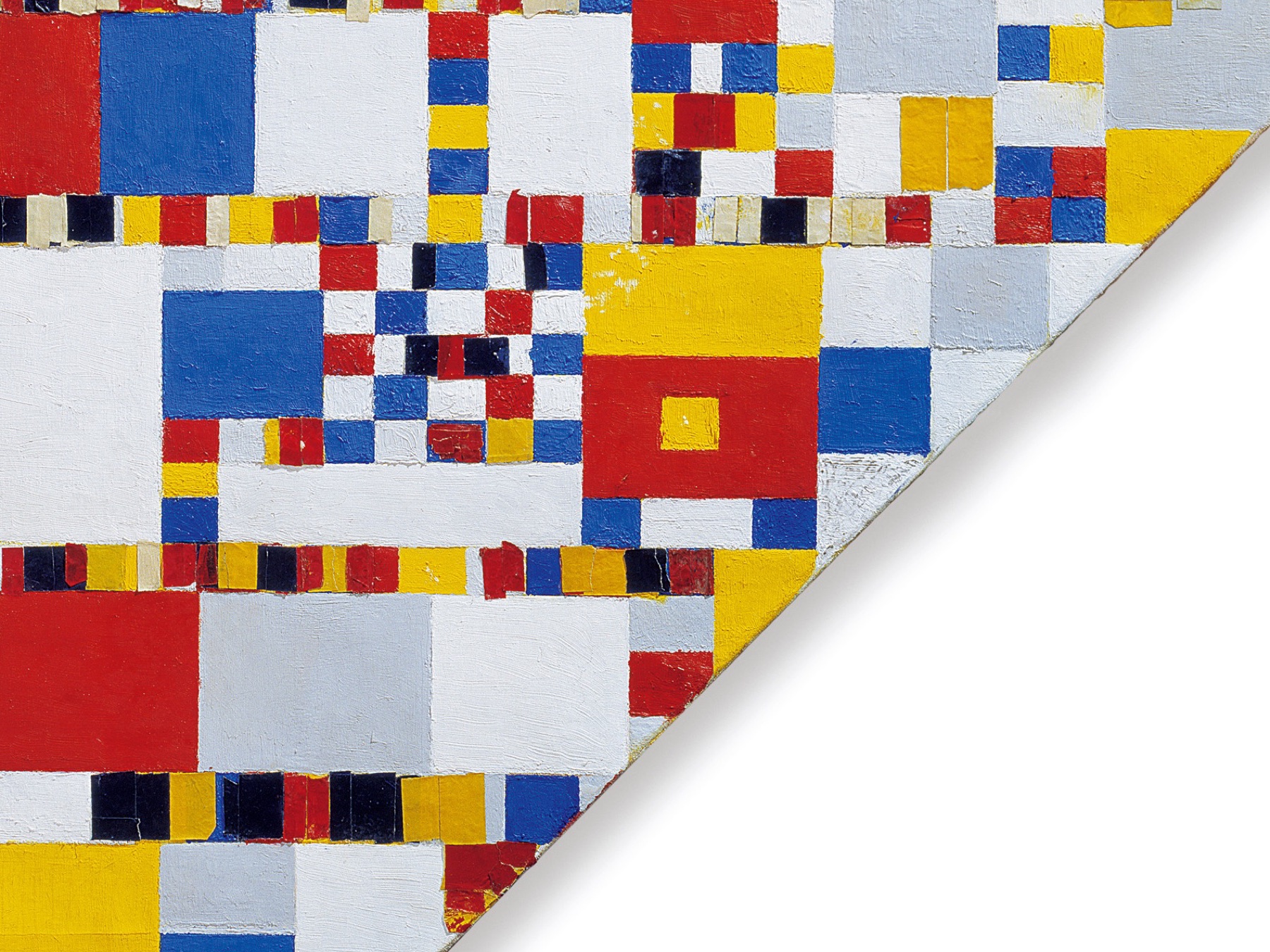
Small squares tighten the rhythm
A compact group of tiny red, blue, yellow and pale squares makes this region especially busy beside larger surrounding blocks.
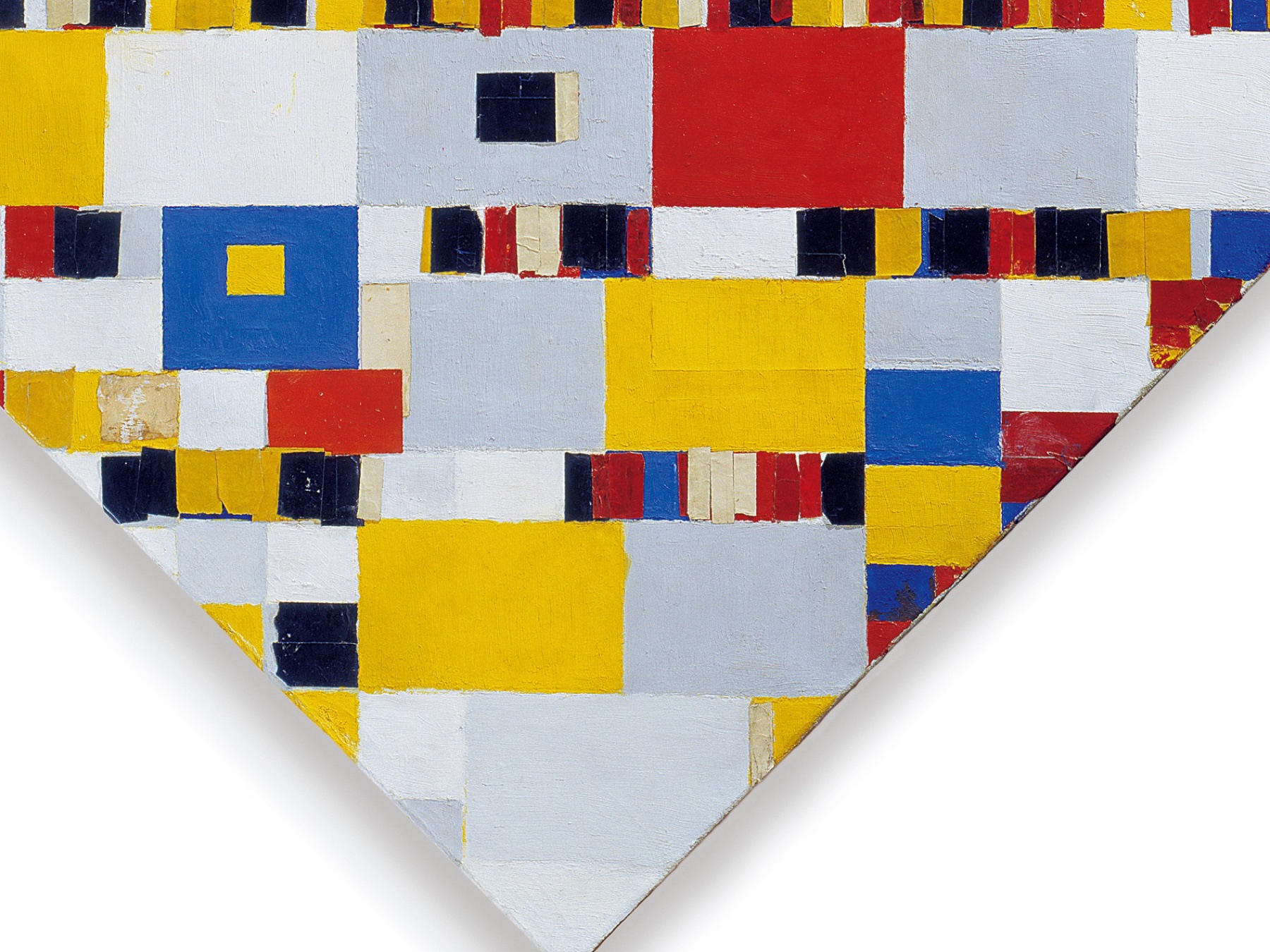
The pattern continues toward the point
Interrupted coloured rows and larger pale areas lead the eye down toward the diamond's lower tip.
Why did Mondrian hang a square as a diamond?
Mondrian had used diamond-shaped presentation long before New York. Turning a square canvas on its point changes the relationship between the outer boundary and the horizontal and vertical marks within it. In Victory Boogie Woogie, no vertical side of the canvas supports the vertical parts of the design, and no level top edge quietly repeats its horizontals. Every line meets a sloping outer edge. The result is a tension between the painting's straight internal directions and the pointed shape seen from across a room.
The museum says Mondrian referred to the developing work at different times as a “Victory-painting,” a “Boogie Woogie painting,” or “Diamond.” That last working name is a reminder that its shape mattered to him, not just its eventual title. It does not mean that an exact verbal programme survives for every coloured block. The visible relationships remain the most direct evidence of what the painting does.[1]
An often quoted size can also cause confusion. A Kunstmuseum publication gives the canvas as 127.5 × 127.5 cm. The museum's collection database lists 178.4 cm for a measurement explicitly labelled as the stretcher measured diagonally. These are different ways of describing the object. Calling 178.4 cm a normal side length would make the painting seem much larger than the stated square canvas. The clearest brief description is a square of about 127.5 cm per side, displayed on a point, while preserving the database's separately labelled diagonal measurement.[1][4]
How does it differ from Broadway Boogie Woogie?
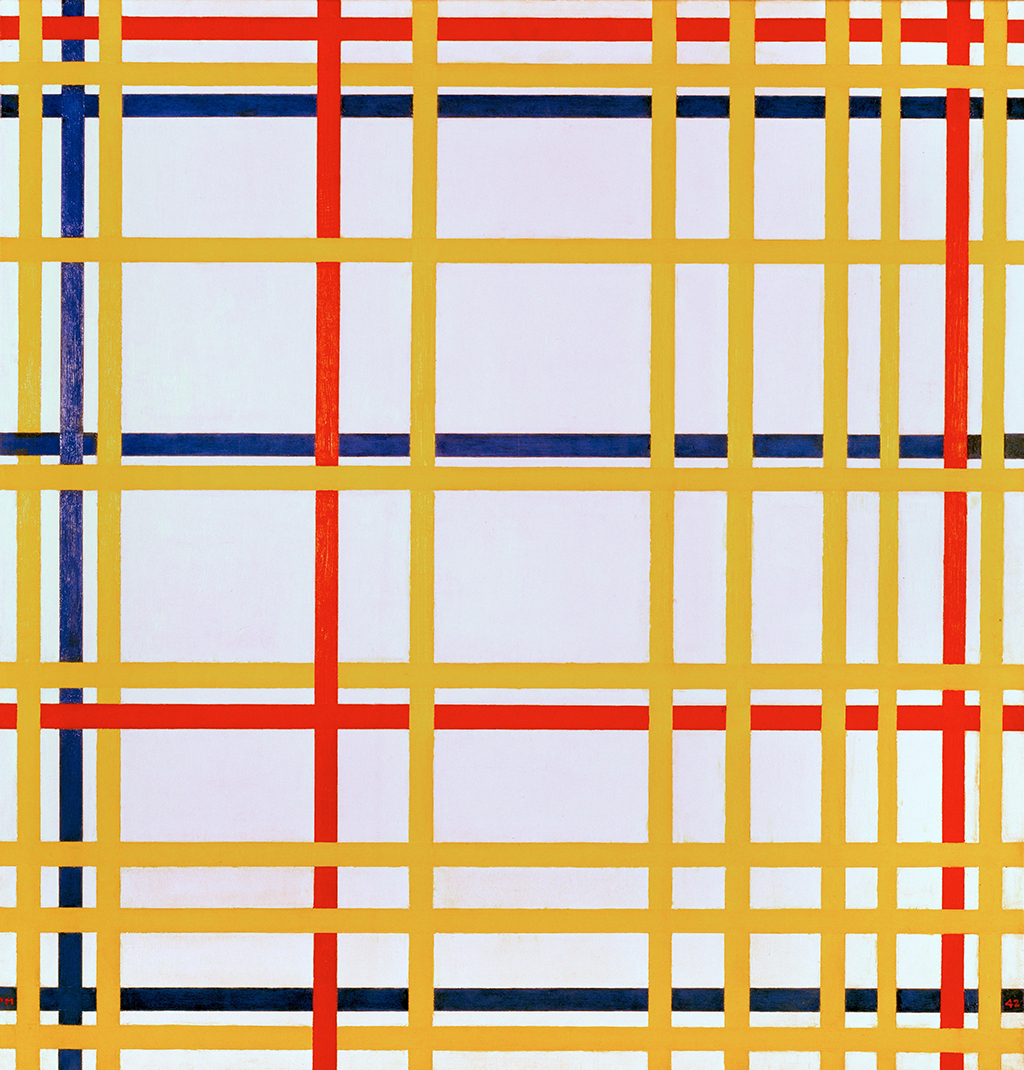
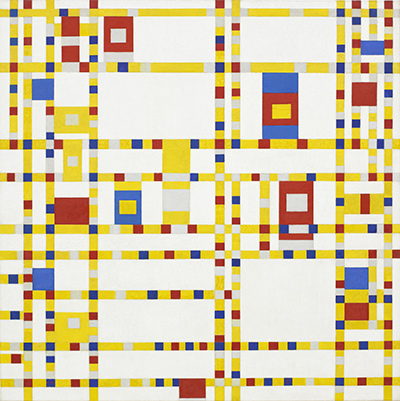
The earlier Broadway Boogie Woogie is a completed square canvas in MoMA's collection, dated 1942–43. Its yellow routes and coloured interruptions are carefully revised but read as a finished arrangement. Victory Boogie Woogie shares the New York interest in broken colour and rapid visual rhythm. It is rotated, denser in many passages, and still bears the tape and other materials of an unresolved process. RKD catalogues the works separately as B323 and B324.[2][3]
Mondrian worked on them in overlapping years. The Kunstmuseum's account makes clear that he completed Broadway and continued working on Victory until illness intervened. It would be too simple to call Victory a sequel in which he merely increased the number of squares. A new orientation and a more provisional surface changed the problem he was trying to solve. It is possible to feel a family resemblance between the paintings without treating the later canvas as a finished statement of where Mondrian wanted every part to end up.[1][5]
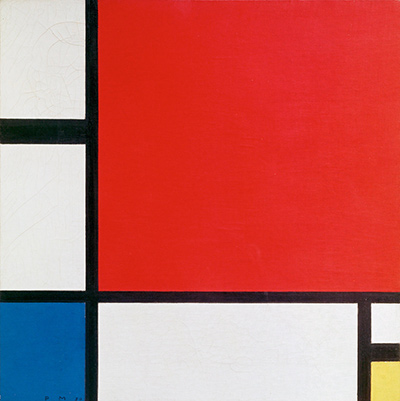
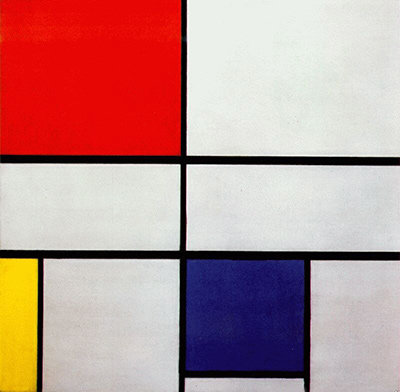
Both paintings also differ from the 1930 Zürich Composition with Red, Blue and Yellow, with its broad black bars and few large planes. Mondrian had not abandoned his interest in relations among lines, colours and white spaces. He had changed how those relations move across the surface. The New York paintings let small shifts and interruptions matter in a way that is much less prominent in the earlier composition.[3]
What was Mondrian still changing?
Kunstmuseum Den Haag describes a painter who repeatedly thought a work was close to completion, then changed it substantially. The museum identifies one small blue block right of centre as a passage that stayed as first placed. It says many other parts were revised. This is an account of a continuing search for relationships, not evidence that the picture lacked discipline. Mondrian was testing how large and small, light and dark, quick and slow could coexist without falling into a fixed, symmetrical pattern.[1]
The museum gives an unusually specific account of his final changes. On 23 January 1944, though ill, he still worked on the painting and that evening began a major revision, covering many coloured squares with tape of other colours and painting over some larger squares. He entered hospital on 26 January. When he died on 1 February, the canvas was left unfinished in his studio. These dates explain why the surviving tape cannot be treated as a harmless later accessory: the museum places at least some of it within Mondrian's own last period of work.[1]
The unfinished state also sets a limit on interpretation. We cannot know whether Mondrian would have removed every piece of tape, translated some of it into paint, or changed the pattern again. The museum's account suggests he often reconsidered what seemed near completion. A finished version imagined after the fact would therefore be speculation. The object we have is the historically real work: a powerful composition that remains visibly in process.
Research into photographs by Kate Steinitz gives a rare view of an earlier state. The Mondrian Papers dates her New York studio photographs to June–August 1942; one shows Mondrian working on what it identifies as an early Victory Boogie Woogie. Its lines had not yet been broken into the short coloured sections visible in the surviving canvas. The researchers place that shift around October 1942, when Mondrian sought to reduce the unintended suggestion of depth produced by overlapping coloured lines. The photograph documents a stage of the work, not a completed alternative version.[7]
A near-contemporary document confirms that this was understood from the start. In its 1945 Mondrian memorial exhibition checklist, MoMA listed Victory Boogie Woogie as item 51, described it as unfinished, and named oil, paper and tape on canvas among its materials. The checklist credited its loan to The Miller Company in Meriden, Connecticut. These details do not resolve exactly how Mondrian would have finished the work; they show that its provisional surface was documented and publicly exhibited within little more than a year of his death, long before the 1998 Dutch acquisition.[6]
Watch: Piet Mondrian
See his studio, the move toward geometric abstraction and the rhythms of his New York paintings.
Piet Mondrian: Abstract Painting as We Know It
Curator Michael White explores the paintings and Mondrian’s studio as an abstract space.
Watch on YouTubeDoes the title mean victory in the war?
The word “Victory” invites a wartime reading. Mondrian was making the painting in New York while the Second World War continued, and Kunstmuseum Den Haag connects the beginnings of the work with his hope that the war would end well. The museum also records his varying working names, including “Victory-painting,” “Boogie Woogie painting” and “Diamond.” Those names do not provide a single key that translates each form into a military or political symbol.[1]
The museum describes oppositions it finds important to the painting: chaos and order, large and small, light and dark, fast and slow, static and dynamic. These can be felt in the changing distribution of colour and space. They are broader than one proposed image of a battle won over tyranny. The safer reading keeps the wartime setting and Mondrian's optimism in view while allowing the canvas to remain an abstract experiment rather than an illustration of a slogan.[1]
The boogie-woogie part of the title points to another part of New York life. Mondrian encountered the music after arriving in the city and found its changing pulse stimulating. Kunstmuseum's account relates the work's desired rhythm to what he heard in America. Yet a musical analogy, like a wartime one, should not be pushed into a claim that each block stands for a note. The sense of rhythm arises from the viewer's movement among the unequal parts.[1][5]
How did the painting reach The Hague?
The painting did not pass directly from Mondrian's studio to the Dutch museum. Kunstmuseum Den Haag says that, after his death, it was found to belong to the art dealer Francis Valentine Dudensing. According to the museum, Dudensing had sold Broadway Boogie Woogie without commission, and Mondrian had promised him the next canvas. Dudensing then sold Victory Boogie Woogie to collector Emily Tremaine. That chain is much more specific than the shorthand statement that the work “was given to the Dutch state.”[1]
The Dutch state connection came decades later. In 1998, a gift from De Nederlandsche Bank enabled the Stichting Nationaal Fonds Kunstbezit to acquire the painting and donate it to the state. It has since been on long-term loan to Kunstmuseum Den Haag, where it is a central work in the museum's Mondrian collection. Its object record also credits the Cultural Heritage Agency of the Netherlands and the Ministry of Education, Culture and Science in connection with that loan.[1]
This history matters because the painting is often described as though the museum simply owns it. The institution cares for and presents the work, but the museum's own record makes the state ownership and long-term loan clear. A visitor should check current display details with Kunstmuseum Den Haag, as any individual artwork may move for research, conservation or exhibition.
Why does its unfinished state matter?
Victory Boogie Woogie is not remarkable only because it was the last work Mondrian touched. Its mixture of paint, tape and drawing materials lets viewers see something of the testing that usually disappears into a finished surface. The crowded pattern is not random: changes in a small block affect the neighbouring routes and the larger balance of the diamond. Yet no final arrangement was fixed before the artist died.
That openness can make the work unusually direct. We encounter Mondrian's questions rather than a reconstructed answer. He had carried the horizontal, vertical and primary-colour vocabulary through decades of change, from quiet Paris compositions to the rapid rhythms of New York. Here that vocabulary is still active, still being rearranged. To call the work unfinished is a historical fact; it does not make the surviving canvas a lesser or merely preparatory object.[1][2]
What has conservation research added?
The unfinished surface is a source of evidence, and also a conservation challenge. In 2007, Kunstmuseum Den Haag described a second phase of scientific investigation carried out in the gallery with a mobile European laboratory. Researchers used contactless imaging and analysis, including infrared, ultraviolet and X-ray techniques, to study materials and the order of Mondrian's changes. The museum stated the aim as learning more about his working practice and the painting's development. That project did not amount to a published reconstruction of one certain final design.[8]
The museum highlighted details easily lost in reproduction: Mondrian used glue and adhesive tape alongside paint, scraped away some paint, and left different kinds of brushwork visible. It also recorded that the picture was unvarnished. These are reasons to look at the surviving surface as a sequence of decisions rather than a flat digital pattern. The museum's account identifies research methods and questions, but does not give a map assigning every square to a precise day; that level of chronology cannot be inferred from a photograph.[8]
The painting's later public life depends on preserving that provisional state. The 1945 MoMA checklist already showed it as unfinished and described paper and tape on the canvas. Conservation must respect the fact that what looks temporary was left by Mondrian and became part of the work's documented history. This does not make every loose edge or colour change intentional, but it does mean that “finishing” the composition on his behalf would erase evidence of how he was working.[6][8]
Mondrian artworks directory
Frequently asked questions
Is Victory Boogie Woogie finished?
No. Mondrian was still revising it in January 1944 and died on 1 February before completing the canvas. The surviving tape and other working materials are part of its recorded state.[1]
Where is the original painting?
It is owned by the Dutch state and is on long-term loan to Kunstmuseum Den Haag, where it is recorded as object 0810747. Check the museum for current gallery placement.[1]
How large is it?
What materials did Mondrian use?
The museum lists oil paint, tape, paper, charcoal and pencil on canvas. The tape helps show that he was still trying changes to the composition.[1]
Is it the same painting as Broadway Boogie Woogie ?
Discussion
Which taped or painted passage most changes the balance of the diamond for you?
Reader Insights
Follow one coloured path across the diamond. Where does a change of colour redirect your eye?
Which open white area seems to balance the densest group of coloured blocks?
How does this unfinished diamond differ from the completed Broadway Boogie Woogie?
Join the Conversation
Share what you notice in this painting below.
References
- Kunstmuseum Den Haag, collection record for Piet Mondrian, Victory Boogie Woogie, object 0810747. View source.
- RKD – Netherlands Institute for Art History, Mondrian catalogue raisonné, New York sequence, entries B323 and B324. View source.
- The Museum of Modern Art, collection record for Broadway Boogie Woogie, object 73.1943. View source.
- Kunstmuseum Den Haag, “Mondrian to Dutch Design: 100 years of De Stijl,” work caption for Victory Boogie Woogie. View source.
- Kunstmuseum Den Haag, “Mondrian's final masterpieces to be reunited,” exhibition introduction. View source.
- The Museum of Modern Art, “Mondrian Memorial Exhibit,” press release and checklist, 19 March 1945, item 51, recording the unfinished state, materials and lender of Victory Boogie Woogie. View source.
- The Mondrian Papers, Wietse Coppes, “New insights into a photograph from New York” (2022), identifying Kate Steinitz's 1942 photograph of an early state of this painting. View source.
- Kunstmuseum Den Haag, “Onderzoek naar de Victory Boogie Woogie,” on the 2007 material study and imaging methods. View source.
- Lead and annotated image credit. Piet Mondrian, Victory Boogie Woogie, 1942–44, unfinished. Dutch state; long-term loan to Kunstmuseum Den Haag, object 0810747. High-resolution reproduction supplied by the site owner as public domain.
 The Red Tree Piet Mondrian.jpg)