 by Tom Gurney
Tom Gurney BSc (Hons) is an art history expert with over 20 years experience
Published on June 19, 2020 / Updated on September 29, 2026
Email: tomgurney1@gmail.com / Phone: +44 7429 011000
About the painting
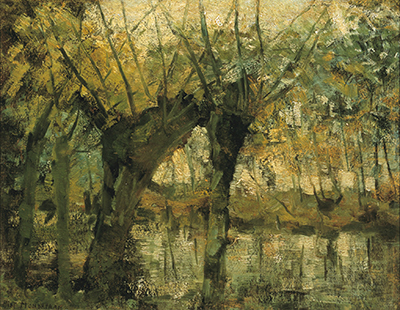
Two pollarded willows lean across a watery landscape, their branches mixing with a screen of yellow-green foliage. Mondrian's Willow Grove: Impression of Light and Shadow is RKD A468, dated c. 1905 and held by the Dallas Museum of Art as 1975.65.FA. The museum's own short account places this work among his early landscapes inspired by direct observation and loose Impressionist brushwork. It is a specific Gein-period painting, not a generic illustration of every willow grove he made.[1][2]
At a glance
- ArtistPiet Mondrian (1872–1944)
- TitleWillow Grove: Impression of Light and Shadow
- Datec. 1905
- Catalogue numberRKD A468
- MediumOil on canvas in a Dallas-contributed AMICA record
- CollectionDallas Museum of Art
- Object number1975.65.FA; Foundation for the Arts Collection, gift of Mr. and Mrs. James H. Clark[1][2][3]
Mondrian across periods
Contents
- How do light and shadow work together?
- Where does it fit among Mondrian's willow paintings?
- How did it enter the Dallas collection?
- The grove's changing depth
- The Dallas object among nearby works
- Two scales of attention
How do light and shadow work together?
The foreground willows are dark and irregular. Their trunks rise and divide, and branches cross the lighter growth behind them. Patches of yellow, olive and pale green appear through gaps. The eye moves between dark tree structure and illuminated spaces, which is exactly the contrast named in the title. Water below reflects some of the verticals and colour, making the view less stable than a simple line of trees across land.
 The Red Tree Piet Mondrian.jpg)
Short paint marks create much of that effect. A branch is not outlined cleanly from beginning to end; it may disappear into foliage and return as a darker stroke. The cluster of trees can seem dense from a distance and surprisingly broken close up. This handling makes light seem to flicker through the grove.
The picture is relatively small. A Dallas-contributed AMICA record gives 35.08 × 45.42 cm, while other online transcriptions vary. Because the current museum story does not itself foreground exact dimensions, the article avoids building an interpretation on a disputed fraction of a centimetre. The secure facts are the RKD number, Dallas accession, date range and observed composition.[3]
Where does it fit among Mondrian's willow paintings?
RKD places A468 among several c. 1905 willow groves. A466 has two prominent trees in the Hague museum; A467 has a prominent central trunk in the Frans Hals Museum; A469 includes chickens near the water in the Israel Museum. These are related motifs but distinct works. The Dallas inventory 1975.65.FA and the dense light-and-shadow arrangement establish this page's identity.[1]
The Dallas Museum's five-painting account places Willow Grove early in a sequence that later includes a pointillist apple tree and geometric abstraction. That sequence helps visitors see change in the artist's methods. It should not make the grove merely a hidden grid. Its subject is still trees, reflected water and shifting natural light.[2]
How did it enter the Dallas collection?
The Dallas-contributed AMICA record gives the credit line as the Foundation for the Arts Collection, a gift of Mr. and Mrs. James H. Clark. RKD's digital catalogue lists the Dallas accession. These sources establish the modern collection history without requiring an unsupported claim about when Mondrian first sold the painting or who owned it during every intervening year.[1][3]
The retained local image shows the distinctive arching willows and reflected light. It remained in place; the page adds researched identification and context rather than making a new image acquisition necessary.
Watch: Piet Mondrian
See his studio, the move toward geometric abstraction and the rhythms of his New York paintings.
Piet Mondrian: Abstract Painting as We Know It
Curator Michael White explores the paintings and Mondrian’s studio as an abstract space.
Watch on YouTubeThe grove's changing depth
Two dark pollarded trunks stand close to the viewer, but their branches are difficult to separate from the yellow-green growth behind them. Through one gap the picture seems open; through another, foliage closes it again. Water below returns fragments of the light and dark pattern. This produces a shifting sense of depth rather than a tidy line of trees before a uniform background. The title's “impression” is apt for those unstable passages, though the work remains a specific willow-grove landscape.
The short strokes are important to that effect. A branch can disappear into a patch of foliage and reappear a little farther on, asking the eye to supply continuity. In the later tree abstractions Mondrian would also test the relationship between branches and intervals, but the Dallas painting's light and reflections have their own observed logic. It should not be explained only as a rehearsal for geometric painting.
The Dallas object among nearby works
RKD lists several related willow paintings around 1905, including A466, A467 and A469. The Dallas accession 1975.65.FA and A468 number keep this grove distinct from a work with chickens by the water or another with a single prominent trunk. The Dallas-contributed record gives a gift through the Foundation for the Arts Collection, but the accessible records do not document every earlier owner. A close visual account and a precise modern identity can stand alongside that limit.[1][3]
Two scales of attention
At first the two willows provide the main structure. A closer look shifts attention to the small painted gaps between their limbs and to the broken reflection below. Those spaces are where the changing light becomes most visible. The picture's modest size makes that near view especially valuable, though the exact decimal dimensions differ among online records. The Dallas and RKD identifiers establish the object; the interpretation rests on visible light, foliage and water rather than an unsupported exact measurement.[1][3]
Mondrian artworks directory
Frequently asked questions
What is the RKD number?
Willow Grove: Impression of Light and Shadow is A468.[1]
Is it an abstract Mondrian?
It is an observed willow landscape. Loose marks and repeated trunks give it a strong structure, but its trees, water, light and shadow remain recognisable.[2]
Discussion
Where does the strongest light appear?
Reader Insights
How do the willow trunks organise the scene?
What changes across the shaded ground?
What changes across the shaded ground?
Join the Conversation
Share what you notice in this painting below.
References
- RKD – Netherlands Institute for Art History, Gein landscape catalogue, A468 and neighbouring willow works. View source.
- Dallas Museum of Art, Piet Mondrian's career in five paintings, museum-authored account placing Willow Grove in his early landscape work. View source.
- Dallas Museum of Art via AMICA, contributed object record for 1975.65.FA, material, size and Clark gift credit. View source.
- Lead image credit. Piet Mondrian, Willow Grove: Impression of Light and Shadow, c. 1905, oil on canvas, Dallas Museum of Art 1975.65.FA, RKD A468.