 by Tom Gurney
Tom Gurney BSc (Hons) is an art history expert with over 20 years experience
Published on June 19, 2020 / Updated on September 29, 2026
Email: tomgurney1@gmail.com / Phone: +44 7429 011000
About the painting
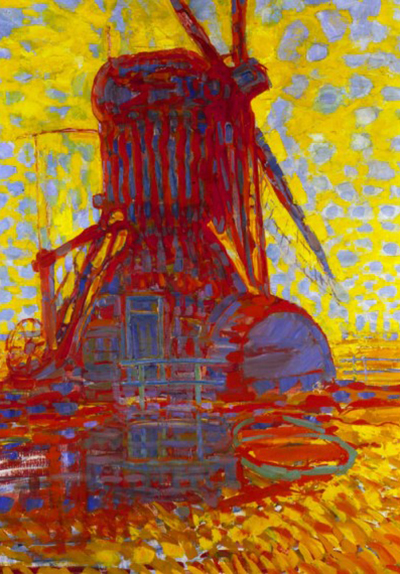
A red and blue windmill rises into a blazing yellow sky. Instead of smoothing the light into a gentle atmosphere, Piet Mondrian set short, vivid strokes beside one another until the building seems to vibrate. Mill in Sunlight, also called Mill in Sunlight: The Winkel Mill, is a 1908 oil painting in Kunstmuseum Den Haag, object 0334288. Its startling colour caused argument when Mondrian showed it in Amsterdam in January 1909. The work is catalogued as A654 in scholarship, and its image and object number distinguish it from a 1917 charcoal work that shares the short title Mill in Sunlight.[1][2][3]
At a glance
- ArtistPiet Mondrian (1872–1944)
- Museum titleMolen (Mill); Mill in sunlight
- Also known asMill in Sunlight: The Winkel Mill
- Date1908
- Catalogue numberA654
- MediumOil on canvas
- Dimensions114.8 × 87 cm in the current museum object record
- CollectionKunstmuseum Den Haag, The Hague
- Object number0334288; bequest of Salomon B. Slijper[1][2][3]
Windmills under changing light
Contents
- What does the painting show?
- Which mill is it?
- Why did its colours cause such a reaction?
- How was it made and how large is it?
- What place does it have in Mondrian's career?
What does the painting show?
The mill's tower stands in the centre, with sails cutting diagonally through the upper part of the view. Red and blue marks build its body. The ground below carries more red, orange and yellow; the sky is largely yellow, broken by blue and pale areas. A low horizon keeps the mill prominent. The painted building is recognisable, but ordinary local colour has been intensified far beyond what a neutral daylight description would require.
 The Red Tree Piet Mondrian.jpg)
The light seems to come from behind and around the structure. The strongest yellow is in the sky, while the mill is saturated red and dark blue. As a result, the viewer experiences a strong contrast before noticing the building's architecture. The sides and openings are indicated with energetic strokes rather than careful finish. That sense of dazzling light is central to the collecting museum's interpretation: it says the intense red and blue against varied blue and yellow are Mondrian's way of showing what it is like to look towards brilliant sunlight.[1]
The foreground matters as much as the sky. Warm strokes spread across the ground and echo the red on the mill, joining the building to its setting. Yellow is not confined to a flat background; it returns in smaller touches beneath the mill. Blue appears in the body, the sky and the ground. The colours therefore interact across the canvas rather than filling three isolated regions.
Which mill is it?
The fuller title identifies the Winkel Mill. The Mondrian Route, a project devoted to places connected with the artist, names the Winkel mill and describes the structure as backlit by a brilliant evening sun. Kunstsammlung Nordrhein-Westfalen's exhibition also uses Mill in Sunlight: The Winkel Mill for this painting. Those sources connect the short English title to a particular mill subject and help separate it from Mondrian's many other windmill views.[2][4]
It is easy to confuse mills because Mondrian returned to the motif at different times and under different conditions. The Oostzijdse Mill in Moonlight has a dark sky and luminous reflections rather than this red mill against hot yellow. The Red Mill is a distinct later canvas. Here the museum inventory 0334288, the 1908 date and the exceptionally bright Winkel image are decisive identifiers.
Another possible collision is within the museum's own catalogue: Kunstmuseum Den Haag has a 1917 charcoal-on-paper work called Mill in sunlight, object 0320967, measuring 105 × 90 cm. That is not the 1908 oil canvas on this page. A search result that gives “Mill in Sunlight” without medium or accession may silently combine the two.[1][5]
Watch: Piet Mondrian
See his studio, the move toward geometric abstraction and the rhythms of his New York paintings.
Piet Mondrian: Abstract Painting as We Know It
Curator Michael White explores the paintings and Mondrian’s studio as an abstract space.
Watch on YouTubeWhy did its colours cause such a reaction?
Mondrian organised a January 1909 exhibition at the Stedelijk Museum, Amsterdam, with his artist friends Cees Spoor and Jan Sluijters. Kunstmuseum Den Haag says that when Mill in Sunlight appeared there, some critics were bewildered by its red, blue and yellow. The museum quotes one critic who could not understand a red-blue-yellow mill and another who described a blood-red mill against a perforated yellow sky. Conrad Kickert, previously more sympathetic to Mondrian's work, was also dismissive. Frederik van Eeden treated the colour as evidence of psychological disturbance.[1]
Not every response was hostile. The writer Israël Querido praised the intensity of the sunlight and the cascade of yellows, vermilion and orange. The museum preserves this contrast between rejection and enthusiasm, rather than presenting the exhibition as a uniformly misunderstood triumph. What the critics disagreed about was visible: could such a violently coloured mill be a convincing way to paint the experience of light?[1]
The disagreement helps us look again. A viewer who expects the literal colour of brick, timber and sky may see only an exaggeration. A viewer who starts from the physical sensation of squinting into strong light may find the colour persuasive. Kunstsammlung NRW explicitly places the painting among Mondrian's early encounters with Post-Impressionism and Fauvism. That context explains the bolder palette without requiring a claim that a single outside artist supplied the exact design.[2]
A Dutch scholarly article traces the exchange further. Querido discussed the painting in De Controleur on 19 May 1909, and Mondrian replied there on 23 October 1909. In that response Mondrian described his wish to keep his work connected to sensory experience while allowing art to lead toward what he called finer, spiritual regions. His own words do not make the mill a fixed symbol with one meaning; they show how he was thinking about the relation between the visible subject and a less material ambition at the time of the painting's first public reception.[8]
How was it made and how large is it?
The museum identifies the work as oil on canvas, 114.8 cm high and 87 cm wide. Some exhibition summaries round the height to 114 cm; the current object record supplies the more precise 114.8 cm. Its tall format suits the vertical tower and long sails. A small reproduction can make the brush marks appear as simple patches, but the physical canvas is more than a metre high.[1][6]
The museum notes that the painting has been restored with financial support from American Express. That public line confirms restoration, but gives no treatment report in the cited page. It would be irresponsible to infer exactly which pigments were cleaned or which passages were repaired. The visible colour and the documented museum interpretation are ample basis for discussing its effect.[1]
The collection credit is a bequest from Salomon B. Slijper, a major Mondrian collector. This is the current institutional home of the object. Museum display arrangements change; the object record and exhibition page are the right places to confirm whether it is hanging on a given visit.[1][6]
What place does it have in Mondrian's career?
This canvas belongs to a period when Mondrian was still painting recognisable Dutch subjects but experimenting with increasingly independent colour and brushwork. Its mill remains a mill, not an abstract sign. Yet the painting asks colour to convey the force of the light rather than merely to label objects. This is why it can look surprising beside earlier, quieter mill scenes.
Fondation Beyeler's exhibition room guide treats Mill in Sunlight as an important example of Mondrian's expressive colour around 1908 and recalls the Amsterdam scandal. It places the work among different phases before his fully abstract compositions. That is a useful frame: the 1908 experiment neither contains a ready-made later grid nor sits outside the artist's development. It shows one of the ways he tested what painting could do while continuing to look at the world.[7]
Mondrian artworks directory
Frequently asked questions
When was Mill in Sunlight painted?
The collecting museum dates the oil canvas to 1908. Its object number is 0334288.[1]
How large is it?
Is it the 1917 charcoal work of the same title?
Where is the painting now?
It belongs to Kunstmuseum Den Haag, from the bequest of Salomon B. Slijper.[1]
Discussion
How does the yellow sky alter the mill’s red?
Reader Insights
Where do red and blue recur in the ground?
What does the strong backlight do to your first impression?
What does the strong backlight do to your first impression?
Join the Conversation
Share what you notice in this painting below.
References
- Kunstmuseum Den Haag, official Molen (Mill); Mill in sunlight object record, 0334288: date, precise size, medium, 1909 reception, interpretation and collection credit. View source.
- Kunstsammlung Nordrhein-Westfalen, Mondrian. Evolution digital exhibition, 1908–11 section, naming the Winkel Mill and explaining expressive colour and contemporary reaction. View source.
- De Gruyter Brill, open-access exhibition inventory listing Mill in Sunlight: The Winkel Mill as catalogue A654. View source.
- Mondrian Route, Winkel Mill location and 1909 reception account. View source.
- Kunstmuseum Den Haag, separate Mill in sunlight charcoal work of 1917, 0320967. View source.
- Kunstmuseum Den Haag, Mondrian & De Stijl exhibition page giving rounded measurements for the 1908 oil canvas. View source.
- Fondation Beyeler, Mondrian exhibition room guide placing Mill in Sunlight among his expressive colour experiments. View source.
- Judit Gera, “Op zoek naar een definitie van het geheimzinnige element x,” Literatuur 16 (1999), pp. 141–42, citing Querido's 19 May 1909 discussion and Mondrian's 23 October 1909 response in De Controleur. View source.
- Lead image credit. Piet Mondrian, Molen (Mill); Mill in sunlight (the Winkel Mill), 1908, oil on canvas, 114.8 × 87 cm, Kunstmuseum Den Haag, 0334288, catalogue A654.