


 by
Tom Gurney
Tom Gurney BSc (Hons) is an art history expert with over 20 years experience
Email:
tomgurney1@gmail.com
/ Phone:
+44 7429 011000
Henri Matisse, Bathers with a Turtle, 1907–08: Introduction
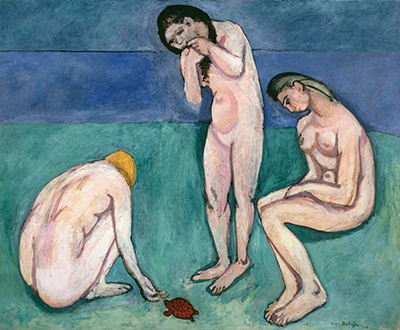
Three nude women share a shore with a tiny shelled creature in Henri Matisse's Bathers with a Turtle. One woman crouches close to it, extending a leaf; another stands with her hands near her mouth; the third sits apart, looking down. Behind them are three broad bands of green and blue. The encounter is simple enough to describe, yet the bathers do not seem to be enjoying a carefree day by the sea. Their separate poses and uncertain expressions make the small animal the focus of a strangely unsettled scene.[1][2]
The Saint Louis Art Museum owns the painting, an oil on canvas measuring 181.6 × 221 centimetres and catalogued 1907–08. The museum places its creation in Paris and reports that Matisse completed it by February 1908. It came to Saint Louis as a 1964 gift from Joseph and Louise Vauclain Pulitzer and is recorded as object 24:1964. Those facts identify a specific painting, distinct from the many other groups of bathers that Matisse drew or painted across his career.[1][2]
At a Glance
- Artist Henri Matisse
- Work Bathers with a Turtle
- Date 1907–08
- Explore Painting
This work across Henri Matisse’s career
Dance (1910)
1910The Red Studio
1911The Piano Lesson
1916The Snail
1953Contents
- What is the little animal doing here?
- How do the three bathers relate to one another?
- Why is the setting made of three bands?
- What can conservation evidence tell us?
- Which earlier works informed the bathers?
- What about the African works Matisse studied?
- Why did early viewers find the painting strange?
- How did it travel from Germany to St. Louis?
- What makes Bathers with a Turtle matter now?
What is the little animal doing here?
The animal sits low between the left and central figures. Its reddish shell and short legs make it small against the human bodies, yet the crouching woman's extended hand directs our attention precisely to it. She seems to offer it a leaf. The title calls it a turtle, while the museum observes that its round shell and short land-going legs make it look more like a tortoise. The discrepancy need not be repaired by changing the painting's established name. It reminds us that a familiar title can be less exact than the image it names; neither the picture nor the museum record establishes a particular species.[2]
The creature changes the meaning of the bather group. Without it, the three women might be read mainly as contrasting figure studies: crouching, standing and seated. With it, each seems to have a different relation to one shared point on the ground. The left woman's hand reaches toward it. The central woman watches or reacts with her hands raised. The sitter turns her head down in its direction but keeps more distance. The animal is a center of attention without becoming a large or spectacular object.
In 1941, Matisse himself described the painting in uncomplicated terms as three women by the sea playing with a turtle. The museum notes that many viewers find the mood melancholy or alienated despite that description. Both statements are worth keeping in view. We can see the gestures but cannot prove an exact narrative: the standing woman's hands may suggest curiosity, alarm or another response, and the seated woman's downward look need not be assigned one feeling. The unresolved mood helps the painting resist the easy expectation that bathers in nature must be relaxed.[1]
How do the three bathers relate to one another?
At left, the crouching bather folds inward. Her back forms a rounded mass, with bent legs tucked close below it. A yellow-orange area near the head catches the eye before the pale body narrows toward the hand reaching down. The posture is concentrated and practical: she can bring the leaf to the animal only by lowering herself almost to the ground. Matisse gives her body weight through broad patches of pink, cream and gray, then holds its edges with darker lines.
The central figure is tall and more exposed. She stands on bare feet, head inclined, arms bent so that her hands press near her mouth or chin. Her vertical body divides the space between the crouching woman and the sitter. Yet she does not become a confident center of a formal group. The face is generalized, the pose oddly tense, and the curved dark hair and hands gather attention near the top while her feet point back toward the animal. The eye moves up and down her figure rather than through a smooth exchange of glances among all three women.
At right, the seated woman forms a second large curve. Her legs angle down and left, while her torso and head bend toward her lap. Her hands lie together instead of reaching toward the turtle. The body fills a broad area of the shore but seems withdrawn from the action. Her pose balances the crouching form on the opposite side, producing two bent bodies around the standing figure. The balance is visual rather than emotional: we cannot know what the three women think from their positions alone.
There are no towels, bathing costumes or other signs of a modern beach outing in the final picture. The women are placed in a setting stripped of individual landmarks. This makes their bodies, the animal and the spaces between them carry almost all the scene's meaning. The unusual combination of closeness and separation is part of what the owner museum calls the work's mystery. The figures occupy one painting but do not form a reassuring circle of shared play.[2]
Why is the setting made of three bands?
The green lower band can be read as grassy shore. Above it, a deep ultramarine strip suggests sea; a cooler blue-green or teal area above that serves as sky. The boundaries are almost horizontal, with very little modelling to create distance. These are cues for a coastal place, yet they do not specify one. Matisse lets broad color planes establish the environment while the bathers sit or stand against them like strong, separate shapes.[1]
That is not how the composition began. Saint Louis Art Museum's 2024 Matisse and the Sea exhibition presented the painting with an earlier Three Bathers, an oil sketch made in Collioure in summer 1907 and now owned by the Minneapolis Institute of Art. The study contains details absent from the Saint Louis canvas: towels, a rock, fishing boats and hills. It also uses warmer beach colors, including red, orange, yellow and green. The three women have related positions, but the two paintings are distinct objects, and the study describes a more particular coastal place.[3][4]
The finished painting was made later in Paris, not painted on the same Collioure beach shown in the study. Matisse could retain the bather arrangement while removing the surrounding evidence of where it was first imagined. The museum's conservation research also found that he painted out clouds, hills and boats and revised the bathers' gestures and positions. This is an important distinction: the spare bands are a decision reached through alteration, not simply a sign that Matisse had never considered a detailed landscape.[5]
The result works at two scales. From across a room, the canvas has a clear, almost diagrammatic structure: shore, sea, sky; croucher, standing figure, sitter. At closer range, the bodies are irregularly painted and the small turtle interrupts the order. The green and blue bands make the scene calm in one sense, while the human forms and their uncertain attention make it uneasy in another. The landscape's simplicity gives the encounter nowhere to hide.
What can conservation evidence tell us?
The museum's technical examination for its 2024 exhibition confirmed that the final composition followed extensive revision. The previous boats, hills and clouds are hidden under later paint, and the three figures were moved and reworked. These findings help explain why the painting is simultaneously spare and labored. Removing a landmark from a canvas that already carries one is a different kind of action from leaving a fresh canvas empty. The polished general effect rests on many local changes.[5]
The museum also published a useful account of its pigment findings. The flesh tones include yellow ochre, burnt umber, lead white and madder lake pink; the large background areas include viridian green and ultramarine blue. These are material identifications from analysis, not a recipe that would reproduce the exact appearance of the painting. Pigment choice, mixing, layering and the color of neighboring areas all affect what the viewer sees. The restrained range is especially striking beside Matisse's reputation for blazing Fauvist color.[3]
The visible dark outlines also matter. They define shoulders, feet and the bends of limbs without making every body anatomically smooth. Some contours seem cut or pressed into the surrounding color; others loosen into broken brushwork. The contrast between the flat bands and the altered, flesh-colored bodies is what gives the scene force. The bathers remain tangible enough to stand and crouch, yet their shapes are allowed to take priority over naturalistic polish.
Technical evidence should not be made to answer every interpretive question. Knowing that a boat was covered does not tell us exactly why Matisse wanted a less specific shore, or what each woman feels about the turtle. It tells us the change was real. The 1907 study, the final canvas and the museum's material findings together support a stronger explanation than a general claim that Matisse painted a simple background because he always preferred flat color.
Watch: Matisse’s art and working methods
Choose a museum film or a close reading to continue exploring Matisse’s work.
Matisse: “For Me It’s Always New”
The Museum of Fine Arts, Boston considers Matisse’s creative practice.
Watch on YouTubeWhich earlier works informed the bathers?
The European tradition of bathers gave Matisse a long-established subject to test. The Saint Louis exhibition placed Paul Cézanne's Three Bathers of 1879–82 near the Matisse. Matisse had bought that Cézanne canvas in 1899 and kept it close as an important work. Cézanne grouped three female nudes beside water within a structured landscape, with trees framing the bodies. The museum presents it as a probable influence, not as a template Matisse copied figure for figure. In Bathers with a Turtle, the triad remains, but the forest and river setting has given way to broad sea bands and an unexpected small animal.[3]
The museum also drew attention to Aristide Maillol's Crouching Woman with Crab, a small bronze of a nude bending toward an animal on the ground. Maillol was Matisse's older friend and worked near him on the Mediterranean coast. The similarity to the left figure in Bathers with a Turtle is specific: a squatting body directed toward a small creature. The exhibition says Matisse may have seen and drawn from Maillol's sculpture. The Met dates the model around 1900–04, with the documented bronze cast by 1924, so the possible influence concerns a pose or model available earlier, not a later cast that could only have been seen after Matisse finished the painting.[3][6]
Matisse's own sculpture supplies another comparison. The Saint Louis Museum's Decorative Figure survives as a bronze cast in 1954 from a design made in 1908. Its record says a clay model was in Matisse's studio while he was painting Bathers with a Turtle and may have affected the seated woman at right, especially the hand pressed between the legs. The surviving bronze is a later cast; that date must not be confused with the presence of an earlier clay model. Looking between painting and sculpture shows Matisse studying bent limbs and the mass of the female figure across two media.[7]
These comparisons are valuable because they are different in kind. Cézanne offered a painted tradition of bathers; Maillol offered a compact sculptural pose involving a person and animal; Matisse's own model explored bodily weight and gesture. None explains the whole Saint Louis painting. Its deliberate mix of sources is more revealing than a search for one original that would settle every line.
What about the African works Matisse studied?
The 2024 Saint Louis exhibition also placed the canvas alongside sculptures made by artists from several African societies. Curator Simon Kelly connects the central figure's hands-near-mouth pose and elongated, angular limbs with works Matisse collected or saw. In particular, a pair of Baga D'mba figures from Guinea may have informed the upright bather's pose. The exhibition also discusses a Pende Giwoyo mask from what is now the Democratic Republic of the Congo that belonged to Matisse and may relate to his treatment of the standing face. These are carefully qualified visual connections, not proof that he transcribed a particular object directly onto the canvas.[3][8]
The original purposes of these works matter. The museum explains the Baga figures in relation to D'mba ceremonial values and the Pende mask as an object worn in dances connected with ancestors. Such objects were made by artists within particular communities, with functions that a European painter collecting them did not necessarily understand. Kelly explicitly situates Matisse's access to African art within colonial power relations and notes that he often responded to form rather than original context. A page about his painting should name that gap instead of flattening varied African traditions into an anonymous style.[3][8]
The visual evidence remains compelling when stated with that care. The central bather's head and hands form a compact, unusual gesture, unlike a relaxed seaside pose. Her limbs are stretched and simplified rather than softly modelled throughout. Those decisions can be compared with the sculptural figures identified by the museum. But the women in the painting have their own relation to the turtle and to the three-color shore; this scene is Matisse's new composition, not a document of the African objects' original stories.
Why did early viewers find the painting strange?
Completed by February 1908, the painting was unusual even among Matisse's experiments. American critic Gelett Burgess, after seeing it in Matisse's studio that year, responded with a joking complaint about its ugliness, while other modernist viewers recognized its originality. The museum's report of those reactions tells us that the tension between the ideal of beautiful bathers and the awkwardness of these forms was visible from the start. It should not be converted into a simple story in which everyone first hated the work and only later understood it.[2]
The scene challenges several expectations at once. Traditional bathers might appear amid lush nature or clear water. Here the shore is a band, and the water is another band. Three nudes share a space but do not converse or move together. The central figure's fingers near her mouth resist an easy interpretation, while the turtle draws serious attention out of proportion to its size. The color is bold but comparatively cool. The picture keeps the familiar subject and removes much of what would make it reassuring.
Matisse also valued the work. According to Saint Louis Art Museum's history, his dealer Félix Fénéon asked what price to seek, and Matisse named 3,000 francs, the highest price he had yet set for a painting. German collector Karl Ernst Osthaus, founder of the Museum Folkwang in Hagen, acquired it in 1908 at a reduced price of 2,500 francs. A painting that seemed difficult to one critic was thus also treated by artist, dealer and collector as a major work. Its early museum destination helped give it an audience beyond Matisse's studio.[2]
How did it travel from Germany to St. Louis?
The first public chapter was the Museum Folkwang in Hagen. After Osthaus died, the museum and painting moved to Essen. The Saint Louis object record gives the transfer period as 1922–1937. In August 1937, the Nazi government confiscated the canvas from the museum under its campaign against art it called “degenerate.” That seizure was a coercive removal from a public collection, not an ordinary sale or an artist's decision to move the work.[1]
The painting then appeared at the Galerie Fischer sale in Lucerne on 30 June 1939, where Joseph Pulitzer Jr. and Louise Vauclain Pulitzer acquired it through Matisse's son Pierre, acting as their agent. The museum records it as lot 93 and states that the Pulitzers gave it to Saint Louis Art Museum in 1964. Its journey therefore includes the earlier German collection, Nazi confiscation, a forced-disposal auction, private American ownership and a later museum gift. Each stage belongs to the painting's history; the wartime sale should not be presented as a routine provenance link without its context.[1][2]
The museum reports that Pulitzer later described a moral conflict about purchasing at the Nazi-organized sale: buying sent money to a regime he opposed, while refusing might leave works at risk. His stated motive was to preserve them. That recollection helps explain the collector's own understanding of the decision, but it does not undo the circumstances of confiscation. The work's current presence in a museum is inseparable from the dislocation that took it from Essen in the first place.[2]
What makes Bathers with a Turtle matter now?
The painting joins several kinds of experiment in one image. Its three female bodies test the bather tradition Matisse knew from Cézanne. The left crouch, central gesture and seated twist show him studying form through drawing and sculpture. Its sky, sea and shore are made from great color bands that suppress a more detailed 1907 setting. Technical findings make that reduction tangible; the final atmosphere remains open to viewers, even after Matisse's own playful account and the museum's more melancholy reading are placed side by side.[1][3]
To look again, find the turtle first. Follow the offered leaf up to the crouching bather, then move to the central hands and the seated figure's downward gaze. Only after tracing that circuit step back and notice the three horizontal bands behind everyone. The small encounter and the enormous simplified seascape pull in different directions. Their unresolved relation is what makes this more than a conventional scene of women bathing.
Matisse continued to revisit bathers, including in the much later Bathers by a River, a different, multi-year canvas. The Henri Matisse artist page and paintings directory place both works within his broader career.
Explore 113 Matisse artworks
This directory covers the 113 individual works explored in these articles, rather than a complete catalogue of Matisse’s output. Cut-paper designs and prints appear under Drawing in the medium filter; each row names its form. Dates retain the qualifications explained in the linked articles.
Discussion
Look again at the images and ideas explored in Henri Matisse, Bathers with a Turtle, 1907–08. These editorial prompts invite your observations.
Reader Insights
What is the little animal doing here?
Which comparison discussed in the article helps you see the work differently?
How do the materials and historical setting affect your reading?
Join the Conversation
Share a detail, comparison or question about Henri Matisse, Bathers with a Turtle, 1907–08 below.
References
- Saint Louis Art Museum , Bathers with a Turtle , object 24:1964, owner facts, interpretive note and documented provenance. View source .
- Saint Louis Art Museum , “Pioneering or strange? Bathers with a Turtle stars in Matisse exhibition”, completion date, reception, sale, confiscation and Pulitzer history. View source .
- Saint Louis Art Museum , Matisse and the Sea accessible exhibition labels, related study, other works, African objects and pigment findings. View source .
- Minneapolis Institute of Art , Three Bathers , 1907, distinct 1907 oil study, accession 61.36.14. View source .
- Saint Louis Art Museum , Matisse and the Sea exhibition press notice, conservation findings on revised figures and earlier landscape. View source .
- Metropolitan Museum of Art , Aristide Maillol, Crouching Woman with Crab , separate sculpture, model and cast date. View source .
- Saint Louis Art Museum , Henri Matisse, Decorative Figure , clay model and 1954 bronze cast distinction. View source .
- Saint Louis Art Museum , curator Simon Kelly Q&A, visual influences and qualified colonial context. View source .






 Henri Matisse.jpg)
