


 by
Tom Gurney
Tom Gurney BSc (Hons) is an art history expert with over 20 years experience
Email:
tomgurney1@gmail.com
/ Phone:
+44 7429 011000
Venus by Henri Matisse: the figure made by an opening: Introduction
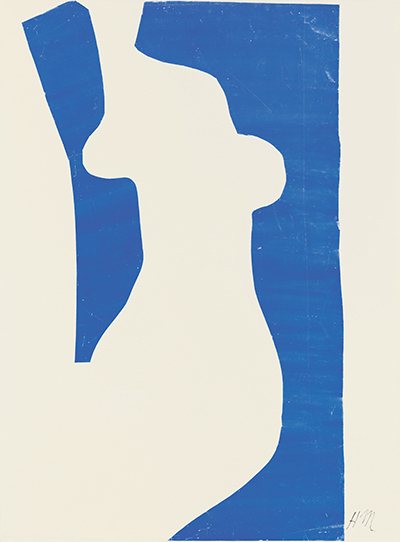
Henri Matisse's Venus invites a small reversal of attention. At first, a white female figure seems to stand against a strong blue field. Look again and the blue field resolves into two separate pieces of painted paper. Their inward edges make the neck, shoulders, breasts, waist and hip of the white form between them. Matisse has made the body visible by shaping what lies beside it. The blue pieces are as active as the figure they surround. [1]
The original belongs to the National Gallery of Art in Washington. It is dated 1952 , and the museum describes it as gouache on paper, cut and pasted on white paper and mounted on a paper panel. Its overall size is 101.2 × 76.5 centimetres. These are the dimensions of a substantial vertical work, though much smaller than the wall-wide cut-outs Matisse was also developing. The artist's initials, “HM,” appear near the lower right. MoMA's 2014 exhibition checklist gives the same date, dimensions and National Gallery accession, 1973.18.2. [1] [2]
At a Glance
- Artist Henri Matisse
- Work Venus
- Date 1952
- Explore Cut paper and drawing
This work across Henri Matisse’s career
Dance (1910)
1910The Red Studio
1911The Piano Lesson
1916The Snail
1953Contents
- Where is the figure?
- What do the blue papers contribute?
- Why does Venus appear beside The Parakeet and the Mermaid?
- How does it differ from the Blue Nudes?
Where is the figure?
The white body is neither a blue silhouette nor a separately pasted white body laid over blue. Its outline is made by the sides of the two blue sheets. The left sheet begins with an angled top, narrows and then swells outward at the level of the left breast. Below it, the inward line bends toward the waist before widening away again. The taller sheet on the right has a broad, almost level top. Its cut edge travels inward around the head and neck, presses out for the right breast, then recedes to define a long waist and the rising curve of a hip. The sheets do not meet. The unpainted paper between them remains open all the way down. [1]
That openness makes the body unusually hard to pin down as a solid object. The neck and chest are legible, yet the figure has no face, arms or drawn internal anatomy. Below the waist, the white area widens generously to the right, while the blue on the left stops much earlier. The lower body seems to turn or lean, but there is no stable stance to read in the usual way. A viewer can recognise a female torso immediately and still have to trace the paper edges to see how it has been formed. The body is both a presence and a space left between things. [1]
The asymmetry matters. If the two sides matched, they might read as a neat blue frame around a centred white emblem. Instead, the left top tilts; the right begins broadly; one side ends near the hip while the other continues to the bottom. The white figure has a narrow upper section and an expansive lower curve, but it is pulled unevenly by the blue at either side. The eye moves back and forth between the two cut edges, continually joining them into a body. This visual work by the viewer gives an apparently simple composition its tension. [1]
The title Venus suggests a classical female figure. Nothing in the museum's short record, however, identifies a particular episode from the goddess's story. There is no shell, setting or narrative action here. Matisse has kept the idea of a body and a title while removing most descriptive cues. Rather than invent a myth scene, it is more useful to attend to the way the cut edges make a figure from a white interval. [1]
Watch: Matisse’s art and working methods
Choose a museum film or a close reading to continue exploring Matisse’s work.
Matisse: The Cut Outs
Tate introduces its exhibition devoted to Matisse’s cut-paper work.
Watch on YouTubeWhat do the blue papers contribute?
The blue is not merely a backdrop. It sets the width of the body at every point, and its two pieces do different jobs. On the left, a shorter, more irregular form closes in around the upper torso and then releases it. On the right, a larger continuous field supplies the long inward curve at the waist and the great outward sweep of the hip. The body could be read as the central subject, but the blue has to be read as a pair of cut shapes in its own right. Their outer edges, rectangular tops and unequal bottoms keep the material construction visible. [1]
The National Gallery's description notes horizontal strokes in the painted blue paper. They can also be seen in the existing image: the colour has slight bands and changes in density rather than the uniform surface of a printed poster. The paper was painted with gouache before being cut. Its colour and cut contour therefore come together in the finished image, but they remain material events: paint lies on paper, and paper has been shaped and attached to another paper surface. This is why calling Venus simply a blue-and-white drawing would miss something essential about it. [1] [3]
Matisse's late cut-out practice often involved painted sheets, scissors and provisional arrangements on studio walls before final mounting. MoMA documents that general method and the movement of shapes in the studio. The National Gallery records how this particular work exists now: cut and pasted on white paper, mounted on a paper panel. Those sources do not give a full sequence of individual cuts, pins or revisions for Venus . The visible result is enough to explain its striking economy. A few contours make colour, line and body at once. [3] [1]
Why does Venus appear beside The Parakeet and the Mermaid?
One documented studio episode gives Venus a second setting. MoMA identifies it in a 1952 photograph of Matisse's Hôtel Régina studio, placed in the clearing of the developing Parakeet and the Mermaid . The photograph also shows Blue Nude II and Standing Blue Nude among the figures being tried there. MoMA explains that Matisse experimented with several forms in this open part of the wall composition before choosing the mermaid for its final version. [4]
This is more specific than a vague claim that the works “influenced” one another. Venus had a visible temporary place in a changing studio arrangement. Its white figure and blue surroundings were tested against a much larger field of coloured leaves, fruits and a bird. The final mermaid is a different figure. The photograph records a trial, not proof that Venus was cut from the completed mural or that it must be read as a preparatory fragment of it. The separate mounted work now in Washington retains its own identity. [4] [1]
The episode also changes how we see the empty space inside Venus . In isolation, the cream-white ground around the two blue pieces gives the body a clean, quiet setting. On the studio wall, the same compact form could be assessed among more crowded shapes at a very different scale. MoMA's photographs of the changing Parakeet show that placement was part of Matisse's thinking. His pieces could be moved and judged in relation to a surrounding composition before an arrangement became final. Venus lets us see that process without confusing a trial position with the finished destination of the object. [4]
How does it differ from the Blue Nudes?
The related Blue Nude works make a useful comparison because they also use blue gouache-painted paper to find the human figure. The Metropolitan Museum of Art dates its Standing Blue Nude to 1952 and describes six separate blue pieces building a frontal body. Its curator connects the work with a number of female-body variations from the same period. In that example, the blue pieces themselves are the body against the surrounding white. In Venus , the body is principally the white interval between blue papers. The colour relationship has been reversed. [5] [1]
That distinction prevents a misleading label. Venus is not Blue Nude II or Standing Blue Nude under another title, even though all three were tried in the same 1952 studio clearing. MoMA's checklist gives each a separate entry and object history. The works share a way of simplifying the female form, but their material solutions differ. In Standing Blue Nude , several fragments meet as a blue figure. In Venus , two areas of blue produce a white figure by staying apart. The latter asks the viewer to read a gap as a body. [2] [4] [5]
The National Gallery records Venus in its collection after a 1973 purchase through the Pierre Matisse Gallery from Vie des Arts Est. in Geneva. Its exhibition history includes the 1961–62 travelling exhibition of Matisse's large cut gouaches and the 2014–15 Henri Matisse: The Cut-Outs exhibition. That history shows the work has been viewed both as a separate object and within the wider late cut-out practice. It does not require us to treat it as merely an accessory to a larger work. [1]
Explore 113 Matisse artworks
This directory covers the 113 individual works explored in these articles, rather than a complete catalogue of Matisse’s output. Cut-paper designs and prints appear under Drawing in the medium filter; each row names its form. Dates retain the qualifications explained in the linked articles.
Frequently Asked Questions
The museum describes two pieces of blue-painted paper attached to a white paper support. Their facing cut edges create the abstracted white figure between them. The finished assembly is mounted on a paper panel; the white form reads as a figure because of the blue contours around it. [1]
It belongs to the National Gallery of Art, Washington, accession 1973.18.2. The museum's object record is the current source for its collection and display information. [1]
Follow the edge of the blue sheet on the right from neck to hip, then return along the shorter left edge. The two lines do not enclose a conventional drawn figure; they make the white paper feel bodily. For the wider method, see the cut-outs guide . The biography places this 1952 experiment among Matisse's late work, while the artist home offers a route through his earlier changes in colour and figure. [1]
Discussion
Look again at the images and ideas explored in Venus by Henri Matisse: the figure made by an opening. These editorial prompts invite your observations.
Reader Insights
Where is the figure?
Which comparison discussed in the article helps you see the work differently?
How do the materials and historical setting affect your reading?
Join the Conversation
Share a detail, comparison or question about Venus by Henri Matisse: the figure made by an opening below.
References
- National Gallery of Art , “Venus,” collection record, accession 1973.18.2. View source .
- Museum of Modern Art , Henri Matisse: The Cut-Outs (2014), object checklist (PDF), p. 29. View source .
- Museum of Modern Art , “Henri Matisse: The Cut-Outs,” process overview, 2014. View source .
- Museum of Modern Art , “Henri Matisse: In the Studio”, 2014, Nice studio section. View source .
- Metropolitan Museum of Art , “Standing Blue Nude,” collection record, object 2002.456.58. View source .






 Henri Matisse.jpg)
