 by
Tom Gurney
Tom Gurney BSc (Hons) is an art history expert with over 20 years experience
Email:
tomgurney1@gmail.com
/ Phone:
+44 7429 011000
Henri Matisse, The Serf: an early sculpture in bronze: Introduction
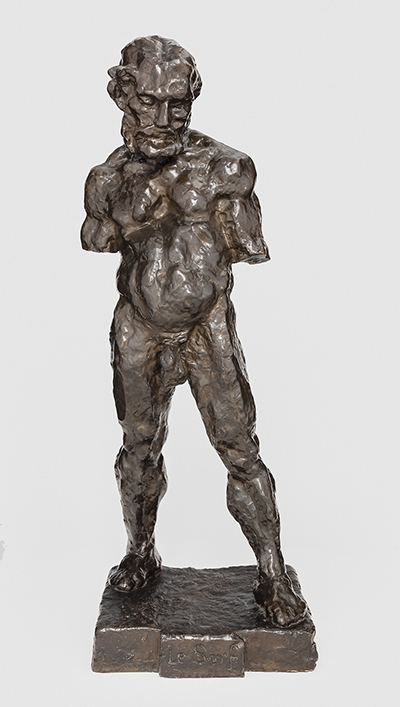
Henri Matisse's The Serf is a standing male nude whose weight seems to gather in the torso. The head is lowered, the chest and abdomen are heavily worked, and the arms stop above the elbows. Light catches small rises and depressions across the bronze instead of gliding over a smooth anatomical surface. This was one of Matisse's sustained early experiments with a figure in the round: a person made from changing masses that can be seen from more than one side.[1][2]
The Museum of Modern Art (MoMA) dates its The Serf to Paris, 1900–04. Other collection records, including SFMOMA's, describe the original modelling as 1900–03. These ranges reflect different ways of cataloguing work that Matisse developed over several years. The surviving bronzes also have individual histories: SFMOMA dates its cast to before 1929, and the Art Institute of Chicago identifies another cast as about 1908. The date of the model and the date of a particular metal object should be read separately.[1][2][3]
At a Glance
- Artist Henri Matisse
- Work The Serf
- Date 1900–04
- Explore Sculpture
This work across Henri Matisse’s career
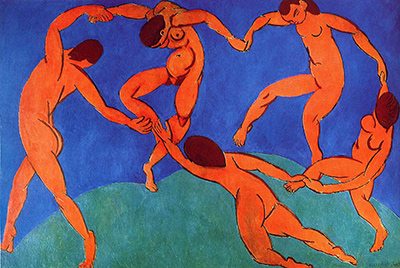
Dance (1910)
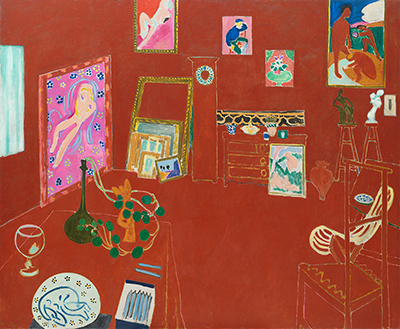
1910The Red Studio
1911The Piano Lesson
1916The Snail
1953Contents
- What does The Serf show?
- Why is the surface so rough?
- Who was the model?
- How does it relate to Male Model?
- What was Matisse's relation to Rodin?
- Which bronze is being described?
- Where can I explore it further?
What does The Serf show?
The figure stands on a low rectangular base, with one foot placed farther forward and outward than the other. The legs hold up a broad, irregular trunk. His neck and head bend slightly down, bringing the face toward the chest; a beard and hair give the head a dense, shadowed outline. The arms are shortened, leaving the shoulders and upper limbs as powerful forms without hands to gesture or complete a narrative action. This is an observed bodily arrangement, not an illustration of a named event.[1]
From the front, the stance can first look still. The feet resist that impression. One leg appears more firmly planted while the other stretches diagonally to the side, so the body's weight does not fall in a perfectly symmetrical column. The abdomen pushes forward. Shoulder, chest and hip shift against each other. As a viewer moves around a freestanding bronze, those relationships would change: a mass that looks broad from the front can narrow in profile, and depressions on the chest or back catch light differently. The available photographs establish the front clearly but cannot replace a full walk around a particular cast.
The base helps stabilize this complicated pose. Its straight edges create a measured platform beneath a body whose outline is anything but regular. A leg descends into the base on each side, making the figure appear firmly set despite its unsettled upper body. The contrast matters: Matisse did not need the man to take a dramatic step to give the sculpture force. Slight changes in the balance of head, chest and feet make the body feel active while it remains standing.
Why is the surface so rough?
SFMOMA describes Le Serf as a work whose broken, lumpy surface differs from ordinary anatomical imitation. Across the image, small ridges, pits and compressed planes are visible on the chest, stomach, thighs and face. The forms do not line up into a clean diagram of named muscles. They build a body from increments of mass, so reflected light helps describe its shape. The result is vigorous, but the precise surface of an individual bronze can also depend on its casting and finish.[2]
Look at the chest. It is broad, yet its two sides do not form a polished pair. Raised and recessed patches interrupt the expected symmetry. The abdomen, rather than being flattened into a smooth transition below the ribs, projects as a rounded and heavily handled volume. The legs are narrower but remain rough. This variation draws attention through the body: face, shoulders, chest and belly become successive concentrations of worked material. The body reads as a whole because these masses remain connected, not because every surface has been anatomically corrected.
The roughness also changes how the figure meets light. A smooth bronze could make the contour and pose do most of the work. Here tiny high points brighten while hollows stay dark. In a photograph, that can resemble a pattern of pale and dark marks; in the actual object, it is relief on metal. The distinction helps explain why the sculptures guide asks readers to notice model, plaster and cast as separate stages. A reproduction shows one lit view of one physical object. It does not establish every mark in the original clay or prove that all later casts have identical patinas.[2]
Who was the model?
Museum accounts identify the sitter as an Italian model known as Bevilacqua. SFMOMA says he had also posed for Auguste Rodin; Bordeaux's museum calls him Pignatelli, alias Bevilacqua, and describes him as a man from the Abruzzo region. The Baltimore Museum of Art links this sitter to both Matisse's sculpture and the painted Male Model. These records ground the figure in a working relationship between artist and professional model. They do not prove that the sculpture records the man's occupation or feelings, nor that its title identifies his social position.[2][4][5]
Matisse's engagement with the model was prolonged. Baltimore says he worked on the sculpture for at least three years; SFMOMA reports that there may have been as many as five hundred modelling sessions. That second number is best understood as the museum's qualified account, not a verified attendance ledger. Its value is in conveying how far the sculpture is from a quick study. Matisse repeatedly reconsidered what he saw, while the standing figure remained the central problem.[2][4]
The sitter appears in works that ask different questions. Bordeaux's Portrait de Bevilacqua is a painted head; MoMA's Male Model is a larger oil-on-canvas standing nude from around 1900. The Serf is a modelled body that occupies space. The Bordeaux museum and the French national object record disagree on the exact date of the small portrait, so it is safest here to use it as evidence of an identified sitter rather than force it into a precise sequence with the sculpture.[5][6]
Watch: Matisse’s art and working methods
Choose a museum film or a close reading to continue exploring Matisse’s work.
Illuminating Matisse's Creative Process: A Painter as Sculptor
A museum lecture on Matisse’s work in three dimensions.
Watch on YouTubeHow does it relate to Male Model?
MoMA catalogues Male Model as an oil on canvas, about 1900, measuring 99.3 × 72.7 cm. Baltimore's cross-media exhibition explicitly brought it together with The Serf. Looking at the two as related studies of the same sitter makes the difference between media especially clear. In paint, colour and strokes establish a body on a flat plane. In sculpture, the body has actual depth; light and the viewer's position alter its appearance.[4][6]
The connection should not make the painting a mere preparatory diagram. MoMA treats Male Model as a finished painting in its own right, with its own date and collection number. Nor can a painting tell us exactly what happened to a bronze's surface during casting. The productive question is more specific: how did Matisse keep bodily weight convincing while moving from marks on canvas to masses in three dimensions? In The Serf, the chest and belly project physically. A leg's angle must work from the side as well as the front. The surface catches real light rather than simulating it with pigment.
The comparison also helps place the sculpture before the colour experiments for which Matisse is often most familiar. It was developed at the start of the century, several years before his celebrated Fauvist canvases of 1905. Treating it as a study of body, mass and material gives it a place in his early career without making every feature a direct anticipation of a later painting. The Male Model page follows that other object on its own terms.
What was Matisse's relation to Rodin?
SFMOMA and Baltimore both describe a connection with Auguste Rodin. The model Bevilacqua had worked for Rodin, and SFMOMA notes that Matisse studied Rodin's sculpture and visited his studio. Rodin's approach to the fragment is a useful visual comparison. The Musée Rodin explains that The Walking Man was assembled around 1899–1900 from torso and leg studies related to Saint John the Baptist. An early version was shown in 1900 without a head or arms. Its absence of limbs concentrated attention on a striding body.[2][7]
The Serf is not The Walking Man with a new title. Matisse kept the head and brought the missing arms to a different point on the body. His figure feels more rooted than Rodin's striding one; the head turns down toward a heavy torso rather than vanishing from it. SFMOMA makes the surface distinction as well: Rodin's interrupted anatomy and Matisse's uneven, built-up masses create different effects. The comparison describes related problems that both sculptors faced; it does not settle exactly when or why the forearms of Matisse's model disappeared.[2][7]
That uncertainty matters. The photograph clearly shows the shortened arms, and later bronze records describe an armless standing man. The museum sources used here do not establish one universally accepted story of an accident or a deliberate cut. An explanation of the change would need stronger evidence than the visible result alone. What can be read with confidence is the resulting formal effect: the shoulders become broad endpoints, and the viewer's attention returns to the torso and stance rather than following hands into an action.
Which bronze is being described?
“The Serf” names a sculptural conception, but museums hold different casts. MoMA's bronze is 553.1956, 92.3 × 34.5 × 33 cm, with a current catalogue date of 1900–04 and no casting year specified there. SFMOMA's 50.6095 measures 91.7 × 37.8 × 33 cm and was cast before 1929. The Art Institute of Chicago identifies its bronze as cast about 1908. The French national record describes a Musée Matisse, Nice, bronze numbered 7/10, made by the Valsuani foundry, without supplying an exact casting year. These are not four names for one movable object.[1][2][3][8]
For a reader, this is more than bookkeeping. A cast has a founder, an edition mark or inscription if recorded, a measured size, a finish and a collection history. The mould and casting process preserve the sculptural form, but an object's surface and patina can differ between examples. If a photograph is not securely matched to a collection record, it is safest to identify the subject as The Serf without assigning that image to MoMA, SFMOMA, Chicago or Nice. The reproduction supports the visual reading of the form; its exact cast remains unverified.
The sculpture's title, too, needs restraint. Le Serf is the French title, usually translated The Serf. Nothing in the museum object records establishes that Bevilacqua literally was a serf, or that the figure depicts a documented episode of servitude. The title may affect how a viewer experiences the lowered head and heavy body, but it is not a biography of the sitter. The reliable story of this object is Matisse's early, long-worked investigation of a standing human form.
Where can I explore it further?
Begin with the museum records for the particular cast that interests you. MoMA's page provides its dimensions and collection number; SFMOMA's adds an interpretive account and its cast date; the Art Institute and Nice records document other examples. A photograph shows the figure's front, but a museum visit or multiple authenticated views can reveal what its shoulders, back and legs do in space. Collection ownership also does not guarantee a bronze is currently on display.[1][2]
Within this Matisse collection, the sculptures guide places The Serf beside later models and casts. La Serpentine offers a contrasting, turning figure from 1909; the Écorché study shows a different early exercise in sculptural anatomy. Each asks how a body can be organised. The Serf makes that question unusually tangible through its rough, weight-bearing surface and the long span of work behind its apparently simple standing pose.
Explore 113 Matisse artworks
This directory covers the 113 individual works explored in these articles, rather than a complete catalogue of Matisse’s output. Cut-paper designs and prints appear under Drawing in the medium filter; each row names its form. Dates retain the qualifications explained in the linked articles.
Frequently Asked Questions
The missing forearms are part of the form seen in the bronzes. The owner records used here do not establish a single settled cause or exact date of removal. The visual result concentrates attention on the shoulders, torso and stance.
Discussion
Look again at the images and ideas explored in Henri Matisse, The Serf: an early sculpture in bronze. These editorial prompts invite your observations.
Reader Insights
What does The Serf show?
Which comparison discussed in the article helps you see the work differently?
How do the materials and historical setting affect your reading?
Join the Conversation
Share a detail, comparison or question about Henri Matisse, The Serf: an early sculpture in bronze below.
References
- The Museum of Modern Art , The Serf , object 553.1956. View source .
- San Francisco Museum of Modern Art , Le Serf , object 50.6095. View source .
- Art Institute of Chicago , collection listing of The Serf , 1900–03, cast c.1908. View source .
- Baltimore Museum of Art , Matisse: Painter as Sculptor exhibition account. View source .
- Musée des Beaux-Arts de Bordeaux , Portrait de Bevilacqua . View source .
- The Museum of Modern Art , Male Model , object 377.1975; French Ministry of Culture, Bordeaux Portrait de Bevilacqua catalogue record. View source 1 . View source 2 .
- Musée Rodin , The Walking Man ; Musée Rodin, fragments and assemblages account. View source 1 . View source 2 .
- French Ministry of Culture , Musée Matisse Nice Le Serf , object 63.2.102. View source .
 Henri Matisse.jpg)