


 by
Tom Gurney
Tom Gurney BSc (Hons) is an art history expert with over 20 years experience
Email:
tomgurney1@gmail.com
/ Phone:
+44 7429 011000
The Fall of Icarus by Henri Matisse: a figure held between flight and descent: Introduction
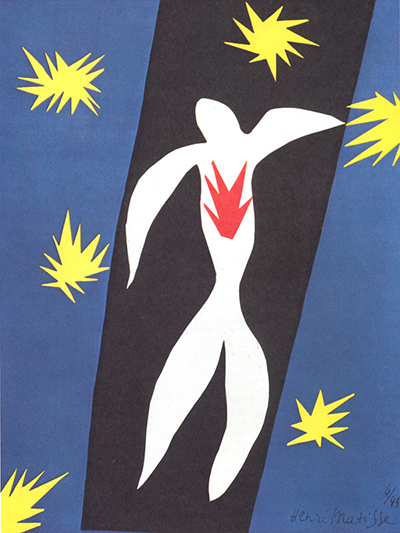
A white figure seems to drift down a slanting black column in Henri Matisse's The Fall of Icarus ( La Chute d’Icare ). Deep blue lies on either side. Jagged yellow bursts interrupt it, and a red shape strikes across the figure's chest. The title recalls the Greek story of the youth who flew too near the sun and fell when his wings failed. Yet the cut-paper figure has no visible wings, sea or horizon. Matisse lets colour and direction carry the drama in this 1943 work. [1] [2]
At a Glance
- Artist Henri Matisse
- Work The Fall of Icarus
- Date 1943
- Explore Cut paper and drawing
This work across Henri Matisse’s career
Dance (1910)
1910The Red Studio
1911The Piano Lesson
1916The Snail
1953Contents
- What makes the figure seem to fall?
- What do the surviving pins tell us?
- Is this the Icarus from Jazz?
- Why can the yellow shapes feel threatening?
What makes the figure seem to fall?
The body is stretched diagonally, with one arm swept outward and the legs tapering toward the lower edge. Its white shape stands out sharply from the black strip beneath it. That strip tilts through the centre rather than making a stable floor. Blue remains visible on both sides, so the body seems suspended in a passage through space. Nothing shows the exact instant when flight turns into a fall. The figure could appear to float for a moment before its downward pull becomes clear. [1]
The yellow bursts sit at different heights around the figure. Their pointed edges contrast with the long, smooth curves of the white limbs. They may first read as suns or stars in a dark sky. The red cut over the torso introduces a sharper, more bodily note: it points down and inward while the limbs open out. These few colours make the movement easy to grasp from a distance, but they also leave the cause and meaning of the fall open to interpretation. [1]
The work was made from gouache-painted paper that Matisse cut and arranged with pins. The 2026 Centre Pompidou and Grand Palais exhibition describes surviving pins in this original, now in a private collection. They are a reminder that the image began as movable pieces, not painted outlines on a continuous canvas. The exhibition gives its size as 36 × 26.5 centimetres: a small sheet capable of suggesting a wide, unstable sky. [1]
Watch: Matisse’s art and working methods
Choose a museum film or a close reading to continue exploring Matisse’s work.
Matisse: The Cut Outs
Tate introduces its exhibition devoted to Matisse’s cut-paper work.
Watch on YouTubeWhat do the surviving pins tell us?
Pins are unusually consequential here because the Centre Pompidou and Grand Palais identify this as one of the few cut-outs that still retains them. A pinned shape could be shifted while Matisse tested its relation to the other pieces. The white body, black diagonal and yellow bursts therefore record an arrangement made through placement, rather than an image drawn once in a fixed outline. The pins do not tell us the order of every adjustment, and the surviving work should not be treated as an unfinished sketch merely because its fastenings remain visible. They make the physical decisions behind its apparent weightlessness easier to imagine. [1]
That material fact sharpens the scene. The falling body seems to move, but every fragment is held in place on a small sheet. Its limbs nearly touch the black passage without merging with it, while the blue intervals on either side keep the figure exposed. Looking closely at the spaces around the paper pieces changes the question from “what happened to Icarus?” to “how can a few separate shapes hold a body in midair?” The instability belongs to the subject and to the way the composition was assembled. [1]
Is this the Icarus from Jazz?
Matisse returned to Icarus for his illustrated book Jazz , but its plate VIII uses a different design. In the 1947 print recorded by the National Gallery of Art, the figure is black against a blue field, with a small red circle on its chest and yellow star-like shapes nearby. The page shown here instead has a white body over a long black column and a larger red mark. The 2026 exhibition explicitly distinguishes the two compositions. [1] [3]
The material objects differ too. MoMA's 2014 checklist lists the privately held Fall of Icarus as a 1943 cut-and-pasted work with pins. In a separate entry it identifies Icarus , the cut-paper maquette for Jazz plate VIII, in the Centre Pompidou collection. That maquette led to the 1947 pochoir, or stencil print. A shared myth and related visual signs do not make the 1943 Fall , the Jazz maquette and the printed plate interchangeable. [2] [3]
Why can the yellow shapes feel threatening?
The Centre Pompidou and Grand Palais exhibition recounts Louis Aragon's reading of the yellow splashes as bursting shells and the figure as a downed aviator. That interpretation places the work in the darkness of the Second World War, when it was made. The pointed shapes and red chest mark allow that reading, while the mythological title still invites stars, sunlight and the ancient story of a disastrous flight. The image holds those possibilities together; it need not be reduced to a single coded message. [1]
Its first intended setting also matters. Pompidou's account describes Matisse making La Chute d’Icare for the frontispiece of an issue of the art journal Verve . The 2026 exhibition links the proposed reproduction to the 1945 issue. Matisse drew on an earlier ballet-curtain study as he developed the cut-paper figure. The composition therefore belongs to the experiments in moving bodies and illustrated pages that surrounded Jazz , while retaining its own image and history. [1] [4]
Explore 113 Matisse artworks
This directory covers the 113 individual works explored in these articles, rather than a complete catalogue of Matisse’s output. Cut-paper designs and prints appear under Drawing in the medium filter; each row names its form. Dates retain the qualifications explained in the linked articles.
Frequently Asked Questions
The 2026 Centre Pompidou and Grand Palais exhibition lists the 1943 Fall of Icarus as a private-collection loan. The Centre Pompidou holds the separate Jazz Icarus maquette. [1] [2]
Look once more at the contrast between the white body's open reach and the black path beneath it. The story is ancient, but the paper shapes keep its outcome unsettled in the present tense. The cut-outs guide explains Matisse's working method, the Clown page opens the Jazz sequence, and the artist home places these experiments in his larger career. [1]
Discussion
Look again at the images and ideas explored in The Fall of Icarus by Henri Matisse: a figure held between flight and descent. These editorial prompts invite your observations.
Reader Insights
What makes the figure seem to fall?
Which comparison discussed in the article helps you see the work differently?
How do the materials and historical setting affect your reading?
Join the Conversation
Share a detail, comparison or question about The Fall of Icarus by Henri Matisse: a figure held between flight and descent below.
References
- Centre Pompidou and Grand Palais , Matisse 1941–1954 , English exhibition press kit, p. 14. View source .
- Museum of Modern Art , Henri Matisse: The Cut-Outs , object checklist, pp. 4, 6. View source .
- National Gallery of Art , Icarus , plate VIII from Jazz , 1980.8.8. View source .
- Centre Pompidou , Le clown , catalogue analysis of the Verve and Jazz projects. View source .






 Henri Matisse.jpg)
