


 by
Tom Gurney
Tom Gurney BSc (Hons) is an art history expert with over 20 years experience
Email:
tomgurney1@gmail.com
/ Phone:
+44 7429 011000
Henri Matisse, L'Écorché, after Puget, 1903: Introduction
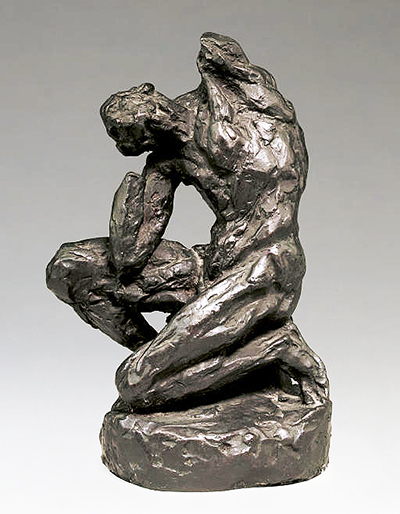
Henri Matisse's L'Écorché, after Puget shows a seated male figure whose body twists over bent legs. The head turns and dips; one arm presses down while the other rises toward the chest. The rough, compact form is easier to understand when its title is explained. An écorché is a flayed figure used to study the structure of muscles beneath the skin. Matisse made this model in 1903 as a free interpretation of an anatomical studio sculpture, according to the Fitzwilliam Museum and the Museum of Modern Art's sculpture catalogue. [1] [2]
The figure Matisse copied was believed at the time to be by Michelangelo and was later attributed to Pierre Puget , the seventeenth-century French sculptor. That history explains the modern “after Puget” title. It does not mean Puget made Matisse's model or that the original attribution is beyond question. The copying was an exercise in looking, modelling and reshaping a pose, not a mechanical reproduction of a known masterpiece. [1] [3]
At a Glance
- Artist Henri Matisse
- Work L'Écorché, after Puget
- Date 1903
- Explore Sculpture
This work across Henri Matisse’s career
Dance (1910)
1910The Red Studio
1911The Piano Lesson
1916The Snail
1953Contents
- What makes the pose difficult to read?
- Was this bronze cast in 1903?
- What can a later bronze show about the original model?
- How did the studio prop become a painted object?
- Why does this sculpture appear in paintings of aubergines?
What makes the pose difficult to read?
The body does not face us squarely. One knee is drawn up, the other leg turns beneath the torso, and the shoulders twist away from the hips. The lowered head and bent arms make a knot of forms at the top and left. The rough rock under the figure has its own broken surface. In the photograph, highlights catch ridges along the back, chest and thighs while dark gaps open between the limbs. The eye has to circle the figure mentally to work out how its parts join.
That effort is part of the value of an anatomical figure. The exposed muscular structure gives the sculptor a way to study how a bent torso might carry weight and movement. MoMA's 1972 catalogue calls the Matisse work a free copy of a standard studio prop. “Free” matters: the sculpture concentrates on the force of the turn and the uneven, worked surface, rather than offering a polished lesson in labelled muscles. It belongs to a period in which Matisse was studying sculpture as well as painting. [2]
Was this bronze cast in 1903?
1903 dates the original model, not every bronze made from it. The Fitzwilliam Museum owns one bronze, M.1-2001 , numbered HM 8/10 and cast by the Valsuani Foundry at an unknown date after 1903 . Its 2001 bequest by Humphrey Whitbread is the history of that particular cast. The museum describes a brown-patinated figure and records the sculpted bronze at 22.8 cm high , apart from its separate tall marble column. [1]
Other numbered casts have different records. MoMA's 1972 exhibition catalogue listed a 2/10 example then in the Joseph H. Hirshhorn Collection. A Christie's catalogue describes a 7/10 Valsuani bronze cast in 1958 . These edition marks and dates should not be blended into a single object biography. The photograph shows the composition on a low base but no readable edition number and no Fitzwilliam marble column; it does not establish which cast was photographed. [2] [3]
Watch: Matisse’s art and working methods
Choose a museum film or a close reading to continue exploring Matisse’s work.
Illuminating Matisse's Creative Process: A Painter as Sculptor
A museum lecture on Matisse’s work in three dimensions.
Watch on YouTubeWhat can a later bronze show about the original model?
The Fitzwilliam cast preserves the folded pose and the worked surface of the 1903 model, but its museum record cannot turn the bronze's unknown casting date into the date of Matisse's first act of modelling. A cast is an object with its own material history. Its brown patina, edition mark and later bequest belong to the Fitzwilliam example; another numbered cast may share the form while having a different foundry date and ownership trail. Reading those details separately is especially important here because the photograph does not show a legible edition mark. The safest visual claim is about the figure's composition, not the identity of the photographed cast. [1] [3]
The small size also changes how the pose is experienced. The Fitzwilliam records a bronze figure only 22.8 centimetres high, excluding its column. A viewer can imagine turning around such a compact object, discovering how a bent knee meets the torso and how the rough base supports the body's twist. A single photograph freezes one view; the sculptural problem unfolds around the figure. MoMA's description of the work as a free copy helps explain why the muscle study is more than a diagram: Matisse made a compact, forceful arrangement that asks to be read from several sides. [1] [2]
How did the studio prop become a painted object?
When the plaster model reappears in the 1911 aubergine pictures, it has changed jobs. An anatomical example copied for study becomes one object among others in a room Matisse is composing. The Fitzwilliam and MoMA identify two separate paintings, so its recurrence is documented rather than guessed from a vague resemblance. In the large Grenoble interior, it joins patterns and furnishings; in the distinct still life now at MoMA, it enters a closer arrangement. The bronze casts are later ways of encountering the sculptural form, while the paintings record Matisse's own decision to use the plaster within pictorial work. That gives the écorché a small but traceable afterlife across media. [1] [2] [4]
Why does this sculpture appear in paintings of aubergines?
Matisse did not leave the écorché behind as a classroom exercise. The Fitzwilliam and MoMA record that its plaster model appears in two of his 1911 paintings: Grenoble's Interior with Aubergines and a distinct Still Life with Aubergines . In the large Interior with Aubergines , a made object joins the flowers, screen, table and other parts of the painted room. The sculpture becomes something Matisse can arrange and look at again through painting. [1] [2]
The old MoMA catalogue names Mrs Bertram Smith as the owner of the separate aubergine still life. MoMA's current record shows that it entered the museum through the Louise Reinhardt Smith bequest in 1995 . The historical owner name is therefore part of the painting's provenance, not its present location. Neither aubergine canvas is the sculpture itself, and neither gives us the casting date of the bronze in this page's photograph. [2] [4]
This small, tightly folded body differs from the standing mass of Matisse's The Serf , another sculpture developed in the early 1900s. Both show his interest in weight and form, but the sources do not establish that one was a preparatory study for the other. For the wider range of his three-dimensional work, see the sculptures directory . Here, the essential distinction remains between a 1903 model and the individual later casts through which viewers encounter it today. [2]
Explore 113 Matisse artworks
This directory covers the 113 individual works explored in these articles, rather than a complete catalogue of Matisse’s output. Cut-paper designs and prints appear under Drawing in the medium filter; each row names its form. Dates retain the qualifications explained in the linked articles.
Discussion
Look again at the images and ideas explored in Henri Matisse, L'Écorché, after Puget, 1903. These editorial prompts invite your observations.
Reader Insights
What makes the pose difficult to read?
Which comparison discussed in the article helps you see the work differently?
How do the materials and historical setting affect your reading?
Join the Conversation
Share a detail, comparison or question about Henri Matisse, L'Écorché, after Puget, 1903 below.
References
- Fitzwilliam Museum , L'Écorché, d'après Puget , M.1-2001, owner record, model/cast distinction and painting references. View source .
- Museum of Modern Art , Alicia Legg, The Sculpture of Matisse (1972), discussion of the free copy and catalogue entry for the Hirshhorn cast. View source .
- Christie's , L'écorché d'après Puget , HM 7/10, 2005 catalogue entry for a distinct 1958 cast and its attribution history. View source .
- Museum of Modern Art , Still Life with Aubergines , 782.1995, current owner record and Smith provenance for the distinct 1911 painting. View source .






 Henri Matisse.jpg)
