


 by
Tom Gurney
Tom Gurney BSc (Hons) is an art history expert with over 20 years experience
Email:
tomgurney1@gmail.com
/ Phone:
+44 7429 011000
White Alga on Orange and Red Background by Henri Matisse: Introduction
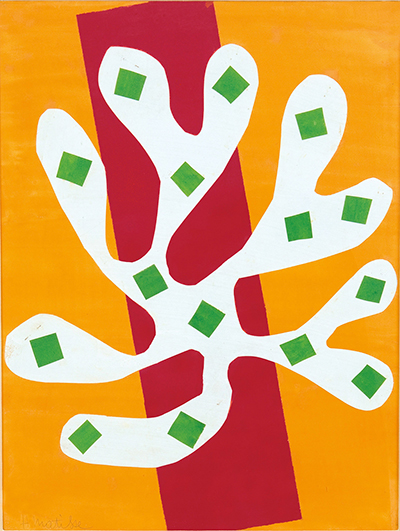
Henri Matisse's White Alga on Orange and Red Background centres on one cut white shape. Its broad base sends narrow branches to the left, right and upward, with rounded ends that spread across an orange field. A red band stands behind it, slightly tilted and narrower than the branching form. Small green squares interrupt the white. The title suggests a sea plant, but the image works without a drawn sea: contrast between white, orange, red and green gives the form its energy. [1] [2]
At a Glance
- Artist Henri Matisse
- Work White Alga on Orange and Red Background
- Date 1947
- Explore Cut paper and drawing
This work across Henri Matisse’s career
Dance (1910)
1910The Red Studio
1911The Piano Lesson
1916The Snail
1953Contents
- How does the white form fill the picture?
- When and how was it made?
- Is there another White Alga?
- What changes when the related alga changes colour?
How does the white form fill the picture?
The white shape nearly reaches every side. Near the top, two upright arms split around a notch of red, then widen into rounded tips. On the right, a branch bends out toward the edge before turning upward. Lower branches stretch left and right, and one curves toward the bottom border. These changes of direction make the form feel as if it grows through the rectangle. Yet its outline also has the firmness of a cut piece: each bend is a choice of contour, not a softly painted transition. [2]
The orange field remains visible in large pockets between the arms. It is especially open at the upper corners, so the white does not become a solid screen over the whole surface. The red band offers a second background inside the orange one. As branches cross it, the white looks brighter; where they reach the orange, the contrast changes. The red runs past the white at top and bottom, holding the tall arrangement together without making a conventional tree trunk or shoreline. [2]
The green marks are small, tilted squares placed across the white branches. They interrupt what could otherwise be a single uninterrupted silhouette. Their even colour repeats across different parts of the branching shape, drawing the eye from tip to tip. The square cut contrasts with the rounded white ends: a few straight edges sharpen a picture dominated by curves. Green may recall plant colour, but the marks are also independent pieces of a colour pattern. Nothing in the image requires them to represent an exact botanical feature. [2]
Watch: Matisse’s art and working methods
Choose a museum film or a close reading to continue exploring Matisse’s work.
Matisse: The Cut Outs
Tate introduces its exhibition devoted to Matisse’s cut-paper work.
Watch on YouTubeWhen and how was it made?
MoMA's 2014 exhibition checklist dates this cut-out to 1947 and gives the medium as gouache on paper, cut and pasted . Its dimensions are 52.5 × 40.5 centimetres. The colour fields and branching figure were therefore assembled from painted papers, rather than painted as one continuous image. The title's French form, Algue blanche sur fond orange et rouge , names both the white motif and the two background colours. [1]
MoMA's account of Matisse's Vence studio describes how he could move and pin cut forms before deciding how to keep them. The museum's interactive view of the Vence wall identifies this 1947 work among the cut-outs associated with that setting. Those sources give a useful working context, though they do not show every step by which this particular set of white, green, red and orange pieces reached its final arrangement. [3]
Is there another White Alga?
Yes. MoMA reproduced White Alga on Red and Green Background beside this orange-and-red version. Both are dated 1947 and both are recorded at 52.5 × 40.5 centimetres. The related work puts a white branching figure over red and green, with red accents inside the white, rather than this work's orange field, red band and green square accents. Fondation Beyeler's current record confirms that the red-and-green work is in its collection. The matching dimensions and related titles invite a close comparison, but the two are distinct physical cut-outs with different collection histories. [1] [2] [4]
The 2014 MoMA checklist credited this orange-and-red work to Mr. and Mrs. Donald B. Marron, New York. That is a historical exhibition credit, not a current location for the original. It should not be replaced with Fondation Beyeler's ownership of the red-and-green version. [1] [4]
What changes when the related alga changes colour?
The two White Alga compositions offer a controlled comparison. MoMA's catalogue places the orange-and-red sheet beside the red-and-green sheet at the same recorded size. In this one, a white branch crosses a narrow red band while orange extends beyond it. In the other, red and green divide the background in a different way. A white contour can therefore remain the principal event even as the colours around it change its apparent weight and warmth. The comparison concerns two documented works, not a sequence proving which design Matisse preferred or completed first. [1] [2]
Try following only the orange spaces between the white arms. They form irregular channels, widest near the corners and narrower where branches approach one another. The eye can then switch to the red strip, which passes behind the white and makes the middle feel denser than the margins. The green squares interrupt that denser passage without behaving like a painted shadow. This gives the image several scales of looking: the branching silhouette at a distance, the two-colour ground within it, and the small angular accents up close. Its apparent simplicity depends on those separate relationships remaining legible. [2]
Explore 113 Matisse artworks
This directory covers the 113 individual works explored in these articles, rather than a complete catalogue of Matisse’s output. Cut-paper designs and prints appear under Drawing in the medium filter; each row names its form. Dates retain the qualifications explained in the linked articles.
Frequently Asked Questions
They are visible accents set within the white branches. They repeat the colour of plant life without describing leaves, spores or another precise structure. Their straight edges set up a contrast with the rounded white lobes. [2]
No. MoMA catalogues it as an individual 1947 cut-and-pasted paper work, separate from the maquettes and printed plates of Jazz . The cut-outs guide follows the broader method, and the artist home places these late experiments within Matisse's career. [1]
Return to the white shape's branching outline. It reaches into nearly every part of the rectangle, but the orange gaps keep each turn of the cut edge visible. The work's subject is a sea plant by title; its force comes from what the pieces of colour do together.
Discussion
Look again at the images and ideas explored in White Alga on Orange and Red Background by Henri Matisse. These editorial prompts invite your observations.
Reader Insights
How does the white form fill the picture?
Which comparison discussed in the article helps you see the work differently?
How do the materials and historical setting affect your reading?
Join the Conversation
Share a detail, comparison or question about White Alga on Orange and Red Background by Henri Matisse below.
References
- Museum of Modern Art , Henri Matisse: The Cut-Outs , object checklist, p. 15. View source .
- Museum of Modern Art , Henri Matisse: The Cut-Outs , catalogue preview, printed pp. 140–41 and catalogue list. View source .
- Museum of Modern Art , “In the Studio”, Vence section, and Vence wall explorer. View source 1 . View source 2 .
- Fondation Beyeler , Algue blanche sur fond rouge et vert , owner record for the separate red-and-green cut-out. View source .






 Henri Matisse.jpg)
