


 by
Tom Gurney
Tom Gurney BSc (Hons) is an art history expert with over 20 years experience
Email:
tomgurney1@gmail.com
/ Phone:
+44 7429 011000
The Codomas by Henri Matisse: a trapeze act in cut colour: Introduction
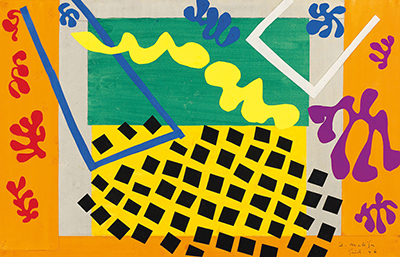
In Henri Matisse's The Codomas ( Les Codomas ), two yellow shapes seem to travel through the air above a dark lattice. Angular bars lean in from either side; violet forms gather near the right edge. The scene recalls a trapeze act without drawing performers in anatomical detail or fixing a single moment of flight. Bright orange, green, blue and purple press against the suspended yellow. Matisse made the design for plate XI of his illustrated book Jazz , first as cut paper and later as a colour stencil print. [1] [2]
At a Glance
- Artist Henri Matisse
- Work The Codomas
- Date 1943; inscribed July 1946
- Explore Cut paper and drawing
This work across Henri Matisse’s career
Dance (1910)
1910The Red Studio
1911The Piano Lesson
1916The Codomas by Henri Matisse: a trapeze act in cut colour (current article)
1943; inscribed July 1946The Snail
1953Contents
- Who were the Codomas?
- What is the black pattern below?
- Is the date 1943, 1946 or 1947?
- How does it fit into Jazz?
- Why does a circus memory carry tension?
Who were the Codomas?
The Metropolitan Museum of Art identifies the title as Matisse's remembered version of the Flying Codonas, a celebrated trapeze act of brothers active in the early twentieth century. The unusual spelling belongs to the artwork; changing it to the performers' name would obscure what Matisse called the picture. The Met reads two irregular yellow forms in the upper part of the design as the airborne acrobats. Their bodies are suggested through colour and movement rather than faces, costumes or a carefully drawn apparatus. [2]
Two angular structures reach toward the central space. Between and beneath them, yellow curls across a green field. The yellow shapes can seem to bridge the gap between trapezes, while the hard blue and pale bars make the gap measurable. That contrast gives the composition its suspense: the performers have left a secure point, yet the image does not tell us where they will land. The eye makes the crossing repeatedly, following the yellow forms over the dark pattern below. [1] [2]
What is the black pattern below?
Small black quadrilaterals form a dense, slanting lattice across the lower half. The Met offers two readings: it may be a safety net, or it may suggest seats in the theatre. Both fit the high viewpoint implied by the aerial act. Neither is confirmed by a detailed architectural setting. Matisse gives the viewer enough pattern to sense the space beneath the performers, then leaves its exact construction unresolved. [2]
At the right, violet forms curl and bunch against the orange border. According to the Met, Matisse described them as clowns watching the somersaults. They are compressed into an energetic mass rather than shown as individually recognisable people. Smaller coloured flourishes on the margins keep the eye circling the scene. Pompidou's account of Jazz notes how plant-like shapes entered some of its circus subjects. Here those lively forms can suggest a world of spectators and decoration without turning the page into a literal record of one performance. [2] [3]
Watch: Matisse’s art and working methods
Choose a museum film or a close reading to continue exploring Matisse’s work.
Matisse: The Cut Outs
Tate introduces its exhibition devoted to Matisse’s cut-paper work.
Watch on YouTubeIs the date 1943, 1946 or 1947?
The Centre Pompidou owns the original maquette: gouache-painted papers cut and pasted on paper mounted on canvas, 43.5 × 67.1 centimetres, inventory AM 1985-315 (11). Its ink inscription reads “H.Matisse/Juill.46,” and the museum's object label uses July 1946. MoMA's 2014 exhibition checklist dates the same Codomas maquette to 1943. Pompidou's catalogue explains that some Jazz designs made in 1943 or early 1944 were signed and dated in 1946 while the book was being prepared. The records therefore document an early design phase and a later inscription, without identifying the first day every paper shape was cut. [1] [4]
The printed Jazz plate is a different physical object, published in 1947 using pochoir stencils. The National Gallery of Art owns one colour-stencil example as plate XI; the Met owns another. Printed colour carries the design into a book that could have multiple copies, while the Pompidou maquette retains the assembled cut pieces of Matisse's original. A photograph may make the two look alike, so date, medium and collection should follow the particular object being described. [1] [2] [5]
How does it fit into Jazz?
Jazz moves among circus memories, travel, stories and invented forms across twenty plates. Centre Pompidou identifies The Codomas as one of the circus images where more flowing, plant-like shapes enter the design. It sits apart from the cut lettering of The Circus and the lone floating figure of The Clown . In The Codomas , risk is shared across the airborne yellow performers, the watching violet clowns and the possible net or audience below. The whole sheet participates in the act. [2] [3]
Why does a circus memory carry tension?
The Met situates the Jazz circus subjects in the years of the Second World War. Its interpretation holds two experiences in view: danger and deprivation in wartime, and recollections of entertainment from a more open public life. The Codomas makes that overlap especially plausible because a trapeze act is joyful precisely while it is risky. The black pattern beneath the flyers might promise a net, or it might be a crowd of seats awaiting their landing. The page never supplies enough information to resolve the safety of the act. This is the Met's curatorial reading of the image and its moment, rather than evidence that Matisse encoded a specific wartime event in each shape. [2]
Notice how the eye is denied a resting place. The yellow figures hover over a tilted dark field; pale bars and blue uprights draw attention to the surrounding apparatus; violet clowns crowd the edge. A conventional narrative picture might show a departure, a catch and the spectators' response in separate stages. Here they seem compressed into one arrangement. The performers' route has to be reconstructed by the viewer, and it changes each time the yellow shapes are followed across the page. That is why the net-or-seats ambiguity matters visually: it determines whether the lower field feels protective, watchful or precarious, even while its individual marks remain the same. [2]
Explore 113 Matisse artworks
This directory covers the 113 individual works explored in these articles, rather than a complete catalogue of Matisse’s output. Cut-paper designs and prints appear under Drawing in the medium filter; each row names its form. Dates retain the qualifications explained in the linked articles.
Frequently Asked Questions
It can be read that way. The Met also suggests theatre seats, and the picture does not label the pattern more precisely. [2]
The original maquette is in the Centre Pompidou's Musée national d'art moderne collection. Prints from the 1947 book are held separately by institutions including the National Gallery of Art and the Met. [1] [2] [5]
Look again at the yellow forms above the black lattice. Their path remains open, held for an instant among colour, apparatus and spectators. The cut-outs guide explains the material method, and the artist home sets this book project within Matisse's longer career. [1]
Discussion
Look again at the images and ideas explored in The Codomas by Henri Matisse: a trapeze act in cut colour. These editorial prompts invite your observations.
Reader Insights
Who were the Codomas?
Which comparison discussed in the article helps you see the work differently?
How do the materials and historical setting affect your reading?
Join the Conversation
Share a detail, comparison or question about The Codomas by Henri Matisse: a trapeze act in cut colour below.
References
- Centre Pompidou , Les Codomas , original Jazz maquette and catalogue analysis, AM 1985-315 (11). View source .
- Metropolitan Museum of Art , The Codomas , plate XI from Jazz , 1983.1009(11). View source .
- Centre Pompidou , Jazz , collection dossier. View source .
- Museum of Modern Art , Henri Matisse: The Cut-Outs , object checklist, p. 7. View source .
- National Gallery of Art , The Codomas , plate XI from Jazz , 1980.8.11. View source .






 Henri Matisse.jpg)
