 by
Tom Gurney
Tom Gurney BSc (Hons) is an art history expert with over 20 years experience
Email:
tomgurney1@gmail.com
/ Phone:
+44 7429 011000
Two Dancers by Henri Matisse: a curtain study made with movable paper: Introduction
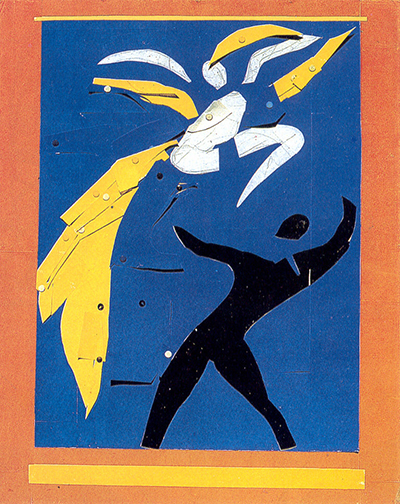
In Henri Matisse's Two Dancers ( Deux danseurs ), a dark figure stands wide-legged near the bottom of a blue field, arms raised toward a second figure that seems to fly across the top. White and yellow pieces give the lifted body a sudden burst of movement. The orange border holds both figures inside a stage-like rectangle. This is a 1937–38 study for the curtain of Léonide Massine's ballet Rouge et Noir , not the finished curtain itself. [1] [2]
At a Glance
- Artist Henri Matisse
- Work Two Dancers
- Date 1937–38
- Explore Cut paper and drawing
This work across Henri Matisse’s career
Dance (1910)
1910The Red Studio
1911The Piano Lesson
1916The Snail
1953Contents
- How do the two dancers move together?
- Why are pins still visible?
- Which ballet was the study for?
- How did this theatre experiment feed later work?
How do the two dancers move together?
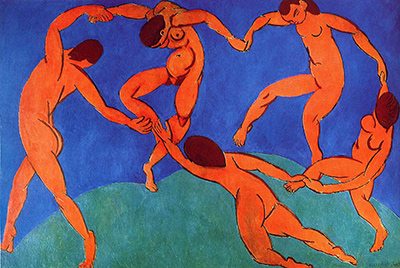
The lower dancer's black legs make a firm, open base. One arm reaches across the blue; the other rises at the right edge, close to the lifted figure. Above, white bent limbs, yellow strips and blue pieces overlap, making it difficult to isolate every joint at first glance. That difficulty adds speed. The upper body seems to twist and leap while the darker one steadies the encounter below. Their positions create a vertical exchange across the picture rather than the circular chain of dancers in Matisse's earlier Dance . [1] [2]
The blue field is more than empty space around the figures. It appears between their limbs and behind the yellow pieces, giving the airborne dancer room to move. The orange edge supplies a clear outer limit, like the frame of a stage. A yellow bar near the bottom repeats the warm colour of the flying figure, so the eye travels from the lower border back up through the action. Matisse uses a few large colour relations to make a complicated bodily movement readable from a distance. [1]
The meeting of the two bodies can also suggest a struggle. Centre Pompidou's catalogue cautiously proposes that Matisse drew on studies he had made in 1935 after Pollaiuolo's Hercules and Antaeus , turning the close, wrestling pair into a dance. That is a scholarly interpretation, not a label for the two performers on stage. What the study itself shows is a tension between a grounded black figure and a pale figure lifted into the blue. [1]
Why are pins still visible?
The original is made of gouache-painted paper pieces, cut and pinned, with graphite on card mounted on a frame. Small dark pinheads can be seen among the shapes. MoMA's curator Samantha Friedman points to the surviving thumbtacks and layers as evidence of how Matisse built and adjusted the flying figure. The paper was not simply cut once and fixed in its final place: pins let him try a position, remove a piece and alter the relationship between the dancers. [1] [3]
Centre Pompidou connects this working method to the coloured paper Matisse used while planning the large dance panels for the Barnes Foundation in the early 1930s. In both projects, movable shapes helped him test bodies in motion at a decorative scale. Here, the surviving study makes that experimental stage unusually visible. Later cut-outs could become independent finished works; this piece still has a specific job as a proposal for a ballet curtain. [1] [2]
Watch: Matisse’s art and working methods
Choose a museum film or a close reading to continue exploring Matisse’s work.
Matisse: The Cut Outs
Tate introduces its exhibition devoted to Matisse’s cut-paper work.
Watch on YouTubeWhich ballet was the study for?
The owner record calls it a study for the stage curtain of Rouge et Noir . Centre Pompidou's teaching account also uses the name L’Étrange Farandole for Massine's project. MoMA says the ballet premiered in 1939 , after this 1937–38 design work. Those names explain the dance subject and intended theatrical setting; the painted-paper study is a different object from the curtain seen in performance. [1] [2] [3]
The Pompidou original measures 80.2 × 64.5 centimetres and entered the national collection by dation in 1991. MoMA's exhibition catalogue lists a second Two Dancers curtain study from 1937–38, only 63 × 64.5 centimetres and in a private collection at that time. Their shared title and ballet do not make their materials, sizes or collection histories interchangeable. The image here corresponds to the taller Pompidou version, with its blue field, orange border and many pinned pieces. [1] [4]
How did this theatre experiment feed later work?
Centre Pompidou treats the ballet designs as part of the route toward Matisse's later paper practice. Its account of Jazz says he returned to earlier studies for Massine's curtain when preparing the first book plates, including The Clown and The Toboggan . It also connects a ballet figure study to the white body of The Fall of Icarus . These links do not make Two Dancers a plate from Jazz ; they show that movable paper figures first tried for a stage could become a store of poses and relationships for later pages. A dancer's leap, an acrobat's flight and Icarus's descent can share a language of cut limbs while serving different subjects. [1] [2]
The staging of this sheet helps explain that continuity. Its orange border holds a compact blue field, yet the flying figure seems to test that limit. The lower dancer acts as a visual counterweight: without the dark, planted legs, the upper body might look like an isolated fragment. The pins show that Matisse could alter the distance between them and with it the sense of lift. In a theatre study, this was a practical way of finding a dramatic arrangement. In the later cut-outs, the same freedom to move pieces could sustain an independent work. The surviving Two Dancers lets us see both the immediate stage problem and a method that proved more broadly useful. [1] [3]
Explore 113 Matisse artworks
This directory covers the 113 individual works explored in these articles, rather than a complete catalogue of Matisse’s output. Cut-paper designs and prints appear under Drawing in the medium filter; each row names its form. Dates retain the qualifications explained in the linked articles.
Frequently Asked Questions
No. This pinned ballet study dates to 1937–38. Centre Pompidou describes the ballet experiments as part of the earlier work that helped Matisse develop the cut-paper language he later used for Jazz . The cut-outs guide follows that change across his career. [1]
Look once more at the pins around the raised dancer. They make the leap feel both energetic and provisional: a moment of movement assembled from pieces that Matisse could still move. The artist home places this theatre project alongside his larger search for expressive colour and form.
Discussion
Look again at the images and ideas explored in Two Dancers by Henri Matisse: a curtain study made with movable paper. These editorial prompts invite your observations.
Reader Insights
How do the two dancers move together?
Which comparison discussed in the article helps you see the work differently?
How do the materials and historical setting affect your reading?
Join the Conversation
Share a detail, comparison or question about Two Dancers by Henri Matisse: a curtain study made with movable paper below.
References
- Centre Pompidou , Deux danseurs , AM 1991-280, owner record and Anne Coron's catalogue analysis. View source .
- Centre Pompidou , Deux danseurs teaching account. View source .
- Museum of Modern Art , Two Dancers audio transcript, 2014 exhibition. View source .
- Museum of Modern Art , Henri Matisse: The Cut-Outs , catalogue preview, list of exhibited works. View source .
 Henri Matisse.jpg)