


 by
Tom Gurney
Tom Gurney BSc (Hons) is an art history expert with over 20 years experience
Email:
tomgurney1@gmail.com
/ Phone:
+44 7429 011000
Beasts of the Sea by Henri Matisse: a vertical world of cut colour: Introduction
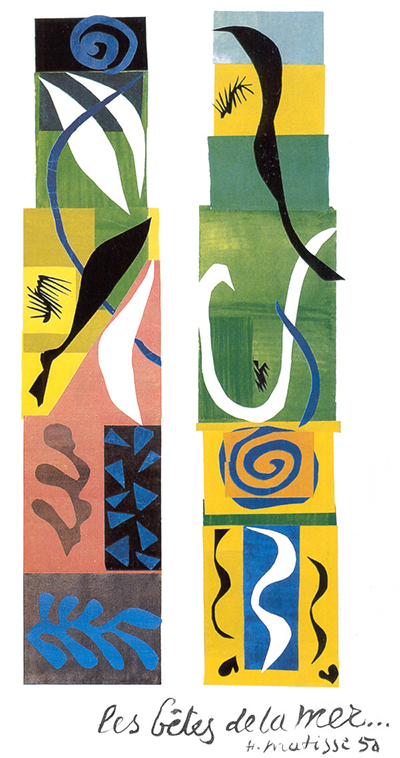
Henri Matisse's Beasts of the Sea puts a sea world into two tall columns. Blocks of black, green, yellow, pink, grey and blue stand one above another. Across them move blue spirals, dark curves, white slivers and leaf-like shapes. A viewer may find a fish, seaweed or a flash of life in the water, but the work does not turn every cut piece into a named creature. Its force comes from the meeting of a steady rectangular structure with forms that seem free to curl and swim through it. [1]
The National Gallery of Art in Washington owns the original. It dates the work to 1950 and records gouache-painted paper cut and pasted on white paper, mounted on canvas. The overall height is 295.5 centimetres and the width 154 centimetres: almost three metres high, much taller than a book illustration. Matisse wrote its French title, les bêtes de la mer , across the bottom and signed and dated it nearby. The inscription anchors the subject, while the forms themselves leave room for recognition and uncertainty. [1]
At a Glance
- Artist Henri Matisse
- Work Beasts of the Sea
- Date 1950
- Explore Cut paper and drawing
This work across Henri Matisse’s career
Dance (1910)
1910The Red Studio
1911The Piano Lesson
1916The Snail
1953Contents
- What do the two columns do?
- Which shapes are sea creatures?
- How was it made, and where does it sit in the cut-outs?
What do the two columns do?
The left and right stacks have different rhythms. At the top left a blue spiral sits over a dark block; a long blue curve descends through green and across a lighter middle area. White pointed forms cut into the coloured field. Lower down, a dark shape resembles a fish in profile, while a pink section and a blue branching form pull the eye toward the bottom. The right column begins in cooler and warmer rectangular zones, but a tall black S-like cut shape crosses several of them. A white U-shaped form and a blue line push through green, with an orange spiral turning near the lower yellow and blue blocks. [1]
The stacked blocks could have made the work rigid. Instead, each crossing curve asks the eye to continue beyond the edge of one rectangle into the next. A blue line moves through several colours without changing its own identity. A dark form interrupts both green and yellow. This makes the columns feel like a setting through which things pass, rather than two separate diagrams. At the same time, the strong horizontal joins remain visible. The picture holds movement and structure together instead of hiding one under the other. [1]
Colour does not behave as a naturalistic map of ocean depth. Pink, yellow and black interrupt the greens and blues. They may suggest changing reflections or currents, but the work is not an attempt to reconstruct a measurable underwater scene. Each large rectangle has a colour presence of its own; each organic piece can change character when it passes into another field. The orange spiral near the lower right seems especially lively because it lies against blue and near yellow. The sea appears through relationships of cut shapes and colour, not through a horizon, shore or painted perspective. [1]
Which shapes are sea creatures?
The National Gallery's visual description cautiously calls one narrow black form fish-like and other pieces perhaps seaweed. That caution is useful. The title licenses a marine reading, and a curling line can resemble an eel or a plant moved by water. Yet Matisse has simplified these forms enough that a confident species list would tell a false story about the picture. A pointed profile, a spiky cluster and a spiral may evoke different kinds of underwater life without each being an illustration of a particular animal. The viewer can move between looking for creatures and looking at how the cuts work as shapes. [1]
The blank spaces are part of this reading. White slivers appear within the left column, and a larger pale U shape opens inside the right. Against a block of colour, white can feel like a glint, a current or the gap around a body. It also keeps the darker forms from joining into one heavy mass. The cut-out method makes such openings unusually direct: the contour of a piece and the unfilled space beside it are decided together. A small change to an edge could change what the neighbouring white seems to do. [1] [2]
At the bottom, the written title makes the composition look almost like a field study presented for reading. But the line is Matisse's own inscription, not a label identifying the pieces one by one. It gives the viewer a phrase to carry upward through the two columns. The work can be seen as sea plants and animals, or as a set of signs for moving water and life, while remaining visibly made of painted paper. The pleasure lies partly in how little literal detail is needed to make that imagined environment present. [1]
Watch: Matisse’s art and working methods
Choose a museum film or a close reading to continue exploring Matisse’s work.
Matisse: The Cut Outs
Tate introduces its exhibition devoted to Matisse’s cut-paper work.
Watch on YouTubeHow was it made, and where does it sit in the cut-outs?
Matisse's late cut-out practice used sheets painted with gouache, then cut into shapes and arranged before a final mounting. MoMA's account describes assistants preparing painted sheets and helping place large forms, while Matisse determined their cuts and composition. That is the general studio method; no consulted source provides a step-by-step photographic sequence for this particular work. The National Gallery's medium record supplies what can be said about the finished object: cut and pasted painted papers on white paper mounted on canvas. It is an original material assembly, not a print of one. [2] [1]
The work had a public life almost immediately. The National Gallery records exhibitions in Japan and in MoMA's travelling Matisse retrospective beginning in 1951. MoMA's original 1951–52 catalogue lists Beasts of the Sea as a gouache cut-paper work lent by the artist. Its inclusion shows that the composition was already treated as an exhibitable work during Matisse's lifetime. A 1961 MoMA catalogue later placed it among the early large cut gouaches, alongside the Thousand and One Nights composition and designs associated with the Vence chapel. Those contexts help date its importance without making it merely a rehearsal for better-known later cut-outs. [1] [3] [4]
The National Gallery's provenance records a later passage through Vie des Arts Est. in Geneva and a 1973 sale through the Pierre Matisse Gallery to the Washington museum. That short sequence should not be stretched into a complete list of every custodian between 1951 and 1973. What it does establish is the distinction between the artist's early loan to exhibition and the museum's later acquisition. The collection record, not an old exhibition lender, is the basis for naming the present owner. [1] [3]
For a comparison, look at The Swimming Pool of 1952. Both works let cut-paper contours suggest water and marine life. Beasts of the Sea gathers many colours into a vertical, two-column composition; The Swimming Pool sends ultramarine swimmers and creatures along a white band around a dining room. The first asks a viewer to travel up and down through stacked blocks and crossing curves. The second depends on a bodily turn around a room. They show two different ways in which paper can make a sea without imitating an ordinary view of one. [1] [5]
A closer date comparison is Zulma , also from 1950. The 2026 Centre Pompidou and Grand Palais exhibition grouped Beasts of the Sea with Zulma and Creole Dancer among important large cut-paper works. In Zulma , a standing figure and the angled furniture around her hold a room-like space together. Beasts of the Sea gives no such central human body or table. Its two columns and uncertain marine forms make the composition feel more like a vertical set of shifting signs. Together they show that Matisse's early large cut-outs could be figured and spatially anchored, or more open to the viewer's recognition of plants, creatures and movement. [6] [1]
Explore 113 Matisse artworks
This directory covers the 113 individual works explored in these articles, rather than a complete catalogue of Matisse’s output. Cut-paper designs and prints appear under Drawing in the medium filter; each row names its form. Dates retain the qualifications explained in the linked articles.
Frequently Asked Questions
It is an original cut-paper composition. Matisse painted paper with gouache, cut and pasted the pieces on white paper, and the work is mounted on canvas. The National Gallery gives those material details in its object record; the canvas is the support, not a surface on which the forms were painted directly in oil. [1]
The National Gallery records an overall size of 295.5 × 154 centimetres. It lists larger framed measurements separately. The almost three-metre height helps explain the force of the stacked colours and long forms that a small screen image can compress. [1]
No exact list is established by the owner record. Its description uses tentative phrases such as fish-like and perhaps seaweed. The title points toward marine life, but the picture keeps many pieces between creature, plant and abstract curve. [1]
It belongs to the National Gallery of Art in Washington, which acquired it in 1973. Display arrangements can change; the museum's object page is the place to check current viewing information. [1]
Return to the upper blue spiral, then follow the long curves down each column. Some look like creatures for a moment and become pure movements against the next colour. That shift between recognition and form is the work's central experience. The cut-outs guide follows the method across other subjects, while the biography places this 1950 work in Matisse's late career. [1]
Discussion
Look again at the images and ideas explored in Beasts of the Sea by Henri Matisse: a vertical world of cut colour. These editorial prompts invite your observations.
Reader Insights
What do the two columns do?
Which comparison discussed in the article helps you see the work differently?
How do the materials and historical setting affect your reading?
Join the Conversation
Share a detail, comparison or question about Beasts of the Sea by Henri Matisse: a vertical world of cut colour below.
References
- National Gallery of Art , “Beasts of the Sea,” collection record, accession 1973.18.1. View source .
- Museum of Modern Art , “Henri Matisse: The Cut-Outs,” process overview, 2014. View source .
- Museum of Modern Art , Henri Matisse (1951–52) exhibition catalogue (PDF), no. 74a. View source .
- Museum of Modern Art , The Last Works of Henri Matisse: Large Cut Gouaches (1961) (PDF), no. 4 and introduction. View source .
- Museum of Modern Art , “The Swimming Pool,” collection record. View source .
- Centre Pompidou , Matisse 1941–1954 exhibition press dossier (PDF), 2026. View source .






 Henri Matisse.jpg)
