 by
Tom Gurney
Tom Gurney BSc (Hons) is an art history expert with over 20 years experience
Email:
tomgurney1@gmail.com
/ Phone:
+44 7429 011000
The Eskimo (L'Esquimau) by Henri Matisse: a mask among cut leaves: Introduction
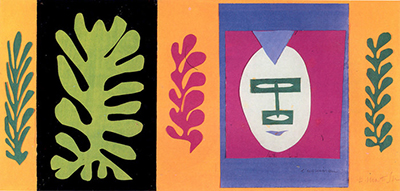
Henri Matisse's The Eskimo (L'Esquimau) stretches across a long orange field. A white oval face occupies a magenta rectangle at the right, framed again in blue. Green lines make two horizontal features and a narrow vertical connection within the face. Across the rest of the work, green and magenta cut shapes branch like leaves. The image offers a mask-like presence and a rhythm of plants, separated and joined by blocks of colour. Matisse made it as a cut-paper composition in the late 1940s; it is an artwork in its own right, not a plate from Jazz . [1] [2]
At a Glance
- Artist Henri Matisse
- Work The Eskimo (L'Esquimau)
- Date 1947–48
- Explore Cut paper and drawing
This work across Henri Matisse’s career
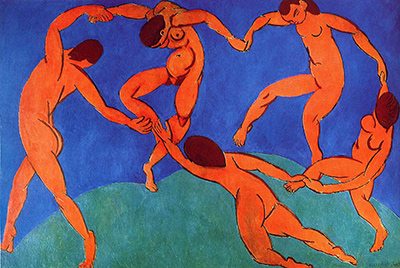
Dance (1910)
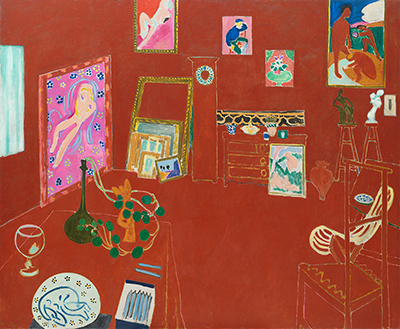
1910The Red Studio
1911The Piano Lesson
1916The Snail
1953Contents
- How does the mask hold the picture together?
- When was it made, and where is it now?
- What does the long format allow Matisse to do?
- Is it part of Jazz?
How does the mask hold the picture together?
The face sits inside two straight-edged frames, one magenta and one blue. Its white oval contrasts with both. The green features are economical: the longer bar crosses near the upper middle, a short stem drops from it, and another small bar closes the shape below. A small purple mark gives the lower face a hint of a mouth. Matisse does not build a modelled head with light, shadow and individual expression. The few coloured pieces make a direct sign of a face, while the surrounding frames give it an almost panel-like force. [2]
Moving left, the composition changes pace. A magenta sprig stands alone on orange. Beside it, a larger pale-green cut form spreads across a tall black strip. Its lobes and gaps make it read as both plant and pattern. At the far left and far right, narrower green branches echo one another across the long sheet. The eye can move through these intervals, from a small branch to a broad leaf, then to the sharply framed mask. The parts remain separate, yet their repeated branching contours make the width feel connected. [2]
The title is the name recorded for the work, not evidence of a specific sitter. The cut face does not identify an individual or an Arctic community, and the surrounding leaves do not locate a real landscape. The work invites close attention to the choices Matisse made with paper: a white oval placed inside colour, a face reduced to lines, and organic forms set against firm rectangular divisions. [1] [2]
Watch: Matisse’s art and working methods
Choose a museum film or a close reading to continue exploring Matisse’s work.
Matisse: The Cut Outs
Tate introduces its exhibition devoted to Matisse’s cut-paper work.
Watch on YouTubeWhen was it made, and where is it now?
Designmuseum Danmark owns the original. In its 2024 annual report, the museum dates L'Esquimau to 1947–48 and records lending it to the Fondation Marguerite et Aimé Maeght in France in 2024. MoMA's 2014 exhibition checklist instead used 1947 . That narrower label fits within the owner's later range, but the two sources do not give the same degree of dating precision. MoMA identifies the medium as gouache-painted paper, cut and pasted on paper, and gives the size as 40.5 × 86 centimetres. [1] [2]
The owner also notes that its original Matisse cut-outs are fragile and are lent only rarely under special conditions because light and vibration can affect them. This matters to the way the work is seen. Its flat colour can look effortless in a reproduction, but the surviving object is assembled paper that needs care whenever it moves or goes on display. [1]
MoMA's checklist places another Designmuseum Danmark work, Panel with Mask , close to it in date. That panel is tall, 110 × 53 centimetres; this composition is wide, 40.5 × 86 centimetres. Their shared interest in mask-like shapes should not erase their different formats or make them two names for one cut-out. Panel with Mask offers a useful next comparison for how Matisse could vary the scale and setting of a face. [2]
What does the long format allow Matisse to do?
At 86 centimetres wide and only 40.5 centimetres high, this sheet asks for a sideways reading. The mask is not centred like a portrait head. It waits at the right, after a sequence of branches and a larger pale-green form against black. The empty orange intervals between these motifs prevent the work from becoming a single continuous garden scene. They make each encounter with a leaf, stem or face distinct. This is a visual reading of the documented work, not evidence that Matisse intended a fixed narrative from left to right. [2]
The face also changes the scale of the surrounding forms. Once the white oval is recognised as a head, a green branch beside it can seem large; looked at as pure pattern, the same branch is simply another cut silhouette. The firm blue and magenta rectangles around the head resist the freer lobes elsewhere. Matisse makes the contrast between straight frame and irregular foliage do as much work as the contrast between orange and green. Seen beside the tall, compartmented Panel with Mask , the horizontal format becomes one of this work's defining decisions, rather than a neutral support for its motifs. [2]
Is it part of Jazz?
No. Jazz was an illustrated book of twenty colour plates published in 1947 from earlier cut-paper designs. MoMA lists this work separately from the book's plate maquettes. It shares the broader method of cutting and arranging painted paper, but its long arrangement of leaves and face has its own object record, size and collection. The cut-outs guide explains the technique across Matisse's later works. [2]
Explore 113 Matisse artworks
This directory covers the 113 individual works explored in these articles, rather than a complete catalogue of Matisse’s output. Cut-paper designs and prints appear under Drawing in the medium filter; each row names its form. Dates retain the qualifications explained in the linked articles.
Frequently Asked Questions
MoMA records gouache on paper, cut and pasted on paper. The face, frames and plant-like motifs are assembled from coloured shapes rather than painted as a continuous scene. [2]
The available object and owner records provide a historical title, not the name of a sitter or evidence for a particular community. The visible face is highly simplified and mask-like. [1] [2]
Return to the white oval after following the leaves from left to right. The face is small within the long field, yet its bright shape makes it the picture's point of arrival. The artist home shows how such late paper works fit within Matisse's wider changes in colour and form. [2]
Discussion
Look again at the images and ideas explored in The Eskimo (L'Esquimau) by Henri Matisse: a mask among cut leaves. These editorial prompts invite your observations.
Reader Insights
How does the mask hold the picture together?
Which comparison discussed in the article helps you see the work differently?
How do the materials and historical setting affect your reading?
Join the Conversation
Share a detail, comparison or question about The Eskimo (L'Esquimau) by Henri Matisse: a mask among cut leaves below.
References
- Designmuseum Danmark , 2024 annual report, printed pp. 46–47, on L'Esquimau and its 2024 loan. View source .
- Museum of Modern Art , Henri Matisse: The Cut-Outs , object checklist, p. 15. View source .
 Henri Matisse.jpg)