


 by
Tom Gurney
Tom Gurney BSc (Hons) is an art history expert with over 20 years experience
Email:
tomgurney1@gmail.com
/ Phone:
+44 7429 011000
Blue Nude IV by Henri Matisse: a figure revised in plain sight: Introduction
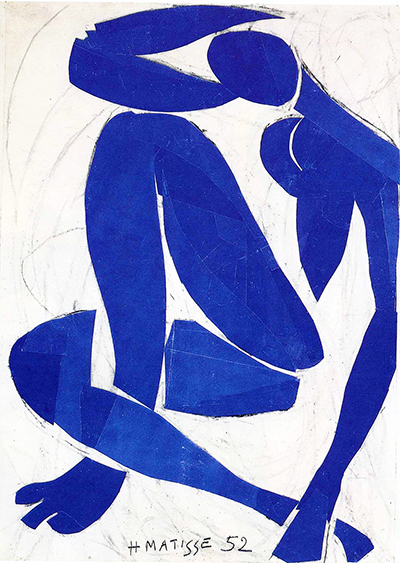
Henri Matisse's Blue Nude IV is a seated woman assembled from strong blue paper shapes. An arm bends across the top of her head, a raised leg fills much of the left side, and another long limb descends at the right. Slim white openings separate the blue pieces. Around them, faint charcoal lines remain visible on the white ground. The work shows both a boldly simplified body and traces of Matisse's search for its final position. [1] [2]
The Musée d'Orsay records Nu bleu IV as a 1952 work made from blue gouache-painted Canson paper, cut, assembled and pasted on white Canson paper, with a charcoal sketch. It measures 103 × 76 centimetres and is signed and dated “H. Matisse 52” at the bottom. Its French inventory number is RF 36789. Musée d'Orsay is the responsible institution, while the work is kept at the Musée Matisse in Nice. That distinction helps explain why both museums may appear in captions. [1]
At a Glance
- Artist Henri Matisse
- Work Blue Nude IV
- Date 1952
- Explore Cut paper and drawing
This work across Henri Matisse’s career
Dance (1910)
1910The Red Studio
1911The Piano Lesson
1916The Snail
1953Contents
- How does the body fit together?
- Why are there charcoal lines?
- What does the edge of the sheet contribute?
How does the body fit together?
The figure occupies nearly the full height of the sheet. The blue head nestles below the arm that sweeps across the top. A bent knee forms a large upright mass on the left, while a diagonal leg crosses the lower area. On the right, a long blue shape pulls the eye back down toward the bottom edge. The body is readable as a curled seated pose, but it is not enclosed by one continuous outline. White seams open between thigh, torso, arm and lower leg. Those spaces make the separate pieces legible and give the folded form room to breathe. [1] [3]
The blue is concentrated rather than spread evenly. A few large pieces carry most of the body's weight; smaller wedges and slivers clarify its turns. The figure presses against the borders, especially at the top and lower right, so it feels bigger than its paper support. White is not an empty leftover. It runs through the body as narrow channels, distinguishing limbs that might otherwise fuse into one blue mass. Centre Pompidou's discussion of the seated Blue Nudes stresses this movement of air and light through the figure. [3]
Why are there charcoal lines?
They are evidence of revision. Centre Pompidou reports that Matisse began Blue Nude IV first, put it aside while he made I, II and III, and then returned to complete IV. He tried positions for the blue pieces, and charcoal marks on the ground retain signs of those changes. The numeral IV therefore does not mean it was conceived only after the other three. This is the series member in which a longer process remains especially visible. [2] [3]
That history changes the way the white paper reads. Some charcoal curves run near the finished blue edges without exactly following them. They show possibilities the artist considered, while the pasted blue shapes state the arrangement he kept. The marks do not make the work unfinished; they let us see a finished decision alongside evidence of earlier ones. Its signed 1952 date and the remaining charcoal belong to the same original object. [1] [2]
Watch: Matisse’s art and working methods
Choose a museum film or a close reading to continue exploring Matisse’s work.
Matisse: The Cut Outs
Tate introduces its exhibition devoted to Matisse’s cut-paper work.
Watch on YouTubeWhat does the edge of the sheet contribute?
Curator Claudine Grammont describes Matisse working under a “law of the frame” : he fitted a figure within a predetermined rectangular field and adjusted its pieces and contours in relation to that boundary. In Blue Nude IV , the raised arm crowds the upper edge, while the bent leg fills the left side. The rectangle does not merely contain a figure made elsewhere. Its limits help determine how tightly the blue parts must fold together. Grammont compares the presence of these figures on a wall to a caryatid, a sculpted figure that seems to bear architectural weight. That is a reading of their visual force, not a claim that this paper work was designed to support a building. [2]
The charcoal makes that relationship unusually clear. Each attempt to shift a blue piece could change the shape of the adjacent white interval. The artist was deciding where a limb should end and how much air to leave around it at the same time. A narrow white wedge between two blue masses can suggest an elbow, hip or space behind the body. Grammont's account treats these voids as part of the figure's movement and volume. Following them around the sheet offers a way to see the work as a composition of blue shapes and white shapes together , rather than as a silhouette simply placed on white paper. [2]
The series gives this choice a useful test. Pompidou notes that the four seated nudes vary in size, curvature and pace of execution despite their family resemblance. I–III were completed in separate rapid sessions, according to Lydia Delectorskaya's recollection, while IV occupied many sessions and retained the visible charcoal record. The speed of another version therefore cannot be used to describe this one. The extra work did not produce more anatomical detail; it refined the intervals by which a few broad pieces become a folded person. [2]
Compare Blue Nude II , another seated blue figure of 1952. Pompidou says I–III were made quickly after IV had been set aside. The shared blue-on-white method makes them a series, but IV's visible charcoal and resumed working history give it a distinct character. Venus reverses the figure-ground relation again: there, two blue pieces make a white female body appear between them. In Blue Nude IV , the blue pieces themselves form the body. [2] [3]
Explore 113 Matisse artworks
This directory covers the 113 individual works explored in these articles, rather than a complete catalogue of Matisse’s output. Cut-paper designs and prints appear under Drawing in the medium filter; each row names its form. Dates retain the qualifications explained in the linked articles.
Frequently Asked Questions
No simple making order follows the numerals. Pompidou's account says Matisse began IV first, made I–III after setting it aside, then returned to finish it. [2]
It is an original cut-paper composition: blue gouache-painted Canson papers assembled on white paper, with charcoal sketch lines. The owner catalogues the specific materials rather than calling it an oil painting. [1]
No. Blue Nude IV belongs to four seated cut-paper figures made in 1952. Matisse's earlier Blue Nude (Souvenir de Biskra) is a separate 1907 painting. Their related poses do not make them one object or one medium. [2]
Musée d'Orsay is the responsible institution; the work is kept at Musée Matisse, Nice. The owner record notes a 1979 gift from Maria Schrepel, Jean Matisse's wife. Display arrangements can change. [1]
Follow a charcoal arc beside the blue knee, then return to the white gap that separates it from the torso. The eye can see both a body and the process of deciding where its pieces belong. The cut-outs guide explains the wider method, and the biography places this 1952 work in Matisse's late career. [1]
Discussion
Look again at the images and ideas explored in Blue Nude IV by Henri Matisse: a figure revised in plain sight. These editorial prompts invite your observations.
Reader Insights
How does the body fit together?
Which comparison discussed in the article helps you see the work differently?
How do the materials and historical setting affect your reading?
Join the Conversation
Share a detail, comparison or question about Blue Nude IV by Henri Matisse: a figure revised in plain sight below.
References
- Musée d'Orsay , “Nu bleu IV,” collection record, inventory RF 36789. View source .
- Centre Pompidou , “The Secret History of Henri Matisse's ‘Blue Nudes’”, 20 March 2026. View source .
- Centre Pompidou , “Nu bleu II,” collection record and curator's analysis. View source .






 Henri Matisse.jpg)
