


 by
Tom Gurney
Tom Gurney BSc (Hons) is an art history expert with over 20 years experience
Email:
tomgurney1@gmail.com
/ Phone:
+44 7429 011000
The Knife Thrower by Henri Matisse: danger arranged in cut colour: Introduction
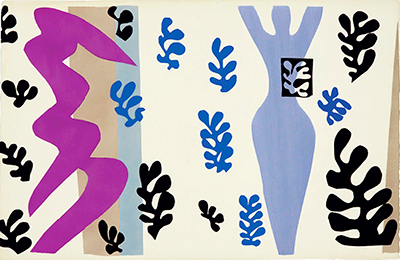
A magenta figure lunges across the left side of Henri Matisse's Le lanceur de couteaux ( The Knife Thrower ). On the right, a pale blue figure stands upright with arms lifted. Black and blue leaf-like shapes hang in the white space around them. The title supplies the circus act; the cut-paper design does not describe it with a detailed arena, audience or visible sequence of thrown blades. Its suspense comes from two very different bodies placed opposite one another and from the empty space they face across. [1] [2]
The original maquette belongs to the Centre Pompidou in Paris. It is made of gouache-painted paper cut and pasted on paper mounted on canvas, and measures 43.3 × 67.5 centimetres. Pompidou identifies it as the design for plate XV of Matisse's illustrated book Jazz and records an ink inscription at lower right, “H Matisse/Juill.46.” Its accession number is AM 1985-315 (15). The cut-paper original is a different object from the coloured stencil print that appeared in the published book in 1947. [1] [2]
At a Glance
- Artist Henri Matisse
- Work The Knife Thrower
- Date 1943–44; inscribed July 1946
- Explore Cut paper and drawing
This work across Henri Matisse’s career
Dance (1910)
1910The Red Studio
1911The Piano Lesson
1916The Knife Thrower by Henri Matisse: danger arranged in cut colour (current article)
1943–44; inscribed July 1946The Snail
1953Contents
- Which figure is the thrower?
- What happens in the space between them?
- Why do museums give different dates?
- How does it fit within Jazz?
Which figure is the thrower?
The magenta form on the left is the thrower. It has a broad, slanted upper section, abrupt turns through the torso and legs, and a strong diagonal that pushes toward the right. Behind it is a narrow vertical strip of beige and light blue. That flat strip makes the purple figure's thrust feel more pronounced. The body is not carefully modelled with hands, clothing and face. It is cut to carry an action: a lean, a bend and a release directed across the sheet. The Metropolitan Museum of Art, describing a 1947 print of the same design, reads its sharp angles as echoing the knife thrower's weapon. [2] [1]
The blue form on the right is the target. Its raised arms and narrower middle make it read as a standing person, yet its sides curve more gently than the thrower's pointed turns. The head is a small extension between the lifted arms; the lower body tapers toward the bottom edge. This is not a portrait of a sitter. The figure is simplified so that its vulnerable posture and contrast with the thrower can be grasped immediately. One body seems to spring through space while the other is held upright, open to what may come. [2]
A black square sits across the blue target's chest. Within it is a pale, branching form. It might initially look like another leaf-shaped sign, but its placement asks for closer attention. The Met reports Matisse telling Lydia Delectorskaya that this decoration represented the target's trusting, flower-like heart. The museum's account gives the square a human charge without making it a literal anatomical diagram. It lets a decorative cut shape stand for an exposed inner life at the very point toward which the act directs our attention. [2]
What happens in the space between them?
The white interval holds many smaller blue and black forms. Some branch like leaves or sea plants; others seem to wheel or tumble. They do not provide a precise map of knives travelling from left to right. They make a changing rhythm around the two performers. A black cluster presses in near the target at the far right, while blue pieces step through the middle. The thrown act is imagined across that living gap, not fixed as a single frozen blade. The viewer's eye repeatedly crosses it, just as the suspense of a knife-throwing act depends on the distance between performer and target. [1] [2]
Colour keeps the two sides distinct. The purple left figure has no equivalent on the right. The target's blue is paler than the saturated blue of several surrounding forms; black shapes punctuate both halves. The beige and light-blue background strip behind the thrower gives the left a narrow vertical anchor. The rest is more open, so the eye is drawn into the central white field. A viewer can read the scene rapidly as a circus danger and then return to the paper shapes as an arrangement of colour, edges and intervals. [1] [2]
The work's energy is not the carefree spontaneity that can be assigned too readily to Matisse's late cut-outs. The Met's account of Jazz observes that circus subjects in the book often carry danger beneath their bright colour. Here the risk is embedded in the title and in the stark difference between an active thrower and an exposed target. The maquette need not be decoded as a specific wartime event or an exact autobiographical scene for that contrast to matter. Its visual relationships do the work. [3] [2]
Watch: Matisse’s art and working methods
Choose a museum film or a close reading to continue exploring Matisse’s work.
Matisse: The Cut Outs
Tate introduces its exhibition devoted to Matisse’s cut-paper work.
Watch on YouTubeWhy do museums give different dates?
The Centre Pompidou dates its original maquette July 1946 , following the inscription on the object. MoMA's 2014 cut-outs checklist dates the Knife Thrower maquette 1943–44 , while agreeing on its medium, dimensions and Pompidou collection. This is a dating difference for the same design, not evidence of two unrelated pictures. Pompidou's catalogue essay explains that some Jazz maquettes developed in 1943 or early 1944 were signed and dated in 1946 when the book was prepared for production. For this page, the visible inscription is reported as July 1946, and the earlier design dating is attributed to MoMA rather than silently erased. [1] [4]
The published print has another date and another medium. Jazz appeared in 1947 under the publisher Tériade. Its plates were reproduced by pochoir , a stencil process chosen to carry the strong colours of the cut-paper designs. The Met's copy of plate XV is a 1947 pochoir print, not the original pasted-paper maquette; it measures 42.2 × 65.1 centimetres as a sheet. MoMA also catalogues a 1947 pochoir Knife Thrower in its own collection. A photograph of the image can make these surfaces look similar, so labels of date, material and collection need to follow the particular object being discussed. [1] [2] [5]
The original's cut pieces do more than provide a design that could later be printed. Their contours make the action and also remain separate material forms. Pompidou's essay places the Jazz maquettes at a turning point, when Matisse was using gouache-painted cut paper systematically for a project that could be translated into another medium. It also records his initial disappointment with the printed result, followed by a more measured view of its colour and effect. That response helps explain why the maquette and book plate should both be taken seriously while still being named accurately. [1]
How does it fit within Jazz?
The Knife Thrower is plate XV in a twenty-plate book. Other plates include acrobats, a clown, a swimmer and imagined creatures. The sequence mixes circus memory with travel, story and danger. The Sword Swallower is another risky circus image in the same book, but it is plate XIII and a separate composition. Its performer is not the purple thrower here, and the French title L'avaleur de sabres does not name this knife-throwing scene. Keeping the two apart makes their shared theme more interesting: the book returns to bodily risk through different images, rather than repeating one act. [4] [3]
The book's black handwritten pages also matter. Pompidou explains that Matisse chose to copy the accompanying text with a brush, placing dark writing between strongly coloured plates. The image of the thrower therefore had a rhythm beyond its own edges: a reader encountered it as part of alternating words and pictures. The broad horizontal maquette anticipates a double-page spread, but the hand-painted paper original has a material presence of its own. To understand Jazz , it helps to hold both the designed book sequence and the individually made image in mind. [1]
Explore 113 Matisse artworks
This directory covers the 113 individual works explored in these articles, rather than a complete catalogue of Matisse’s output. Cut-paper designs and prints appear under Drawing in the medium filter; each row names its form. Dates retain the qualifications explained in the linked articles.
Frequently Asked Questions
The Met identifies that figure as the target, with arms raised. Its black chest square contains a pale decorative form that Matisse, in the museum's account, associated with a trusting, flower-like heart. The record does not identify the figure as a named person. [2]
No. They are different plates of Jazz : knife thrower XV and sword swallower XIII. Both put circus danger into cut colour, but their titles and pictures refer to different acts. [4]
Look again at the empty strip between the figures. The knife is suggested by the title and the thrower's angular drive, but the danger is held in a balance of bodies, black signs, bright blue pieces and white space. The Clown page opens another Jazz design; the cut-outs guide explains the material method, and the artist home offers a route through Matisse's wider changes in colour and form. [1]
Discussion
Look again at the images and ideas explored in The Knife Thrower by Henri Matisse: danger arranged in cut colour. These editorial prompts invite your observations.
Reader Insights
Which figure is the thrower?
Which comparison discussed in the article helps you see the work differently?
How do the materials and historical setting affect your reading?
Join the Conversation
Share a detail, comparison or question about The Knife Thrower by Henri Matisse: danger arranged in cut colour below.
References
- Centre Pompidou , “Le lanceur de couteaux,” original maquette and catalogue analysis, AM 1985-315 (15). View source .
- Metropolitan Museum of Art , “The Knife Thrower,” plate XV from Jazz , 1947 pochoir, object 1983.1009(15). View source .
- Metropolitan Museum of Art , Jazz , collection essay. View source .
- Museum of Modern Art , Henri Matisse: The Cut-Outs (2014), object checklist (PDF), p. 7. View source .
- Museum of Modern Art , “The Knife Thrower” from Jazz , 1947 pochoir, object 291.1948.15. View source .






 Henri Matisse.jpg)
