


 by
Tom Gurney
Tom Gurney BSc (Hons) is an art history expert with over 20 years experience
Email:
tomgurney1@gmail.com
/ Phone:
+44 7429 011000
Matisse's The Painter's Family : four people in a room of patterns: Introduction
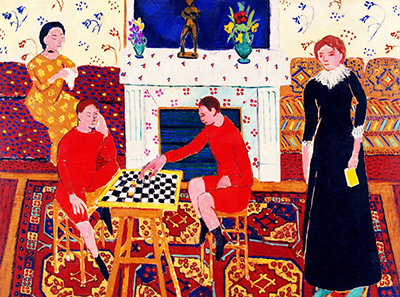
Two boys lean toward a game of draughts at the centre of Henri Matisse's The Painter's Family. A woman sits to their left; another stands to their right holding a yellow book. Behind them, the fireplace, mirror, walls, upholstered seats and carpets fill the room with patterns. This is a portrait of Matisse's own household, but it is also a large experiment in making people visible among competing colours and ornaments. The State Hermitage Museum identifies the figures as his sons Jean and Pierre, his daughter Marguerite, and his wife Amélie. It dates the work 1911, made at Issy-les-Moulineaux near Paris.[1]
The Hermitage records oil on canvas, 143 × 194 centimetres, inventory ГЭ-8940. At that scale, the figures, furnishings and rugs form an environment rather than a small domestic anecdote. The museum calls the work Family Portrait in Russian, while The Painter's Family is the established English title. Both point to the same 1911 canvas. The Hermitage's object record, rather than a guess from the clothing, establishes who is pictured. It does not assign a hidden family secret to any one person's pose or colour.[1]
At a Glance
- Artist Henri Matisse
- Work The Painter's Family
- Date 1911
- Explore Painting
This work across Henri Matisse’s career
Dance (1910)
1910The Red Studio
1911The Piano Lesson
1916The Snail
1953Contents
- Who is in the room?
- Why does the draughts table command attention?
- How do the carpet, walls and mirror shape the portrait?
- Is this a private family scene or a designed interior?
- How did the canvas reach the Hermitage?
Who is in the room?
Jean and Pierre face one another across the small game table. They are absorbed in the board, which sits near the middle of the painting and is easy to recognize by its alternating squares. Their bodies make a strong central pair: one boy sits at left and the other at right, each dressed in red. The Hermitage names the sons together but does not, in its brief public description, settle which of the painted boys is Jean and which is Pierre. The important visual relationship is their shared concentration and the diagonal movement of arms and legs toward and around the board.[1]
Amélie sits further back at the left, in a yellow-orange patterned garment. She is present within the room, yet the boys' game does not depend on her attention. At the right, Marguerite stands in a long black dress, a small bright yellow book held beside her. Her upright shape is a firm edge against the busy upholstery and wall. The black dress is especially noticeable because so much of the room is red, orange, cream and blue. Colour helps distinguish her figure from the surrounding pattern; it is not evidence of an undisclosed emotional divide in the family.[1]
The people do not make a conventional group in which everyone looks toward the painter or performs one shared action. The boys play; Amélie sits apart; Marguerite stands with her book. These differing positions give the interior a lived-in appearance, but the arrangement is carefully designed. Matisse has placed the boys and their board at the centre, with the two women setting distinct vertical and diagonal accents around them. The Hermitage describes the figures as structural axes that bring clarity to a large canvas full of ornament. A reader can see what the museum means by looking first at the board and then tracing the four bodies through the patterned field.[1]
Why does the draughts table command attention?
The board is a small rectangle compared with the carpet and fireplace, yet its checked squares create one of the painting's strongest contrasts. It sits between the boys' arms and faces, gathering their gestures toward a single point. The game also repeats the work's interest in pattern on a different scale. The carpet below contains many angled and repeated elements; upholstery and wallpaper multiply them farther back. Against those larger fields, the board's alternating squares are simple enough to read immediately. Matisse gives the viewer a visual foothold in a room that might otherwise feel overwhelming.[1]
The boys' red clothing further marks the game as the central event. Red recurs elsewhere in the rugs and furnishings, so their bodies both stand out and belong to the room's colour scheme. The table and their limbs break up the carpet's dense surface, creating a small clearing in front of the white fireplace. It is tempting to describe the game as a symbolic lesson about family roles or competition, but neither the object record nor the visible board requires that story. We can say with confidence that the game structures where the boys look and where our eye goes.[1]
The Museum Berggruen in Berlin holds a related 1911 charcoal drawing, Les joueurs de dames, showing the two boys at a draughts table. Its curator explicitly compares the drawing with the Hermitage canvas. In the drawing, the boys and table occupy a largely unelaborated ground; the board is indicated without the painted game pieces. The museum observes a strong diagonal between the players. By contrast, the finished family canvas gives the game a wider environment and surrounds it with Amélie, Marguerite, furniture and ornament. The drawing clarifies the boys' relationship as a subject in its own right, while the painting tests how that subject can remain legible in a crowded room.[2][1]
The Berlin record dates the drawing to 1911 and says the Hermitage painting was completed in the spring of that year. It does not need to be treated as a mechanically exact blueprint in which every later brushstroke was fixed in advance. Its value as a comparison lies in what Matisse selected and changed. The two boys and board are recognizable in both works, but the scale, medium and surrounding space differ markedly: 48 × 63 centimetres of charcoal on paper in Berlin, and a 143 × 194 centimetre oil canvas in St Petersburg. A domestic moment expands into a composition that can hold an entire family and its furnishings.[2][1]
Watch: Matisse’s art and working methods
Choose a museum film or a close reading to continue exploring Matisse’s work.
Matisse: “For Me It’s Always New”
The Museum of Fine Arts, Boston considers Matisse’s creative practice.
Watch on YouTubeHow do the carpet, walls and mirror shape the portrait?
The carpet spreads over most of the foreground, making an intricate red ground for the table and seated boys. Patterns appear to run behind and beneath chair legs. Instead of offering a quiet neutral floor that would leave the figures isolated, the rug insists on being seen. Smaller repeated marks in the wallpaper and upholstery continue the activity upward. The white fireplace is a comparatively open area, interrupting those dense surfaces behind the game. Its horizontal shelf and vertical sides give the eye a stable architectural frame near the centre of the picture.[1]
Above the fireplace, a deep blue mirror or reflective field makes a striking dark rectangle. The Hermitage describes the blue mirror as a focal point of the painting's concentrated atmosphere. It is not necessary to know exactly what the mirror reflects to feel its role: it pauses the pattern and draws the eye up from the checked board. Flowers and objects near it introduce smaller accents of colour. The near board and high blue rectangle answer each other across the white fireplace, giving the broad canvas a central axis even though the four people are not lined up symmetrically.[1]
This room is richly furnished, but the painting is poor evidence for a precise account of family income or a claim that every visible object was a luxury. Its patterned textiles and decorative surfaces matter primarily because they give Matisse a demanding visual problem. The people must hold their own amid repeated lines and colours. Marguerite's black silhouette, the boys' red garments, Amélie's warm patterned dress and the pale fireplace give the eye intervals of greater clarity. Pattern surrounds them without swallowing them. That is the balance the Hermitage singles out when it praises the canvas's organization rather than reading it as a straightforward snapshot of daily life.[1]
Is this a private family scene or a designed interior?
It is both a portrait of identifiable family members and a deliberately arranged painting. The Hermitage calls the subject—a family in an interior—simple and natural, then emphasizes Matisse's effort to make it monumental. His figures are not rendered as four separate likenesses cut out against an empty background. They are placed within the same system of colour and line as the furnishings. The boys' red is echoed in the rugs, while Marguerite's black sets a strong boundary against them. Amélie's yellow-orange pattern relates her to the upholstery and other warm surfaces. The family is therefore present through both identity and placement within the design.[1]
The picture's multiple activities should not be converted into claims about what each person feels toward the painter. Marguerite's gaze, Amélie's hands and the boys' concentration are visible features or, in the boys' case, actions identified by the Hermitage. They do not reveal secret knowledge or prove a domestic hierarchy. Matisse is not shown as a fifth figure, but that absence alone does not establish a psychological drama. It creates the position from which he can arrange the group: a viewer standing outside the frame and looking into the room. The painting lets us encounter a family while remaining conspicuously a constructed image.[1]
This distinction is especially important for Marguerite. Her dark dress is formally powerful because it is a long, nearly continuous shape set among fragmented ornamental surfaces. The bright yellow book at her side punctuates that black field. The Hermitage names both the black dress and yellow book as key colour accents. Their visual force does not establish Marguerite's feelings or a story about her place in the household. The museum's account gives a grounded reason to discuss the dress: it helps the large painting remain legible.[1]
How did the canvas reach the Hermitage?
The Hermitage records the work as coming from the collection of Sergei Shchukin, a major early supporter of Matisse. It states that the painting entered the Hermitage in 1948, transferred from the State Museum of New Western Art. The Metropolitan Museum of Art notes that Shchukin's collection was nationalized in 1918 and later divided between the Hermitage and the Pushkin Museum. These institutional records explain the broad path from a French family portrait to a Russian public collection without requiring an invented direct commission or a fully detailed transfer history for this particular canvas.[1][3]
The owner facts keep the work distinct: 1911, Issy-les-Moulineaux, four named family members, an oil canvas nearly two metres wide, Hermitage ГЭ-8940. The Berlin drawing is a separate work that helps us see how strongly the draughts pair could stand alone. In the painting, they remain the centre of a far more complex world. Readers can place it among Matisse's paintings and return to the canvas's central achievement: four people, a game and a room full of patterned surfaces held together without reducing any one of them to background decoration.[1][2]
Explore 113 Matisse artworks
This directory covers the 113 individual works explored in these articles, rather than a complete catalogue of Matisse’s output. Cut-paper designs and prints appear under Drawing in the medium filter; each row names its form. Dates retain the qualifications explained in the linked articles.
Frequently Asked Questions
The Hermitage identifies Matisse's sons Jean and Pierre playing draughts, his daughter Marguerite , and his wife Amélie . Its public account does not specify which seated boy is Jean and which is Pierre. [1]
It belongs to the State Hermitage Museum , inventory ГЭ-8940 . The museum records its transfer from the State Museum of New Western Art in 1948 and its earlier presence in Shchukin's collection. [1]
Discussion
Look again at the images and ideas explored in Matisse's The Painter's Family : four people in a room of patterns. These editorial prompts invite your observations.
Reader Insights
Who is in the room?
Which comparison discussed in the article helps you see the work differently?
How do the materials and historical setting affect your reading?
Join the Conversation
Share a detail, comparison or question about Matisse's The Painter's Family : four people in a room of patterns below.
References
- State Hermitage Museum , Family Portrait ( Семейный портрет ), ГЭ-8940. View source .
- Staatliche Museen zu Berlin , Museum Berggruen, Les joueurs de dames , NG MB 149/2000. View source .
- The Metropolitan Museum of Art , Portrait of Sergei I. Shchukin . View source .






 Henri Matisse.jpg)
