


 by Tom Gurney
Tom Gurney BSc (Hons) is an art history expert with over 20 years experience
Email: tomgurney1@gmail.com / Phone: +44 7429 011000
Introduction
A woman bends over a child in her arms. The child reaches towards her face, while several other hands seem to appear around them. At first glance, Picasso's drawing can look like a familiar image of maternal closeness. Look longer and the sheet becomes less simple. The woman's head and the child's body are given darker, denser lines; to the right and below, lighter contours test other placements of an arm and hand. The image is both a mother-and-child scene and a record of Picasso working out how that scene might be made.
The drawing is usually called A Mother Holding a Child and Four Studies of Her Right Hand or, more briefly, Mother and Child and Study of Hands. Picasso signed and dated it 1904. It belongs to the Harvard Art Museums' Fogg Museum, accession 1965.318, as the Frick Collection's exhibition record[1] and a Musée national Picasso-Paris archival photograph[3] identify. Its medium is black crayon on paper. This is not a 1904 oil painting, nor is a later lithographic reproduction the original drawing. [1] [3]
At a Glance
- Made: Paris, winter 1904
- Medium: Black crayon on paper
- Collection: Harvard Art Museums, Fogg Museum (1965.318)
- What to notice: The mother and child share the sheet with four studies of her right hand
Mother and Child Study (1904) in Picasso's career
The highlighted work is dated with the qualifications explained in the sources on this page. The other works are selective points of comparison, not the start or end of a style.
Contents
- Looking at the mother and child
- What does a study reveal?
- The drawing between Blue and Rose
- From Picasso's page to the Fogg collection
Looking at the mother and child
The mother's bowed head draws the eye first. Her dark hair is built with repeated strokes that surround a face turned down towards the child. The strongest shading lies around her hair, eye and shoulder. Picasso gives far less definition to the lower body, allowing its outline to fade into the activity elsewhere on the page. The contrast makes the head feel concentrated and close, even though the sheet also contains other sketches.
The child's small hand reaches upwards and touches, or nearly touches, the woman's cheek. The other arm and the wrapped or lightly indicated body are much less clearly bounded. Rather than mapping every limb, Picasso relies on the gesture between face and hand to establish the relationship. That is one reason the pair remains understandable even when other lines cross their bodies. The scene holds together around a few points of contact.
Below the child's body, a broad arm supports it. Fingers spread across the centre of the composition; another set of fingers appears slightly lower. On the right side of the page, a large hand extends horizontally from a lightly indicated arm. At the bottom, further hand forms accumulate. Some are outlines, some are shaded, and some seem to connect to an arm that the artist did not carry through as a full figure. They are not extra people crowding the mother. They are trials on the same sheet, visible beside the more firmly described pair.
The title counts four studies of the mother's right hand. That conventional description is useful, but it need not imply a known order in which Picasso drew them. The page does not show us a numbered progression from mistake to final answer. He may have tried alternatives, returned to one, or reworked lines on the sheet. What can be seen is a concern with how a hand supports a child, crosses the body and contributes to the overall shape. The tests are part of the artwork's interest, not a blemish to be mentally erased.
A light, separate head-and-shoulders sketch is also visible near the upper right. It makes the surface feel open to further possibilities beyond the mother-and-child group. The Frick Collection[1] observes that the drawing has an aesthetic balance of its own even while functioning as a study. The dark central figures and pale peripheral trials explain why. There is a focal image, but the eye can travel out through the trial hands and return to the child reaching towards the face. The sheet does not force a choice between finished image and working process. [1]
That balance is easier to appreciate when the material is correctly named. The 1965 Fogg memorial exhibition catalogue[2], preserved online by MoMA, describes black crayon on cream-coloured paper and notes a signature and the date at the lower right in graphite pencil. The Paris Picasso archive repeats an older label with much the same information. Later catalogue descriptions call the support tan wove paper. The exact colour name may vary with the record and with the ageing or reproduction of the sheet; the well-supported drawing medium is crayon. The old website's addition of “ink” is not established by these object records. [2]
What does a study reveal?
A study can be an attempt to solve a specific visual problem without being an incomplete work in every sense. Here the problem is not simply “how to draw a hand.” The fingers have to hold or frame a small body, link the child to the mother and help turn several overlapping contours into a readable whole. Moving a hand slightly changes the emotional and compositional emphasis. One arrangement encloses; another reaches; another leads the eye across the sheet.
The four hands also draw attention to a part of a mother-and-child picture that viewers might otherwise take for granted. A face can suggest feeling, but hands enact the relationship. The woman's support and the child's upward touch make the two figures legible as a pair. Picasso could have elaborated a room or described their clothing carefully. Instead he concentrates on contact, posture and the line that carries one body into the other.
This does not tell us what either person felt. Words such as tenderness may express a viewer's response to the child's reach and the lowered face; they are not evidence of a documented mother, child or event. Neither figure is named in the secure object records used here. The drawing should not be turned into an unverified portrait of Picasso's own family, partner or child. Its expressive force comes from a visible arrangement, not a biographical identification that the sheet cannot prove.
The working surface also resists a neat story of artistic hesitation. A common explanation says that Picasso drew four unsuccessful hands and then chose the correct one. Such a sequence cannot be read straight from the final sheet. We can see alternatives; we cannot see the chronology of each stroke. The artist kept them together rather than cutting away the supporting studies. Their coexistence lets viewers witness variation without knowing the private moment of decision.
The Frick's 2011 exhibition text[1] places the drawing in Paris, winter 1904 and calls it a study for a gouache. An earlier Fogg catalogue[2] connects it to a painting then described as in the Göteborg Art Museum, Sweden. These records support the idea that Picasso was developing the mother-and-child motif across sheets and finished compositions. They do not by themselves justify naming every similar 1905 family picture as the exact destination of these hand studies. A close-looking page can discuss the drawing on its own terms while acknowledging its preparatory role. [1] [2]
The same catalogue records a standing male nude on the back of the sheet. That is a separate drawing on the verso, not a hidden part of the mother-and-child composition. It reports that art historian John Richardson suggested the nude might be a self-portrait. A suggestion is not a verified sitter identity. The information does, however, remind us that the physical page has two sides. A reproduction of its front alone cannot convey the whole material object. [2]
Watch: Pablo Picasso
Explore Picasso through five videos from museums, broadcasters and art educators.
Picasso’s Guernica: Great Art Explained
Explore the composition and historical setting of Picasso’s best-known response to war.
Watch on YouTubeThe drawing between Blue and Rose
The date 1904 can tempt a too-tidy period label. Picasso's earlier Blue Period included several images of mothers with children, often spare and sorrowful. Musée d'Orsay's Picasso Blue and Rose exhibition[5] traces such subjects from 1901 to 1903 and describes the shift towards a broader range of colour in late 1904 and early 1905 as gradual. The labels “Blue” and “Rose” are helpful for orienting a career, but this black-crayon drawing cannot itself be assigned a bright Rose Period palette. Its problem is line, gesture and the relation between people. [5]
Picasso settled into the Bateau-Lavoir in Paris in May 1904, according to Orsay's chronology. At roughly the same time, the mother-and-child subject continued to change around him. Earlier pictures had already explored shelter, distance and vulnerability. The drawing does not suddenly abandon those concerns. It gives the figures more rounded, concentrated contours than some earlier Blue Period images, yet its pale paper and emphatic dark marks still produce a serious, quiet mood. The period boundary is better understood as a stretch of experiments than as a switch thrown on a single date. [5]
One comparison makes the point particularly clearly. The Museu Picasso Barcelona's The Destitute[6], a 1903 mother-and-child work, uses blue and an enlarged protective hand to convey the difficulty of sheltering a child. Its figures and circumstances are not those of the Harvard drawing. Yet the hand remains a central expressive device in both. The comparison is about Picasso returning to a human action, not about identifying a direct preparatory sequence between the two objects. [6]
Later images of circus families take the motif in another direction. Orsay describes the saltimbanque cycle, developed from late 1904 through 1905 in drawing, painting, printmaking and sculpture, as joining family life to the world of performers. Göteborgs konstmuseum owns the 1905 Acrobat Family with a Monkey. Its Swedish research on that work[8] cautions against confidently identifying the pictured woman as Picasso's model Madeleine; it notes conflicting views about models and character-building. That caution applies even more strongly to a claim that the woman on this Harvard sheet is definitely Madeleine. A thematic and perhaps preparatory relationship is not an identification of a real sitter. [8]
Nor should a similar title send the reader to a different museum object. Barcelona holds an 1896 drawing titled The Artist's Mother and Study of Hands[7]. That drawing concerns Picasso's own mother and has Barcelona inventory number MPB 111.465. The 1904 Fogg sheet has accession 1965.318, shows a woman with a child and comes from a different time and collection. Their shared words “mother” and “hands” are not evidence that they are versions of one work. [7]
From Picasso's page to the Fogg collection
The drawing's later history is unusually well documented. The 1965 Fogg memorial catalogue[2] records that Charles Vignier transferred it to Paul J. Sachs in Paris on 10 December 1929. Its bequest by Meta and Paul J. Sachs brought it to the Fogg, where the accession number 1965.318 distinguishes it from later reproductions and other Picasso drawings. The Metropolitan Museum of Art's research on Sachs[4] places the sheet within his important collection of figure drawings and prints. [2] [4]
It has also circulated through exhibitions and their catalogues. The Fogg memorial record lists a 1958–59 showing that travelled through Rotterdam, Paris and New York, and a 1964 Picasso and Man exhibition in Toronto and Montreal. The Frick Collection[1] later presented the sheet in Picasso's Drawings, 1890–1921. These appearances help explain why the image is familiar even though the original belongs to a specific museum collection. A printed poster, catalogue plate or online picture may show the drawing, but it is not the 1904 sheet itself. [1]
The Paris Picasso museum's archive entry[3] illustrates a further distinction: its object is a photograph of the drawing, not the Harvard drawing. Its archive number and photograph dimensions belong to that later print. The typed label on the back is valuable evidence for identifying the artwork, but it should not be used as if Paris owned the original or as if the photograph's size measured Picasso's paper. [3]
What holds attention after the catalogue details is the movement of the hand. The child reaches towards the woman's face. Her arm bears the child's weight. Around them, Picasso tries how another hand might turn, cross, touch or support. The study exposes the decisions that make a familiar subject visually precise. It is not merely a sentimental picture left unfinished, nor merely a diagram for another work. Its central group and its surrounding alternatives remain visible together, allowing the viewer to see both the image Picasso made and some of the possibilities he kept beside it.
Discussion
Use the evidence and your own close looking to explain your view. These are editorial prompts, not reader comments.
Reader Insights
Which line appears exploratory rather than part of a final contour?
What does the sheet reveal about revising an arm or hand placement?
How does this drawing differ from a finished mother-and-child painting?
Join the Conversation
Which reading best fits the evidence?
References
- Frick Collection, Picasso's Drawings, 1890–1921, cat. 16.
- Fogg memorial exhibition catalogue, 1965, cat. 66, hosted by MoMA.
- Musée national Picasso-Paris archival photograph and old Fogg label.
- The Metropolitan Museum of Art, Paul J. Sachs collection research.
- Musée d'Orsay, Picasso Blue and Rose.
- Museu Picasso Barcelona, The Destitute.
- Museu Picasso Barcelona, The Artist's Mother and Study of Hands.
- Göteborgs konstmuseum's research on Acrobat Family with a Monkey.
Image Credits
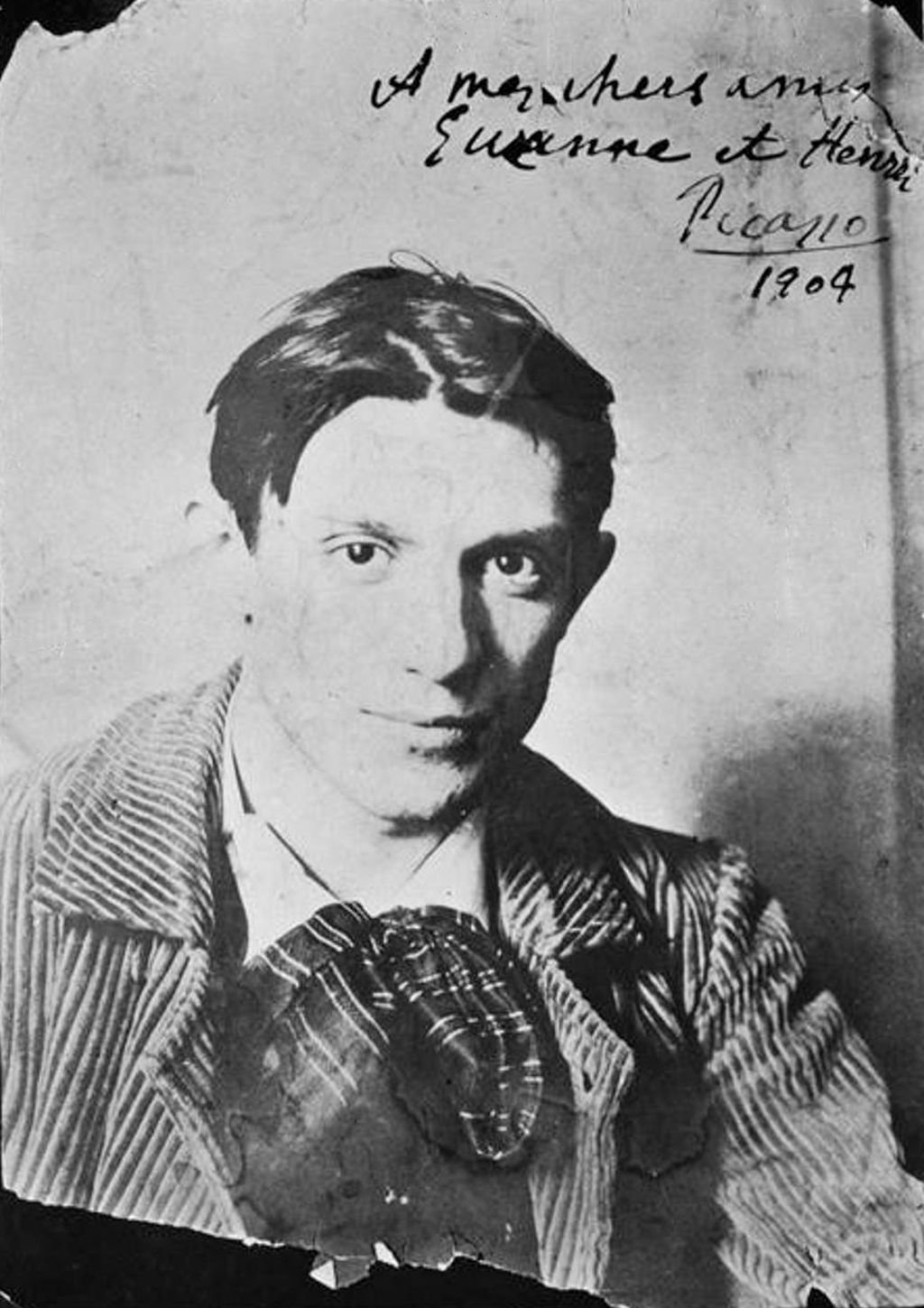
- Ricard Canals i Llambí, 1904. Wikimedia Commons labels the photograph public domain; its source credits RMN-Grand Palais. Resized to 1024px; no crop. Source record. Licence.
