 by Tom Gurney
Tom Gurney BSc (Hons) is an art history expert with over 20 years experience
Published on June 19, 2020 / Updated on September 28, 2026
Email: tomgurney1@gmail.com / Phone: +44 7429 011000
About the artist
Piet Mondrian (1872–1944) is known around the world for paintings built from straight lines, unequal white spaces and carefully placed red, yellow and blue. Those images are only part of his story. He spent years painting Dutch landscapes, trees, mills and single flowers before moving through Cubism toward the abstract language he called Neo-Plasticism. In New York, his final paintings changed that language again, breaking long bars into small, shifting units of colour. This page is a guide to the full range of the artist's work and to the individual paintings in this collection.[1][2][3]
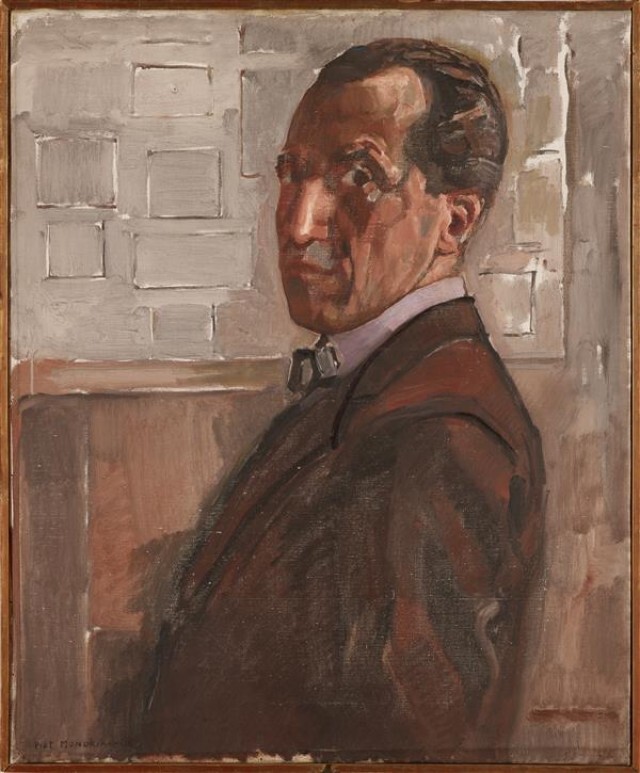
The main image is Mondrian's painted Self-portrait of 1918, made while he was involved with the artists around De Stijl. It is an artwork, not a photograph of the artist in his later Paris or New York studio. For a fuller account of his training, travels, writing and working method, visit the Piet Mondrian biography. Here, the emphasis is on how to connect the stages of his career with actual works, their collections and the questions they raise for a viewer.[1][4]
At a glance
- ArtistPiet Mondrian, born Pieter Cornelis Mondriaan
- Life1872, Amersfoort, the Netherlands – 1944, New York City
- TrainingRijksacademie, Amsterdam, from 1892
- Places of workThe Netherlands; Paris; London; New York
- Subjects and mediaLandscapes, trees, flowers, still lifes, paintings and drawings; later abstract compositions
- Associated ideasCubism, De Stijl and Neo-Plasticism
- Start exploringBiography, paintings, drawings and the artwork directory below[1][2][5]
Explore Mondrian's movements, fellow artists and key works
Dutch Luminism and tree experiments
1908–11Cubist experiments
1911–14De Stijl and abstract grids
1917–20Neo-Plasticism and geometric abstraction
1920–38New York revisions of the grid
1940–44Evening: The Red Tree
1908–10Gray Tree
1911Broadway Boogie Woogie
1942–43Victory Boogie Woogie
1942–44Contents
- How did Mondrian's painting change?
- What did Cubism offer him?
- What is Neo-Plasticism?
- What does the studio tell us about his work?
- Which paintings are essential to see?
- What changed in New York?
- Who influenced Mondrian, and what followed him?
- How should you explore the collection?
How did Mondrian's painting change?
The familiar grid did not arrive all at once. Mondrian trained in the Netherlands and worked with recognizable landscapes, buildings and flowers. The Guggenheim describes his early art as moving among academic realism, Dutch Impressionism and Symbolism. Those categories are broad, but they correct a common misunderstanding: a picture of a mill, a sea view or a chrysanthemum can be a serious part of Mondrian's development rather than an embarrassing preliminary to abstraction.[2]
His subjects returned in different forms. A tree might be painted for its blaze of colour, then studied again for the pattern of its branches. A tabletop group could first be described in space and later reorganized into planes that press toward the picture surface. The Guggenheim's account of his two Still Life with Gingerpot paintings is a useful example of that shift. The objects do not have to disappear immediately for their structural relationships to become the main concern.[2]
Mondrian first visited Domburg on the Dutch coast in 1908 and returned over the next years. Its trees, dunes, sea and architecture offered subjects for experiments with light and intense colour. Avond (Evening): The Red Tree was begun in 1908 and worked on until 1910. The Kunstmuseum relates its first study to an old apple tree at Villa Loverendale. Red boughs against a blue ground make a natural motif feel vigorous and almost electric.[1][6]
 The Red Tree Piet Mondrian.jpg)
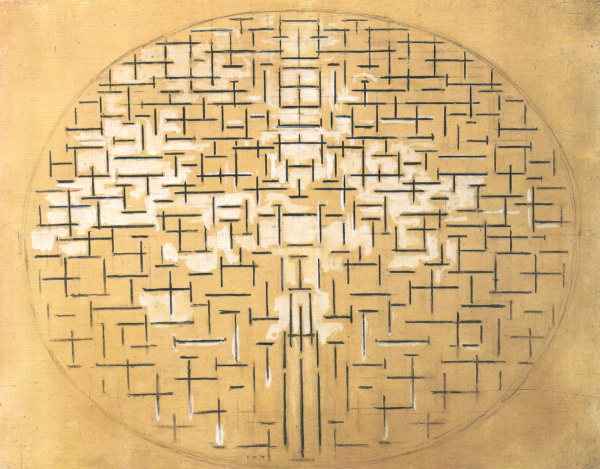
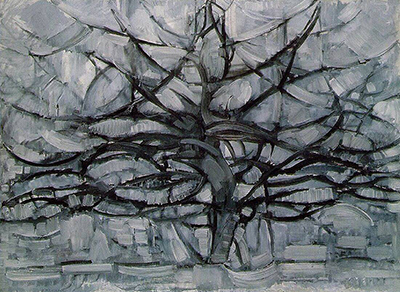
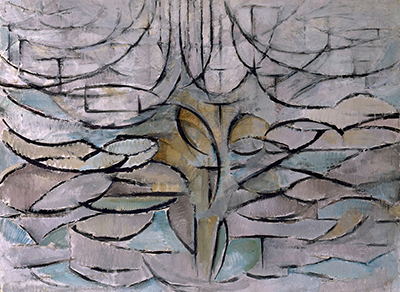
In Gray Tree of 1911, the branches remain visible but seem to join the gray marks behind them. The museum emphasizes the reduced palette and the growing importance of line. In Flowering Apple Tree of 1912, a branching subject becomes a still denser network. These are three distinct canvases, not three labels for one painting or a claim that every one depicts the same physical tree. Seen together, they let us watch Mondrian change how a familiar subject occupies a canvas.[7][8]
What did Cubism offer him?
Mondrian encountered French Cubism in 1911 and moved to Paris in January 1912. The Kunstmuseum biography places that move after his work in the Netherlands; it should not be shifted back into 1911 simply because his interest in the new art began then. Cubism provided a way to reconsider pictorial space. Forms could be broken, repeated and arranged across a surface instead of being described from one uninterrupted viewpoint.[1][7]
He worked through that possibility in trees, buildings and still lifes. The results are not copies of Picasso or Braque. Mondrian's own art increasingly tested how vertical and horizontal relationships might organize a picture after the represented subject had been reduced. This is a key distinction: Cubism helped open the question, but Neo-Plasticism became Mondrian's different answer. It took years of experiments, including periods when natural motifs and abstract structure were visible at the same time.[2][9]
The First World War interrupted his life in Paris. Visiting the Netherlands in 1914, he could not return when fighting began. He continued making more abstract work and met artists and supporters including Bart van der Leck, Theo van Doesburg and Salomon B. Slijper. The group and magazine De Stijl began in 1917 with Mondrian among its participants. It was a collaboration and debate among artists, architects and designers, not a style invented by one painter in a single year.[1][9]
What is Neo-Plasticism?
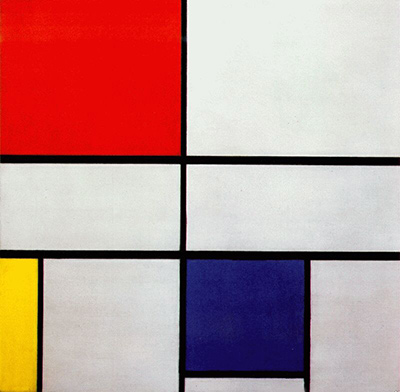
Mondrian returned to Paris in 1919. By about 1920, his painting had developed into the approach he called Neo-Plasticism. MoMA describes it as a rejection of naturalistic representation in favour of straight lines, rectangular planes and primary colours. In Mondrian's paintings, black, white and gray also take active roles. Red, yellow and blue are not laid onto a neutral diagram; their unequal areas work with the thickness, length and placement of lines and with the white spaces left between them.[3][5][9]
Look at a mature canvas for a moment and the apparent simplicity becomes less simple. A black bar may stop short of the edge while another reaches it. A large white area may appear to be empty until a small blue square changes its balance. Red may dominate at first glance, yet a narrow yellow strip can draw the eye away. The visual effect depends on relations among unequal parts, not on counting the colours or assigning a fixed meaning to each rectangle.
These paintings were made and adjusted by hand. MoMA's retrospective stresses that their precision grew from an intuitive search through revisions, not from a purely mathematical formula. A limited vocabulary gave Mondrian a way to notice how a small change could alter a whole composition. The canvases also have actual surfaces, frames, inscriptions and ownership histories. Their titles can resemble one another, so a viewer needs the specific object's date, image and collection to identify it securely.[9]
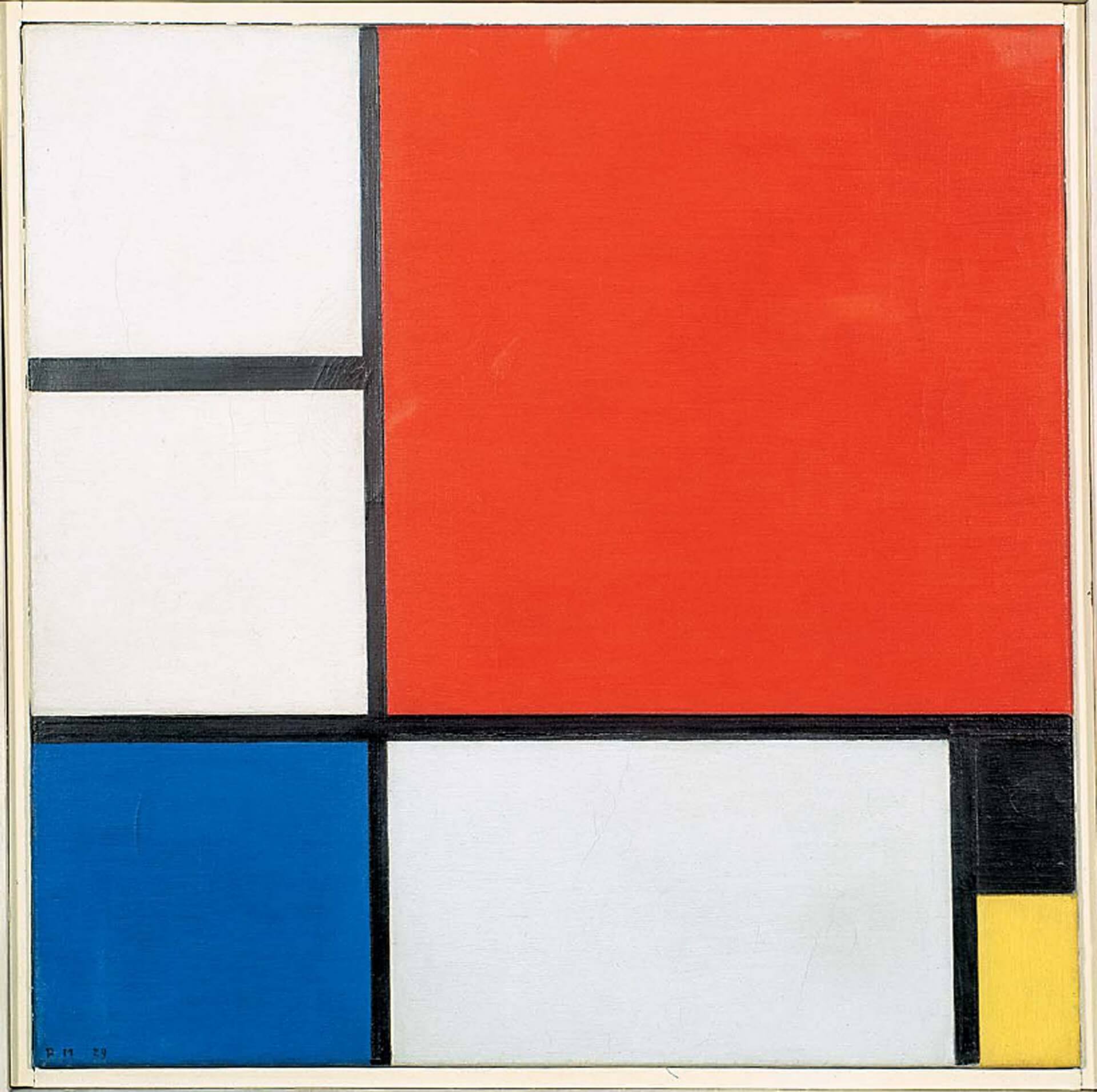
The 1930 Composition with Red, Blue and Yellow in Kunsthaus Zürich is one such object: it is catalogued as B217 and was later given to the museum by Alfred Roth. Its title often gets shortened or reordered online. The 1929 Composition II in Belgrade is a separate painting, B212, in the National Museum of Serbia. Their years, arrangements and collections differ. This site gives them separate pages so that an image shown by Google or another source can lead to the correct work rather than to a generic colour-grid description.[10][11]
What does the studio tell us about his work?
The studio was another place for testing relationships. The Kunstmuseum says the coloured shapes on Mondrian's Paris studio walls attracted attention. MoMA later reconstructed the New York room he occupied at 15 East 59th Street in 1943–44. Its description includes movable painted rectangles attached to walls, furniture made and rearranged from simple materials, and a colour scheme drawn from his artistic vocabulary. That New York space was an environment shaped by the same interest in balance as the paintings, though it should not be treated as an exact replica of every studio he occupied.[1][9]
Movable wall pieces are a reminder that order can be found through repeated choices. Shift one colour and its neighbours change in effect; enlarge a white area and a line may need another ending. MoMA's retrospective emphasized Mondrian's intuitive working process, including unfinished compositions and studies. The paintings may look as if a ruler and a fixed recipe could have produced them, but their recorded revisions show an artist testing with his eyes and hands. The studio and the canvas were different materials for thinking through such relations.[9]
This also helps explain why reproductions need careful labels. A small screen image can show the arrangement of red, yellow and blue, but may lose the texture of brushwork, slight differences among whites and the edges of painted forms. It cannot tell a reader on its own whether a square in a search result is the Zürich canvas, the Belgrade canvas or another near-named composition. Collection records and close looking work together: one establishes the physical object, and the other helps us see what Mondrian did with it.[10][11]
Watch: Piet Mondrian
See his studio, the move toward geometric abstraction and the rhythms of his New York paintings.
Piet Mondrian: Abstract Painting as We Know It
Curator Michael White explores the paintings and Mondrian’s studio as an abstract space.
Watch on YouTubeWhich paintings are essential to see?
A good route through Mondrian's work begins with contrast. The Red Tree and Gray Tree show what happens when one familiar motif is approached through different colour and structural choices. Flowering Apple Tree takes a related natural form into a more intricate 1912 arrangement. None is merely an “early Mondrian” label: each has its own surface, year and collection record.[6][7][8]
The two red, blue and yellow compositions in Zürich and Belgrade make a different lesson visible. Similar words in a title do not guarantee the same object. Compare the area of each colour, the widths and endings of the bars, and the years supplied by RKD and the holding museums. The Zürich painting is 1930 B217; the Belgrade picture is 1929 B212. Their dedicated pages provide the fuller identification and provenance.[10][11]
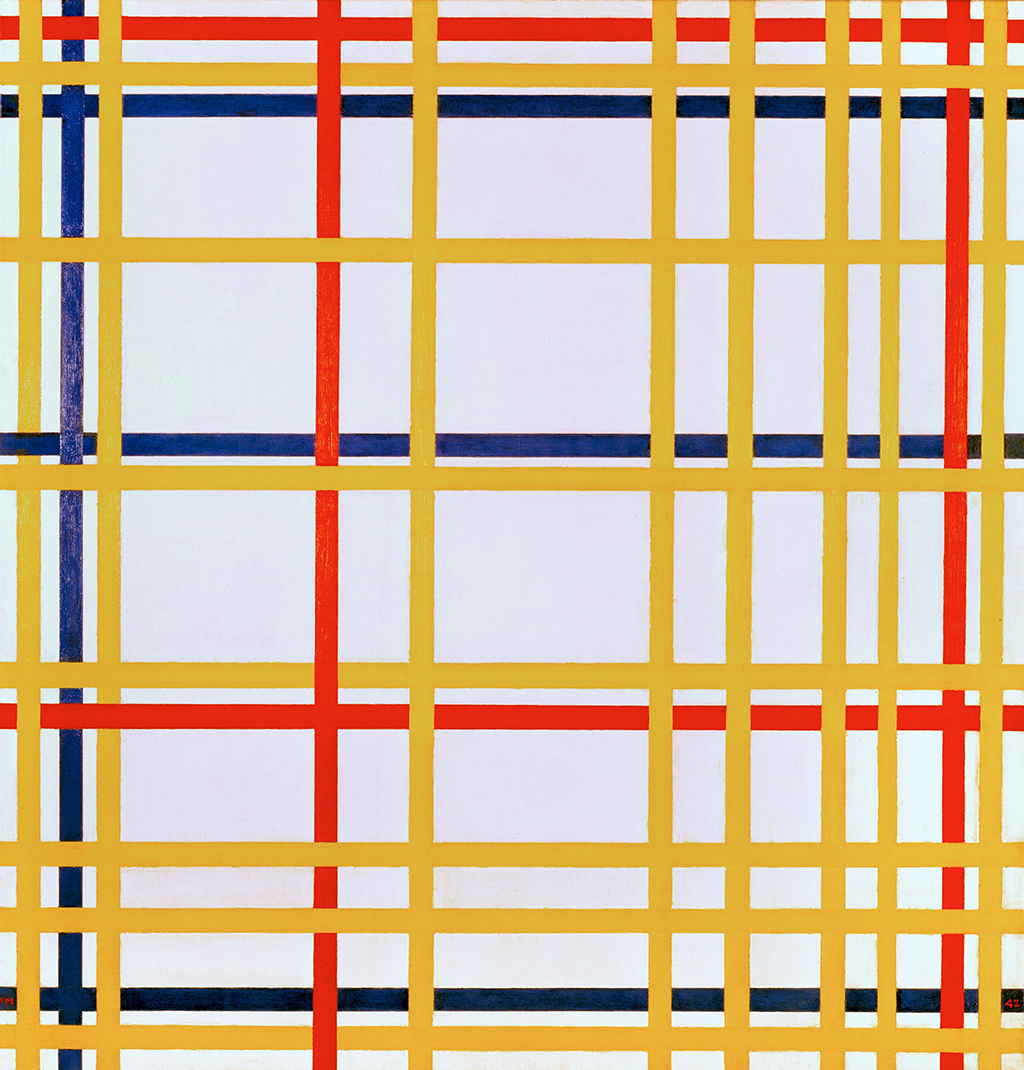
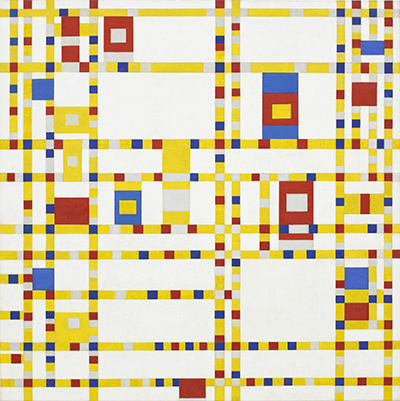
At the end of the career, Broadway Boogie Woogie and Victory Boogie Woogie both draw on changing rhythms in New York but have different states of completion. MoMA's Broadway is a finished square painting of 1942–43. The diamond-hung Victory, worked on in 1942–44, remained unfinished at Mondrian's death and preserves tape and other working materials. Looking at them together is more revealing than treating the second as a mere copy of the first.[12][13]
The Essential Works selection below keeps these seven objects distinct. It is a starting path, not a claim that other paintings are unimportant. The searchable directory further down the page includes the site's full known Mondrian artwork set. Use it to move to landscapes, flowers, still lifes, drawings and less familiar compositions when a particular stage catches your interest.
Seven essential Mondrian works
Evening: The Red Tree
1908–10 · A tree and light expressed through red branches against a blue field.
Gray Tree
1911 · The branch structure enters a close range of gray and black marks.
Flowering Apple Tree
1912 · A familiar tree motif becomes a dense network of intersecting marks.
Composition II (Belgrade)
1929 · B212 · A separate red, blue and yellow composition in the National Museum of Serbia.
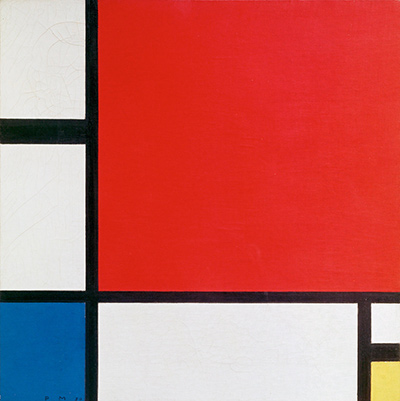
Composition with Red, Blue and Yellow (Zürich)
1930 · B217 · Kunsthaus Zürich’s painting with a documented Alfred Roth dedication.
Broadway Boogie Woogie
1942–43 · B323 · A completed New York canvas whose interrupted colour creates shifting rhythm.
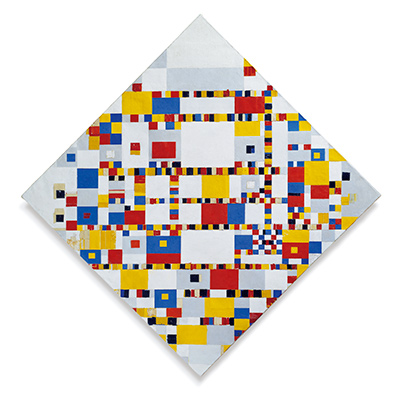
Victory Boogie Woogie
1942–44 · B324 · The unfinished diamond that preserves Mondrian’s taped revisions.
What changed in New York?
War forced Mondrian from Paris to London in 1938 and then to New York in 1940. MoMA records his arrival on 3 October 1940 and his introduction to boogie-woogie music through Harry Holtzman. Its recent account also places that music in the history of Black musicians and the Great Migration. The point is not to turn an abstract painting into an illustration of a piano score. Mondrian found in changing beat, interruption and repeated pulse a suggestive parallel to problems he was exploring on canvas.[1][14]
In Broadway Boogie Woogie, bars that might once have been continuous become many short segments of colour. White and gray gaps alter their apparent pace. MoMA describes a work revised with great care. Calling the yellow passages “taxi routes” may be a tempting modern comparison, but it goes beyond what the object record establishes. What the painting visibly gives us is a series of coloured relationships whose rhythm changes across the square.[12]
Victory Boogie Woogie is different even before one notices the tape: a square canvas is displayed on a point, changing how the straight internal directions meet its outer shape. Kunstmuseum Den Haag records oil paint, tape, paper and drawing materials, and describes revisions that continued in January 1944. Mondrian died on 1 February. A finished version cannot be reconstructed with confidence from the surviving canvas, but the unfinished state makes his continuing search visible. The original is owned by the Dutch state and is on long-term loan to the Kunstmuseum.[13]
The New York paintings do not cancel the earlier art. They retain Mondrian's concern with balance, opposition and the relation of each part to the whole, while allowing more small changes and interruptions. Comparing a tree from 1911, a composition from 1930 and a boogie-woogie canvas from the 1940s shows a life of revisions rather than a single final style.[9][12]
Who influenced Mondrian, and what followed him?
Artists do not work in isolation, but every connection needs its own kind of evidence. Kunstmuseum Den Haag says the example of Vincent van Gogh encouraged Mondrian to isolate strong motifs such as a tree or lighthouse. He met Jan Toorop in the Domburg years. In 1911 he encountered the Cubist work of Pablo Picasso and Georges Braque. During the war years he worked alongside artists including Bart van der Leck and Theo van Doesburg as the De Stijl network took shape. Those links are not interchangeable: an earlier example, a modern exhibition and a fellow participant are different relationships.[1][6][7]
The influence running outward is likewise varied. Guggenheim notes that Mondrian's visual vocabulary has been adapted in furniture, fashion, buildings, branding and other design settings. Its broad recognizability is real, but a later object with red, blue and yellow rectangles is not necessarily an attempt to make a Mondrian painting. His own work pursued a precise balance on a particular surface. The Connections section above offers a source-linked guide to several of the people and later contexts that help explain that history.[15]
How should you explore the collection?
Begin with one close comparison. The biography gives the longer chronology; the paintings, drawings and prints sections organize types of work. Individual artwork pages identify their objects before interpreting them. That matters especially with Mondrian because so many titles use “Composition,” a number, or a short list of colours. A painting in Zürich, another in Belgrade and a third in New York can be blurred together by a search result unless the collection and date accompany the image.[10][11]
Try following an element across periods. A tree branch in 1911 and a black division in 1930 are not the same motif, but both make surrounding space active. The large white areas of a Paris composition and the white interruptions in Broadway work differently, yet both ask the viewer to notice what lies between coloured parts. These comparisons are invitations to look, not claims that Mondrian hid one picture inside another.
Finally, check the object record when you need a fact. The institutions linked in the references identify dates, materials, dimensions and ownership; display in a gallery may change. This site's linked artwork pages bring those records together with close looking. The directory below lets you explore beyond the seven selected works without losing the distinctions among individual paintings.
Mondrian artworks directory
Frequently asked questions
What is Piet Mondrian famous for?
Did Mondrian always paint abstract pictures?
What does De Stijl mean in his career?
Is the Zürich red, blue and yellow painting the Belgrade Composition II?
Which boogie-woogie painting did Mondrian finish?
Discussion
Which early Mondrian work most changes how you see the famous colour-grid paintings?
Reader Insights
Compare The Red Tree and Gray Tree. What becomes more important than the subject?
Look from a 1930 composition to Broadway Boogie Woogie. What happens to the lines?
How do the Zürich B217 and Belgrade B212 paintings differ in colour and arrangement?
Join the Conversation
Share what you notice in this painting below.
References
- Kunstmuseum Den Haag, “Biography,” Mondrian chronology. View source.
- Solomon R. Guggenheim Museum, Jennifer Blessing, collection essay for Mondrian's Chrysanthemum and the two Gingerpot paintings. View source.
- Museum of Modern Art, “Piet Mondrian,” artist collection record. View source.
- Kunstmuseum Den Haag, record for Mondrian's 1918 Self-portrait, object 0334324. View source.
- Museum of Modern Art, “Neo-Plasticism,” art term. View source.
- Kunstmuseum Den Haag, record for Avond (Evening): The Red Tree. View source.
- Kunstmuseum Den Haag, record for The Grey Tree. View source.
- Kunstmuseum Den Haag, record for Flowering Apple Tree. View source.
- Museum of Modern Art, 1995 retrospective release, on Cubism, De Stijl, Neo-Plasticism and revisions. View source.
- Kunsthaus Zürich, record for Composition with Red, Blue and Yellow, inventory 1987/0028. View source.
- RKD – Netherlands Institute for Art History, catalogue sequence B206–B225, including Belgrade B212 and Zürich B217. View source.
- Museum of Modern Art, collection record for Broadway Boogie Woogie, object 73.1943. View source.
- Kunstmuseum Den Haag, collection record for Victory Boogie Woogie, object 0810747. View source.
- Museum of Modern Art, Mondrian Boogie Woogie exhibition introduction, on Mondrian's 1940 arrival and boogie-woogie history. View source.
- Solomon R. Guggenheim Museum, Piet Mondrian: Ever further exhibition release, on the long arc and later design adaptations. View source.
- Lead image credit. Piet Mondrian, Self-portrait, 1918. Kunstmuseum Den Haag, object 0334324. Image: Wikimedia Commons, public domain.