 by Tom Gurney
Tom Gurney BSc (Hons) is an art history expert with over 20 years experience
Published on June 19, 2020 / Updated on October 15, 2026
Email: tomgurney1@gmail.com / Phone: +44 7429 011000
The Apostles Group: a Louvre drawing once attributed to Titian: Introduction
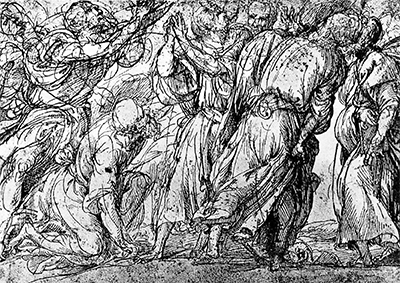
A cluster of robed figures turns, gestures and presses together in this small Renaissance drawing. The subject and an old inscription once made it seem a direct study by Titian for the apostles beneath the Virgin in his Frari Assumption. The Louvre now catalogues the sheet as Domenico Campagnola, dated 1517–18, and connects it more immediately with Campagnola’s engraved Pentecost. That change does not erase Titian from the sheet’s history. It changes the question from “Which part of Titian’s altarpiece was this drawn for?” to “How did a composition associated with Titian move through another Venetian artist’s work and through later collectors’ hands?”[1][2]
The object is INV 5516 recto in the Louvre’s Department of Prints and Drawings. The museum describes pen and brown ink with brown wash on a sheet 23.1 × 30.2 centimetres. Its present attribution rests on a comparison of style and related imagery; it is not a signed declaration by Campagnola on the paper. The record also preserves an opposing view that the hand may belong to a follower. These qualifications are essential when a drawing has carried Titian’s name for centuries.[1]
At a Glance
- WorkApostles Group
- Research recordMusée du Louvre
Contents
- Reading a crowd of apostles
- How the Frari attribution took hold
- Campagnola’s Pentecost engraving
- A current attribution with a recorded dissent
- From Crozat and Mariette to the Louvre
- What this sheet teaches about Titian’s drawings
Reading a crowd of apostles
The compact composition has no calm centre. Bodies overlap and draperies tumble into one another. A figure near the middle raises joined or closely held hands, while others turn in different directions, and a figure at the left bends toward the ground. The pen moves through heads, arms and folds in a dense mesh of line. Brown wash, recorded by the Louvre, gives the drawing tonal weight around the figures. The crowded arrangement is easier to read as a study of collective response than as a set of separate portraits.[1]
That response could belong to more than one Christian subject. In an Assumption, apostles gather around the place from which Mary has departed and look upward to her ascent. At Pentecost, the apostles receive the Holy Spirit. Raised hands, startled faces and collective motion suit both. The Louvre’s title, simply Group of Apostles, wisely does not identify an entire event from a group of figures alone. Its catalogue discusses both the old Frari connection and the link to Campagnola’s Pentecost print. The surrounding scene, absent from this surviving sheet, matters when deciding how the group was used.[1][2]
A narrow view of the figures can also obscure the drawing’s physical history. The Louvre records a 23-millimetre strip of paper added along the whole top edge. The sheet was later pasted to a much larger collector’s mount. Those changes mean that a modern image of the central drawing, especially a close crop, is not the full object a collector handled. The drawing is both an early sixteenth-century design and an artefact of later presentation.[1]
How the Frari attribution took hold
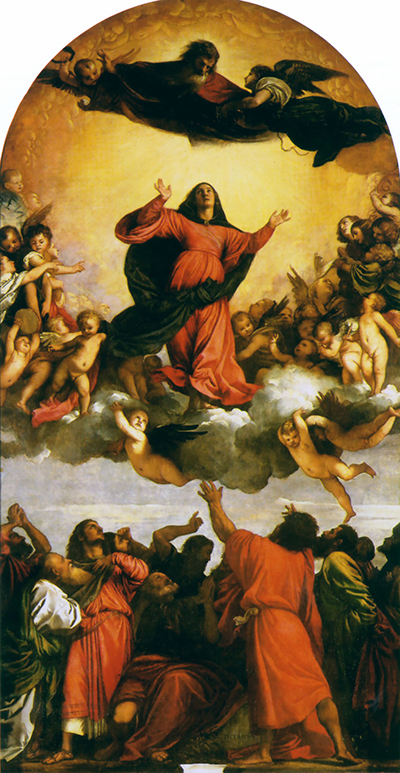
An old note at the lower right reads, in substance, “Titian for the high altar of the Frari in Venice.” It linked the figures to Titian’s monumental Assumption of the Virgin, painted for Santa Maria Gloriosa dei Frari in 1516–18. Because the altarpiece itself contains a turbulent group of apostles below the ascending Virgin, the proposed relationship was visually attractive. But an annotation written on or attached to a drawing records someone’s identification; it is not proof that Titian held the pen or that the sheet was made inside his workshop.[1]
The note was reinforced by the object’s later mounting. Pierre-Jean Mariette’s mount names “TITIEN VECCELLI” in a cartouche, and earlier collection records sold the sheet under Titian’s name. The Louvre lists Titian among its former attributions, including those of Mariette and later cataloguers. It also records Campagnola as the present maker on the basis of Konrad Oberhuber’s attribution. Reading these names chronologically is more useful than treating them as a vote. A collector’s old name tells us how the sheet was understood and valued at that time; a modern attribution weighs the drawing against related works and the handling of the line.[1]
The sheet was associated with a celebrated Titian, so it acquired a compelling story before twentieth-century reassessment. The history shows why inherited titles are sticky. A label could be copied into sale catalogues, onto mounts and into museum inventories, each appearance giving the old attribution further apparent authority. The Louvre keeps this record visible while identifying the physical sheet differently today.[1]
Campagnola’s Pentecost engraving
Oberhuber related the Louvre group to an engraving of the descent of the Holy Spirit made by Domenico Campagnola around 1517–18. The National Gallery of Art in Washington owns impressions of a 1518 engraving titled The Descent of the Holy Spirit, catalogued under Campagnola’s name. An impression is an independent, surviving point of comparison, unlike the hypothetical lost drawing sometimes invoked behind the Louvre sheet. It locates a similar gathering of apostles within Campagnola’s printmaking practice at the same date.[1][2][3]
Drawing and engraving do different jobs. Ink and wash allow revisions in a unique sheet; an engraved plate produces repeatable impressions. Connecting this drawing with an engraving therefore asks how a group was adapted from one medium to another, not merely whether two titles sound alike. The Louvre says the drawing was a preliminary study for the apostles witnessing the Spirit’s descent in Campagnola’s print. That is its current explanation of the sheet’s immediate function, based on the figures’ style and execution. It is a stronger, object-based proposal than a bare historical label calling the drawing a Titian study.[1][2]
Campagnola also engraved a separate Assumption of the Virgin in 1517. The Metropolitan Museum of Art owns an impression showing Mary above a gathering of apostles. Its existence makes the shared Venetian vocabulary of excited apostle groups particularly clear. Yet the Met’s Assumption engraving and the National Gallery’s Pentecost engraving are distinct prints, and neither is the Louvre pen drawing. Keeping the three objects separate prevents a familiar scene of apostles looking upward from becoming a false one-to-one proof about the Louvre sheet.[2][4]
Oberhuber allowed for a more distant Titian connection: he thought the Louvre design could ultimately derive from a lost drawing by Titian for the apostles of the Frari painting. This is a hypothesis about a missing link in a chain of images. Since the proposed Titian sheet does not survive, it cannot be compared directly for line, paper or alterations. Even if the broader compositional debt is right, it would not make the Louvre sheet an autograph Titian. Influence, preparation, copying and authorship describe different relationships.[1]
A current attribution with a recorded dissent
The Louvre says Campagnola’s authorship is generally accepted, but its catalogue also reports Harold Wethey’s objection. Wethey judged the drawing too weak for Domenico himself and proposed a follower of Campagnola. That is a different disagreement from the earlier Titian attribution. Both Campagnola and a follower would move the surviving hand away from Titian; the question between them is how close this sheet stands to Campagnola’s own practice.[1]
The museum’s notation preserves a useful hierarchy of confidence. The direct Titian attribution belongs to the sheet’s collecting history. Campagnola is the current catalogue name, backed by a comparison to a dated engraving. A follower remains a published alternative. The putative lost Titian design is a separate explanatory proposal. Combining these into the sentence “Titian designed the drawing” would turn several distinct claims into one certainty that the evidence does not support.[1][2]
The dating also requires care. The Louvre gives 1517–18 for the drawing, a period consistent with Campagnola’s related print activity and with the completion of Titian’s Frari altarpiece. A matching period makes a relationship plausible, but dates alone cannot establish a direct commission or the order in which every design was made. The sheet should be described as a work of the Venetian artistic world around the Frari project, with its precise chain of transmission left open.[1][2]
From Crozat and Mariette to the Louvre
The drawing’s collector history is unusually informative about its attribution. Pierre Crozat marked it with the number 18 at the lower right. At the 1741 sale after his death, it appeared within a group of six drawings sold as Titian’s, including one described as a study for the lower apostles of the Frari altarpiece. Hecquet bought the group for Mariette. The Louvre records the price for this purchase as 12 livres, 5 sols. The old description shows that the Frari connection was already part of the sheet’s market identity long before modern attribution debate.[1]
Mariette’s own mount then gave the drawing its large display frame and Titian cartouche. When his collection was sold in November 1775, the sheet again appeared among works named for Titian. Lempereur acquired it, and it entered the French royal cabinet that year. It eventually passed to the Louvre. Even a later Musée Napoléon inventory described astonished apostles and repeated the idea of a drawing connected to Titian’s Frari Assumption. The persistence of the name is therefore documented at several stages, not guessed from one stray inscription.[1]
These records establish where the sheet travelled after the early eighteenth century. They do not fill the gap between its making around 1517–18 and its appearance in Crozat’s collection. Nor does an old sale price tell us how the original artist or patron regarded it. The strongest value of this provenance for today’s reader is interpretive: it explains why a Campagnola-attributed drawing could be so firmly embedded in the literature and display history of Titian.[1]
What this sheet teaches about Titian’s drawings
The Louvre Group of Apostles sits at the edge of Titian’s oeuvre, but that edge is historically revealing. Its figures were linked to one of Titian’s best-known paintings; a specialist later connected their handling and arrangement to Campagnola’s dated print; another specialist challenged Campagnola’s own hand. The sheet demonstrates how a shared composition can travel between a monumental painted altar, drawings and printed images without every surviving object being by the same artist.[1][2]
It also shows why the physical evidence deserves a place beside names. The ink-and-wash technique, added strip, collector’s number and Mariette mount are all features of this specific Louvre object. They distinguish it from the Frari painting and from the surviving engraved impressions. The Titian drawings guide offers the broader context for such attribution problems. For this sheet, the responsible short description is Domenico Campagnola, formerly attributed to Titian, with the Louvre’s follower alternative and possible lost Titian source clearly marked as interpretations.[1]
Researched Titian and related works
Frequently Asked Questions
The Louvre currently attributes the surviving drawing to Domenico Campagnola. Titian is a former attribution, and a follower of Campagnola has also been proposed.[1]
An old note links the group to Titian’s Frari high altar, and Mariette’s later mount labels it “TITIEN VECCELLI.” They document a historical attribution, not a signature by Titian.[1]
It was long described that way. The Louvre now connects the surviving sheet to Campagnola’s Pentecost engraving. A more distant derivation from a lost Titian design has been proposed but cannot be verified against that missing drawing.[1][2]
It is INV 5516 recto in the Louvre’s Department of Prints and Drawings, Paris.[1]
Discussion
What do you notice when you look closely at The Apostles Group: a Louvre drawing once attributed to Titian?
Share a specific observation or a source that adds context.
Reader Insights
Which detail changes your reading?
How does its original setting affect what we see?
Which part of the evidence remains uncertain?
Join the Conversation
Add your observation below.
References
- Musée du Louvre, “Groupe d’apôtres,” INV 5516 recto, object, attribution and provenance record. View source.
- National Gallery of Art, Domenico Campagnola, The Descent of the Holy Spirit, 1518, engraving, Rosenwald Collection 1943.3.2694. View source.
- National Gallery of Art, second impression of Campagnola’s The Descent of the Holy Spirit, 1518, 1943.3.2693. View source.
- Metropolitan Museum of Art, Domenico Campagnola, Assumption of the Virgin engraving, 1517, accession 20.24.59. View source.