by Tom Gurney
Tom Gurney BSc (Hons) is an art history expert with over 20 years experience
Published on June 19, 2020 / Updated on October 15, 2026
Email: tomgurney1@gmail.com / Phone: +44 7429 011000
Landscape with a Goat: an early drawing attributed to Titian: Introduction
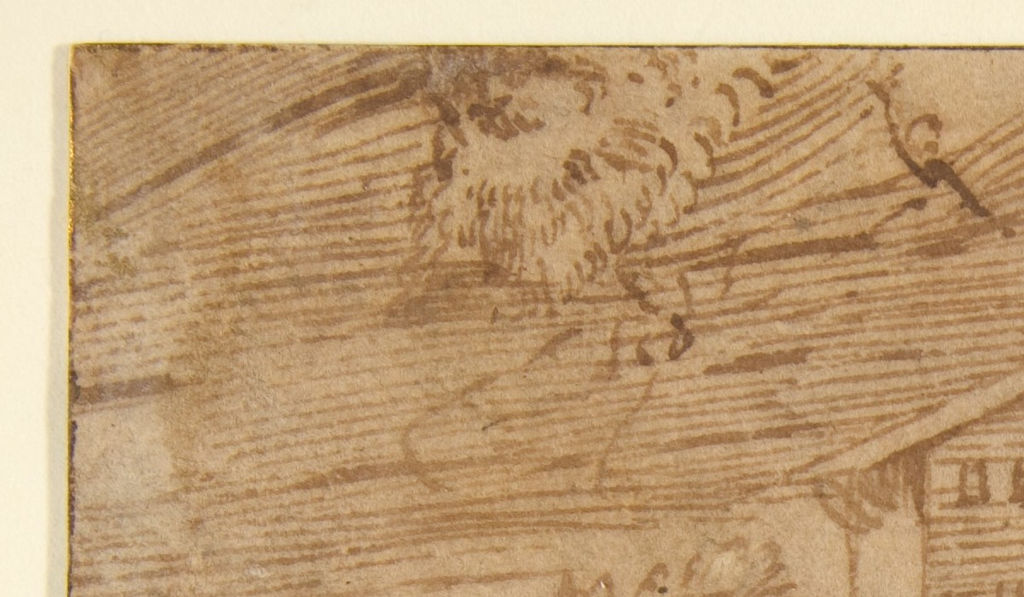
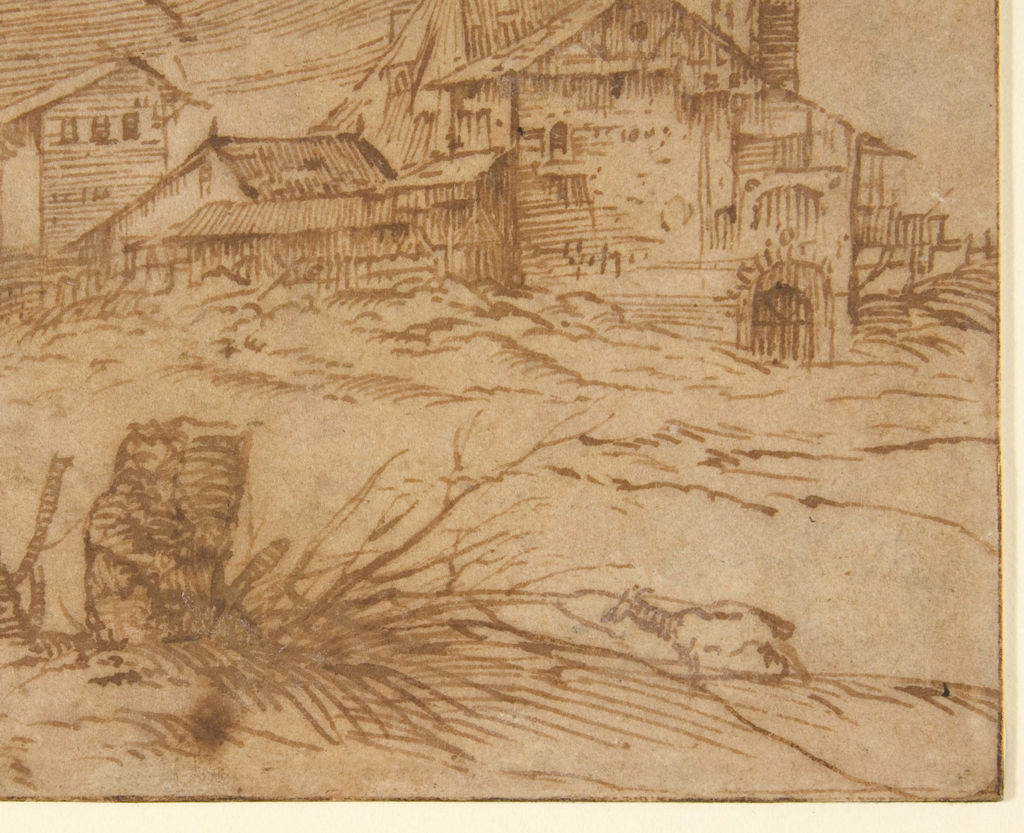
A few buildings climb across a hill. Shrubs, tracks and a small goat occupy the lower ground. Near the upper left edge, a puzzling remnant intrudes on the landscape: it is part of a bearded man's head, left behind when the sheet was cut down. The drawing belongs to the Metropolitan Museum of Art in New York, object 1991.462. It is a little work in pen and brown ink, only 9.7 × 15.3 cm, and is catalogued Landscape with a Goat. The museum dates it broadly 1500–11, while explaining that its authorship and precise year call for care.[1]
The Met calls the sheet one of the few drawings that can plausibly be attributed to Titian. That word matters. His paintings are numerous, but drawings accepted as his are scarce, and early Venetian landscape drawing presents difficult boundaries between artists working in related styles. The present sheet offers an unusually close look at how a landscape could be assembled in pen, even if no signature proves the maker. It is also a distinct physical object from a larger Landscape with a Goat in the Louvre, despite the titles' similarity.[1][2]
At a Glance
- WorkLandscape with a Goat
- Research recordMetropolitan Museum of Art
Annotated details from Landscape with a Goat
Select a numbered area to find its detail below. Open a detail image to view it larger.
Details from LANDSCAPE WITH A GOAT
Landscape with a Goat Head Fragment
Landscape with a Goat Buildings and Goat
Gift of Mr. and Mrs. Paul L. Herring and Mr. John D. Herring, 1991 Public domain. Image source · Reuse licence
Contents
- How the landscape is built
- The fragment at the edge
- Titian, Giorgione and an uncertain date
- The other Landscape with a Goat
- A sheet with a later collecting history
How the landscape is built
The buildings are constructed from compact vertical and horizontal marks. Lines darken the walls, windows and steep roofs. The structures do not emerge from a carefully ruled architectural plan; their tight hatching gives them solidity within a quickly evoked rural scene. In the foreground, longer and more curved strokes make shrubs, grass and uneven ground. The goat is small enough to be missed on a first viewing, yet it fixes the setting as a lived-in pastoral landscape rather than a display of empty architecture.[1]
The Met's catalogue draws attention to this contrast of marks across related sheets: close straight strokes for buildings, vigorous curves for natural forms. It is a practical observation about drawing technique. A pen can change the density and direction of line very quickly, setting a hard-edged roof against softer foliage without changing medium. The artist lets the brown ink and the paper's light ground create an atmospheric difference with remarkably few tools. The museum also records framing lines in pen and brown ink around the composition.[1]
Nothing in the Met's account identifies the buildings as a surveyed village or names a commission for the image. They resemble rustic farms of the sort the museum associates with the countryside near Titian's birthplace, Pieve di Cadore, but that comparison is not a geographic identification of this exact hillside. The sheet is valuable for the way it selects and organises familiar rural forms, not for proving that Titian recorded a specific address.[1]
The fragment at the edge
The upper-left remnant makes the material history of the drawing visible. The Met says it has been interpreted in various ways, but is surely the lower part of a bearded human head. Because the sheet has been trimmed, we cannot see the full figure or know exactly how the head related to the landscape on the original paper. The drawing could once have offered a larger composition or shared space with another study. The present rectangular view is a later surviving fragment, not necessarily the artist's entire intended page.[1]
One proposal has tried to join it intellectually to an Alpine landscape with an eagle in the Uffizi. The Met describes that suggestion but says the evidence for the two studies formerly being parts of the same sheet is scant. Similar manner and an odd cut edge are not proof that two museum objects once touched. The bearded head is worth noticing because it complicates the surviving landscape, while the lost original arrangement remains uncertain.[1]
The fragment also changes how we look. If the head belongs to a figure, the paper may have moved between studies of people and landscape. Yet the goat and buildings occupy the attention now. Their tiny scale and lively marks make a convincing scene even though the page has lost some of its former edge. It is possible to appreciate the surviving composition without pretending that the trim has no consequences.[1]
Titian, Giorgione and an uncertain date
The Met relates the sheet to the poetic landscape manner of Giorgione, whose work mattered greatly to young Titian. Its overview of Titian's career notes how close the two artists' early pastoral styles could be. That shared visual world is one reason the attribution of such drawings should be expressed carefully: a similarity to early Titian's painting can support a proposal, but does not function like a signed document.[1][3]
The museum compares this sheet with a different drawing of farm buildings and a goat in the Louvre, an Uffizi alpine landscape with an eagle and a more problematic group represented by an Alpine Village with Two Lovers at Chatsworth. Straight-hatched architecture and freely curving ground recur across the group. The common habits suggest an early Venetian landscape practice; they do not prove all the sheets have identical authorship or were made together. The Met also compares the landscape handling with Titian's documented 1510–11 frescoes in the Scuola del Santo at Padua and with the London Noli me tangere of about 1512.[1]
The dating remains a range rather than a single secure year. The Met's top-line date is 1500–11, and its essay suggests perhaps about 1511. It records proposals placing related drawings in the first decade of the century, around 1511–12, or as late as 1512–15. These disagreements do not make the sheet undatable in any useful sense. They place it in the early phase when Titian and Giorgione's approaches to landscape were closely intertwined, while warning against claiming that a pen sketch must precede or follow a named painting by exactly one year.[1][3]
The other Landscape with a Goat
The Louvre drawing, INV 5539 recto, bears the French title Paysage avec des bâtiments de ferme et une chèvre. It is also in pen and brown ink, but measures about 15.8 × 22 cm—larger than the Met's 9.7 × 15.3 cm sheet. The two museum numbers, measurements and collection histories establish two objects. The Met cites the Louvre landscape as a stylistic comparison, not as a second name for its own drawing.[1][2]
The Louvre record notes that a motif from its sheet was reworked on the verso of another Paris drawing, INV 4648. That is evidence about a Paris group of drawings and motifs. It does not mean the New York sheet is the verso of the Louvre work, or that the goat in each landscape is the same little patch of ink. Keeping the records separate lets comparison remain productive without losing the identity of either drawing.[2]
A sheet with a later collecting history
The Met acquired its drawing in 1991 as a gift from Mr and Mrs Paul L. Herring and John D. Herring. A Met scholarly catalogue of sixteenth-century Italian drawings also lists earlier owners William Esdaile and Sir Thomas Lawrence. These names trace part of the sheet's later collecting life; they do not establish where the artist kept it, how it was first used or why it was trimmed. The small work became newly prominent in Titian studies after its modern appearance and acquisition.[1][4]
The Met marks its image public domain under Open Access, allowing the pen work to be studied at a scale far larger than the original sheet. Enlargement is helpful for following each stroke, but it can make a drawing under ten centimetres high seem monumental. Keep the actual dimensions in mind: the landscape's economy and the tiny goat are achievements of a hand working rapidly across a modest piece of paper.[1]
The Titian drawings guide places the sheet among questions of attribution and medium. Begin with the village and goat, compare the straight and curved pen marks, and finally inspect the bearded fragment at the cut edge. That sequence reveals both the drawing's lively invention and the limits of what its surviving state can prove.[1][3]
Researched Titian and related works
Frequently Asked Questions
The drawing discussed here is Metropolitan Museum of Art object 1991.462, in New York.[1]
The Met catalogues it under Titian but says it is one of the few sheets that can plausibly be attributed to him. The exact attribution remains a scholarly judgement.[1]
The remaining lower part of a bearded man's head. The paper was trimmed, so the original full image is unknown.[1]
Pen and brown ink, including brown-ink framing lines.[1]
Discussion
What do you notice when you look closely at Landscape with a Goat: an early drawing attributed to Titian?
Share a specific observation or a source that adds context.
Reader Insights
Which detail changes your reading?
How does its original setting affect what we see?
Which part of the evidence remains uncertain?
Join the Conversation
Add your observation below.
References
- The Metropolitan Museum of Art, “Landscape with a Goat,” object 1991.462, collection essay and object record. View source.
- Musée du Louvre, “Paysage avec des bâtiments de ferme et une chèvre,” INV 5539 recto, record of the distinct Paris sheet. View source.
- The Metropolitan Museum of Art, “Titian (ca. 1485/90?–1576),” Heilbrunn Timeline of Art History, on early pastoral drawing and Giorgione's influence. View source.
- The Metropolitan Museum of Art, Sixteenth-Century Italian Drawings in New York Collections, entry 108, catalogue data and collecting history. View source.