by Tom Gurney
Tom Gurney BSc (Hons) is an art history expert with over 20 years experience
Published on June 19, 2020 / Updated on October 15, 2026
Email: tomgurney1@gmail.com / Phone: +44 7429 011000
Titian's Man with a Glove: the Louvre portrait and its unknown sitter: Introduction
A young man emerges from a dark setting. His face and pale shirt catch the light, while his clothing almost joins the ground behind him. One hand is bare; the other is gloved and holds a removed glove. That small action has supplied the name by which the picture is widely known, but it has not supplied the sitter's identity. The Musée du Louvre catalogues it as Portrait d'homme, dit L'Homme au gant—a portrait of a man called Man with a Glove. Its inventory numbers are INV 757 and MR 507. The oil painting on canvas measures 100 × 89 centimetres.[1]
The wording of the title matters. It describes a visible detail and a conventional name, not a historical person. The Louvre's current record attributes the painting to Titian and dates it broadly to 1500–1525, the first quarter of the sixteenth century. A precise year often attached to reproductions should not replace that institutional date without a stated argument. The most secure starting points are the physical picture, the Louvre's identifiers, and the fact that the sitter remains unnamed.[1]
At a Glance
- WorkMan with a Glove
- Research recordMusée du Louvre
Annotated details from Man with a Glove
Select a numbered area to find its detail below. Open a detail image to view it larger.
Details from MAN WITH A GLOVE
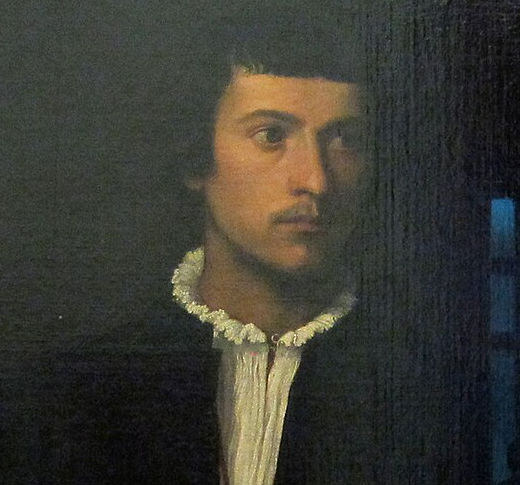
Man with a Glove Face and Collar
Man with a Glove Hands
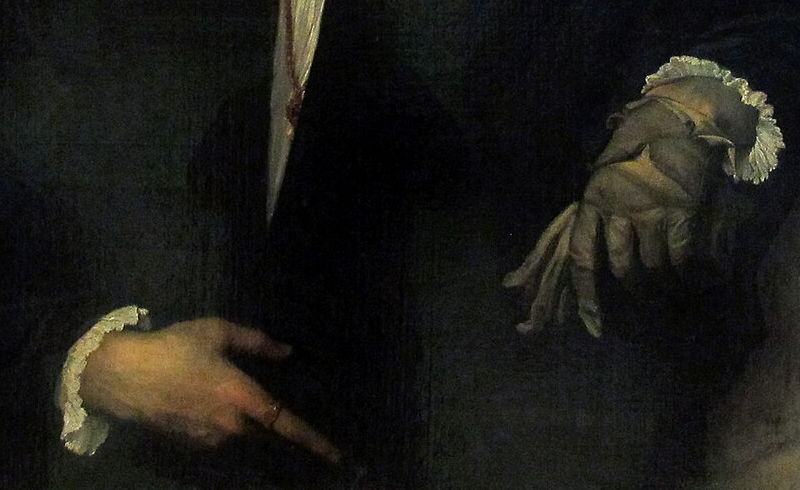
Photo: Sailko, CC BY 3.0; frame cropped and details resized. Painting: Titian, Man with a Glove, Musée du Louvre INV 757. Image source · Reuse licence
Contents
- What the hands are doing
- A face made present without a name
- What date can be given?
- Clothing, status and caution
- A provenance with question marks
- A modern artist's response
- How to read this painting responsibly
What the hands are doing
The gloved hand appears at the viewer's right and carries its partner, which has been taken off. The bare hand rests lower on the opposite side of the body. Their contrast creates a miniature sequence: a hand prepared for public appearance, a glove removed, another glove still worn. The image holds that action still. It does not tell us whether the young man was arriving, departing, posing after a greeting or simply displaying a fashionable accessory. Treating a plausible social scenario as a documented event would add a story the picture cannot confirm.[1]
The hands are unusually important because so little else explains the sitter. There is no name, coat of arms, book or profession-specific tool in the Louvre's title or record. A glove could be a valued article of dress, and the combination of carefully presented hands and dark clothing communicates controlled elegance. But no detail by itself proves that he belonged to a named family, held an office or had just performed a particular act of courtesy. The pose gives him individuality without giving him a biography.[1]
The bare hand and the gloves also ask us to notice the painting's material contrasts. Skin can be modelled softly, leather folded into irregular forms, white cloth edged with small bright passages and dark fabric held just apart from the background. The young man's body is visible partly through differences within darkness rather than through a bright costume. A viewer's eye can move from face to open shirt and then down toward the hands. This is close looking at the reproduced image, not a technical report on pigments or underdrawing; the Louvre's public record identifies oil on canvas but does not give an exhaustive conservation study.[1]
A face made present without a name
The head turns slightly, and the sitter's gaze goes beyond a straightforward exchange with the viewer. His expression is restrained. The dark surrounding space prevents a detailed setting from competing with his features. Bright areas of face and shirt give him a physical presence even as the rest of the figure withdraws into shadow. That combination can feel intimate and distant at once, which helps explain why the portrait remains memorable when the sitter's life is unknown.[1][2]
It is tempting to translate expression into a definite character judgment: melancholic, arrogant, shy or intellectually absorbed. None can be proved from the visible face alone. Portraits are constructed images, often shaped by painter and sitter together. A slight turn of the head and a steady expression show Titian's means of presentation, not a clinical record of a personality. The most defensible description explains how pose, light and the small glove action direct attention while leaving private motives open.[1]
The Louvre's title keeps that restraint. “Portrait of a man” acknowledges that identification is not secure; “called Man with a Glove” acknowledges the name earned through reception. A catalogue that once used a different attribution, or an exhibition that offered a narrower date, belongs to the work's history, but should not be substituted silently for the present object label. Titles are useful for finding pictures; inventory numbers are better for making sure two people are discussing the same canvas.[1]
What date can be given?
The Louvre's current record says 1500–1525. That is a deliberately broad classification rather than a claim that Titian spent the whole interval working on the painting. It places the image within an early part of his career but does not assign it a firm year. Some accounts of early Titian portraiture favour a narrower span based on dress, stylistic comparison or exhibition context. Without that argument and its source, a number such as “1520” should be presented as an approximate scholarly proposal, not as a fact supplied by the Louvre's main data field.[1]
Dates also depend on identifying the exact picture being compared. Another portrait by Titian with a glove appears in the National Gallery, London. Its Portrait of a Young Man, inventory L611, is dated about 1515–20. That date belongs to the London canvas, not to the Louvre's INV 757. The London painting has a hat, a stone parapet and carved architectural details; its sitter also remains unknown. Shared accessories can show a fashion or compositional interest without collapsing separate sitters, pictures and dates into one.[1][3]
There is a second potential confusion within the Louvre's own collection. A smaller Portrait d'homme with the usual title L'Homme au gant is listed as INV 885 bis / MR 509 and is on long-term loan to the Musée-Palais Fesch in Ajaccio. The Louvre records it as a sixteenth-century work of the school of Titian, measuring 87 × 73 centimetres. It records a 1662 sale from Jabach to Louis XIV for that canvas. Those details belong to the Ajaccio picture, not to the Louvre's 100 × 89-centimetre INV 757, acquired from Jabach in 1671. The repeated title and shared collector are good reasons to check the inventory number before transferring a date, attribution or provenance.[1][4]
The comparison is useful in another way. The National Gallery interprets its sitter as having removed a glove while taking off his hat, creating a momentary action. The Louvre picture also uses gloves to make a portrait feel less rigid, but it has a different pose and no matching hat in the composition. The two objects show how a glove can animate a likeness; they do not prove that the same gesture or social circumstance is represented. Readers should check museum, inventory and visible setting before borrowing a descriptive detail from one “young man with glove” for another.[1][3]
Clothing, status and caution
The clothing is dark, carefully controlled and interrupted by light material at the neck and wrists. The gloves are given sufficient prominence to serve as the picture's defining feature. Together these choices suggest a sitter able to present himself with refinement. They do not supply a measurable rank. Dress can mark taste, expense and social aspiration, but the Louvre's public record does not identify a particular order of nobility, job or wedding occasion. The portrait should not acquire an invented profession because its young man looks confident.[1]
The absence of an elaborate setting matters too. Titian could present patrons through heraldry, architectural details or conspicuous materials. Here restraint concentrates interest on posture and bodily detail. The face remains the focal point even though the title singles out a glove. The removed object guides the eye back to the sitter: who chose to be pictured at this instant, and why? Those are productive questions, but the painting's power does not depend on pretending we can answer them with a name.[1]
Its scale is substantial for a half-length image: a metre high. In a gallery, the young man occupies more space than a small cabinet likeness. Online crops can alter that experience, especially if they isolate the face and suppress the relation between the two hands. The 100 by 89 centimetre dimensions in the Louvre's record help a reader imagine the full object rather than only a photograph of one expressive detail.[1]
A provenance with question marks
The Louvre's early history for INV 757 is explicitly tentative. It places question marks before the dukes of Mantua, Charles I of England, a London sale in 1651 and J. Jackson. These are possible stages, not a fully proven uninterrupted chain. The museum's more secure sequence brings the painting to the Paris collection of Everhard Jabach, from whom Louis XIV acquired it in 1671. Those later names explain how the portrait entered a royal collection that eventually became part of the Louvre.[1]
The 1683 royal inventory introduced another historical difference. It described the painting as “in the manner of Titian.” That wording records a past classification, while the Louvre's current artist field names Titian. The old line is not evidence that the museum now rejects the attribution, and the current line does not erase the earlier hesitation. Attribution histories are part of an object's reception, just as ownership histories are; their dates and wording need to be kept in their own time.[1]
The later display and loan history is comparatively visible. The Louvre records the picture in exhibitions of Titian and Venetian painting, including displays in Vienna and Washington in 2006–07 and an Ajaccio exhibition devoted to The Man with a Glove in 2010. These loans tell us about the painting's importance to later viewers and institutions. They do not settle the sitter's name or turn the qualified earlier owners into certain ones. The museum's record presently lists the picture in the Denon wing's Room 711, a location worth checking again before a visit because display arrangements can change.[1]
A modern artist's response
The Louvre's 2024 account of Elizabeth Peyton's engraving L'Ami (D'après Titien) shows how a later artist can approach the portrait without claiming to solve it. Peyton worked from a reproduction cropped toward the young man's face, and the museum reflects on the uncertainty of whether the glove's removal or retention is the more compelling action. Her print belongs to a contemporary response to Titian, not to the sixteenth-century making of INV 757.[2]
The change of crop is revealing. If the hands disappear, the sitter's face may seem to carry the whole story. In Titian's full canvas, the glove and the bare hand complicate that impression. The Louvre's account of Peyton's work draws attention to how copying, engraving and selective framing can make a familiar portrait newly strange. This is reception history: it tells us what a modern maker found suggestive, while leaving Titian's exact intention and the sitter's identity unresolved.[2]
How to read this painting responsibly
Start with the whole image and its two hands. Then look at the face, the white edges of clothing and the dark areas that hold the figure together. The glove is an observable object; its meaning is open. Next check the Louvre's exact title, INV 757 / MR 507, dimensions, attribution and broad date. Those details distinguish the canvas from the National Gallery's separate glove-bearing portrait. Finally read the provenance's punctuation: its early question marks and its firmer 1671 acquisition record do not have the same certainty.[1][3]
The paintings guide places this work among portraits with named and unnamed sitters. Compare it with Federico II Gonzaga, whose identity rests on a different historical record. In Man with a Glove, the restraint of the setting, the withheld name and the arrested gesture make the person vivid without making him knowable in a modern biographical sense. That is a distinctive achievement of the painting, not a gap to be filled by a guessed identity.[1]
Researched Titian and related works
Frequently Asked Questions
The Louvre's current catalogue does not establish his identity. The familiar title describes the accessory rather than naming him.[1]
It is in the Musée du Louvre, Paris, as INV 757 / MR 507. The museum's live record lists its current gallery location.[1]
The Louvre uses the broad first-quarter-of-the-sixteenth-century date 1500–1525. A narrower date should be attributed to the argument or exhibition that proposes it.[1]
No. London's Portrait of a Young Man, L611, is a separate canvas with a hat, parapet and architectural setting. Its date and visual details should not be transferred to the Louvre's painting.[1][3]
The Louvre lists Charles I among possible early owners with a question mark. It more firmly records Louis XIV's purchase from Everhard Jabach in 1671.[1]
Discussion
What do you notice when you look closely at Titian's Man with a Glove: the Louvre portrait and its unknown sitter?
Share a specific observation or a source that adds context.
Reader Insights
Which detail changes your reading?
How does its original setting affect what we see?
Which part of the evidence remains uncertain?
Join the Conversation
Add your observation below.
References
- Musée du Louvre, “Portrait d'homme, dit L'Homme au gant,” object INV 757 / MR 507, collection record, provenance and exhibition history. View source.
- Jean Capeille, Musée du Louvre, “Auprès de L'Homme au gant: Elizabeth Peyton à la chalcographie du Louvre” (5 November 2024). View source.
- National Gallery, London, “Titian, Portrait of a Young Man,” separate canvas L611. View source.
- Musée du Louvre, second “Portrait d'homme,” also called L'Homme au gant, INV 885 bis / MR 509, on long-term loan in Ajaccio. View source.