 by Tom Gurney
Tom Gurney BSc (Hons) is an art history expert with over 20 years experience
Published on June 19, 2020 / Updated on October 15, 2026
Email: tomgurney1@gmail.com / Phone: +44 7429 011000
Titian's Orpheus and Eurydice: Introduction
Orpheus and Eurydice at the Accademia Carrara in Bergamo is a painting in which landscape does much of the storytelling. Figures occupy the outer edges of a small horizontal panel. Between them lie dark ground, a looming rock, a fiery opening and a distant view across water. The regional catalogue currently attributes the work to Titian and dates it to about 1512. Its national counterpart gives about 1510 for the same object. Both dates place this unusually small mythological picture near the beginning of Titian's career, long before the expansive mythologies he made for royal patrons.[1][2]
The painting is oil on panel, 39.6 centimetres high and 53 centimetres wide. It belongs to the Carrara's Fondo Lochis under inventory number 81LC00179. Those identifiers matter because the subject has been treated by many artists and the attribution of this particular panel has changed over time. Here the object is the Bergamo panel, with a recorded chain of nineteenth-century ownership and a long, sometimes contested scholarly history.[1][2]
At a Glance
- WorkOrpheus and Eurydice
- Research recordlombardiabeniculturali.it
Contents
- What happens in the picture?
- The myth and the moment depicted
- Why is the landscape so important?
- Titian or Giorgione?
- The panel's material history
- From the Lochis collection to the Carrara
- Why this early mythological painting matters
What happens in the picture?
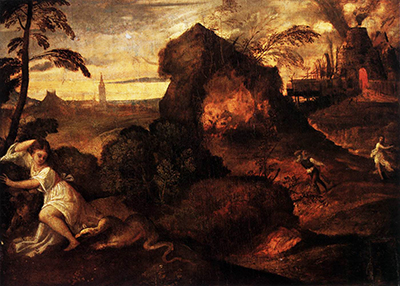
The Carrara's own description identifies Orpheus and Eurydice as fleeing Hades, with a creature biting Eurydice's leg. At first glance, the visual field may seem dominated by the central rock and burning glow. Looking longer, the human drama emerges in two small, separated groups toward the sides. The distance between them makes a story of loss and attempted recovery legible across the whole width of the panel rather than in one large encounter.[1][3]
The regional record inventories a serpent, a village and bell tower, the sea, structures on stilts, and what it calls possible ovens. Its question mark after the last identification is a useful reminder of scale: at this size, some painted forms are difficult to name securely. A viewer can see the distant settlement and the contrast between firelit and shadowed terrain without deciding that every tiny building has a particular practical use. The record names the figures, but the story is conveyed as much through the intervals of land as through individual gestures.[1]
The left side opens to a horizon and a slender tower. The centre rises into a heavy, almost obstructive mass of dark rock, pierced by a bright orange glow. The right side is another tangle of tree, architecture and rough ground. These zones do not give the eye one uninterrupted road into the distance. Instead, movement across the picture feels interrupted and uncertain. That effect suits a myth whose central journey is both a passage out of the underworld and a failure to complete it. This is a reading of the composition, not a claim that Titian left a written explanation of its symbolism.[1]
The reproduction is modest in resolution, so the painting's smallest details deserve restraint. The broader arrangement, however, is clear: the landscape is neither a neutral stage nor a precise map of the ancient underworld. It compresses distant habitation, water, rock, fire and figures into a single unsettled scene. The regional catalogue makes this point forcefully when it calls the landscape the picture's true protagonist.[1]
The myth and the moment depicted
In Ovid's Metamorphoses, Eurydice dies when a serpent bites her ankle soon after her marriage to Orpheus. Orpheus descends among the dead and moves the rulers of the underworld through his music. They allow Eurydice to follow him back toward daylight on one condition: he must not turn to look at her before they reach the surface. Near the end of their climb, he does turn, and loses her a second time.[4]
That sequence is essential context, but it need not force this panel into an exact illustration of one line of Ovid. The museum describes a flight from Hades and a biting creature. The catalogue's subject inventory also names a serpent. The painted landscape invites a viewer to register the peril of the passage, the earlier wound and the possibility of renewed separation together. Treating the picture as a compressed visual telling explains its emphasis on terrain and atmosphere better than requiring every figure to stand for an unambiguous instant in the poem.[1][3][4]
The title does not tell us whether a contemporary owner would have read a precise literary source or a more general version of the widely known myth. Ovid gives a strong point of reference for the serpent and the forbidden backward glance, while the picture's iconography is interpreted by the collection records. A roughly contemporary engraving by Marcantonio Raimondi offers another treatment of Orpheus and Eurydice, but the Metropolitan Museum does not establish it as a model for the Bergamo panel. It shows how the subject circulated in early sixteenth-century visual culture, not a documented line of borrowing.[4][5]
Why is the landscape so important?
The regional catalogue describes the picture's space as built from contrasting masses of colour rather than a single smoothly measured perspective. Its dark foreground, illuminated centre and receding horizon create a rhythm of blockage and opening. That formal account helps explain why a panel only just over half a metre wide can suggest a much larger, unstable world. The colour contrasts make the terrain active: the viewer's attention repeatedly passes from bodily danger to distant light and back.[1]
The catalogue compares this landscape with northern European ideas, naming Dürer and Bosch, and notes the popularity in Venice of northern fire landscapes. Such comparisons concern visual affinities and a wider taste for dramatic scenery. They do not identify a particular print that Titian copied, or prove a journey north. The fiery passage and strange terrain also help explain why the work once sat comfortably in discussions of Giorgione: both early Venetian attribution and early Venetian landscape painting remain intertwined in the literature on this panel.[1]
The same institutional account relates its construction through colour to Titian's work in the Scuola del Santo at Padua in 1511. It uses that comparison to place the painting around the start of the second decade of the century. The comparison is a dating argument based on style, rather than a dated contract for Orpheus and Eurydice. It is valuable precisely because no securely documented first commission has settled the question. The panel is generally considered likely to have been intended for private viewing, but the catalogue offers no named original patron.[1]
Other early works can clarify the range of possibilities without turning them into a commissioned set. The regional record reports Paul Joannides's comparison with Titian's Three Ages of Man in Edinburgh and Sacred and Profane Love in Rome when discussing a date as late as 1514. These are analogies used to position a small landscape in an early career. They do not make the three works parts of one programme. Likewise, this Bergamo painting is distinct from the later Ferrara Camerino and Philip II poesie, despite their shared classical subject matter. The Titian paintings guide places those groups in their own contexts.[1]
Titian or Giorgione?
The Carrara's current regional catalogue names Titian as author, and the museum's 2026 presentation does the same. Earlier scholars divided over the panel. The record lists Franz Wickhoff's 1895 proposal of a pupil of Titian, Herbert Cook's 1900 attribution to Giorgione, and proposals associated with Bernard Berenson and Georg Gronau for a Giorgione copyist. Antonio Morassi argued for Titian himself in 1930; Wilhelm Suida and Roberto Longhi followed in the following decades. The catalogue incorporates that history instead of presenting the present attribution as if it had never been challenged.[1][3]
This history is unusually useful to the reader. A small early Venetian picture can be difficult to assign from manner alone, especially when critics are considering artists whose early landscape practices overlap. An old catalogue label of “Giorgione” is evidence of a past judgment, not evidence that the panel was physically different. Conversely, today's Titian heading is a considered institutional attribution, not a surviving signature or a known commission naming him. The complete record says its attribution rests on bibliography and explicitly records the alternative Giorgione attributions.[6]
The date has moved with these interpretations. The regional record notes proposals from about 1506 to 1510, while Joannides extended the possible range toward 1514. Its own heading uses about 1512. The national general catalogue displays about 1510, even though it shares the object identity and inventory. A responsible date for a short description is therefore “early 1510s,” with the distinction between the two catalogue displays available to anyone looking more closely. Neither approximate date should be presented as the year on a documented bill or inscription.[1][2]
The panel's material history
The complete SIRBeC record includes unusually specific condition reports. In 1995 the support was described as an oak panel with evidence of a substantial knot near the lower left. Vertical cracking followed the wood grain; conservators had fixed it, though some ridges remained visible. The report recorded more extensive retouching in the sky near the rock and at the lower left, old varnish that darkened the surface, and a rectangular restoration near a knot at the lower right. Those details belong to the surviving object. They caution against treating every visible dark or bright passage in a reproduction as an untouched sixteenth-century effect.[6]
The condition history has several stages. A report in 1867 warned about lifting preparation and losses. In 1976 a description still called the condition mediocre, noting vertical surface irregularities and instability. An intervention in 1982 consolidated small areas of lifting paint, lightly cleaned the surface and filled small losses. Later reports used more favourable condition terms, although the 1995 description still documented the support and old varnish. None of this is evidence for a hidden alternative composition; the records cited here are condition and treatment information, not published X-ray findings.[6]
The reverse bears an inventory inscription transcribed by the catalogue as “N 62 Titian/34.” It should be read as a mark from the painting's later history rather than a signature by Titian. The object is recorded by the museum as inventory 81LC00179. These mundane identifiers help keep the provenance and attribution discussion attached to the actual panel when different catalogues use different dates or earlier artist names.[2][6]
From the Lochis collection to the Carrara
Guglielmo Lochis acquired the panel from the Milanese dealer Carlo Francesco Longhi. Most studies cited in the regional catalogue place the purchase in 1835. It also records Giovanna Brambilla Ranise's proposed date of 1844. The full catalogue lists a sequence from Longhi's private collection through Lochis's Bergamo palace and villa at Mozzo, then to the Accademia Carrara. Its archival references include a Lochis letter dated 4 June 1835 and an 1866 preliminary agreement for the collection's transfer. The existence of a dated letter does not, by itself, resolve the 1835 versus 1844 purchase question, which the catalogue leaves open.[1][6]
The work entered the public collection through the Lochis legacy, recorded in 1866, and remains associated with the Fondo Lochis. This provenance is substantially firmer than an imagined Renaissance patron: the nineteenth-century records identify collector, dealer and later museum, while the original destination is only judged probable. Keeping those different levels of certainty separate preserves the painting's history without filling a documentary gap with a compelling story.[1][6]
Why this early mythological painting matters
The Bergamo Orpheus and Eurydice makes a human story depend on the experience of moving through space. Its small scale encourages close viewing, but its landscape resists easy passage. The serpent and threatened figure connect it to the familiar myth; the central fire and fractured terrain turn that myth into a visual problem of distance, danger and uncertain return. The catalogue's account of colour-built space, northern landscape comparisons and stylistic links around 1511 gives substance to that reading.[1][3]
It also offers a concise lesson in how art history works. Its current Titian attribution, approximate date, disputed earlier labels, documented nineteenth-century route and material condition are different kinds of evidence. Together they make the object more interesting than a simple title and date would suggest. They also show why the physical Bergamo panel, rather than a generic “Orpheus and Eurydice” image, must remain the anchor of any interpretation.[1][2][6]
Researched Titian and related works
Frequently Asked Questions
The painting belongs to the Accademia Carrara in Bergamo, in the Fondo Lochis. Its inventory number is 81LC00179.[1][2]
The current regional catalogue and the Carrara attribute it to Titian. The record also documents older attributions to Giorgione, a Giorgione copyist and a pupil of Titian, so the attribution has a scholarly history.[1][3][6]
The regional catalogue says about 1512; the national view of the same object says about 1510. Published proposals cited by the regional record range from about 1506 to 1514. “Early 1510s” is a useful broad description.[1][2]
It is oil on an oak panel, 39.6 centimetres high and 53 centimetres wide. The oak identification is in the complete conservation record.[1][6]
The museum describes the pair fleeing Hades and a creature biting Eurydice's leg. Ovid's narrative supplies the snakebite and the later backward glance, but the surviving catalogue evidence does not fix this panel to one exact verse.[3][4]
Discussion
What do you notice when you look closely at Titian's Orpheus and Eurydice?
Share a specific observation or a source that adds context.
Reader Insights
Which detail changes your reading?
How does its original setting affect what we see?
Which part of the evidence remains uncertain?
Join the Conversation
Add your observation below.
References
- Lombardia Beni Culturali / Accademia Carrara, “Orfeo ed Euridice,” SIRBeC record C0050-00547. View source.
- Italian Ministry of Culture, “Orfeo ed Euridice,” national catalogue object 0302024495. View source.
- Accademia Carrara, “Vista da vicino – Orfeo ed Euridice,” museum object programme, 2026. View source.
- Ovid, Metamorphoses, book 10, Latin text and Brookes More translation hosted by Perseus. View source.
- The Metropolitan Museum of Art, “Orpheus and Eurydice,” engraving by Marcantonio Raimondi, ca.1500–06, object 56.581.12. View source.
- Lombardia Beni Culturali / Accademia Carrara, full SIRBeC record C0050-00547, including conservation, provenance and bibliography. View source.