by
Tom Gurney
Tom Gurney BSc (Hons) is an art history expert with over 20 years experience
Email:
tomgurney1@gmail.com
/ Phone:
+44 7429 011000
Portrait of Christina of Denmark by Hans Holbein the Younger: Introduction
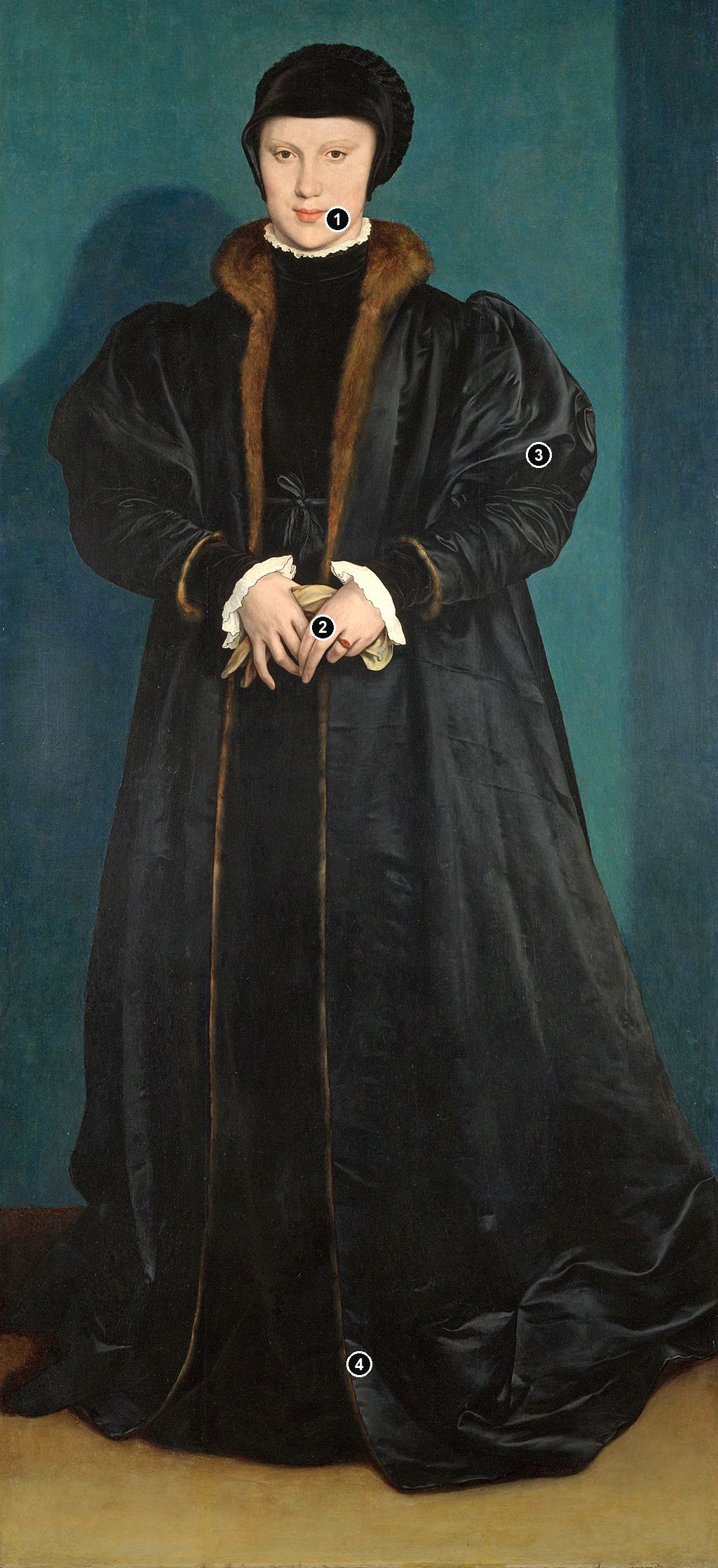
Christina of Denmark stands with her gloves gathered loosely between her hands. Black clothing spreads from the small cap around her face to the folds resting on the floor. Against this expanse, the pale face and fingers seem extraordinarily close. Holbein gives us enough space to see her full height, yet scarcely any room to look away.
Painted in 1538, the portrait belongs to Henry VIII’s search for a fourth wife following the death of Jane Seymour. Christina was sixteen and already the widowed Duchess of Milan. Henry sent Holbein to Brussels to obtain her likeness; the marriage never followed. [1] The painting is now in the National Gallery, London. [2]
Its diplomatic purpose explains why the portrait was wanted. Looking closely reveals how much Holbein made of that practical task: a gently turned head, a small red ring, a shadow on blue-green, and a gown whose black changes constantly as the light catches it.
At a Glance
- Artist Hans Holbein the Younger, 1497/8–1543. [2]
- Collection title Christina of Denmark, Duchess of Milan . [2]
- Date 1538. [2]
- Medium Oil on wood, identified as Baltic/Polish oak. [2]
- Dimensions 179.1 × 82.6 cm in the current collection record. [2]
- Collection National Gallery, London, NG2475. [2]
- Sitting Brussels, 12 March 1538, beginning at one in the afternoon and lasting three hours. [1]
- Commission A likeness for Henry VIII during marriage negotiations. [2] [1]
- Acquisition Presented through the Art Fund with an anonymous donation, 1909. [2]
This work across Hans Holbein the Younger’s career
Dead Christ in the Tomb
1521–22 [4]Sir Thomas More
1527 [5]Georg Giese
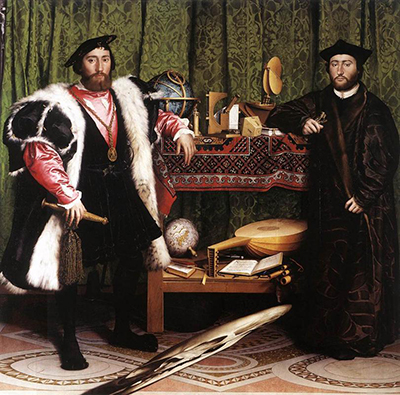
1532 [6]The Ambassadors
1533 [7]Contents
- A standing figure in a narrow space
- Black clothing, mourning and light
- The face, the hands and the gloves
- Brussels, 12 March 1538
- Three hours and a finished painting
- The marriage that did not happen
- From the royal collection to the National Gallery
- Annotated details
A standing figure in a narrow space
The figure nearly occupies the painting from top to bottom. There is a little blue-green above Christina’s cap and a strip of ochre floor beneath the hem. Her sleeves extend widely across the upper half, while the skirt widens towards the lower corners. These shapes make the narrow panel feel full without crowding her face.
The posture is less rigid than it first appears. Christina’s head and body are turned slightly towards the left of the image. Her hands meet below the waist, with one finger pointing down more distinctly than the others. Lower down, the robe spreads unevenly across the floor, its folds gathering into a larger, shinier heap on the right. The nearly upright body and the irregular hem have different rhythms.
Try following the two brown edges of the robe from collar to floor. They begin prominently beside the face, narrow as they descend past the hands, then become delicate threads against the lower black. This long movement helps you understand the figure’s height. It also joins the most immediately legible passages at the top to the darker, slower-looking part of the painting below.
There is no table, chair or elaborate setting to explain where Christina stands. A dark band runs down the right edge, while a rounded shadow appears beside her head on the left. The floor supplies a footing; the background supplies very little architectural information. That balance is one reason the portrait can feel both formal and immediate. We see a whole standing person, but the room gives us few distractions.
The long skirt conceals the feet and the distribution of weight through the legs. Our sense of balance therefore comes from the visible arrangement of head, shoulders, sleeves and hands. The gown’s width might initially suggest immobility, yet the slight turn above it and the unequal spread below prevent the body from becoming a simple vertical column.
Black clothing, mourning and light
In December 1537, the English ambassador John Hutton reported that Christina wore mourning apparel in the Italian manner. Her husband, Francesco Sforza, Duke of Milan, had died in 1535. Hutton’s description predates Holbein’s visit and identifies the clothing as a widow’s dress already worn before the English commission. [1]
Knowing this changes the way we see the ensemble, but it does not tell us exactly what Christina felt while wearing it. The robe is public dress with an established meaning. The painted face cannot supply a private account of grief two years after her husband’s death.
On the surface of the picture, black offers Holbein an enormous range. The central dress remains relatively quiet. Beside it, the outer robe catches light in long, slender streaks. Across the sleeves, curved highlights bunch together and open out again, allowing us to follow the fabric as it swells away from the arms. The dark cap has a much more compact surface, with a banded edge visible around the back of the head.
The brown fur interrupts these smooth passages. Near the neck it looks soft and thick; farther down, the narrow trim offers a warmer boundary between two areas of black. That change of texture matters even where the colour difference is small. A smooth highlight can suggest a taut fold in one place, while a mottled brown edge suggests softness in another.
At the neck, a fine white frill separates skin from the high black collar. Wider white cuffs appear above the hands. Their brightness does more than pick out small pieces of clothing: it gives the exposed skin a carefully shaped border. The frills are irregular, with little points and dips that keep these pale boundaries from looking mechanical.
There is considerable finery here, though it makes its effect through fabric, volume and handling of light. The broad sleeves, the generous length of the robe and the fur all occupy space. The single visible ring is a much smaller accent. Looking at these differences helps us avoid equating mourning with an absence of display. The colour is restrained; the clothing remains richly presented.
Hutton’s correspondence also records a separate portrait for which Christina had appeared out of mourning dress. He hoped to see it through the lady who had commissioned it. This matters because it shows that more than one image, and more than one manner of dress, were available around the time of the negotiations. Holbein’s black-clad figure represents a particular appearance, not the complete range of Christina’s wardrobe or social life. [1]
Annotated Details from Christina of Denmark
The numbered points identify visible features discussed in this article. Return from each detail to the whole composition. Hans Holbein the Younger, Christina of Denmark, Duchess of Milan, 1538. Oil on oak. National Gallery, London, NG2475.
Details from CHRISTINA OF DENMARK
Compare the cropped details with the complete images above. Notice how their colours, shapes and positions contribute to the larger compositions.
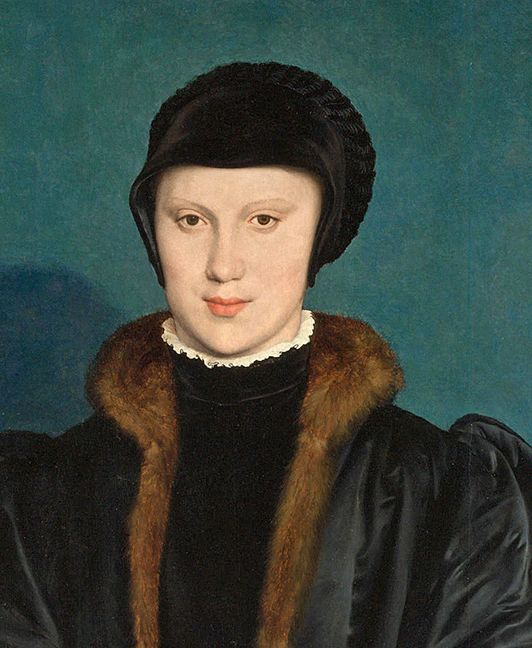
Face framed by cap and fur
The cap and warm fur frame a small pale face above the long black robe. Compare the gently turned cheeks with the sharper edges of the white frill.
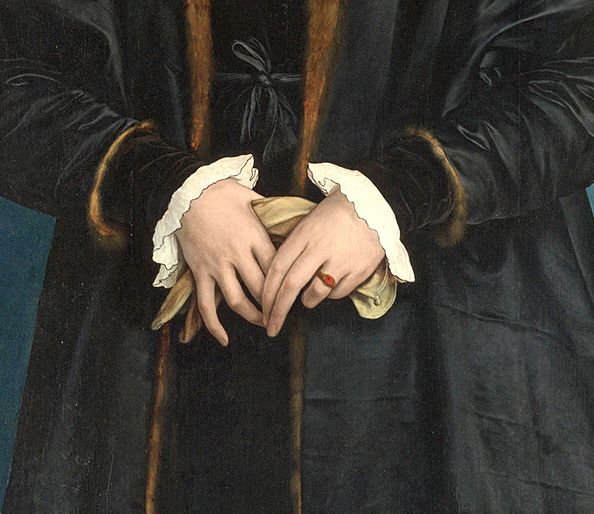
Hands, cuffs and empty gloves
The hands overlap without a tight clasp. Empty glove fingers bend among them, while the cuffs and red ring distinguish small changes of surface and colour.
Light across the broad sleeve
Narrow highlights run around the black sleeve’s folds. The same dark colour can describe smooth stretches, sharp creases and deeply shadowed hollows.
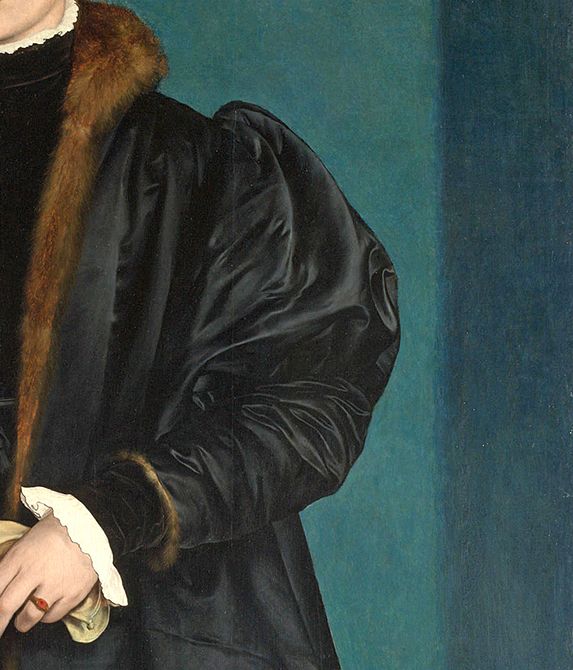
The robe meets the floor
The robe spreads unevenly across the floor. Follow the shiny folds on one side and the quieter dark fabric on the other.
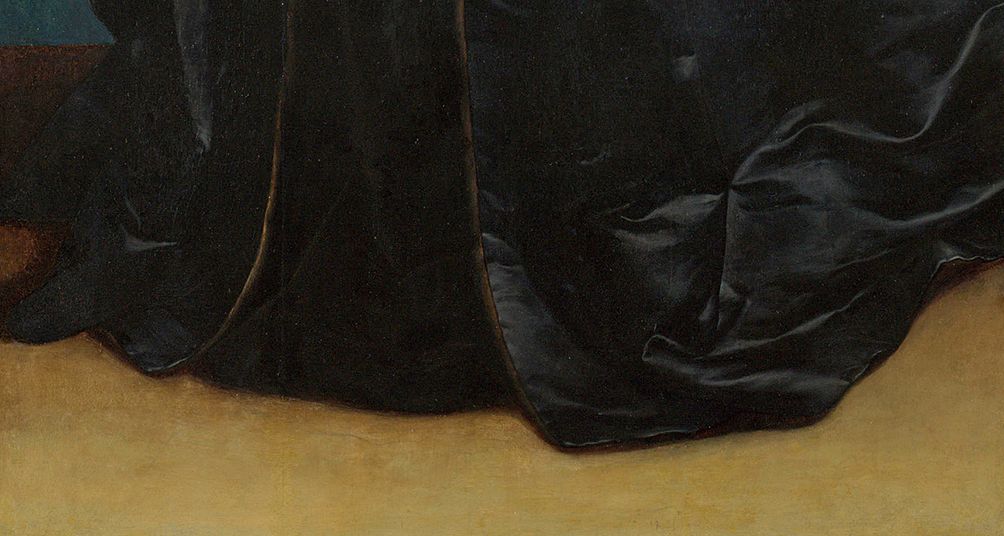
The face, the hands and the gloves
The face is small within the whole panel. Its visual importance comes from contrast and placement as much as size. The cap closes around the forehead and cheeks, directing attention towards the eyes and the warm colour of the lips. At the bottom, the chin approaches the white frill; above, the forehead is left broad and comparatively unbroken.
The two sides of the face are unequal. One cheek is more exposed, the other more compressed by the turn. The nose is lightly modelled rather than strongly outlined from top to bottom. Around it, small differences in shade give the features depth without making them look carved. The mouth has enough colour to remain distinct even when the portrait is seen at a distance.
Her gaze can feel engaging, guarded or simply attentive, depending on how we approach it. These are responses to the painting, not established facts about her intentions. The portrait contains no painted speech or gesture that settles what she thought of the English proposal. Even a description such as “calm” is best understood as an account of the image’s effect.
The hands offer another kind of particularity. They meet without forming a tight clasp. Fingers overlap, turn and descend at different angles. One hand shows more of its back; the other makes the red stone on the ring conspicuous. The cuffs frame them, but the gloves occupy the space between and behind them, adding a second, warmer pale colour.
Notice how differently those gloves behave from the hands holding them. Empty fingers bend and flatten; the material seems pliable and easily gathered. The painted skin, by comparison, is organised around joints and slender lengths of finger. Holbein makes both recognisable within a very small area, while allowing their outlines to interlock.
This cluster of hands, gloves and cuffs forms a quiet centre below the expansive sleeves. The thin ribbon bow above it is easily missed because it scarcely departs from the surrounding black. Once noticed, its loops draw attention to the narrowness of the waist before the garment spreads below. It is a good passage to revisit after taking in the full silhouette: the apparently simple costume contains several different scales of detail.
Contemporary descriptions remind us that the person could exceed the portrait. Hutton wrote about Christina’s speech, her smile and the dimples it revealed. In February 1539, Thomas Wriothesley judged her living appearance finer than any painted likeness he had seen. These reports belong to men assessing a prospective royal bride, so their praise has a purpose. They nevertheless point to qualities that a still image cannot preserve: changing expression, conversation and movement. [1]
Watch: Holbein’s portraits and working methods
Explore museum films on Holbein’s drawings, painted portraits and close-looking details.
Hans Holbein at the court of Henry VIII
A Royal Collection Trust film exploring Holbein’s work at Henry VIII’s court.
Watch on YouTubeBrussels, 12 March 1538
The sitting emerged from a sequence of introductions. Cromwell’s instructions told Philip Hoby to go to Hutton’s lodging and remain there discreetly until the ambassador had spoken to Mary of Hungary, Regent of the Netherlands. Hoby was then to approach Christina, convey Cromwell’s greetings and request a sitting for the king’s painter. Once the likeness was taken, he and Holbein were to return. [1]
The instructions give Hoby two tasks. He was to arrange an image, and he was to observe how Christina responded to the idea of becoming Queen of England. Her words, gestures and expression were all to be remembered for a report to Henry. In this encounter, the painter’s observation and the envoy’s observation worked alongside one another. A likeness could record features; Hoby was expected to carry back information about a conversation. [1]
Hutton’s letter to Cromwell of 14 March records what happened. Hoby and Holbein reached Brussels on 10 March. Hutton had already sent another portrait towards England, but recalled it when he learned that Holbein had arrived. He considered the earlier likeness insufficient for the purpose and expected the king’s painter to produce something better. [1]
That judgement gives the commission a practical urgency. A portrait was useful only if the people directing the negotiations trusted it. Hutton’s decision to interrupt the earlier delivery shows that obtaining an image was not, by itself, enough. Its adequacy mattered, and the availability of Holbein changed what the ambassador was willing to send.
The next morning Hutton spoke to the regent, then to Christina. According to his account, Christina said that she should consult her aunt before granting the request. She sent a member of her household, Lord Benedict, to meet Hoby. Hoby was admitted to speak to her that afternoon; Holbein was collected at one o’clock the following day, 12 March. [1]
Hutton then gives the celebrated measure of the sitting: “but thre owers space”. He praises the resulting likeness as “very perffight” and finds the other portrait poor by comparison. These are Hutton’s words in his letter to Cromwell. Hoby accompanied Holbein and took part in the arrangements; the surviving written account of the three hours is the ambassador’s. [1]
The correspondence also preserves the care taken over appearances around the visit. Hoby did not pay a conspicuous farewell call on the regent because, Hutton explained, it might attract notice to business being kept discreet. A portrait sitting therefore sits within a larger diplomatic performance of introductions, permissions, messages and controlled visibility. [1]
Three hours and a finished painting
Hutton’s report is valuable because it fixes the duration of Christina’s attendance. It does not establish that Holbein painted this entire oak panel in three hours. The time spent with a sitter and the time required to complete a portrait are different things.
No preparatory drawing of Christina survives. Susan Foister considers it likely that the image brought back to Henry was established in drawings, with the large painting executed after Holbein’s return. [8]
The surviving portrait drawings offer a useful comparison. Royal Collection conservators Rachael Smith and Victoria Button describe how Holbein could record a face rapidly in chalk, sometimes on paper prepared with a pink ground. Drawn notes and abbreviated patterns could preserve information about clothing for later use. Their account also stresses that his methods varied. [9]
The drawing of Philip Hoby makes that division of attention easy to see: the face is much more developed than the shoulders. It gives us a surviving example of concentrated likeness-making, though it cannot supply the lost Christina studies. We should leave open how many sheets Holbein used in Brussels and exactly what he put on each of them.
Technical examination of the Christina panel has found underlying outlines, followed closely around the head but changed more freely around the hands and gloves. A line near the floor suggests an initially longer skirt. [8] These adjustments are especially interesting beside the finished image’s apparent ease. The arrangement of a hand, a cuff or a glove could still be reconsidered as the portrait developed.
The panel consists of four oak boards, and its painted surface is worn and extensively retouched. [8] Its present appearance therefore carries a material history as well as the record of a sitting. Fine distinctions in very dark areas deserve care: a reproduction can help us enjoy the arrangement, but it cannot reveal every stage in the object’s making or treatment.
A reduced portrait in the Royal Collection is a separate object, currently attributed to William Scrots and dated 1538–45?. Its dress and jewellery differ, including three rings. The collection describes it as an adaptation of Holbein’s full-length image. It should not be presented as the securely identified original study from the Brussels sitting. [10]
The marriage that did not happen
Christina’s family connections made the proposal a matter between courts. She was the daughter of Christian II of Denmark and Isabella of Austria, and a niece of Emperor Charles V. In Brussels she lived with her aunt Mary of Hungary. Henry’s interest thus involved a young widow whose relatives held major positions in European politics. [1] [10]
The documents place both likeness and behaviour within this negotiation. Mary told the imperial ambassador Eustace Chapuys that permission had been given for a portrait to be taken and shown to Henry. Chapuys, writing from London on 23 March, reported that the painter had returned on the 18th and that the image had pleased the king. He associated Henry’s improved spirits with continual music-making, while allowing that the king’s behaviour might also serve a diplomatic purpose. [1]
That qualification is easily lost when the story becomes a romantic anecdote. Chapuys was interpreting events for another court. His letter records what he had heard about Henry’s response and what he thought the response might mean. It does not give us an unmediated glimpse of the king falling in love with this finished panel.
The negotiations continued well beyond the sitting. In Wriothesley’s report of February 1539, Christina answered a question about her inclination by referring to the emperor’s authority over her. The envoy took encouragement from her manner, but his interpretation remains his own. Her reported words reveal the dynastic framework within which she was expected to answer; they leave her private wishes uncertain. [1]
The match ultimately failed. Christina married François, duc de Bar, in 1541 and later became Regent of Lorraine after his death. [2] [10] Holbein’s picture fixes her at an earlier moment, before these later responsibilities. Its familiar place in the story of Henry’s marriages should not make the rest of her life disappear.
From the royal collection to the National Gallery
Henry retained the portrait despite the failure of the marriage negotiations. It appears in records of his collection, with a full-length Duchess of Milan listed after his death. [1] The image had an existence beyond the immediate decision for which it was commissioned.
By about 1590 it belonged to Lord Lumley; it later entered the Arundel collection. Some intervening steps remain uncertain, including a possible period with the Earl of Pembroke. [8] These uncertainties concern the painting’s passage between owners, rather than the basic identity of the standing woman.
For later collectors, Christina’s portrait could be valued as a Holbein, as an image of a historical figure and as an impressive painted presence. Those ways of looking overlap, yet they are different from Henry’s original interest in obtaining an accurate likeness of a possible wife. The same features and clothing survived while the uses of the painting changed.
The Duke of Norfolk lent it to the National Gallery in 1880. Nearly thirty years later, its proposed sale prompted an urgent effort to secure it for the collection. Art Fund records a campaign in May 1909, with less than a month to raise the purchase price. A £40,000 donation from a woman who required anonymity was decisive. The total cost was £72,000. [11]
The distinction between a loan and ownership became very real. Visitors had long been able to see Christina at the Gallery, but the picture could still be sold. The successful purchase gave that familiar encounter a firmer basis. Today its place in a public collection allows attention to return repeatedly to the details that the diplomatic story can overshadow: the small bow, the changing black, the relaxed fall of the empty gloves.
There is a small difference between published measurements: the current collection record gives 179.1 × 82.6 cm, while Foister’s 2024 catalogue lists 180.2 × 82.8 cm overall and 178.5 × 82.8 cm for the painted surface. [2] [8] In either account, this is a portrait approaching human scale. Its height is part of the encounter: a face seen above a long descent of cloth, with the hands held quietly between.
Artworks directory
Explore paintings, drawings, prints and designs, including works without a separate article. Related studies and versions have their own entries; workshop works and copies are labelled. Print designs and series are grouped rather than repeated for every impression.
Frequently Asked Questions
She was a Danish princess and the widowed Duchess of Milan when Holbein portrayed her in 1538. Henry VIII considered her as a fourth wife, but they did not marry. [1]
She wears mourning dress after the death of the Duke of Milan in 1535. Hutton had described her Italian-style mourning apparel before Holbein’s arrival. The costume does not establish her private emotions during the sitting. [1]
That separate panel, RCIN 403449, is currently attributed to William Scrots. It adapts Holbein’s composition with differences in clothing and jewellery. [10]
Discussion
Look again at the images and ideas explored in Portrait of Christina of Denmark by Hans Holbein the Younger. These editorial prompts invite your observations.
Reader Insights
Compare a sleeve, the central dress and the lower hem. Which passage makes the fabric’s weight or surface clearest?
The gloves bend where the hands remain gently structured. How does this small contrast affect your sense of the sitter’s presence?
Hutton described Christina’s speech and smile as well as her appearance. Which part of a meeting can a portrait preserve, and which part must remain outside it? [2]
Join the Conversation
What first holds your attention in Christina’s portrait: her face, the gathered gloves, the black sleeves or the full standing figure? Describe the detail, then consider how knowing the purpose of the Brussels sitting changes your response.
References
- John Hutton, Thomas Cromwell, Mary of Hungary, Eustace Chapuys and Thomas Wriothesley , diplomatic correspondence and instructions of 1537–39, transcribed in Arthur B. Chamberlain, Hans Holbein the Younger , vol. II, 1913, chapter XX, especially pp. 116–24 and 130–33; also consulted for the royal inventory transcription on p. 133. Hutton’s sitting report is his letter to Cromwell of 14 March 1538, calendared in Letters and Papers, Henry VIII , XIII, part I, no. 507. Public-domain text at Project Gutenberg. View source .
- The National Gallery , Christina of Denmark, Duchess of Milan , Hans Holbein the Younger, 1538, NG2475, current collection record, including object details. View source .
- Kunstmuseum Basel, Bildnis des Bonifacius Amerbach, 1519, inventory 314 (in German) . View source .
- Kunstmuseum Basel, Der tote Christus im Grab, 1521–22, inventory 318 (in German) . View source .
- The Frick Collection, Sir Thomas More, 1527, accession 1912.1.77, collection record . View source .
- Gemäldegalerie Berlin, Georg Gisze . View source .
- Susan Foister, The Ambassadors, The German Paintings before 1800 (2024) . View source .
- Susan Foister, The National Gallery , “Christina of Denmark, Duchess of Milan”, in The German Paintings before 1800 , 2024, especially “Technical Notes”, “The Sitter”, “The Commission” and “Provenance”. View source .
- Rachael Smith and Victoria Button, Royal Collection Trust , “Holbein’s portrait drawings”, especially the introduction, “Creating a skin tone” and “Clothing and jewellery”. View source .
- Royal Collection Trust , attributed to William Scrots, Princess Christina of Denmark, daughter of Christian II, King of Denmark, Duchess of Milan and later Duchess of Lorraine , 1538–45?, RCIN 403449, collection record. View source .
- Art Fund , Christina of Denmark, Duchess of Milan , acquisition and campaign record, supported 1909. View source .
- Würth Collection, Holbeins Schutzmantelmadonna, inventory 14910, current owner account (in German) . View source .
- Metropolitan Museum, Dance of Death series . View source .
- Kunstmuseum Basel, Bildnis der Frau des Künstlers mit den beiden ältesten Kindern, about 1528–29, inventory 325 (in German) . View source .
- Kunsthistorisches Museum Wien, Next Generation, Jane Seymour, about 1536–37, inventory 881 (in German) . View source .