


 by
Tom Gurney
Tom Gurney BSc (Hons) is an art history expert with over 20 years experience
Email:
tomgurney1@gmail.com
/ Phone:
+44 7429 011000
England and the Tudor Court: Introduction
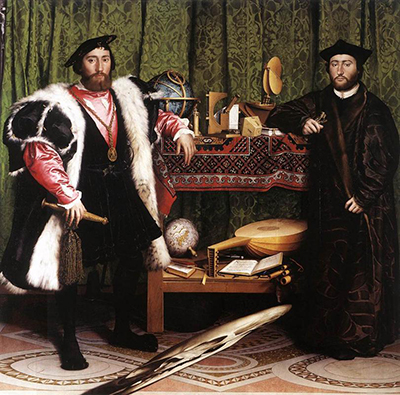
In The Ambassadors , two Frenchmen stand among globes, books and instruments in a painting made in London. Jean de Dinteville spreads his fur-lined coat across the left side; Georges de Selve, visiting England, answers him with a long, dark silhouette on the right. Between them, objects seem almost close enough to touch. Hans Holbein painted the double portrait in 1533, several years before the secure evidence for his appointment as Henry VIII's painter. Its international company gives a useful entrance into his English career. [1]
Holbein's London was made up of overlapping circles: learned households, German merchants, royal officers, visiting diplomats and skilled craftspeople from continental Europe. An introduction might lead to a likeness; an ornamental drawing might pass to a goldsmith; a portrait might cross the Channel to inform a marriage negotiation. The court was a powerful centre within this world, and Holbein eventually entered its salaried service. His English achievement grew through these relationships. The wider biography follows the journeys between Augsburg, Basel and London. [2]
At a Glance
- First English stay 1526–28, working for Thomas More's circle and on royal decorations. [2] [3]
- Second English period From 1532 until his death in London in 1543, with journeys abroad. [2]
- King's Painter Appointed by September 1536, with an annual salary of £30. [4]
- Patrons and sitters Scholars, merchants, royal servants, foreign visitors and the royal family; these were different kinds of commission. [2] [5] [4]
- Court responsibilities Portraiture and designs for metalwork, jewellery, weapons and books. [4]
- Diplomatic missions Christina of Denmark in 1538; Anne and Amalia of Cleves in 1539. [6] [7]
- Surviving evidence Paintings, preparatory drawings, ornamental designs, copies after lost works and documentary records. [2] [8] [9]
Hans Holbein the Younger in context
Albrecht Dürer
1471–1528 [13]Lucas Cranach the Elder
1472–1553 [14]Dead Christ in the Tomb
1521–22 [17]Sir Thomas More
1527 [18]Georg Giese
1532 [5]The Ambassadors
1533 [1]Contents
- Introductions, friendship and the first patrons
- Households and officers of the court
- Merchants, correspondence and a wider London market
- Ministers, appointments and the business of service
- Taking a likeness and building a portrait
- Whitehall and the repetition of a royal image
- Portraits across borders: Christina and Anne
- Designs moving between hands
- Death and the survival of an English career
Introductions, friendship and the first patrons
A few lines near the end of Thomas More's letter to Erasmus of 18 December 1526 bring Holbein's arrival into focus. More praises the painter's ability, worries that England may yield less employment than he had hoped, and undertakes to help. The surrounding letter ranges over Erasmus's health and religious writings. News of a visiting artist occupies a small place within a much larger correspondence. Holbein's prospects depended partly on people whose principal concerns lay elsewhere. [19]
This was a practical advantage of the humanist network. A painter did not have to be the central subject of a friendship to benefit from it. More could know the quality of work associated with Erasmus, receive the artist and help bring his abilities to the attention of potential patrons. The probable letter of recommendation that Holbein carried has not survived as a secure document. More's response, however, establishes admiration and a promise of support after his arrival. [19] [3]
The connection had roots in the book trade. In Basel, Holbein and his brother Ambrosius supplied illustrations for Johannes Froben, whose publications included More's Utopia . The 1518 edition carried work by both brothers. Hans therefore encountered More's writing in the business of making books before portraying the author in England. [3] A printed page could connect people who had never stood together in a room. When Holbein eventually met More, he brought experience that belonged to the same learned world.
His portrait of More , painted in 1527 and now in the Frick Collection, gives this relationship a physical presence. [18] The sitter's eyes look past us towards the right. His folded hands occupy a compact space below the broad fur collar, while the chain makes a bright curve across his chest. The dark cap separates the face from the hanging green curtain. Each material has its own behaviour: fur softens the shoulders, the chain catches light in separate links, and the red sleeves gather in deep folds.
This is an image of someone able to commission a costly representation of himself. It also asks for patient attention to a particular face. The slightly uneven contours of the mouth and the strong projection of the nose resist the regularity of the surrounding dress. Holbein gives the official ornaments and the individual features equal clarity without making them compete for the same kind of attention.
The portrait predates More's execution in 1535. [18] Later knowledge makes its stillness poignant, but the commission belongs to his successful working life. Holbein's first English patron was a living participant in government, scholarship and household affairs. Keeping that moment in view helps us understand what the painter was being employed to do: establish a convincing presence for a person already known through several kinds of public activity.
Households and officers of the court
More also commissioned a large portrait of his household. Individual studies survive, including the Royal Collection drawing catalogued as RCIN 912225, associated with the group. [20] A household portrait had to make relationships legible: age, proximity, gesture and the distribution of attention could join people within a shared space. The preparatory heads preserve encounters with individuals before those encounters were organised into a larger composition.
The original painting is lost. At Nostell, a much later copy after Holbein, traditionally associated with Rowland Lockey and dated about 1592–1620, preserves the group with qualifications attached to its authorship and history. [21] Looking at such a copy can reveal the arrangement of bodies and objects, but it cannot supply direct evidence of Holbein's original brushwork. The distinction matters especially in a career whose major group images have survived unevenly.
Other early patrons held positions within the royal household. Sir Henry Guildford, whom Holbein painted in 1527, was its controller. Mary, Lady Guildford, was portrayed in the same year. Their pictures are now in the Royal Collection and Saint Louis Art Museum respectively. [22] [23] A court office helps explain a sitter's connections and standing. It does not by itself make the sitter's portrait a royal commission.
The Guildford paintings also show how much could be asked of a portrait besides recognition. Elaborate dress, ornaments and architectural framing give their sitters a ceremonious setting. A viewer could register the person at first glance, then return to the patterned sleeve, the edge of a jewel or the meeting of costume and background. Holbein's capacity to make those different materials persuasive was useful to patrons concerned with how they appeared before others.
He undertook royal work during this first stay too. In 1527 he contributed to the decorations for an Anglo-French diplomatic meeting at Greenwich, including a painted view of Thérouanne. [3] Such employment placed his skills inside a collaborative undertaking whose purpose was ceremonial display. A temporary setting for negotiations required a different relationship between image and audience from the portable panel of a private sitter.
These commissions establish the variety of his first English practice. A learned household, paired portraits of a royal official and his wife, and decorations for diplomacy brought different expectations. Holbein was working near the monarchy through several channels by 1528. The title of King's Painter would come later. The first stay was already a substantial career episode, followed by four years back in Basel before his return to England in 1532. [2]
Merchants, correspondence and a wider London market
German merchants became important patrons during the second English period. The Steelyard, the Hanseatic trading community's London base, connected the city with commercial centres across northern Europe. Georg Giese's portrait of 1532, now in Berlin, is an especially rich witness to this patronage. [5] Holbein presents the merchant surrounded by correspondence and equipment, so that the business of maintaining distant connections becomes part of his visible identity.
The letters do more than occupy shelves. Some are folded, others opened; their pale surfaces interrupt the green-brown enclosure behind him. Giese holds one low in front of his body, where its white rectangle catches the eye between his hands. The red sleeves spread outwards across the foreground. Their sheen is answered by glass, metal and the intricate carpet, each described through a different pattern of edges and reflections.
The flowers at the left rise in front of the sleeve, their fine stems crossing its broad surface. Their delicacy makes the fabric seem heavier. Above, hanging objects and pinned papers introduce thinner, more fragile lines into the setting. We can follow the shelves as an arrangement of practical things, then become aware of how carefully the painter has distributed every interruption around the head. The room feels occupied, but the face remains easy to find.
For comparison, More's portrait concentrates its portable signs of standing on his body: fur, chain, cap and sleeves. Giese's identity extends around him into the furniture of correspondence. Both images offer a person through selected materials, yet the setting changes the kind of encounter. One figure meets us against a curtain; the other appears amid the exchanges through which his business operates. The comparison makes London patronage visible as several markets sharing the same painter.
The merchant category still has limits. The Metropolitan Museum qualifies the identity of the man traditionally called Hermann von Wedigh III; his supposed place within London's Steelyard community should not be treated as certain. [24] Similar clothes and portrait formats do not prove that every sitter belonged to the same institution. An English career reconstructed from paintings must allow for people whose names or circumstances remain imperfectly known.
The Ambassadors expands this international patronage to almost life-size double portraiture. Dinteville was the French ambassador in England; de Selve's visit supplied the occasion for their representation together. [1] The two men stand at opposite ends of shelves crowded with objects. Their elbows help connect the tall figures to that central display, while their differently coloured clothes keep each outline distinct.
The picture rewards several distances of viewing. From across a room, the figures and the bright carpet dominate. Closer up, the books, globe and instruments invite inspection. The stretched skull in the foreground disrupts the apparent ease with which the rest can be recognised. Holbein's London practice could accommodate this demanding construction alongside smaller individual portraits. Foreign diplomatic patrons were already commissioning ambitious work before his salaried royal appointment.
Ministers, appointments and the business of service
Thomas Cromwell's portrait, dated 1532–33 by the Frick Collection, introduces another form of employment. Papers and a bound book surround a minister seated at a table. [25] Its concentrated arrangement differs from Giese's room and the open standing space of the Frenchmen. Holbein adjusts the representation to an official whose work can be suggested through things close to his hands.
One of those things has acquired a new material history. Research announced by Trinity College Library in 2024 identifies the depicted volume with a richly bound Book of Hours in its collection. The proposed connection brings the painting into conversation with a surviving object transmitted through the Sadleir family. It should remain a research identification, rather than proof that every painted detail exactly records the book in its present condition. [26]
The possibility is revealing even with that qualification. A devotional book could also be an expensive possession, carrying the labour of printers, illuminators, binders and metalworkers. Its appearance beside official papers joins different kinds of value in one small area of the picture. Court life involved portable objects that could be read, handled, displayed and passed between people. Holbein's portraits repeatedly allow those objects to participate in the encounter.
By September 1536, a letter by the poet Nicholas Bourbon records Holbein's appointment as King's Painter. He received £30 annually. Lucas Horenbout also held the title, so the appointment placed Holbein among royal specialists. His duties extended to designs for metalwork, jewellery, weapons and books as well as portraits. [4] The position supplied regular pay and a formal obligation to serve; it did not turn the whole visual life of the court into one man's work.
The surviving accounts give the appointment an everyday financial dimension. Entries printed by Nicholas Harris Nicolas record advances against wages as well as quarterly accounting. [7] A royal title and immediate access to ready money were separate matters. The practical language of payment sits beside the ceremonial confidence of the portraits, reminding us that these images were made within arrangements for labour, materials and remuneration.
More and Cromwell were both executed, in 1535 and 1540 respectively. [18] [25] Their pictures have often encouraged comparisons between the men and speculation about Holbein's changing allegiance. A commission establishes a professional relationship; it does not reveal the painter's private judgement of a sitter's politics or religion. His continued employment depended on useful skills and connections within a changing court. The portraits give unusually exact faces to that history while leaving many of his own opinions unrecorded.
Watch: Holbein’s portraits and working methods
Explore museum films on Holbein’s drawings, painted portraits and close-looking details.
Hans Holbein at the court of Henry VIII
A Royal Collection Trust film exploring Holbein’s work at Henry VIII’s court.
Watch on YouTubeTaking a likeness and building a portrait
The encounter with a sitter was one stage in a longer process. Rachael Smith and Victoria Button's examination of the Royal Collection drawings explains how Holbein prepared information for possible paintings or miniatures. Chalk allowed rapid observation; pink-coated paper could provide a skin tone before the sitter arrived. Watercolour, touches of ink and written notes supplemented what chalk could convey. The finished image could then develop over many more hours. [27]
This division helps explain the drawings' selective attention. A face may be modelled through delicate changes of tone while clothing is reduced to a few boundaries. A note can carry information that would take much longer to draw. The sheet needs to preserve the features that cannot easily be recovered once the person has gone. Its different degrees of finish belong to that practical purpose, even though the resulting drawing can be deeply satisfying as an image in itself.
The Royal Collection's separate portrait study of More, RCIN 912268, has pricked outlines. These small holes are evidence of a method for carrying an observed design to another surface. [28] The likeness could therefore persist through a sequence of material changes: from the sitter to a drawing, and from the drawing towards the painted portrait. A recognisable face did not have to be reinvented each time the medium changed.
The distinction becomes particularly clear in the great cartoon for Henry VIII and Henry VII, now in the National Portrait Gallery. Made about 1536–37, it preserves the male half of Holbein's Whitehall composition on joined sheets of paper. The museum qualifies the exact relationship between this retained cartoon and a transfer sheet used in execution. [8] Its size gives drawing a different bodily presence from the intimate head studies. Here, paper establishes figures on the scale of a wall.
Henry VIII's broad body presses across the foreground. His father stands further back and higher in the arrangement, narrower within his long robe. The younger king's spread legs, projecting elbows and wide sleeves make a structure that seems almost architectural. The face has to function within this large arrangement; its authority comes partly from the way the whole figure occupies space.
A portrait could consequently remain faithful to observed features while becoming a highly constructed public image. Decisions about stance, spacing and surrounding forms governed what the likeness did once it left the sitting. Holbein's drawings reveal successive problems rather than one miraculous act of copying nature. The small head study secured information; the large cartoon organised an encounter between royal bodies and the viewer.
Whitehall and the repetition of a royal image
The mural at Whitehall, completed in 1537, placed Henry VIII and Jane Seymour with Henry VII and Elizabeth of York. The original was destroyed by fire in 1698. Remigius van Leemput's reduced copy of 1667, made for Charles II, preserves the complete dynastic arrangement, while Holbein's cartoon records only its male side. [8] [9] Together they allow different aspects of a lost royal commission to remain visible.
The four figures bring marriage and succession into a single composition. Henry VIII stands before his father; the women occupy the corresponding side of the central structure. The arrangement establishes relations across generations as well as across the painted space. Looking from the cartoon to the complete copy changes our understanding of the broad male figures: they belonged to an image whose argument depended on the whole family.
The mural's position within a palace also mattered. A wall painting could hold its place while people approached it, stood before it or passed through the room. Its bodies remained at their appointed scale. A portable portrait offered different possibilities: it could be carried elsewhere, placed beside another image or seen under changed conditions. Holbein's royal imagery worked through both kinds of object, with different relationships between the represented ruler and his audience.
The familiar full-length Henry spread through repetitions of the design. The Walker Art Gallery's painting is attributed to Holbein's workshop. [29] The invention could be repeated through other hands, preserving the commanding stance while changing details of dress or setting. “After Holbein” and “workshop of Holbein” describe consequential parts of the picture's life, even where an individual copyist cannot be named.
It is difficult to recover the full organisation of his English workshop from these survivors. A shared design does not identify every person who worked from it, and the date of a copy must be considered separately from the date of its model. What the pictures make clear is the durability of an arrangement. Henry remains recognisable through the wide shoulders, planted feet and emphatic silhouette even when the object before us is no longer the original mural.
The contrast with the portrait drawings is striking. In a head study, an uneven eyelid or slight turn of the mouth distinguishes one person from another. In the repeated royal image, the body's overall shape can announce identity at once. Holbein's practice joined these scales of recognition. His success as a court painter involved making a particular man present and devising a form through which kingship could continue to be displayed.
Portraits across borders: Christina and Anne
Royal service sent Holbein into negotiations where the sitter and intended recipient lived in different countries. The mission to portray Christina of Denmark, the widowed Duchess of Milan, in Brussels in March 1538 is unusually well documented. Sir Philip Hoby travelled with Holbein under Cromwell's instructions. John Hutton, the English ambassador, reported to Cromwell on 14 March that Christina had sat on 12 March, beginning at one in the afternoon, for three hours. [6] [30]
That report makes time unusually tangible. An appointment had to be obtained, the duchess made available and enough information gathered for a useful likeness. The three hours describe the sitting. They do not establish that the National Gallery's large full-length panel was painted from start to finish in that interval. Susan Foister considers preparatory drawings the likely means by which Holbein brought his observations back to England. [6]
In the painting, Christina's dark clothing opens around the lighter face, neck and hands. Her fingers gather the gloves at the centre, where the cuffs interrupt the long vertical sweep of the gown. The effect depends on very small differences inside a restricted range of colour. The light does enough to distinguish the sleeves, bodice and fur without breaking the figure into competing pieces.
Set beside The Ambassadors , this restraint is striking. Both images make standing figures persuasive, yet Christina has none of the shelves and instruments that occupy the double portrait. Her presence is sustained by the outline of the gown, the placement of the hands and the narrow space around the head. Holbein could reduce the setting without making the encounter less exacting.
For Henry, a proposed marriage gave the likeness an immediate purpose. The painting made an absent person available for scrutiny, while envoys supplied other information. Its usefulness depended on confidence in both the painter and the chain through which the image reached the king. The negotiations ultimately failed. [6] A convincing portrait could assist diplomacy without determining its outcome.
The Cleves mission followed in 1539. Nicholas Wotton's letter from Düren of 11 August praised Holbein's likenesses of Anne and Amalia. [7] The statement is evidence of contemporary confidence in the painter's work. It does not securely identify every surviving portrait with the particular objects Wotton saw. The Louvre now allows that its painting of Anne may have been completed in London from studies, although it was long assumed to have been made in her presence abroad. [31]
Anne married Henry in January 1540 and the marriage was annulled in July. [31] Later stories turn the episode into a verdict on Holbein's honesty. The contemporary praise of his likenesses and the accounting that continued to name him in 1540 and 1541 provide firmer evidence for his professional position. Some of those later entries record money previously paid; they are not all fresh rewards. [7] The marriage's failure does not establish that he lost his appointment for producing a deceptive portrait.
Designs moving between hands
Nicolaus Kratzer provides a link between Holbein's first English acquaintances and the collaborative work of royal service. Holbein painted him in 1528 with an instrument under construction and tools close to hand. The Louvre identifies the object he is working on as a many-sided sundial. [32] The portrait makes skilled handling central to the sitter's presence: thought appears through the work of the fingers and the carefully arranged equipment.
Years later, Kratzer's involvement survives in another form. The British Museum identifies his handwriting among the technical annotations on Holbein's design for Anthony Denny's clocksalt, made about 1543. It distinguishes these notes from an early inscription recording Denny's gift of the finished object to the king at the beginning of 1544. [33] The sheet preserves contributions made at different stages by different people.
The design rises like a little tower. A large hourglass occupies its centre; figures, ledges and a clock dial carry the eye upwards to a crown. Beside it, a separately drawn compass offers information from another viewpoint. The page asks a maker to imagine a complicated object in three dimensions. Wash gives the supports enough solidity to seem buildable, while the notes keep practical discussion visible around the ornamental forms.
An invention of this kind depended on more than the designer's hand. The patron connected it with the king; technical knowledge helped establish its functions; manufacture required further expertise. The finished maker is unknown. [33] The gaps in that chain should remain visible, because naming Holbein alone can conceal the labour necessary to turn an attractive sheet into working metalwork.
The court's wider community included the goldsmith Hans of Antwerp and the jeweller Cornelis Hayes, with whom Holbein is recorded collaborating. Later etchings by Wenceslaus Hollar preserve designs from a book that subsequently disappeared. [4] Such survivals reveal a substantial field of activity whose finished objects are largely absent. Paper, including copies on paper, carries much of its history.
Individual designs also require their own caution. The Basel sheet traditionally called a fountain with Anne Boleyn's badge is now catalogued more neutrally as a table ornament with caryatids, dated 1533/36. Its exact royal association and execution are uncertain. [34] The visible crown cannot answer every question about a patron or occasion. A drawing can tell us a great deal about Holbein's ornamental imagination while leaving the completed object's history unknown.
Death and the survival of an English career
Holbein made his will on 7 October 1543. The administration recorded on 29 November establishes that he had died by then, in London. The will describes him as a servant of the king, directs the sale of goods and a horse to meet debts, and provides support for two unnamed children at nurse. [30] These obligations belong beside the royal title: the maker of commanding images remained involved in ordinary matters of payment, property and care.
The documents do not establish his exact death day or prove the frequently repeated claim that plague caused his death. They leave the English career ending within a narrow interval, while its material remains continued through other people's possession and use. [30] A design might still be made into an object; a likeness might still be copied; an old drawing might acquire a new importance as evidence for a lost painting.
The Royal Collection's central group of eighty portrait drawings was probably acquired by Henry VIII after Holbein's death. [2] Their survival offers something different from the finished royal image. Beside the king's broad public silhouette are the small, particular observations through which Holbein encountered a succession of sitters. A face, an inscription or a technical note can reopen a relationship that the grander picture alone would leave hidden.
Artworks directory
Explore paintings, drawings, prints and designs, including works without a separate article. Related studies and versions have their own entries; workshop works and copies are labelled. Print designs and series are grouped rather than repeated for every impression.
Frequently Asked Questions
A design identifies his contribution to an object's conception. Skilled manufacture involved other craftspeople. The maker of Denny's clocksalt is unknown, while Kratzer's annotations preserve one technical contribution to its development. [33]
Discussion
Look again at the images and ideas explored in England and the Tudor Court. These editorial prompts invite your observations.
Reader Insights
Compare More's curtain, Giese's correspondence and the shelves in The Ambassadors . Which setting tells you most about the relationship between sitter and viewer?
Christina sat in Brussels for an image intended for Henry in England. Consider what a painted likeness could convey across that distance, and what still depended on an envoy's report.
A cartoon, a workshop portrait and an annotated design preserve different forms of participation. Look for what each object allows us to know about the people who made it.
Join the Conversation
Which English commission most changes your picture of Holbein's work: a merchant's portrait, the Whitehall cartoon or a design for a royal gift? Choose a detail that explains your response.
References
- Susan Foister / National Gallery , The Ambassadors , in The German Paintings before 1800 , 2024, particularly “The Sitters” and “The Making of the Portrait”. View source .
- Royal Collection Trust , Holbein in the Royal Collection , collection and career overview. View source .
- Royal Collection Trust , Holbein at the Tudor Court , Chambers Gallery large-print labels, Greenwich decorations, “Basel to London, 1526” and More family sections. View source .
- Royal Collection Trust , Holbein at the Tudor Court , Nash Gallery large-print labels, “Artists at Court” and “Holbein the Designer”. View source .
- Gemäldegalerie, Staatliche Museen zu Berlin , Der Kaufmann Georg Gisze , 1532, inventory 586 (in German). View source .
- Susan Foister / National Gallery , Christina of Denmark, Duchess of Milan , in The German Paintings before 1800 , 2024, “The Commission”. View source .
- Nicholas Harris Nicolas, editor , The Privy Purse Expences of King Henry the Eighth , 1827, introduction, pp. xxvi–xxvii, Wotton's letter and payment transcriptions. View source .
- National Portrait Gallery , King Henry VIII; King Henry VII , about 1536–37, NPG 4027, cartoon and Whitehall mural account. View source .
- Royal Collection Trust , Remigius van Leemput, Henry VII, Elizabeth of York, Henry VIII and Jane Seymour , 1667, RCIN 405750. View source .
- National Gallery, Early Renaissance, glossary. View source.
- National Gallery of Art, Northern Renaissance. View source.
- National Galleries of Scotland, Mannerism, glossary. View source.
- National Gallery of Art, Albrecht Dürer, artist record. View source.
- National Gallery of Art, Lucas Cranach the Elder, artist record. View source.
- National Gallery, Hans Holbein the Younger, artist record. View source.
- Kunstmuseum Basel, Bildnis des Bonifacius Amerbach, 1519, inventory 314 (in German) . View source .
- Kunstmuseum Basel, Der tote Christus im Grab, 1521–22, inventory 318 (in German) . View source .
- Frick Collection , Sir Thomas More , 1527, accession 1912.1.77. View source .
- Thomas More , letter to Erasmus, Greenwich, 18 December 1526, P. S. Allen edition, letter 1770, p. 443, lines 71–74; scan from the Center for Thomas More Studies (in Latin). View source .
- Royal Collection Trust , Sir Thomas More , about 1526–27, RCIN 912225, study associated with the family group. View source .
- National Trust , Sir Thomas More and his Family , after Hans Holbein, traditionally associated with Rowland Lockey, about 1592–1620, Nostell, object 960059. View source .
- Royal Collection Trust , Sir Henry Guildford , 1527, RCIN 400046. View source .
- Saint Louis Art Museum , Mary, Lady Guildford , 1527, object 1:1943. View source .
- Metropolitan Museum of Art , Hermann von Wedigh III (died 1560) , 1532, object 50.135.4, qualified sitter identification. View source .
- Frick Collection , Thomas Cromwell , 1532–33, accession 1915.1.76. View source .
- Trinity College Library, Cambridge , Thomas Cromwell's Book of Hours , 19 January 2024, research announcement. View source .
- Rachael Smith and Victoria Button / Royal Collection Trust , Holbein's portrait drawings , conservation account. View source .
- Royal Collection Trust , Sir Thomas More , 1527, RCIN 912268, study with pricked outlines. View source .
- National Museums Liverpool / Walker Art Gallery , Portrait of Henry VIII , workshop attribution in museum print description. View source .
- Arthur B. Chamberlain , Hans Holbein the Younger , vol. II, 1913, chapter XX, Hutton's report of 14 March 1538; chapter XXVIII, will of 7 October 1543 and administration of 29 November. Published transcriptions and translations of contemporary documents. View source .
- Musée du Louvre , Le portrait d'Anne de Clèves par Hans Holbein le Jeune , restoration and interpretation account (in French). View source .
- Musée du Louvre , Portrait de Nicolas Kratzer , 1528, INV 1343, description and inscription (in French). View source .
- British Museum , Design for a clock-salt , about 1543, museum number 1850,0713.14, inscriptions and curator's commentary. View source .
- Kunstmuseum Basel , Tafelaufsatz mit Karyatiden , 1533/36, inventory 1662.165.89, collection item 19348 (in German). View source .
- Kunstmuseum Basel, Hans Holbein d.J.: Die Basler Jahre 1515bis 1532, 2006 exhibition account (in German) . View source .
- Metropolitan Museum, Dance of Death series . View source .
- Kunstmuseum Basel, Laïs Corinthiaca, 1526, inventory 322 (in German) . View source .
- Würth Collection, Holbeins Schutzmantelmadonna, inventory 14910, current owner account (in German) . View source .
- Kunstmuseum Basel, Bildnis der Frau des Künstlers mit den beiden ältesten Kindern, about 1528–29, inventory 325 (in German) . View source .
- Kunsthistorisches Museum Wien, Next Generation, Jane Seymour, about 1536–37, inventory 881 (in German) . View source .
- Splash image , Hans Holbein the Younger, The Ambassadors, 1533: Jean de Dinteville and Georges de Selve during Holbein’s second English period. National Gallery, London. Image: Google Arts & Culture/Wikimedia Commons. National Gallery, London; Google Arts & Culture/Wikimedia Commons. Image source . Public domain .


