 by
Tom Gurney
Tom Gurney BSc (Hons) is an art history expert with over 20 years experience
Published on June 19, 2020 / Updated on October 22, 2026
Email:
tomgurney1@gmail.com
/ Phone:
+44 7429 011000
The Bather by Paul Cézanne: Introduction
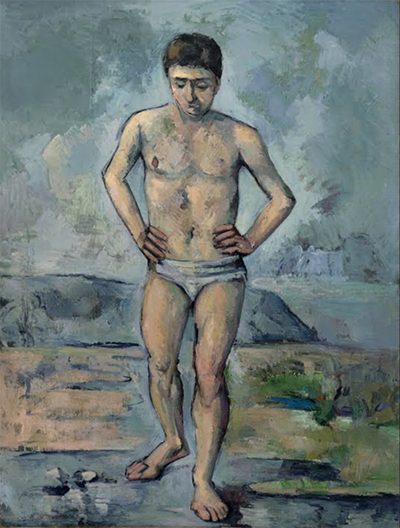
A young man faces us with his hands on his hips, yet his gaze falls to the ground. One foot bears his weight while the other seems to have just left it. Behind him, blue-grey paint suggests water, sky and a distant bank, without identifying a particular location. Cézanne’s The Bather , painted around 1885, makes an ordinary standing pose feel strangely difficult to settle: the figure is both firmly present and suspended between steps. The painting belongs to the Museum of Modern Art in New York. [1]
At 127 centimetres high, this is a substantial single-figure canvas, closer in scale to a portrait than to a small figure study. Its subject also belongs to Cézanne’s continuing exploration of bathers, though here the solitary person demands almost all the space. The online catalogue raisonné records the painting as Grand baigneur , FWN 915, and documents a history of titles and proposed dates. MoMA dates the canvas to about 1885. [2]
At a Glance
- Artist Paul Cézanne (1839–1906). [1]
- Work The Bather ; also catalogued as Grand baigneur , FWN 915. [1] [2]
- Date and medium c. 1885, oil on canvas. [1]
- Size 127 × 96.8 cm (50 × 38⅛ in). [1]
- Collection The Museum of Modern Art, New York, Lillie P. Bliss Collection, object 1.1934. [1]
This work across Paul Cézanne’s career
The Kiss of the Muse
c.1860The Artist’s Father, Reading L’Événement
autumn 1866The Hanged Man’s House
c.1873A Modern Olympia
1873–74Maincy Bridge
1879–80The Blue Vase
1889–90The Basket of Apples
c.1893Apples and Oranges
c.1899The Large Bathers (Philadelphia)
1900–1906 (Philadelphia Museum dating)Château Noir (MoMA)
1903–04Contents
- A figure caught between movement and stillness
- The ground and the body share a palette
- From studio photograph to painted landscape
- A bather among Cézanne’s bathers
- An uneasy welcome in New York
A figure caught between movement and stillness
The body fills the height of the canvas. Dark hair sits low on the forehead; shoulders and arms slope out to two bent elbows; the hands press against the hips. Those elbows make two open pockets of background beside the torso. Below a narrow white garment, the legs diverge: the forward foot approaches the lower edge, while the rear foot turns out and rests more lightly. Each part can be followed, yet the pose does not resolve into an obvious action. He could advance, pause, or merely shift his weight. The title calls him a bather; the picture offers no visible plunge or swimming gesture.
The downward head matters as much as the legs. Hands on hips might signal confidence in a different image. Here, the lowered eyes and softened torso make the pose inward-looking. MoMA’s visual description identifies the forward, weight-bearing foot and the lifted heel behind; its curator Ann Temkin draws attention to the paired triangular spaces under the arms and to the figure’s nearness to the picture plane. These are useful starting points for looking, although a viewer need not settle on a single emotion for the young man. [3] [4]
The painting’s scale gives this hesitant stance a quiet force. Cézanne does not need a heroic action to make the figure monumental: the head nearly reaches the upper boundary, and the feet claim the foreground. Yet the body is not an academic ideal assembled from smooth, sharply measured parts. The left and right sides have different rhythms, the knees do not mirror one another, and the feet meet the ground at different angles. The slight instability keeps the viewer’s eye moving along the outline instead of accepting it as a fixed silhouette.
The ground and the body share a palette
Look first at the horizontal zone behind the thighs. A blue-grey strip runs across the canvas, interrupted by the legs, and darker forms suggest a bank or rocks. Above it, the background opens into pale blue, violet and green. Below, patches of tan, rose and blue mark an uneven shore. At the lower right a small intense blue area can read as water; other blue strokes lie nearer the left foot. Cézanne has provided enough cues to make an outdoor setting plausible, but not enough to map a shore, a horizon and a fixed path through it.
The skin is built from some of those same cool colours. Blue-green shadows recur on the chest, arms, thighs and calves; warm pinks and ochres return in the ground. That exchange makes figure and setting belong to one painted surface. A darkened contour can hold the torso apart from the backdrop, while adjacent patches seem to let the atmosphere enter it. MoMA’s 2019 account stresses this dependence between figure and background, describing a challenge to the conventional priority of a sharply separate human subject. [1]
The edges change their character as the eye travels. The shoulder facing the pale sky is easier to locate than some transitions at the lower legs. Small, angled marks in the background do not merely fill empty space; they set a pace against the more continuous vertical body. Near the hands, the contrast between flesh and the darker belt of landscape strengthens the bent-arm pattern. Near the feet, colour and brushwork become restless, so that the exact boundary between dry ground and reflected blue is less secure. Looking closely, the bather seems made of the place even as he blocks it from view.
This is why the picture can appear shallow without feeling simple. Its prominent figure stands forward, the landscape runs sideways behind him, and the coloured strokes pull both into contact. Temkin’s audio commentary calls attention to how little conventional recession separates the man from the far ground. The experience is less like looking through a window to a distant setting than meeting a body and a landscape assembled together on the canvas. [4]
From studio photograph to painted landscape
The outdoor scene was not the setting in which the model posed. MoMA holds an albumen photograph of an unidentified standing model, catalogued as the image for this painting. The print is small—13.9 × 8.8 centimetres—and its maker is unknown. The photograph gives a concrete source for the stance without identifying the model or establishing that Cézanne watched him bathe. [5]
MoMA’s teaching account states that Cézanne worked from a photograph of a studio model and translated that figure into a watery landscape. This is a more precise account than imagining a boy stepping into water before the painter. The image could preserve a pose while Cézanne changed its setting, scale, colours and relation to surrounding space. The painting is therefore a construction with a photographic starting point, not a report of one witnessed instant. [6]
The change from studio pose to open terrain leaves the canvas free to ask questions that the photograph alone cannot answer: how can a cool shadow make weight, and how much landscape is needed to support a standing figure? A photographic model was one resource available to a nineteenth-century painter alongside drawing, memory and direct observation. In this case, the documented source helps explain the pose; it does not turn the painting into a mere rehearsal for another work or identify the person shown.
A bather among Cézanne’s bathers
Cézanne returned to bathing figures repeatedly, often arranging groups in a landscape. Here a single body has to sustain the canvas. The catalogue raisonné’s Grand baigneur title registers the unusually large, solitary figure; MoMA calls it The Bather . White clothing and water-like passages make the title intelligible, although the painting shows no particular bathing action. [2]
The title cannot tell us what he thinks. His lowered gaze may suggest hesitation or concentration; the stance could simply be one held for the camera. To say he is deciding whether to enter the water would supply a story the canvas does not document. Cézanne has made a person whose weight we can sense more clearly than his intention.
An uneasy welcome in New York
The work later passed through dealers and collectors, including Ambroise Vollard, Paul Rosenberg and Marius de Zayas, before entering Lillie P. Bliss’s collection. The catalogue raisonné matches the MoMA work by dimensions and ownership history; it also marks some early exhibition identifications as tentative. That qualification matters because “bather” could refer to several Cézanne works. The securely documented 1921 New York exhibition listed this painting as The Bather . [2]
Bliss lent the painting to the Metropolitan Museum of Art that year. A later MoMA gallery label recounts how a hostile pamphlet circulated near the exhibition’s end and singled out this canvas for attack. According to the label, the controversy increased attendance. [1]
Bliss’s role extended beyond that loan. The Metropolitan Museum’s history of her collecting identifies her as an advocate for modern French art and a founder of MoMA in 1929. After her death, her collection helped form the new museum’s permanent holdings. The Bather entered MoMA in 1934 as part of that legacy. Its journey from a disputed loan painting to a museum fixture marks a change in the public setting for Cézanne’s art. [7] [1]
The painting rewards a slower encounter than either praise or outrage allows. Its plain pose, indeterminate shore and active brushwork hold a person and a place in the same uncertain moment.
Cézanne artworks directory
Browse 217 identified works in this researched selection, including paintings, drawings and watercolours. This is a bounded selection, not a complete catalogue of Cézanne’s surviving oeuvre. Unlinked titles have no confirmed article in this collection.
| Name | Date | Medium |
|---|---|---|
| A Head, a Cup, and a Bread Roll | 1891/1894 | Drawing |
| A Man seen from Behind | 1880/1883 | Drawing |
| A Modern Olympia | 1873–74 | Painting |
| A Nude and Foliage | 1879/1882 | Drawing |
| A Smoking Man | 1892–96 (catalogue); c.1890–92 (museum) | Drawing |
| Afternoon in Naples | 1876–77 | Painting |
| An Old Woman with a Rosary | about 1895–96 | Painting |
| Apples and Oranges | c.1899 | Painting |
| Auvers, Panoramic View | 1873–75 | Painting |
| Avenue at Chantilly | 1888 | Painting |
| Banks of the Marne | 1888–94 | Painting |
| Basket | 1877/1900 | Drawing |
| Bather with Outstretched Arms | 1877–78 | Painting |
| Bellows in Front of a Fireplace | 1887/1892 | Drawing |
| Bibémus Quarry | c.1895 | Painting |
| Boy in a Red Vest, Barnes Foundation | 1888–90 | Painting |
| Boy in a Red Vest, MoMA | 1888–90 | Painting |
| Boy in a Red Waistcoat, National Gallery of Art | 1888–90 | Painting |
| Branch in Flower | 1886/1889 | Drawing |
| Carnival Scene | 1885/1888 | Drawing |
| Chair and Dresser | 1880/1883 | Drawing |
| Chateau Noir | 1903–04 | Painting |
| Chestnut Trees and Farm at Jas de Bouffan | c.1885 | Painting |
| Chestnut Trees and Farm at Jas de Bouffan, Pushkin | c.1886 | Painting |
| Chestnut Trees at Jas de Bouffan in Winter | 1885–86 | Painting |
| Château Noir | 1900–04 | Painting |
| Cistern in the Park of Château Noir | c.1900 | Painting |
| Curtain, Jug and Fruit | 1893–94 | Painting |
| Cushion of an Armchair | 1886/1889 | Drawing |
| Draft Letter and Studies of Bathers | c.1878 | Drawing |
| Farmhouse and Chestnut Trees at Jas de Bouffan | 1884–85 | Painting |
| Figure Resting Head on Hand | c. 1889 | Drawing |
| Fireplace Tongs and Poker | 1887/1892 | Drawing |
| Forest Interior, San Francisco | c.1898–99 | Painting |
| Four Bathers | 1888–90 | Painting |
| Fruit and a Jug on a Table | 1893–94 | Painting |
| Gardanne | 1885–86 | Painting |
| Gardanne, Barnes Foundation | c.1885 | Painting |
| Hand and Shoulder of a Boy | c. 1885 | Drawing |
| Harlequin, National Gallery of Art | 1888–90 | Painting |
| Head of a Boy | 1887/1889 | Drawing |
| Head of a Boy Seen from Behind | c. 1885 | Drawing |
| Head of a Young Woman | c. 1880 | Drawing |
| Head of the Artist's Son | 1888/1889 | Drawing |
| Hillside in Provence | c.1890–92 | Painting |
| Horse Chestnut Trees at Jas de Bouffan | c.1885 | Painting |
| House and Farm at the Jas de Bouffan | c.1887 | Painting |
| House in a Park | 1883/1886 | Drawing |
| House in Provence | c.1885 | Painting |
| House of Père Lacroix | 1873 | Painting |
| House Surrounded by Vegetation | 1889/1892 | Drawing |
| Houses in Provence The Riaux Valley near L’Estaque | c.1883 | Painting |
| Jas de Bouffan, the Pool | c.1876 | Painting |
| Kerosene Lamp | 1878/1881 | Drawing |
| L'Estaque, Melting Snow | c.1870 | Painting |
| Lake Annecy | 1896 | Painting |
| Landscape in Provence, Pola Museum | 1879–82 | Painting |
| Landscape Near Aix-en-Provence | 1877/1880 | Drawing |
| Landscape Seen from the Inside of a Cave | 1889/1892 | Drawing |
| Landscape with Poplars | c.1885–87 | Painting |
| Landscape with Trees | 1895/1898 | Drawing |
| Leda and the Swan | c.1880 (possibly later) | Painting |
| Little Girl with a Doll | 1902–04 | Painting |
| Louis Guillaume | 1879–1890 | Painting |
| Madame Cezanne | 1888/1891 | Drawing |
| Madame Cezanne | 1886/1889 | Drawing |
| Madame Cezanne | 1882/1887 | Drawing |
| Madame Cezanne | 1897/1900 | Drawing |
| Madame Cezanne with her Head Lowered | 1893/1896 | Drawing |
| Madame Cézanne in a Red Armchair | c.1877 | Painting |
| Madame Cézanne in a Red Dress, Metropolitan Museum of Art | 1888–90 | Painting |
| Madame Cézanne in a Yellow Chair | 1888–90 | Painting |
| Madame Cézanne in a Yellow Chair, Fondation Beyeler | 1888–90 | Painting |
| Madame Cézanne in the Conservatory | 1891 | Painting |
| Maincy Bridge | 1879–80 | Painting |
| Maison Maria with a View of Château Noir | c.1895 | Painting |
| Man Bending Forward | 1883/1886 | Drawing |
| Man Smoking a Pipe, Pushkin | c.1891, possibly later | Painting |
| Man with a Pipe | 1891–96 | Painting |
| Man with a Pipe, Nelson-Atkins | 1890–92 | Painting |
| Man with a Straw Hat (Gustave Boyer) | c.1871 | Painting |
| Man with Crossed Arms | c.1899 | Painting |
| Man with Pipe, National Gallery of Art | 1892–96 | Painting |
| Mont Sainte-Victoire | c.1902–06 | Painting |
| Mont Sainte-Victoire | 1900–02 | Painting |
| Mont Sainte-Victoire (recto) | c.1895 | Watercolour |
| Mont Sainte-Victoire and the Viaduct of the Arc River Valley | 1882–85 | Painting |
| Mont Sainte-Victoire Seen beyond the Wall of the Jas de Bouffan | c.1885/1888 | Watercolour |
| Mont Sainte-Victoire Seen from Bibémus Quarry | c.1897 | Painting |
| Mont Sainte-Victoire, Barnes Foundation | 1892–95 | Painting |
| Near the Pool at Jas de Bouffan | 1883/1887 | Drawing |
| Pelicans | 1877/1880 | Drawing |
| Peonies | 1890/1893 | Drawing |
| Pierrot and Harlequin | 1888 | Painting |
| Pine Tree | 1882/1885 | Drawing |
| Pont des Trois Sautets | 1906 | Watercolour |
| Poplars | 1879–80 | Painting |
| Portrait of Ambroise Vollard | 1899 | Painting |
| Portrait of Gustave Geffroy | 1895–96 | Painting |
| Portrait of Madame Cezanne with Loosened Hair | 1885–86 | Painting |
| Portrait of the Artist Looking Over His Shoulder | 1883–84 | Painting |
| Portrait of the Gardener Vallier | 1906 | Painting |
| Portrait of Victor Chocquet | 1876–77 | Painting |
| Portrait Of Victor Chocquet Seated | 1877 | Painting |
| Provençal Manor | c.1885 | Painting |
| Pyramid of Skulls | 1898–1900 | Painting |
| Reclining Nude (Leda?) | c.1887 | Painting |
| Scipio | 1866–68 | Painting |
| Seated Man, Oslo | 1898–1900 | Painting |
| Seated Peasant | c.1892–96 | Painting |
| Seated Peasant, Hiroshima | c.1897 | Painting |
| Seated Peasant, Orsay | c.1900 | Painting |
| Self-Portrait | c. 1895 | Drawing |
| Self-Portrait in a Bowler Hat, Ny Carlsberg Glyptotek | 1885–86 | Painting |
| Self-Portrait in a Casquette | c.1875 | Painting |
| Self-Portrait with a Beret | 1898–1900 | Painting |
| Self-Portrait with a Hat, Artizon Museum | c.1890–94 | Painting |
| Self-Portrait with a Pink Background | c.1875 | Painting |
| Self-Portrait with Olive-Coloured Wallpaper | about 1880–81 | Painting |
| Self-Portrait with Palette | 1886–87 | Painting |
| Self-Portrait with White Turban | c.1878–80 | Painting |
| Self-Portrait, c.1895 | c.1895 | Painting |
| Self-Portrait, Pushkin Museum | c.1882 | Painting |
| Spanish Dancers | 1883/1886 | Drawing |
| Still Life with a Curtain | 1892–94 | Painting |
| Still Life with Apples | c.1890 | Painting |
| Still Life with Apples | 1893–94 | Painting |
| Still Life with Apples and a Pot of Primroses | about 1890 | Painting |
| Still Life with Milk Jug and Fruit | c.1900 | Painting |
| Still Life with Open Drawer | 1877–79 | Painting |
| Still Life with Plaster Cupid | about 1894 | Painting |
| Still Life with Skull | 1890–93 | Painting |
| Still Life with Soup Tureen | 1877 | Painting |
| Still Life, Pitcher and Fruit | 1893–94 | Painting |
| Studies Including a Straw Hat | 1895/1898 | Drawing |
| Studies Including Madame Cezanne | 1884/1887 | Drawing |
| Study for "The Judgement of Paris" or "The Amorous Shepherd" | 1883/1886 | Drawing |
| Study for Woman with a Coffee Pot | c.1895 | Painting |
| Study of "The Roman Orator (Germanicus)" | 1883/1886 | Drawing |
| Study of "Venus de Milo" | 1881/1884 | Drawing |
| Study of a Decorative Ornament | 1879/1882 | Drawing |
| Study of a Standing Male Figure after the Antique | c. 1895 | Drawing |
| Study of an Angel in Rubens' "The Prophet Elijah" | 1892/1895 | Drawing |
| Study of Desiderio da Settignano's "Bust of a Child" | c. 1895 | Drawing |
| Study of Houses | 1879/1882 | Drawing |
| Study of Puget's "Hercules Resting" | c. 1879 | Drawing |
| Study of Puget's "Milo of Crotona" | 1895/1898 | Drawing |
| Study of Puget's "Milo of Crotona" | 1880/1883 | Drawing |
| Study of the Allegorical Figure Bellona in Rubens' "The Apotheosis of Henri IV" | 1883/1886 | Drawing |
| Study of the Allegorical Figure Bellona in Rubens' "The Apotheosis of Henri IV" | 1879/1882 | Drawing |
| Study of the Allegorical Figure France in Rubens' "The Exchange of the Two Princesses" | 1882/1885 | Drawing |
| Study of the Allegorical Figure of Health in Rubens' "The Birth of Louis XIII" | 1880/1883 | Drawing |
| Study of the Allegorical Figure of the Genius of Health from Rubens' "The Birth of Louis XIII at Fontainbleau" | 1895/1898 | Drawing |
| Sugar Bowl, Pears and Blue Cup | 1865–66 | Painting |
| The Aqueduct, Pushkin Museum | Dating differs between museum records | Painting |
| The Artist's Father, Reading L'Evenement | autumn 1866 | Painting |
| The Artist's Son | c. 1887 | Drawing |
| The Artist's Son Leaning on his Elbow | c. 1887 | Drawing |
| The Artist's Son Reading | c. 1887 | Drawing |
| The Artist's Son Writing | c. 1887 | Drawing |
| The Artist’s Son, Paul | 1886–87 | Painting |
| The Avenue at Jas de Bouffan | 1868–70 (possibly later) | Painting |
| The Avenue at Jas de Bouffan, Geneva | c.1890 | Painting |
| The Basket of Apples | c.1893 | Painting |
| The Bather, Museum of Modern Art | c.1885 | Painting |
| The Bay of Marseille seen from L'Estaque | c.1885 | Painting |
| The Blue Vase | 1889–90 | Painting |
| The Boy in the Red Vest, Bührle | 1888–90 | Painting |
| The Buffet | 1877–79 | Painting |
| The Card Players, Barnes Foundation | 1890–92 | Painting |
| The Card Players, Courtauld Gallery | 1892–96 | Painting |
| The Card Players, Metropolitan Museum of Art | 1890–92 | Painting |
| The Card Players, Musée d’Orsay | 1893–96 | Painting |
| The Card Players, Qatar | 1892–96 | Painting |
| The Eternal Feminine | c.1877 | Painting |
| The Gardener Vallier | 1906 | Painting |
| The Gardener Vallier, Tate | 1905–06 | Painting |
| The Grounds of the Château Noir | c.1900–04 | Painting |
| The Gulf of Marseille Seen from L’Estaque | c.1885 | Painting |
| The Hanged Man's House in Auvers | c.1873 | Painting |
| The House of Doctor Gachet at Auvers | 1872–73 | Painting |
| The House with the Cracked Walls | 1892–94 | Painting |
| The Kiss of the Muse | c.1860 | Painting |
| The Large Bathers, Barnes Foundation | 1895–1906 | Painting |
| The Large Bathers, National Gallery | 1895–1905 | Painting |
| The Large Bathers, Philadelphia Museum of Art | 1900–06 | Painting |
| The Mill | 1889/1892 | Drawing |
| The Painter’s Father, Louis-Auguste Cézanne | c.1865 | Painting |
| The Peasant | 1890–92 | Painting |
| The Plaster Mill (La Moulin à plâtre) | 1889/1892 | Drawing |
| The Smoker, Hermitage | c.1891 | Painting |
| The Smoker, Mannheim | c.1891 | Painting |
| The Stove in the Studio | c.1865 | Painting |
| The Vase of Tulips | c.1890 | Painting |
| Thistle | 1893/1896 | Drawing |
| Three Heads, One of Madame Cezanne | 1882/1885 | Drawing |
| Three Skulls | c.1898 | Painting |
| Three Skulls on a Patterned Carpet | 1904 | Painting |
| Trees and Shrubs | 1883/1887 | Drawing |
| Turning Road at Montgeroult | 1898 | Painting |
| Two Bathers | 1884/1887 | Drawing |
| Two Heads | 1888 | Drawing |
| Two Heads | 1890/1896 | Drawing |
| Two Heads of Women | 1890/1894 | Drawing |
| Two Studies for "The Judgement of Paris" or "The Amorous Shepherd" | 1883/1886 | Drawing |
| Uncle Dominique in a Tasseled Cap | 1866 | Painting |
| Uncle Dominique in a Turban | 1866–67 | Painting |
| Victor Chocquet and an Angel for "The Apotheosis of Delacroix" | 1878/1880 | Drawing |
| Woman in Blue | c.1904 | Painting |
| Woman Leaning Forward | 1888/1891 | Drawing |
| Woman Leaning Forward | 1890/1894 | Drawing |
| Woman Leaning Forward | 1890/1894 | Drawing |
| Woman with a Coffee Pot | c.1895 | Painting |
| Women Bathers and a Roll of Paper | 1882/1885 | Drawing |
| Young Girl with a Doll | c.1895 | Painting |
| Young Italian Woman at a Table | c.1895–1900 | Painting |
| Young Man and Skull | 1896–98 | Painting |
Frequently Asked Questions
It belongs to the Museum of Modern Art in New York, under object number 1.1934. [1]
Discussion
Look again at the images and ideas explored in The Bather by Paul Cézanne. These editorial prompts invite your observations.
Reader Insights
Notice how the planted foot and the lifted heel pull the figure in different directions. Does he seem ready to move, or held in place?
Trace the cool colours from the water-like ground into the skin. Where does the body feel most separate from its surroundings, and where does it nearly merge with them?
The model posed for a photograph in a studio, yet Cézanne placed him outdoors. How does knowing that change the way you read the scene?
Join the Conversation
Share a detail, comparison or question about The Bather by Paul Cézanne below.
References
- The Museum of Modern Art , “Paul Cézanne. The Bather . c. 1885,” collection record with 2019 publication excerpt and 2024–25 exhibition label. View source .
- Société Paul Cezanne , “ Grand baigneur , c. 1885 (FWN 915),” The Paintings, Watercolors and Drawings of Paul Cezanne: An Online Catalogue Raisonné . View source .
- The Museum of Modern Art , “Paul Cézanne. The Bather . c. 1885,” audio description transcript. View source .
- The Museum of Modern Art , Ann Temkin, “Paul Cézanne. The Bather . c. 1885,” audio commentary transcript. View source .
- The Museum of Modern Art , “Unidentified photographer. Untitled (portrait of the model for Cezanne’s painting ‘The Bather’) . c. 1885,” collection record, SC2008.94. View source .
- The Museum of Modern Art , “Paul Cézanne. The Bather . c. 1885,” MoMA Learning. View source .
- The Metropolitan Museum of Art , Rachel Boate, “Lillie P. Bliss,” Modern Art Index Project , August 2017. View source .
- Le Baiser de la muse, d'après Frillié (FWN 572). View source.
- Louis-Auguste Cezanne, père de l'artiste, lisant L'Événement (FWN 402). View source.
- La Maison du pendu, Auvers-sur-Oise (FWN 81). View source.
- Une moderne Olympia (FWN 628). View source.
- Le Pont de Maincy (FWN 143). View source.
- La Montagne Sainte-Victoire vue de Montbriand (FWN 185). View source.
- Gardanne (vue horizontale) (FWN 224). View source.
- Le Vase bleu (FWN 823). View source.
- Les Joueurs de cartes (FWN 681). View source.
- La Montagne Sainte-Victoire (FWN 296). View source.
- La Corbeille de pommes (FWN 860). View source.
- Pommes et oranges (FWN 871). View source.
- Portrait d'Ambroise Vollard (FWN 531). View source.
- Philadelphia Museum of Art,The Large Bathers,W1937-1-1. View source.
- Château Noir (FWN 360). View source.
- Société Paul Cezanne,online catalogue structure and objectidentification. View source.
- National Gallery of Art,Cezanne Sketchbook,1992.51.9. View source.
- Splash image, Paul Cézanne, The Bather, about 1885. The Museum of Modern Art, 1.1934.