 by
Tom Gurney
Tom Gurney BSc (Hons) is an art history expert with over 20 years experience
Published on June 19, 2020 / Updated on October 22, 2026
Email:
tomgurney1@gmail.com
/ Phone:
+44 7429 011000
Mont Sainte-Victoire Seen from Bibémus Quarry by Paul Cézanne: Introduction
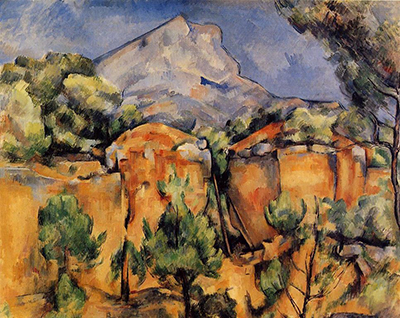
A mountain rises behind a wall of ochre stone, yet the wall is the first thing we meet. In Paul Cézanne’s Mont Sainte-Victoire Seen from Bibémus Quarry , the pale summit occupies the upper centre while the quarry’s cut faces, crevices and shrubs press toward the viewer. The place from which Cézanne looks nearly competes with the landmark he looks toward.
Dated about 1897, this oil painting belongs to the Baltimore Museum of Art’s Cone Collection. Its ochres, greens and blues do as much to hold the picture together as its outlines do. [1]
At a Glance
- Artist Paul Cézanne (1839–1906). [1]
- Date About 1897; published estimates vary. [1]
- Medium and size Oil on canvas, 65.1 × 81.3 cm (25⅝ × 32 in.) in the catalogue raisonné. [1]
- Collection Baltimore Museum of Art, Cone Collection, accession 1950.196. [1]
- Catalogue identity FWN 315; Rewald 837. [1]
This work across Paul Cézanne’s career
The Kiss of the Muse
c.1860The Artist’s Father, Reading L’Événement
autumn 1866The Hanged Man’s House
c.1873A Modern Olympia
1873–74Maincy Bridge
1879–80The Blue Vase
1889–90The Basket of Apples
c.1893Apples and Oranges
c.1899The Large Bathers (Philadelphia)
1900–1906 (Philadelphia Museum dating)Château Noir (MoMA)
1903–04Contents
- The view is built from two kinds of stone
- What colour does to distance
- An abandoned worksite in Cézanne’s Aix
- One mountain, one particular standpoint
- From Paris to Baltimore
The view is built from two kinds of stone
The mountain has a broad triangular rise and a broken crest. Its face is assembled from pale grey, violet and warm beige passages; blue enters the upper slopes and the surrounding sky. Below, quarry stone takes the form of close, upright masses. Their orange surfaces are crossed by darker seams, and their upper edges do not form a continuous ledge. Foliage comes between the blocks and in front of them, sometimes as a dense dark patch, sometimes as dispersed green strokes. A pine at the right edge leans into the sky and partly closes the opening around the mountain.
The summit is neither a single flat silhouette nor an evenly shaded cone. The long left slope climbs to a pointed high point, then the ridge drops in several unequal steps toward the right. Beneath that outer contour, broad, almost horizontal bands sweep across the face. They echo the ledges lower in the picture without pretending that mountain and quarry are made of identically coloured stone. At the left the mountain disappears behind a dense bank of trees; on the right its lower edge dissolves into vegetation. We can name the peak with confidence while remaining less sure where its visible body ends.
This is a landscape with a conspicuous foreground, but the foreground offers little path into it. We do not see an orderly road or a receding field. Instead, cuts and gaps in the rock pull the eye down, while the summit draws it back up. The painting’s clearest vertical division sits near its centre: a dark cleft descends between lit stone faces. Small shrubs gather beneath it. Their colour catches elsewhere in the picture, including in the vegetation that hems the mountain on the left.
John Rewald described Bibémus as a cut, stepped quarry where plants had taken root among abandoned blocks. That account identifies the worked ground visible here, without fixing each painted shape to a surveyed feature. [2]
The closest stone fronts are also varied. The left face spreads as a low horizontal band; the central mass rises with a rounded top and a near-vertical drop; a taller block on the right has an angled upper plane. These differences keep the foreground from becoming one unbroken barrier. The dark opening between the main masses seems deep at its upper edge, then narrows and becomes hard to separate from trunks and shadow below. As the eye follows it downward, what first looked like a clear gap between stones becomes a knot of several forms.
The different kinds of rock have different jobs in the composition. The quarry faces make hard, warm planes that stand close to us. The distant mountain is cooler and seems less bounded, even though its ridge has a firm outline against the sky. That opposition creates a surprising exchange: the quarry’s relatively small stone masses look monumental, while the actual mountain appears almost close enough to sit immediately behind them. There is a real distance between quarry and summit, but no broad valley is allowed to explain it.
The horizontal canvas might have accommodated a broad prospect. Cézanne instead gives much of its lower half to stone and foliage, leaving no continuous horizon between the quarry and the peak. The mountain is seen over the top of the blocks, almost as if the viewer had stopped at an obstruction. There is open blue around its upper contour, but the trees close that opening from both sides. This alternation of blockage and release makes the sky feel earned: a narrow space discovered above a crowded foreground rather than a limitless expanse laid behind it. The eye can travel up to the summit quickly, yet returning downward takes longer because each rock edge proposes a different route.
What colour does to distance
Look first at the central orange block. Light patches of yellow and red-orange draw attention to its surface, while blue-grey marks and dark green vegetation interrupt its edges. The mountain above repeats some of these colours at a lower intensity. Its pale face contains ochre as well as blue; the quarry is touched by cooler hues. Because the colours are not confined to one distance, the mountain and the cut rock can feel joined even when we recognise the gap between them.
Within the mountain, short blue-grey strokes collect along the lower bands, while warmer marks appear near the pale crest. In the foreground, light ochre is crossed by darker, cooler accents rather than filled as a single smooth surface. Greens range from yellowish patches around the block tops to deep tones at the cleft. These variations keep the quarry faces lively without making them lose their bulk. They also prevent the sky, despite its wide blue field, from becoming an empty backdrop: the right-hand canopy pushes through it, and the mountain’s upper contour keeps its edge active.
The brushwork also resists a straightforward hierarchy of detail. Broken touches articulate the upper mountain, the vegetation and the quarry face. Cézanne gives us clues to material and scale, but he does not make distant marks uniformly smaller or softer than near ones. The Baltimore museum’s teaching text calls attention to this and suggests that the mountain is made to seem closer than a camera view might show it. That is a useful description of the painted effect; a photograph alone cannot establish how deliberately any single proportion was altered. [3]
Theodore Reff identified the central cliff, its neighbouring cleft and the tree below as a focus of colour and dense paint. Follow the orange face downward and the tree’s dark shape interrupts it; follow the cleft upward and the eye reaches the cooler band beneath the summit. [4]
The right-hand tree matters for the same reason. Its trunk is a slim boundary at the edge, yet its canopy spreads over a large part of the sky. On the left, dark vegetation pushes inward. Together they create a partial frame, though neither side is neatly symmetrical. The mountain looks framed for a moment and then the foreground’s irregularities break the frame apart. A rounded orange cap on one block answers the peak’s triangular shape without copying it. The resemblance encourages the eye to move between quarry and mountain, then makes their differences harder to ignore.
An abandoned worksite in Cézanne’s Aix
Bibémus was a quarry east of Aix-en-Provence, a place where stone for building had been removed and vegetation later grew through the cuts. The National Gallery in London notes that Cézanne rented a small shack there in the mid-1890s and cites a 1896 letter from his friend Numa Coste saying he was spending much of his time at the site. The National Gallery’s account concerns a different Bibémus painting, In the Bibémus Quarry , but the geographical and documentary setting helps place the Baltimore canvas. [5]
The quarry is therefore a made landscape as well as a natural one. The almost architectural fronts of its blocks did not arise simply through erosion; extraction helped create them. At the same time, the shrubs and trees do not behave like incidental decoration. They enter the cracks, cross the stone surfaces and blur some boundaries that quarrying had made. The picture shows a place in which human cutting and later growth coexist. It does not show the quarry as an active workplace: there are no labourers, tools or carts in this view.
Anne Byrd places the Baltimore painting among Bibémus views whose geometry appears stable at one scale and uncertain at another. She calls its quarry a shifting foreground to a mountain that seems to occupy another realm. Her wider argument, developed through three other quarry canvases and a critical reading of Joachim Gasquet’s later memoir, is that individual brush marks can establish a form and disturb it at the same time. The Baltimore view offers a bounded instance: dark strokes describe the cleft, yet the boundaries of adjacent rock and vegetation keep changing as the eye moves across them. [6]
One mountain, one particular standpoint
Cézanne returned to Mont Sainte-Victoire from different positions over many years. The Mont Sainte-Victoire overview follows that broader motif; the Baltimore painting makes most sense when its Bibémus foreground is kept in view. Earlier paintings from the Arc valley, including Mont Sainte-Victoire and the Viaduct of the Arc River Valley , organise the mountain beyond fields, trees and the railway bridge. Here it appears beyond blocks cut out of an elevated quarry. Moving the standpoint changes what the mountain has to contend with pictorially. [7]
That distinction also matters among the Bibémus works themselves. A separate Bibémus painting in the National Gallery, London, record shows a figure within the steep quarry interior; the gallery dates it 1900–04. The Baltimore canvas opens outward to the mountain. Their shared place name covers different compositions. [5]
The Barnes Foundation holds two useful controls with different subjects: Bibémus Quarry (BF34), a tall c. 1895 view of the workings, and La Montagne Sainte-Victoire (BF13/FWN 296), a broad mountain view across the Arc valley. Neither is the Baltimore FWN 315 canvas. The latter belongs to the larger motif discussion; BF34 helps show how a quarry picture can make the cut rock itself the principal subject. [8] [9]
Rewald photographed the sites with Leo Marchutz decades later. He found that quarry changes prevented recovery of exact positions, while his camera made the mountain appear too small against nearer ground. Their photographs can clarify the broad sightline, though they cannot measure this painted view exactly. [2]
From Paris to Baltimore
The canvas passed from dealer Ambroise Vollard to Paris collector Maurice Gangnat, who lent it to the 1907 Salon d’Automne retrospective under the title La Montagne rocheuse (“the rocky mountain”). The historical title emphasises the rock; the later English one names the viewpoint. [1]
At Gangnat’s sale on 25 June 1925 it was lot 162, bought by Galerie Bernheim-Jeune. The catalogue records Dr Claribel Cone as its owner a week later, on 2 July. The Baltimore museum’s finding aid independently places her purchase in 1925; the painting entered the museum in 1950. [1] [10]
The painting appeared in Cézanne: The Late Work at the Museum of Modern Art in 1977–78. Princeton’s 2020 Cézanne: The Rock and Quarry Paintings checklist groups it with two other Bibémus paintings, inviting comparison between this outward mountain view and quarry interiors. The grouping is a later curatorial choice. [1] [11]
Cézanne artworks directory
Browse 217 identified works in this researched selection, including paintings, drawings and watercolours. This is a bounded selection, not a complete catalogue of Cézanne’s surviving oeuvre. Unlinked titles have no confirmed article in this collection.
| Name | Date | Medium |
|---|---|---|
| A Head, a Cup, and a Bread Roll | 1891/1894 | Drawing |
| A Man seen from Behind | 1880/1883 | Drawing |
| A Modern Olympia | 1873–74 | Painting |
| A Nude and Foliage | 1879/1882 | Drawing |
| A Smoking Man | 1892–96 (catalogue); c.1890–92 (museum) | Drawing |
| Afternoon in Naples | 1876–77 | Painting |
| An Old Woman with a Rosary | about 1895–96 | Painting |
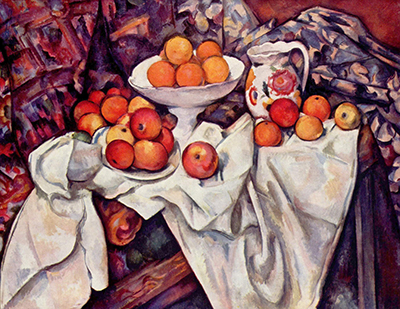
| Apples and Oranges | c.1899 | Painting |
| Auvers, Panoramic View | 1873–75 | Painting |
| Avenue at Chantilly | 1888 | Painting |
| Banks of the Marne | 1888–94 | Painting |
| Basket | 1877/1900 | Drawing |
| Bather with Outstretched Arms | 1877–78 | Painting |
| Bellows in Front of a Fireplace | 1887/1892 | Drawing |
| Bibémus Quarry | c.1895 | Painting |
| Boy in a Red Vest, Barnes Foundation | 1888–90 | Painting |
| Boy in a Red Vest, MoMA | 1888–90 | Painting |
| Boy in a Red Waistcoat, National Gallery of Art | 1888–90 | Painting |
| Branch in Flower | 1886/1889 | Drawing |
| Carnival Scene | 1885/1888 | Drawing |
| Chair and Dresser | 1880/1883 | Drawing |
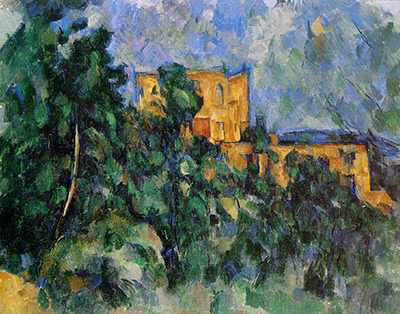
| Chateau Noir | 1903–04 | Painting |
| Chestnut Trees and Farm at Jas de Bouffan | c.1885 | Painting |
| Chestnut Trees and Farm at Jas de Bouffan, Pushkin | c.1886 | Painting |
| Chestnut Trees at Jas de Bouffan in Winter | 1885–86 | Painting |
| Château Noir | 1900–04 | Painting |
| Cistern in the Park of Château Noir | c.1900 | Painting |
| Curtain, Jug and Fruit | 1893–94 | Painting |
| Cushion of an Armchair | 1886/1889 | Drawing |
| Draft Letter and Studies of Bathers | c.1878 | Drawing |
| Farmhouse and Chestnut Trees at Jas de Bouffan | 1884–85 | Painting |
| Figure Resting Head on Hand | c. 1889 | Drawing |
| Fireplace Tongs and Poker | 1887/1892 | Drawing |
| Forest Interior, San Francisco | c.1898–99 | Painting |
| Four Bathers | 1888–90 | Painting |
| Fruit and a Jug on a Table | 1893–94 | Painting |
| Gardanne | 1885–86 | Painting |
| Gardanne, Barnes Foundation | c.1885 | Painting |
| Hand and Shoulder of a Boy | c. 1885 | Drawing |
| Harlequin, National Gallery of Art | 1888–90 | Painting |
| Head of a Boy | 1887/1889 | Drawing |
| Head of a Boy Seen from Behind | c. 1885 | Drawing |
| Head of a Young Woman | c. 1880 | Drawing |
| Head of the Artist's Son | 1888/1889 | Drawing |
| Hillside in Provence | c.1890–92 | Painting |
| Horse Chestnut Trees at Jas de Bouffan | c.1885 | Painting |
| House and Farm at the Jas de Bouffan | c.1887 | Painting |
| House in a Park | 1883/1886 | Drawing |
| House in Provence | c.1885 | Painting |
| House of Père Lacroix | 1873 | Painting |
| House Surrounded by Vegetation | 1889/1892 | Drawing |
| Houses in Provence The Riaux Valley near L’Estaque | c.1883 | Painting |
| Jas de Bouffan, the Pool | c.1876 | Painting |
| Kerosene Lamp | 1878/1881 | Drawing |
| L'Estaque, Melting Snow | c.1870 | Painting |
| Lake Annecy | 1896 | Painting |
| Landscape in Provence, Pola Museum | 1879–82 | Painting |
| Landscape Near Aix-en-Provence | 1877/1880 | Drawing |
| Landscape Seen from the Inside of a Cave | 1889/1892 | Drawing |
| Landscape with Poplars | c.1885–87 | Painting |
| Landscape with Trees | 1895/1898 | Drawing |
| Leda and the Swan | c.1880 (possibly later) | Painting |
| Little Girl with a Doll | 1902–04 | Painting |
| Louis Guillaume | 1879–1890 | Painting |
| Madame Cezanne | 1888/1891 | Drawing |
| Madame Cezanne | 1886/1889 | Drawing |
| Madame Cezanne | 1882/1887 | Drawing |
| Madame Cezanne | 1897/1900 | Drawing |
| Madame Cezanne with her Head Lowered | 1893/1896 | Drawing |
| Madame Cézanne in a Red Armchair | c.1877 | Painting |
| Madame Cézanne in a Red Dress, Metropolitan Museum of Art | 1888–90 | Painting |
| Madame Cézanne in a Yellow Chair | 1888–90 | Painting |
| Madame Cézanne in a Yellow Chair, Fondation Beyeler | 1888–90 | Painting |
| Madame Cézanne in the Conservatory | 1891 | Painting |
| Maincy Bridge | 1879–80 | Painting |
| Maison Maria with a View of Château Noir | c.1895 | Painting |
| Man Bending Forward | 1883/1886 | Drawing |
| Man Smoking a Pipe, Pushkin | c.1891, possibly later | Painting |
| Man with a Pipe | 1891–96 | Painting |
| Man with a Pipe, Nelson-Atkins | 1890–92 | Painting |
| Man with a Straw Hat (Gustave Boyer) | c.1871 | Painting |
| Man with Crossed Arms | c.1899 | Painting |
| Man with Pipe, National Gallery of Art | 1892–96 | Painting |
| Mont Sainte-Victoire | c.1902–06 | Painting |
| Mont Sainte-Victoire | 1900–02 | Painting |
| Mont Sainte-Victoire (recto) | c.1895 | Watercolour |
| Mont Sainte-Victoire and the Viaduct of the Arc River Valley | 1882–85 | Painting |
| Mont Sainte-Victoire Seen beyond the Wall of the Jas de Bouffan | c.1885/1888 | Watercolour |
| Mont Sainte-Victoire Seen from Bibémus Quarry | c.1897 | Painting |
| Mont Sainte-Victoire, Barnes Foundation | 1892–95 | Painting |
| Near the Pool at Jas de Bouffan | 1883/1887 | Drawing |
| Pelicans | 1877/1880 | Drawing |
| Peonies | 1890/1893 | Drawing |
| Pierrot and Harlequin | 1888 | Painting |
| Pine Tree | 1882/1885 | Drawing |
| Pont des Trois Sautets | 1906 | Watercolour |
| Poplars | 1879–80 | Painting |
| Portrait of Ambroise Vollard | 1899 | Painting |
| Portrait of Gustave Geffroy | 1895–96 | Painting |
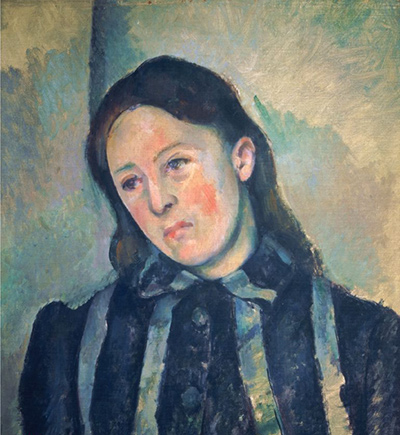
| Portrait of Madame Cezanne with Loosened Hair | 1885–86 | Painting |
| Portrait of the Artist Looking Over His Shoulder | 1883–84 | Painting |
| Portrait of the Gardener Vallier | 1906 | Painting |
| Portrait of Victor Chocquet | 1876–77 | Painting |
| Portrait Of Victor Chocquet Seated | 1877 | Painting |
| Provençal Manor | c.1885 | Painting |
| Pyramid of Skulls | 1898–1900 | Painting |
| Reclining Nude (Leda?) | c.1887 | Painting |
| Scipio | 1866–68 | Painting |
| Seated Man, Oslo | 1898–1900 | Painting |
| Seated Peasant | c.1892–96 | Painting |
| Seated Peasant, Hiroshima | c.1897 | Painting |
| Seated Peasant, Orsay | c.1900 | Painting |
| Self-Portrait | c. 1895 | Drawing |
| Self-Portrait in a Bowler Hat, Ny Carlsberg Glyptotek | 1885–86 | Painting |
| Self-Portrait in a Casquette | c.1875 | Painting |
| Self-Portrait with a Beret | 1898–1900 | Painting |
| Self-Portrait with a Hat, Artizon Museum | c.1890–94 | Painting |
| Self-Portrait with a Pink Background | c.1875 | Painting |
| Self-Portrait with Olive-Coloured Wallpaper | about 1880–81 | Painting |
| Self-Portrait with Palette | 1886–87 | Painting |
| Self-Portrait with White Turban | c.1878–80 | Painting |
| Self-Portrait, c.1895 | c.1895 | Painting |
| Self-Portrait, Pushkin Museum | c.1882 | Painting |
| Spanish Dancers | 1883/1886 | Drawing |
| Still Life with a Curtain | 1892–94 | Painting |
| Still Life with Apples | c.1890 | Painting |
| Still Life with Apples | 1893–94 | Painting |
| Still Life with Apples and a Pot of Primroses | about 1890 | Painting |
| Still Life with Milk Jug and Fruit | c.1900 | Painting |
| Still Life with Open Drawer | 1877–79 | Painting |
| Still Life with Plaster Cupid | about 1894 | Painting |
| Still Life with Skull | 1890–93 | Painting |
| Still Life with Soup Tureen | 1877 | Painting |
| Still Life, Pitcher and Fruit | 1893–94 | Painting |
| Studies Including a Straw Hat | 1895/1898 | Drawing |
| Studies Including Madame Cezanne | 1884/1887 | Drawing |
| Study for "The Judgement of Paris" or "The Amorous Shepherd" | 1883/1886 | Drawing |
| Study for Woman with a Coffee Pot | c.1895 | Painting |
| Study of "The Roman Orator (Germanicus)" | 1883/1886 | Drawing |
| Study of "Venus de Milo" | 1881/1884 | Drawing |
| Study of a Decorative Ornament | 1879/1882 | Drawing |
| Study of a Standing Male Figure after the Antique | c. 1895 | Drawing |
| Study of an Angel in Rubens' "The Prophet Elijah" | 1892/1895 | Drawing |
| Study of Desiderio da Settignano's "Bust of a Child" | c. 1895 | Drawing |
| Study of Houses | 1879/1882 | Drawing |
| Study of Puget's "Hercules Resting" | c. 1879 | Drawing |
| Study of Puget's "Milo of Crotona" | 1895/1898 | Drawing |
| Study of Puget's "Milo of Crotona" | 1880/1883 | Drawing |
| Study of the Allegorical Figure Bellona in Rubens' "The Apotheosis of Henri IV" | 1883/1886 | Drawing |
| Study of the Allegorical Figure Bellona in Rubens' "The Apotheosis of Henri IV" | 1879/1882 | Drawing |
| Study of the Allegorical Figure France in Rubens' "The Exchange of the Two Princesses" | 1882/1885 | Drawing |
| Study of the Allegorical Figure of Health in Rubens' "The Birth of Louis XIII" | 1880/1883 | Drawing |
| Study of the Allegorical Figure of the Genius of Health from Rubens' "The Birth of Louis XIII at Fontainbleau" | 1895/1898 | Drawing |
| Sugar Bowl, Pears and Blue Cup | 1865–66 | Painting |
| The Aqueduct, Pushkin Museum | Dating differs between museum records | Painting |
| The Artist's Father, Reading L'Evenement | autumn 1866 | Painting |
| The Artist's Son | c. 1887 | Drawing |
| The Artist's Son Leaning on his Elbow | c. 1887 | Drawing |
| The Artist's Son Reading | c. 1887 | Drawing |
| The Artist's Son Writing | c. 1887 | Drawing |
| The Artist’s Son, Paul | 1886–87 | Painting |
| The Avenue at Jas de Bouffan | 1868–70 (possibly later) | Painting |
| The Avenue at Jas de Bouffan, Geneva | c.1890 | Painting |
| The Basket of Apples | c.1893 | Painting |
| The Bather, Museum of Modern Art | c.1885 | Painting |
| The Bay of Marseille seen from L'Estaque | c.1885 | Painting |
| The Blue Vase | 1889–90 | Painting |
| The Boy in the Red Vest, Bührle | 1888–90 | Painting |
| The Buffet | 1877–79 | Painting |
| The Card Players, Barnes Foundation | 1890–92 | Painting |
| The Card Players, Courtauld Gallery | 1892–96 | Painting |
| The Card Players, Metropolitan Museum of Art | 1890–92 | Painting |
| The Card Players, Musée d’Orsay | 1893–96 | Painting |
| The Card Players, Qatar | 1892–96 | Painting |
| The Eternal Feminine | c.1877 | Painting |
| The Gardener Vallier | 1906 | Painting |
| The Gardener Vallier, Tate | 1905–06 | Painting |
| The Grounds of the Château Noir | c.1900–04 | Painting |
| The Gulf of Marseille Seen from L’Estaque | c.1885 | Painting |
| The Hanged Man's House in Auvers | c.1873 | Painting |
| The House of Doctor Gachet at Auvers | 1872–73 | Painting |
| The House with the Cracked Walls | 1892–94 | Painting |
| The Kiss of the Muse | c.1860 | Painting |
| The Large Bathers, Barnes Foundation | 1895–1906 | Painting |
| The Large Bathers, National Gallery | 1895–1905 | Painting |
| The Large Bathers, Philadelphia Museum of Art | 1900–06 | Painting |
| The Mill | 1889/1892 | Drawing |
| The Painter’s Father, Louis-Auguste Cézanne | c.1865 | Painting |
| The Peasant | 1890–92 | Painting |
| The Plaster Mill (La Moulin à plâtre) | 1889/1892 | Drawing |
| The Smoker, Hermitage | c.1891 | Painting |
| The Smoker, Mannheim | c.1891 | Painting |
| The Stove in the Studio | c.1865 | Painting |
| The Vase of Tulips | c.1890 | Painting |
| Thistle | 1893/1896 | Drawing |
| Three Heads, One of Madame Cezanne | 1882/1885 | Drawing |
| Three Skulls | c.1898 | Painting |
| Three Skulls on a Patterned Carpet | 1904 | Painting |
| Trees and Shrubs | 1883/1887 | Drawing |
| Turning Road at Montgeroult | 1898 | Painting |
| Two Bathers | 1884/1887 | Drawing |
| Two Heads | 1888 | Drawing |
| Two Heads | 1890/1896 | Drawing |
| Two Heads of Women | 1890/1894 | Drawing |
| Two Studies for "The Judgement of Paris" or "The Amorous Shepherd" | 1883/1886 | Drawing |
| Uncle Dominique in a Tasseled Cap | 1866 | Painting |
| Uncle Dominique in a Turban | 1866–67 | Painting |
| Victor Chocquet and an Angel for "The Apotheosis of Delacroix" | 1878/1880 | Drawing |
| Woman in Blue | c.1904 | Painting |
| Woman Leaning Forward | 1888/1891 | Drawing |
| Woman Leaning Forward | 1890/1894 | Drawing |
| Woman Leaning Forward | 1890/1894 | Drawing |
| Woman with a Coffee Pot | c.1895 | Painting |
| Women Bathers and a Roll of Paper | 1882/1885 | Drawing |
| Young Girl with a Doll | c.1895 | Painting |
| Young Italian Woman at a Table | c.1895–1900 | Painting |
| Young Man and Skull | 1896–98 | Painting |
Frequently Asked Questions
The Baltimore Museum of Art’s Cone Collection holds it as accession 1950.196. [1]
About 1897 is the catalogue raisonné’s estimate; other published dates vary. [1]
Bibémus is a former stone quarry east of Aix-en-Provence. Its cut, weathered blocks and later vegetation provide the painting’s foreground; Mont Sainte-Victoire rises beyond them. [2]
Discussion
Look again at the images and ideas explored in Mont Sainte-Victoire Seen from Bibémus Quarry by Paul Cézanne. These editorial prompts invite your observations.
Reader Insights
Look at the central cleft before the mountain. How does that dark descent change the apparent height of the orange stone around it?
Compare the scale of brush marks on the summit with those in the nearest shrubs. Which details tell you that one is far away, and which details resist that distance?
Cover the foreground briefly, then uncover it. Does the mountain seem to change size when the quarry returns to view?
Join the Conversation
Share a detail, comparison or question about Mont Sainte-Victoire Seen from Bibémus Quarry by Paul Cézanne below.
References
- Société Paul Cézanne. “La Montagne Sainte-Victoire vue de Bibémus, c. 1897 (FWN 315),” The Paintings, Watercolors and Drawings of Paul Cezanne: An Online Catalogue Raisonné , current entry, including provenance and exhibition history. View source .
- John Rewald / Museum of Modern Art. “The Last Motifs at Aix,” in Cézanne: The Late Work , edited by William Rubin, 1977, pp. 83–106, especially pp. 93–95 and 105–06. View source .
- Baltimore Museum of Art. “Cézanne’s Mountain,” November 2009. View source .
- Theodore Reff / Museum of Modern Art. “Painting and Theory in the Final Decade,” in Cézanne: The Late Work , edited by William Rubin, 1977, especially p. 50. View source .
- National Gallery, London. “Paul Cezanne: In the Bibémus Quarry,” collection entry, current online record. View source .
- Anne Byrd. “The Brush Stroke as Catastrophe: Gasquet’s Cézanne and the Paintings of Bibémus Quarry,” RACAR 34, no. 1 (2009), pp. 41–52. View source .
- The Metropolitan Museum of Art. “Mont Sainte-Victoire and the Viaduct of the Arc River Valley,” collection record for 29.100.64. View source .
- Barnes Foundation. “Bibémus Quarry (Carrière de Bibémus),” collection entry for BF34, c. 1895. View source .
- Société Paul Cézanne. “La Montagne Sainte-Victoire,” catalogue entry for Barnes BF13/FWN 296. View source .
- Baltimore Museum of Art Archives. Claribel Cone and Etta Cone Papers, Series 1–6, MS.1 , finding aid, chronology and p. 106 description of Bernheim-Jeune correspondence. View source .
- Princeton University Art Museum. Cézanne: The Rock and Quarry Paintings , illustrated checklist by venue, 2020, p. 3. View source .
- Le Baiser de la muse, d'après Frillié (FWN 572). View source.
- Louis-Auguste Cezanne, père de l'artiste, lisant L'Événement (FWN 402). View source.
- La Maison du pendu, Auvers-sur-Oise (FWN 81). View source.
- Une moderne Olympia (FWN 628). View source.
- Le Pont de Maincy (FWN 143). View source.
- La Montagne Sainte-Victoire vue de Montbriand (FWN 185). View source.
- Gardanne (vue horizontale) (FWN 224). View source.
- Le Vase bleu (FWN 823). View source.
- Les Joueurs de cartes (FWN 681). View source.
- La Corbeille de pommes (FWN 860). View source.
- Pommes et oranges (FWN 871). View source.
- Portrait d'Ambroise Vollard (FWN 531). View source.
- Philadelphia Museum of Art,The Large Bathers,W1937-1-1. View source.
- Château Noir (FWN 360). View source.
- Société Paul Cezanne,online catalogue structure and objectidentification. View source.
- National Gallery of Art,Cezanne Sketchbook,1992.51.9. View source.
- Splash image, Paul Cézanne, Mont Sainte-Victoire Seen from Bibémus Quarry.