by Tom Gurney
Tom Gurney BSc (Hons) is an art history expert with over 20 years experience
Page created on September 4, 2026 / Page updated on September 13, 2026
Email: tomgurney1@gmail.com / Phone: +44 7429 011000
From Baroque Drama to Rococo Intimacy: Read the Evidence, Not a Checklist
Baroque developed earlier and often used movement, scale, light and emotional address in religious, courtly or civic settings, while Rococo emerged later—especially in eighteenth-century France—and often redirected movement and ornament towards more intimate, decorative and sociable settings.[1][2][3] The periods overlap, both vary by place and medium, and no single feature such as colour, subject or size can identify every work.[4][5]
At a Glance
- ChronologyBaroque developed earlier; Rococo emerged later, especially in eighteenth-century France, with substantial overlap.
- Typical scale of addressBaroque often projects public, sacred or courtly drama; Rococo often turns movement and ornament toward sociable or intimate settings.
- Visual evidenceRead light, movement, setting, scale, surface and function together rather than relying on colour alone.
- Important overlapBoth can be theatrical, decorative, technically elaborate and connected to elite patronage.
- Best methodIdentify the work, date, place, medium and original setting before applying a period label.
Contents
Evidence Matrix: Baroque and Rococo
Baroque and Rococo are historical style and period labels, not rigid boxes. Their boundaries change according to region, medium and the question being asked.[1][2]
| Comparison | Baroque | Rococo | Shared ground and limits |
|---|---|---|---|
| Chronology and geography | Broadly associated with the period from about 1590 to 1750, with strong development in Italy and varied forms across Europe and beyond.[1][4] | Emerged in France in the 1720s and 1730s, then spread through eighteenth-century Europe.[2][5] | Their dates overlap. A change in French court culture after 1715 did not transform every place at once.[3] |
| Function, patronage and setting | Could support religious persuasion, princely or civic display, but also private collecting and domestic viewing.[4][6][7] | Became prominent in decorative ensembles, luxury objects and paintings made for more intimate or sociable settings.[3][5] | Neither style belonged to only one patron, audience or type of space. |
| Subjects and meanings | Sacred history, courtly and civic imagery, portraits, landscapes, still lifes and scenes of everyday life all appear.[4][6][7] | Theatrical, pastoral, amorous, mythological and allegorical subjects recur, but do not exhaust its range.[3][8] | “Serious” versus “frivolous” and religious versus secular are unreliable divisions. |
| Composition and movement | Diagonals, curves, compressed action, strong contrasts and direct theatrical address often animate the scene.[1][5] | Curves, counter-curves, asymmetry and flowing natural ornament often organise figures and their surroundings.[2][5] | Both can be mobile, theatrical, ornamental and illusionistic. Movement alone settles nothing. |
| Light, colour and handling | Some painters intensify narrative through forceful light-dark contrast; others use broader daylight or more even illumination.[1][4] | Lighter palettes and delicate handling recur in many French examples, although neither quality is universal.[2][3] | Reproduction colour varies, and palette by itself is not a dependable attribution tool. |
| Scale, surface and space | Monumental, spatially coordinated effects coexist with smaller works for private buyers. Paintings appear on different supports.[4][6][7] | Painting can work closely with surrounding ornament and intimate interiors, yet individual works can still be physically large.[5] | “Monumental” and “intimate” describe forms of address and use as well as dimensions. |
| Similarities and exceptions | Regional, religious and market conditions produce substantial variety.[4][6] | Rococo adapts some Baroque devices while developing its own contexts, subjects and ornamental language.[2][3][5] | Several clues must converge before either label becomes persuasive. |
Chronology: succession with overlap
Baroque is usually placed across the seventeenth century and into the first half of the eighteenth. It developed strongly in Italy, but the label covers markedly different conditions elsewhere. Roman church and palace commissions could coordinate painting, sculpture and architecture to address a viewer through spectacle and emotion. In the Dutch Republic, meanwhile, a large market for privately owned landscapes, still lifes and scenes of daily life complicates any claim that Baroque art was necessarily monumental or religious.[4][6][7]
Rococo took recognisable form in France during the 1720s and 1730s. The death of Louis XIV in 1715 and the Regency help explain a French shift away from some forms of grand court ceremony towards more intimate settings and modes of sociability, but 1715 is context rather than a dividing line for European art.[3] Rococo spread across Europe while works described as Baroque were still being made. Depending on the source and place, Rococo may therefore be presented as a later development from Baroque, a transformation of some of its devices, or a related style with a distinct history.[2][3][5]
The word rocaille helps explain part of that distinction. It refers to ornament derived from shell and rock forms, often developed through curves, asymmetry and natural motifs.[5] It is especially useful for decorative arts and interiors; finding a curve in a painting does not, by itself, make the painting Rococo.
Four works that test the distinction
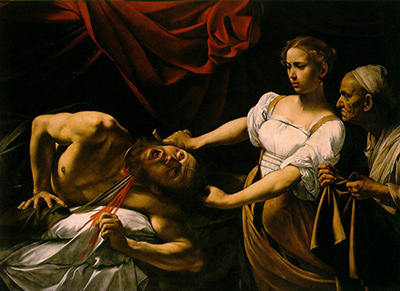
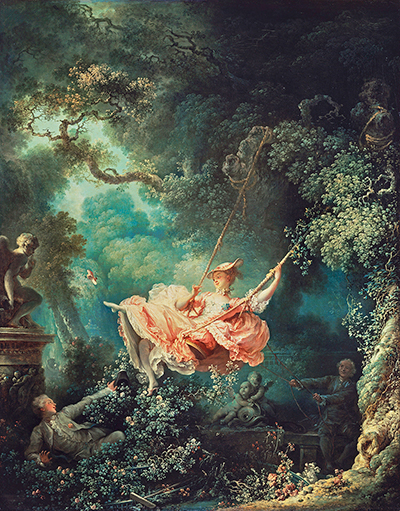
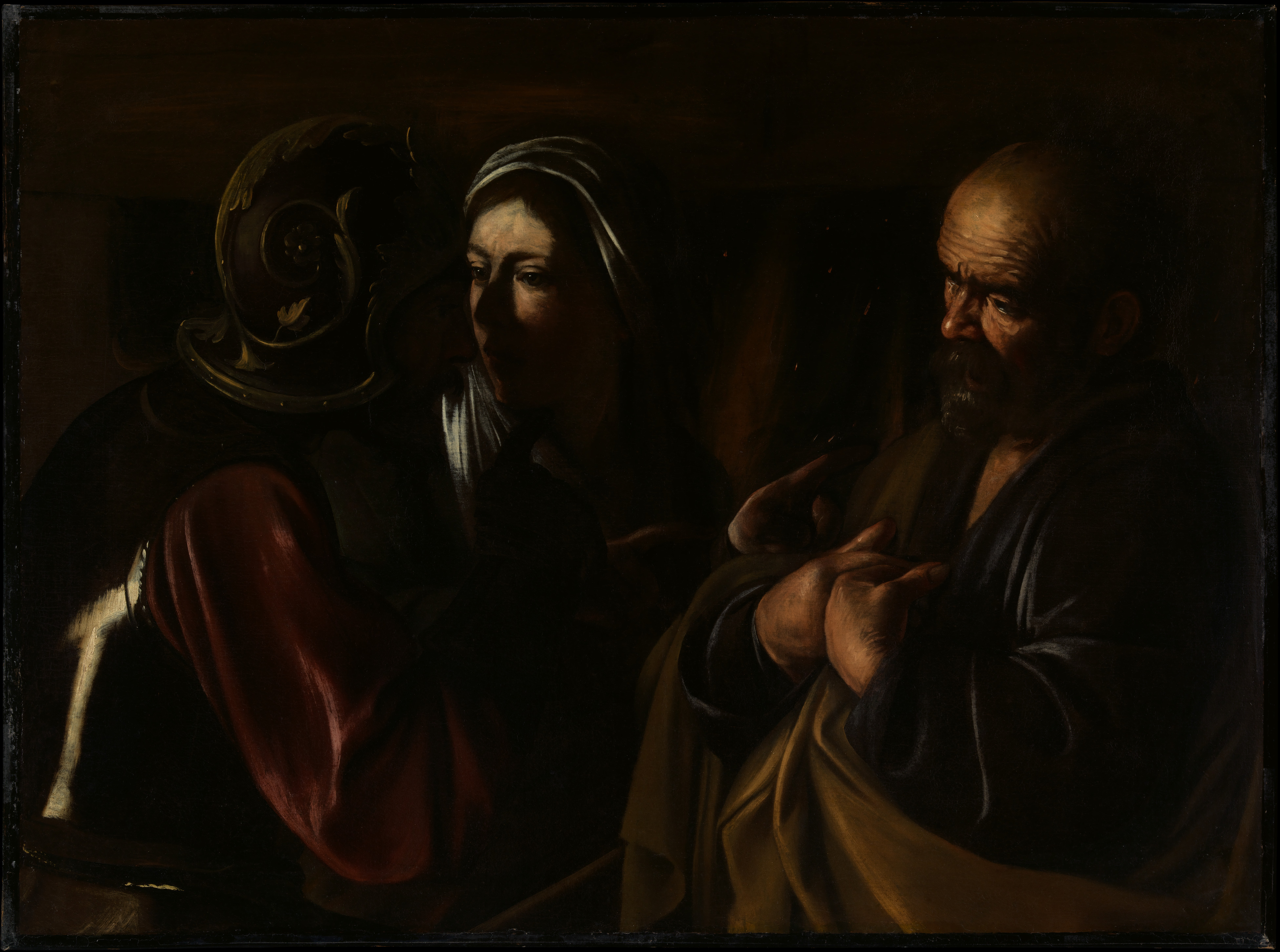
These four paintings demonstrate tendencies and exceptions rather than defining either style. Caravaggio appears above as the early visual anchor; Boucher, Rubens and Watteau remain below. All four are complete, uncropped objects, and their captions give actual dimensions because equal display frames do not mean equal physical scale.
Baroque example: Caravaggio
In The Denial of Saint Peter (1610), Caravaggio compresses a biblical confrontation into three figures near a fire. Brightly lit faces and hands emerge against a nearly black background, while the fingers of the soldier and woman refer to the three accusations and Peter’s three denials.[9] This is a concentrated example of light and gesture driving narrative, not a template for every Baroque painting.
Rococo example: Boucher and Workshop
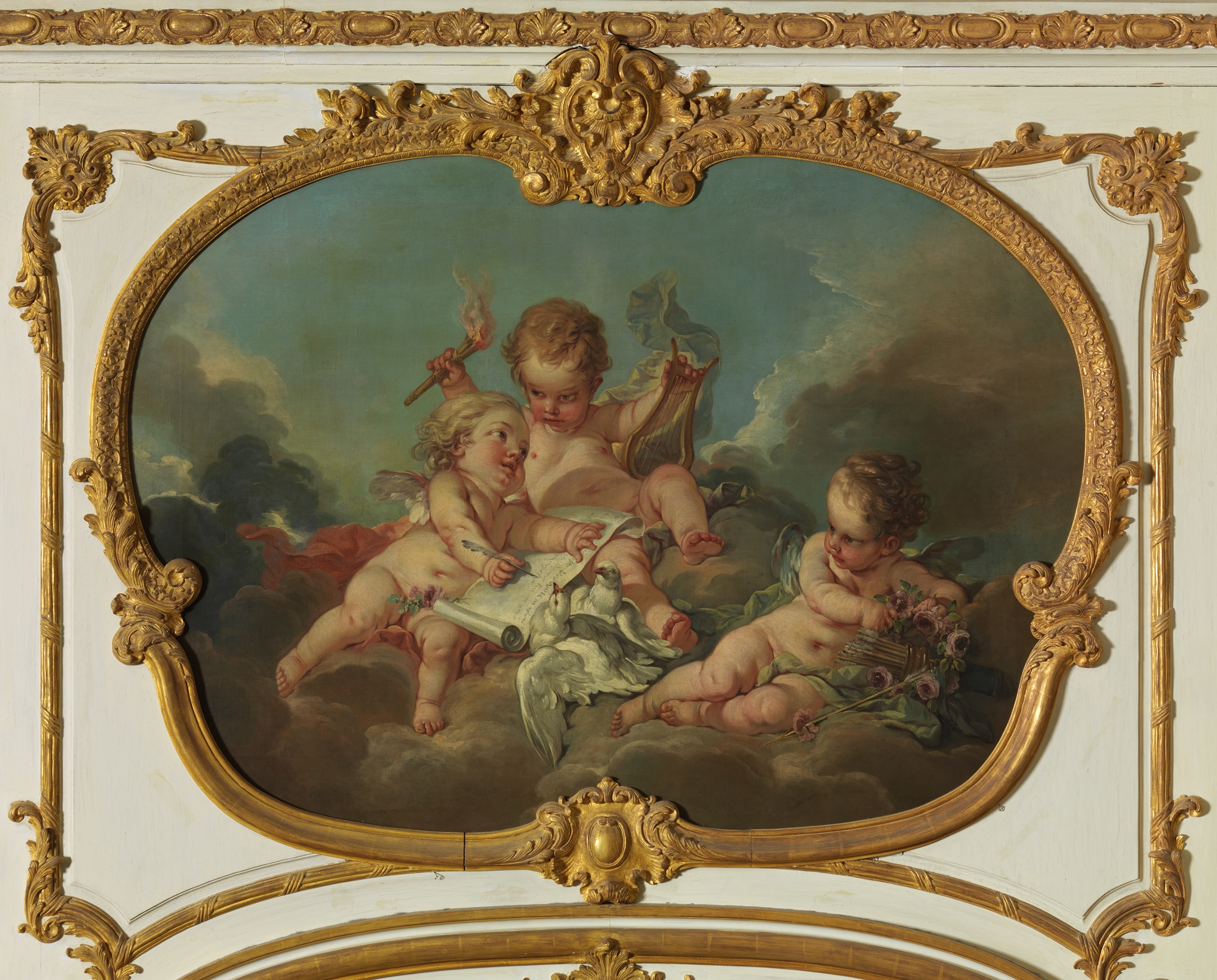
Allegory of Lyric Poetry (1753), by François Boucher and Workshop, presents airborne putti with attributes connected to lyric poetry. Its irregular cutout format allowed the canvas to function with the Rococo carving around it, making format and setting part of the work’s meaning.[10] At approximately 115 by 159 centimetres, it also shows why “intimate” cannot simply mean small.
Baroque example: Rubens
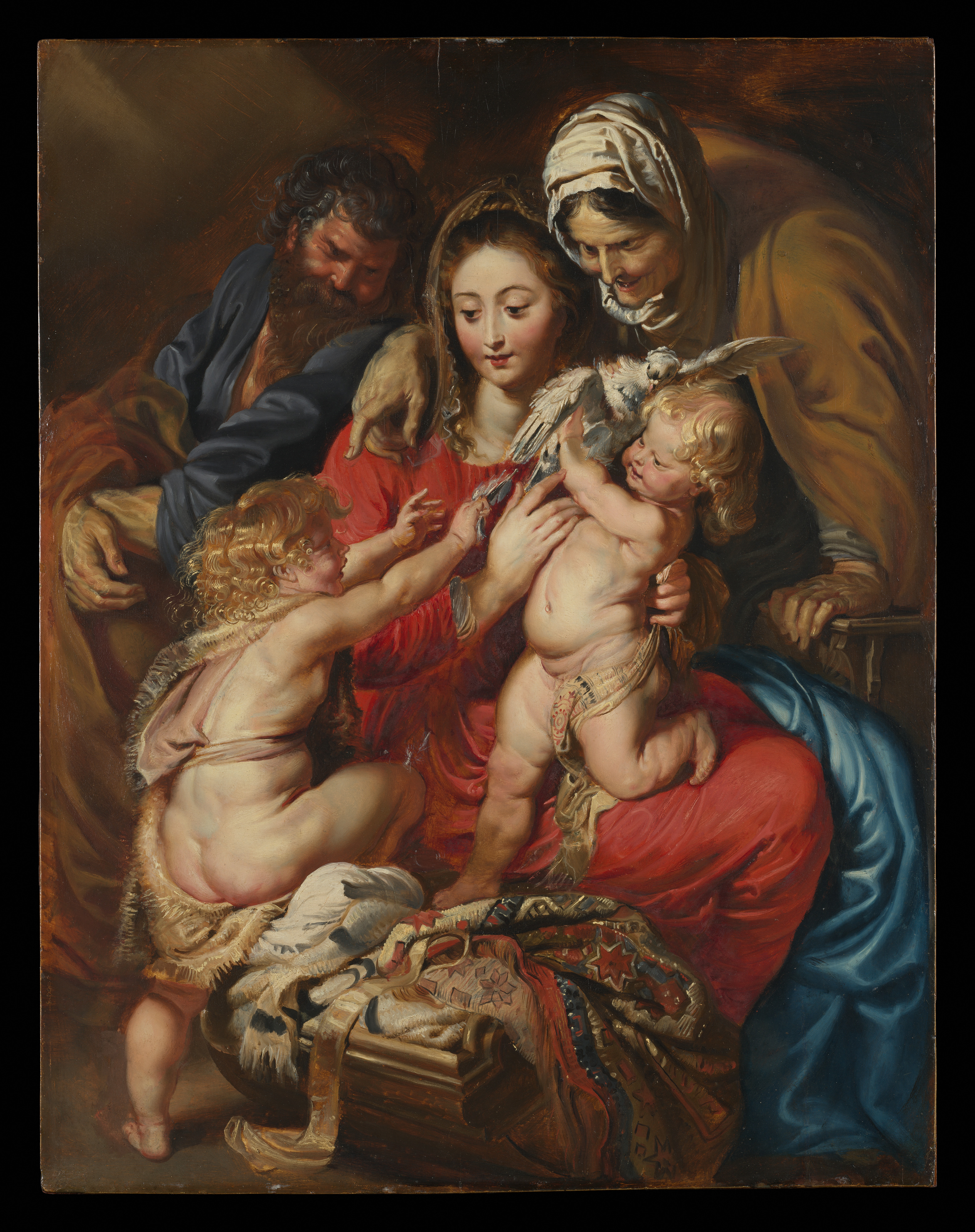
In this panel of about 1608–9, Peter Paul Rubens uses a sacred family group rather than Caravaggio’s nocturnal confrontation. The Met identifies the roughly handled dove as a symbol of the Holy Spirit and an allusion to Christ’s sacrifice.[11] The work is oil on oak, reminding us that even these two early Baroque examples do not share the same support or narrative tempo.
Rococo example: Watteau
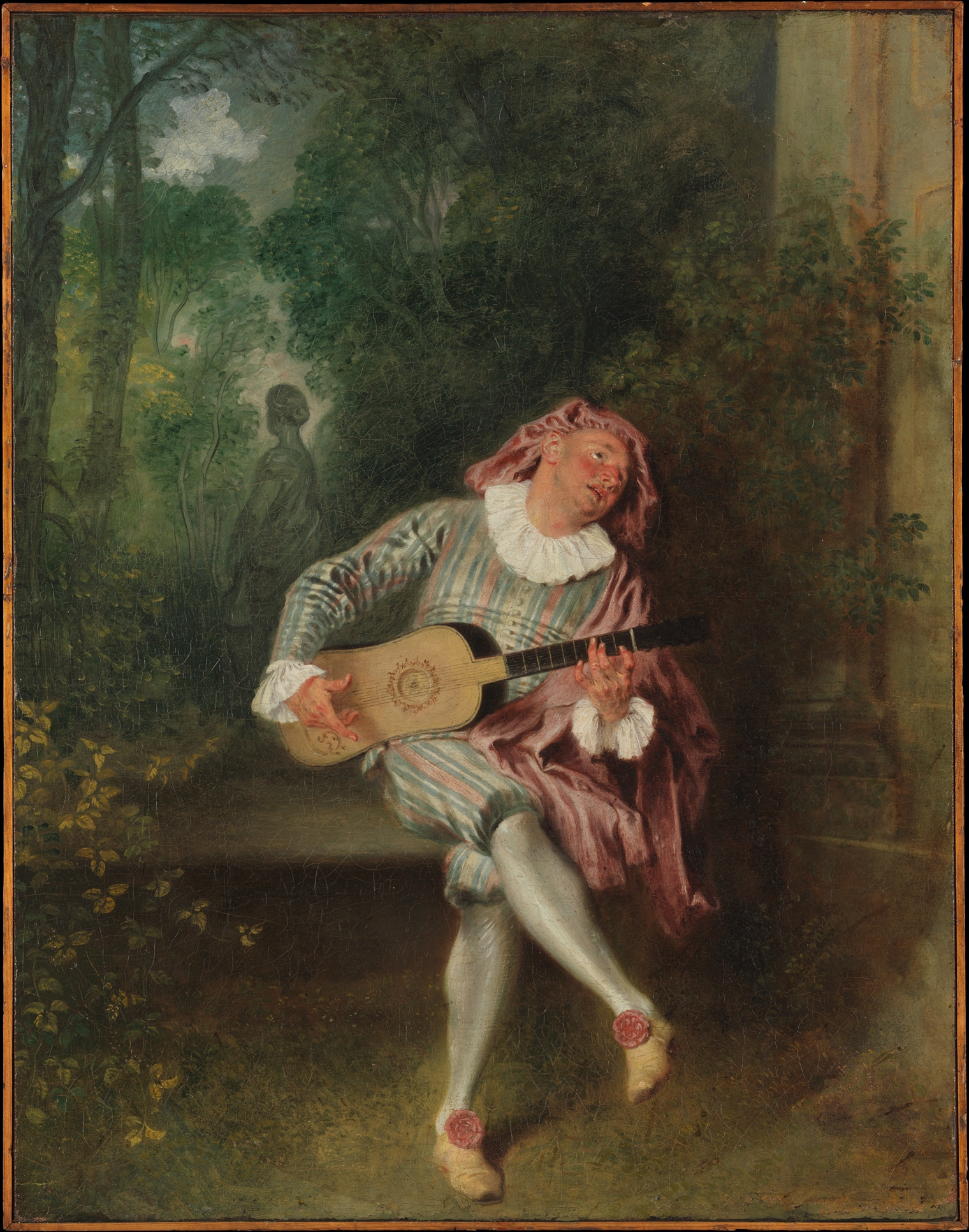
Antoine Watteau’s Mezzetin (about 1718–20) makes a stock comic character from the Italian commedia dell’arte into a painting subject. The musician sits in an overgrown garden, while a female statue turns away behind him; the Met connects that gesture to his lovelorn character and notes the painting’s delicate touch.[12] Theatrical reference, garden setting and emotional suggestion meet here without representing all Rococo art.
Compare what the art is doing
Function, patronage and setting
Ask first what the object was expected to do and where it operated. Baroque art could persuade worshippers, project political or civic authority, coordinate with a large interior, or serve a private buyer.[4][6][7] Rococo also crossed painting, sculpture and design, but its French development placed particular emphasis on decorative ensembles, crafted objects and sociable rooms.[3][5] Boucher’s shaped canvas makes that coordination unusually visible, while the Dutch market for domestic paintings provides an equally useful Baroque counterexample.
Subjects and meanings
Subject offers evidence only when joined to context. Sacred drama is important to Baroque art, as the two selected examples show, but portraits, landscapes, still lifes and everyday scenes also belong to its history.[4][6] Rococo is strongly associated with theatrical characters, pastoral leisure, courtship, mythology and allegory; reducing it to carefree pleasure, however, overlooks the different meanings, functions and audiences such subjects could carry.[3][8] A religious subject does not automatically mean Baroque, just as an amorous or mythological one does not automatically mean Rococo.
Composition and movement
Baroque compositions often pull the viewer through diagonals, curves, layered depth and decisive gestures. Caravaggio’s pointing hands make action legible within a tight group; other Baroque works create movement across much larger spatial schemes.[1][4] Rococo frequently uses asymmetry, counter-curves and natural forms, sometimes allowing figures, painted edges and surrounding ornament to flow into one another.[2][5] Yet motion, curves and theatrical staging belong to both. The question is how they function within the whole work.
Light, colour and handling
Strong light-dark contrast is one possible Baroque tool, not a definition. It gives Caravaggio’s accusation scene urgency, while Rubens’s panel offers a different surface, grouping and emotional cadence.[9][11] Rococo painters often employed lighter palettes or delicate handling: Watteau’s touch is a work-specific example, and French accounts of Boucher emphasise bright colour alongside sentimental or erotic themes.[3][12] Because screens, photography and conservation histories alter appearance, colour should be described cautiously and never used alone.
Scale, ornament and relationship to space
Baroque could organise entire settings around a powerful encounter, but it also includes modestly scaled pictures intended for homes and collectors.[4][6][7] Rococo’s association with intimate interiors likewise does not mean every object is small: Boucher’s large irregular panel gains significance from its intended relationship to carved surroundings.[5][10] Support and format matter too. The selected works include oil on canvas and oil on oak, rectangular and cutout formats. Those differences reveal artistic choices; they do not create a simple material boundary between the styles.
Shared ground and important exceptions
Rococo did not discard movement, theatricality, sensual appeal, curves or illusion. It often reworked devices also found in Baroque art, placing them within different patterns of patronage, scale, ornament and subject. That continuity explains why the boundary can be difficult to draw and why sources use more than one account of the relationship.[1][2][3]
Variation within Baroque is just as important. Catholic commissions in Rome, courtly projects and pictures made for Dutch private buyers answered different needs.[4][6][7] Rococo also travelled beyond its French beginnings and worked through furniture, ceramics, silver, interiors and painting as well as through varied local traditions.[2][5] Neither label describes a single look, and neither should be judged by the most familiar example alone.
How to tell Baroque and Rococo apart
Build an identification from several questions:
- When and where was it made? A seventeenth-century Italian context points differently from France in the 1730s, but overlapping dates require care.
- What was its function and setting? Consider worship, public display, private collecting, sociability or coordination with an interior.
- What is the subject doing? Look beyond subject labels to the kind of encounter, emotion or viewing behaviour the work constructs.
- How is the composition organised? Trace diagonals, curves, grouping, depth, gesture and the relationship between figures and edges.
- How do light, colour and handling work? Describe their narrative or decorative role without treating dark or pale colour as a verdict.
- What are the scale, support and format? Use actual dimensions and materials, then ask how the object relates to its surroundings.
An attribution becomes persuasive when several of these clues converge with historical evidence. No single clue decides it.
What about architecture and interiors?
Baroque and Rococo extend across buildings, rooms, furniture and decorative objects, so architectural context can explain how painting participated in a larger setting.[4][5][7] Detailed comparison of plans, façades, structural systems and room types belongs instead in Architecture Comparisons; the Baroque Architecture guide provides the fuller spatial context.
Explore each movement
For histories, artists and broader groups of works, continue to Baroque Artists or Rococo Art. Return to Art Comparisons when you need to choose another kind of side-by-side question.
Watch Baroque and Rococo Through Three Different Lenses
Choose a comparative overview, a museum-led guide to Baroque evidence, or a close reading of a Rococo painting.
Baroque vs Rococo: What's the Difference?
Begin with a concise side-by-side account, then test its distinctions against the sourced exceptions on this page.
Watch on YouTubeFrequently Asked Questions
Baroque came first. It is broadly associated with the period from about 1590 into the first half of the eighteenth century, while Rococo emerged in France in the 1720s and 1730s. The date ranges overlap, so this is succession with coexistence rather than a clean handover.[1][2][5]
Not in every context. Some histories treat Rococo as a late development or transformation of Baroque, while others stress its distinct French settings, ornamental vocabulary and social uses. The relationship should be specified rather than assumed.[2][3][5]
No. Dramatic darkness is powerful in some Baroque works and lighter palettes recur in Rococo painting, but both labels contain substantial variation. Reproduction colour is also an unstable basis for judgment; use chronology, setting, subject, composition, handling, scale and format together.[1][2][4]
Discussion
Which pairing on this page most usefully complicates the familiar Baroque-versus-Rococo shorthand—and what evidence changes your first impression?
Reader Insights
Date, place, medium, dimensions and original setting are more reliable than a single visual stereotype.
Public devotional or civic address and intimate sociability are tendencies, not automatic labels.
A large Rococo object or intimate Baroque painting tests whether the comparison still explains the work.
Join the Conversation
Share one precise observation or a useful museum example below.
References
- Getty Research Institute, “Baroque (style/period)”, Art & Architecture Thesaurus, accessed 4 September 2026. View source.
- Getty Research Institute, “Rococo (style/period)”, Art & Architecture Thesaurus, accessed 4 September 2026. View source.
- The Metropolitan Museum of Art, “France, 1600–1800 A.D.”, Heilbrunn Timeline of Art History, accessed 4 September 2026. View source.
- Smarthistory, “Introduction to the Global Baroque”, accessed 4 September 2026. View source.
- Victoria and Albert Museum, “The Rococo style – an introduction”, accessed 4 September 2026. View source.
- Smarthistory, “A beginner’s guide to Baroque art”, accessed 4 September 2026. View source.
- The Metropolitan Museum of Art, “Baroque Rome”, accessed 4 September 2026. View source.
- The National Gallery, “Stories of art: 1700–1800, week 1 handout”, accessed 4 September 2026. View source.
- The Metropolitan Museum of Art, “The Denial of Saint Peter”, accessed 4 September 2026. View source.
- The Metropolitan Museum of Art, “Allegory of Lyric Poetry”, accessed 4 September 2026. View source.
- The Metropolitan Museum of Art, “The Holy Family with Saint Elizabeth, Saint John, and a Dove”, accessed 4 September 2026. View source.
- The Metropolitan Museum of Art, “Mezzetin”, accessed 4 September 2026. View source.
- The Metropolitan Museum of Art, “Image and Data Resources”, accessed 4 September 2026. View source.