by Tom Gurney
Tom Gurney BSc (Hons) is an art history expert with over 20 years experience
Page created on September 4, 2026 / Page updated on September 13, 2026
Email: tomgurney1@gmail.com / Phone: +44 7429 011000
Two Flexible Paint Systems, Two Very Different Clocks
Acrylic paint typically becomes apparently dry faster, while oil paint generally remains workable longer for blending and correction.[2][3][4] Neither is a universal winner: the better fit depends on your workflow, formulation, pigment, support, paint thickness, studio conditions, cleanup and ventilation needs, and available drying or storage space.[2][7][8][9]
At a Glance
- BinderOil uses a drying oil; acrylic paint uses a polymer dispersion whose wet phase contains water.
- Working tendencyOil commonly stays workable longer; acrylic commonly sets faster, while slow-drying variants narrow the gap.
- Layer planningOil curing and acrylic water loss/coalescence create different timing, adhesion and storage decisions.
- AppearanceBoth can be thin, opaque, glossy, matte or textured depending on pigment, medium, thickness and ground.
- Best choiceMatch the exact paint system to your working time, surface, ventilation, cleanup and long-term care needs.
Contents
- Evidence Matrix: Oil and Acrylic
- 1. Binder and film formation
- 2. Working time, blending and correction
- 3. Layer cadence and storage
- 4. Body, surface and appearance
- 5. Supports and grounds
- 6. Setup, cleanup, safety and ventilation
- 7. Cost, access and learner fit
- 8. Durability, ageing and care
- Variants that narrow the gap
Evidence Matrix: Oil and Acrylic
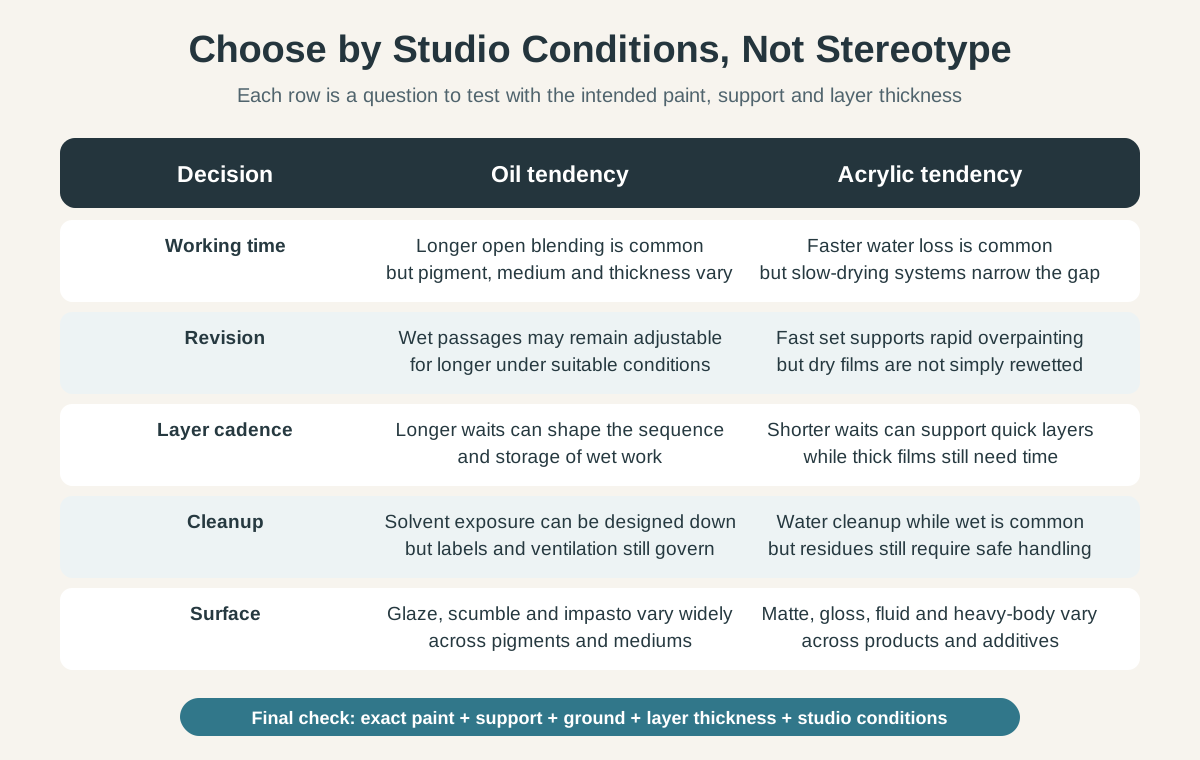
This comparison concerns artists' paint, not household coatings. Each row is a decision point rather than a score: formulations vary within both families, so check the exact paint, ground and auxiliary products you intend to use.
1. Binder and film formation
Oil
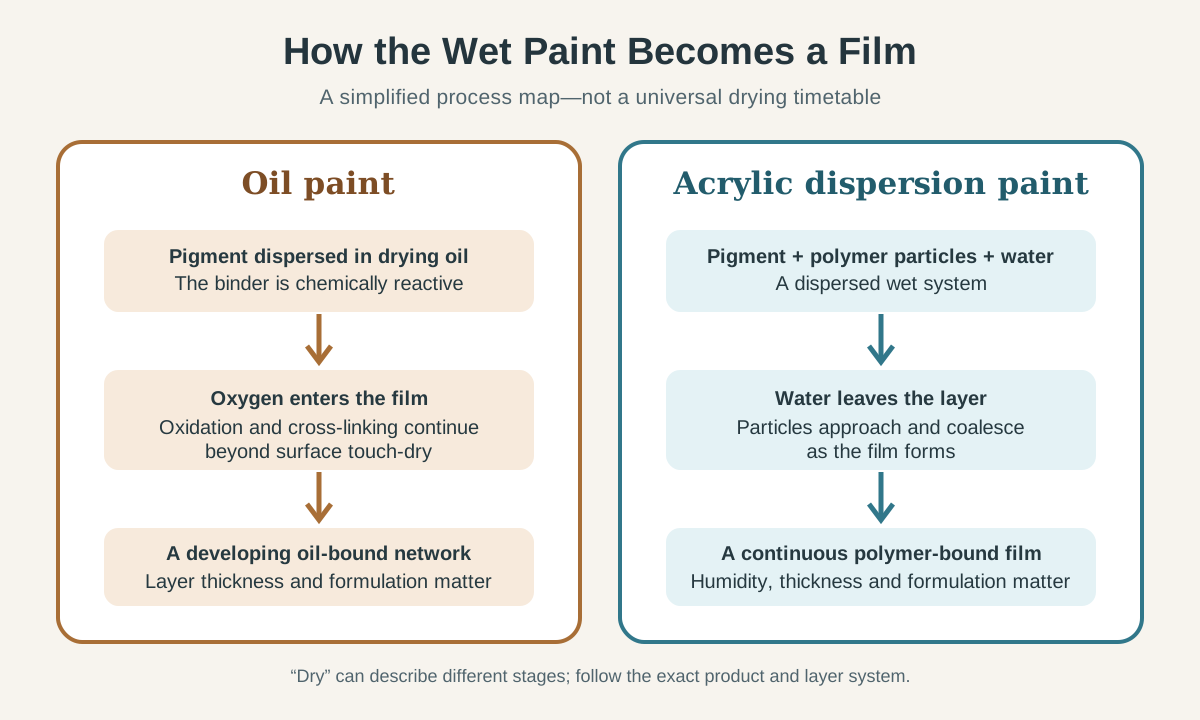
Pigment is held in a drying oil. The film develops through reactions involving oxygen and continues changing after it feels dry.[2][3]
Acrylic
Common water-borne artists' acrylic uses a synthetic polymer dispersion. Water and other volatile components leave as the particles form a film.[5][6]
Check before choosing
“Dry” may mean workable, touch-dry or further developed through the layer. Those states are not interchangeable.
2. Working time, blending and correction
Oil
Usually stays wet longer, allowing gradual blending, softening and revision.[3]
Acrylic
Conventional acrylic usually sets sooner, favouring quick decisions and rapid coverage but shortening wet blending time.[4]
Check before choosing
Pigment, formulation, additives, thickness, support absorbency, temperature, humidity and airflow can change the pace.[2][11][14]
3. Layer cadence and storage
Oil
Slower film development can mean longer pauses and more protected space for wet work.[2][3]
Acrylic
Faster surface drying can make successive stages possible sooner.[4]
Check before choosing
A touch-dry surface is not necessarily a fully developed film. Follow the complete product system rather than a universal timetable.[2][13]
4. Body, surface and appearance
Oil
Can be thin or bodied, transparent or opaque, glossy or more matte, with retained or levelled marks.[3][15]
Acrylic
Can cover the same broad kinds of handling and finish; compatible formulations and mediums alter body, transparency, texture and sheen.[4][6][13]
Check before choosing
Pigment, concentration, binder, additions, thickness and ground matter more than a slogan such as “richer” or “flatter”.
5. Supports and grounds
Oil
Requires a support-and-ground system identified as compatible with the chosen oil paint.[1][7]
Acrylic
Needs documented support and ground compatibility for the chosen acrylic paint.[1][7]
Check before choosing
“Canvas” or “universal primer” is not a complete specification; commercial primings vary.[7]
6. Setup, cleanup, safety and ventilation
Oil
Some workflows use solvent, but oil paint and solvent are not the same thing; solvent-minimising and water-mixable systems exist.[8][9][12]
Acrylic
Wet water-borne acrylic commonly permits water-based tool cleanup, but pigments, additives and spray exposure still require attention.[5][8]
Check before choosing
Read current labels and safety data sheets. Consider the task, quantity, exposure route, enclosure, ventilation and local disposal rules.[8][9]
7. Cost, access and learner fit
Oil
Long working time may help a learner who wants to blend and revise without rushing; drying space and the chosen auxiliary system also count.[3][8]
Acrylic
Rapid layers and wet water cleanup may suit short sessions or a compact setup.[4][8]
Check before choosing
Compare like grade, pigment, quantity and local availability. Neither family is universally cheaper or easier.[13][14][15]
8. Durability, ageing and care
Oil
Oil films continue chemical and mechanical change over long periods.[2][3]
Acrylic
Acrylic films have their own responses to dirt, heat, moisture and cleaning.[5][6][10]
Check before choosing
Construction, formulation, environment, handling and treatment history prevent a universal lifespan verdict.[2][6]
1. Binder and film formation
Paint is more than coloured paste. Pigment is held by a binder, while the support and usually a ground form the structure beneath it; these layers interact as a system.[1] In artist oil paint, the binder is a drying oil, often linseed but sometimes another oil selected for a particular colour or range.[3] Common artists' acrylics instead use a synthetic acrylic-resin dispersion, although solvent-based acrylic paints also exist historically.[4][5]
The two families reach a solid-looking film differently. Drying oils react with oxygen and develop a network that continues to change after the surface no longer feels wet.[2][3] In a common water-borne acrylic, water and other volatile components leave while polymer particles come together into a continuous film.[5][6] This is why acrylic usually seems dry sooner, but it does not justify one fixed time for either medium.
It helps to separate three ideas. Working time is the period in which the paint can still be manipulated as intended. Touch-dry describes the surface at a particular moment. Further film development continues within and between layers after that point.[2][13] The Paint Pigments, Binders and Painting Mediums guide explains this material vocabulary in greater depth.
Oil painting has a long history in European panel and canvas painting, whereas artists' acrylic emerged in the mid-twentieth century and became widely used from the 1960s.[4][16] That chronology explains different bodies of historical practice; it does not rank the media. The broader Oil Painting guide owns oil's history, artists and techniques.
2. Working time, blending and correction
Oil's longer open period is useful when a passage depends on gradual transitions, soft edges or repeated adjustment. Tate notes that slow drying lets painters develop a work over time and make changes, while also allowing colours to blend readily.[3] That can feel forgiving to someone who wants time to judge a mixture before it sets. It can equally feel slow to someone who wants a firm layer quickly.
Conventional acrylic rewards a different rhythm. Its quicker surface setting can suit decisive marks, short sessions and rapid coverage, but a mixture may become less movable while the painter is still considering it.[4] Covering a dry acrylic passage is not the same kind of correction as continuing to blend a wet oil passage. Neither method is inherently more accomplished; each supports a different way of revising.
The contrast remains conditional. Within oil paint, pigments, extenders, the binding oil, additions, film thickness and temperature can alter drying.[2][3][14] Acrylic timing changes with formulation, additives, thickness, the absorbency of the support, temperature, humidity and airflow.[2][11][13] Choose from the behaviour of the actual system, not from the medium name alone.
3. Layer cadence and storage
Acrylic's usual speed can shorten the pause before the next stage. Oil commonly asks for more patience and protected space while the surface develops.[2][3][4] This matters when a project must be moved between sessions.
Speed should not be confused with complete film formation. An apparently dry acrylic layer may still be developing, and an oil layer continues changing after it is touch-dry.[2][13] Mediums and additives alter drying and handling in product-specific ways; there is no universal layer schedule.[2][13][14]
4. Body, surface and appearance
Oil is often praised for depth and acrylic dismissed as flat, but those labels conceal wide variation. Oil colours differ in pigment, vehicle, opacity and transparency; they can be used in thin films, substantial strokes or surfaces whose marks have partly levelled.[3][15] Acrylic ranges can likewise be fluid or heavy-bodied, transparent or opaque, glossy or matte, and compatible gels or mediums can change texture and sheen within a particular system.[4][6][13]
Some acrylic dispersions look slightly milky while wet and clearer when dry, so a value or colour shift may become visible. The degree varies with pigment and formulation, and it should not be described as an equal darkening across every colour.[13] Oil has its own pigment- and binder-dependent optical differences. Neither medium is universally brighter, richer, deeper or more accurate.[6][15]
This is also why a photograph of two swatches would be a poor deciding tool. Unless pigment identity, grade, concentration, ground, thickness, lighting, capture and display were controlled, the image would compare two samples rather than the two media.[2][6][15] The comparison above therefore states its variables instead of pretending that decorative swatches prove a material rule.
5. Supports and grounds
Canvas is not a complete answer to “what can I paint on?” A painting includes a support, any size or seal, a ground and the paint film itself.[1] Prepared canvas, board and suitably prepared paper may be options, but compatibility depends on the named preparation and the selected paint system.[1][7] Detailed selection and preparation belong in Painting Surfaces and Supports.
A Getty study of 53 commercially primed canvases found no standard formulation across the sample, and even some products bearing the same name were not identical.[7] Labels such as “acrylic-primed”, “oil-primed” or “universal” therefore do not reveal a complete chemistry. Check the current support and paint documentation instead of assuming that every prepared surface suits both media.
6. Setup, cleanup, safety and ventilation
Safety begins with the complete product and how it is used, not with a binary label. Hazards can arise from pigments, preservatives, additives and auxiliary materials in either family. Exposure may occur by inhalation, skin or eye contact, or ingestion, and the risk changes with quantity, duration, application method and workspace.[8][9] Premixed colour also reduces the airborne-powder risk created by handling dry pigment.[8]
Traditional oil practice may include mineral spirits, white spirit or another solvent for thinning or cleanup, but solvent is not the oil binder. Compatible solvent-minimising workflows and water-mixable oils show that the setup is not fixed.[8][12] Conversely, “water-based” does not mean hazard-free: acrylics may contain ammonia, preservatives or other additives, and spraying can create a different exposure problem from brush application.[5][8]
Ventilation must match the product and task. Spraying or working with volatile material in an enclosed space can require stronger controls than low-solvent brush work in a well-ventilated area; an open window is not a universal solution.[8][9] Keep paint and solvent containers closed when not in use, minimise unnecessary evaporation, and manage solvent-contaminated waste and rags according to product instructions and local rules.[8][9] Never use solvent to clean skin.[8][9]
Wet water-borne acrylic commonly allows water-based tool cleanup. That does not mean a finished acrylic painting should be washed: conservation research shows that dirt can adhere strongly and that dried or aged acrylic surfaces may remain sensitive to aqueous cleaning.[5][10] Tool care during painting and treatment of a finished artwork are different jobs. For either medium, read the current label and safety data sheet rather than relying on odour or a generic “non-toxic” claim.
7. Cost, access and learner fit
There is no stable price winner. A meaningful comparison must hold grade, pigment, quantity and region as constant as possible, then consider coverage, expected use and any ground, medium or cleanup system required. Manufacturers divide colours into different series and offer different formulations, while availability and naming vary by market.[13][14][15] A single tube price cannot settle the cost of a working setup.
Nor is one medium automatically easier for a beginner. Acrylic may suit someone who works in brief sessions, wants rapid layers and can use a compatible water-based cleanup system. Oil may suit someone who finds extended blending and unhurried correction more manageable and has suitable drying space and a safe materials plan.[3][4][8] The Art Materials for Beginners guide can help turn that preference into a small, coherent setup without creating a shopping ranking.
8. Durability, ageing and care
Longevity cannot be awarded to a binder name. Getty's research shows that paint stiffness, strength and fracture behaviour depend strongly on composition, manufacture and ageing, and that temperature and moisture can also matter.[2] Oil films continue evolving over long periods; their condition reflects pigment, binder, thickness, environment and treatment history.[2][3]
Acrylic has different, not negligible, vulnerabilities. Some films remain comparatively soft, collect dirt, respond to heat and moisture, and present difficult cleaning decisions.[5][6][10] Yet this does not make every acrylic fragile, just as oil's centuries of use do not make every oil construction stable. Either medium can produce a durable work when the formulation, layered construction, handling and environment are appropriate, but neither carries a universal “lasts longer” guarantee.[2][6]
Care must follow the actual object. Museum research into cleaning aged paint is not a home-cleaning recipe, and a treatment safe for one formulation may damage another.[6][10]
Variants that narrow the gap
Slow or open acrylic formulations extend working time while still forming an acrylic film through evaporation. Their behaviour continues to depend on support absorbency, thickness, additives, temperature, humidity and airflow.[11] They are evidence that “acrylic dries immediately” is too crude, not a reason to expect every slow acrylic to behave identically.
Water-mixable oils use modified drying oils and can allow water-based thinning or cleanup within a compatible system.[12] They remain oil colour, not acrylic, and their existence shows why “oil always requires conventional solvent” is also too crude. In both cases, stay within the maker's documented system rather than assuming that materials sharing water cleanup are chemically interchangeable.
Which medium fits your situation?
Choose acrylic when quick successive stages, shorter sessions, limited wet-work storage and the selected paint's cleanup system match your circumstances. Choose oil when extended wet blending or revision matters more and you can accommodate the chosen system's drying, storage, ventilation and waste needs. If either answer is blocked by a single assumption, check a slow acrylic or water-mixable oil category before deciding.
If support compatibility is uncertain, resolve that before buying or painting. If workspace safety is the constraint, compare complete labelled systems rather than binders alone. If budget is decisive, compare equivalent local grades, pigments and quantities together with the auxiliary setup. These checks produce a useful choice; a universal verdict does not.
Explore Art Mediums for the wider family of painting systems, Art Materials for the physical setup, or return to Art Comparisons for another approved side-by-side guide.
Watch Oil and Acrylic Working Time in Practice
Choose a museum oil-paint study, an acrylic-system overview, or a demonstration that deliberately modifies acrylic working time.
Monet's Palette and Technique
Examine palette organisation and handling in a museum-led account of one painter's oil technique.
Watch on YouTubeFrequently Asked Questions
Ordinary oil paint commonly remains workable longer than ordinary acrylic dispersion paint, but no single timetable covers every pigment, medium, thickness or environment. Slow-drying acrylic and modified oil systems can narrow the difference.
Acrylic can be glossy, matte, fluid, transparent or heavily textured, so some visual effects can overlap with oil. Appearance alone cannot establish the binder; object records and technical examination are stronger evidence.
Water cleanup while wet can reduce reliance on solvent, but it is not a blanket safety or disposal guarantee. Pigments, additives, spray or sanding exposure, ventilation and local waste rules still matter.
Neither is universally better. Oil may suit extended blending and wet revision; acrylic may suit faster layers and water cleanup while wet. Choose around your space, pace, surface, ventilation and willingness to manage the complete system.
Discussion
Which practical constraint—working time, layer cadence, ventilation, cleanup or surface—would decide your choice between oil and acrylic?
Reader Insights
Binder, support, ground, medium and layer thickness work together.
Open, touch-dry and fully developed films are not interchangeable states.
Gloss, opacity and texture cannot identify the binder by themselves.
Join the Conversation
Share one precise observation or a useful museum example below.
References
- Smithsonian Museum Conservation Institute, “What Is a Painting?”, accessed 4 September 2026. View source.
- Getty Conservation Institute, “Properties of Historic and Artistic Paints”, accessed 4 September 2026. View source.
- Tate, “Oil paint”, accessed 4 September 2026. View source.
- Tate, “Acrylic paint”, accessed 4 September 2026. View source.
- Smithsonian Museum Conservation Institute, “Caring for Acrylic Paintings”, accessed 4 September 2026. View source.
- Getty Conservation Institute, “Modern Paints”, accessed 4 September 2026. View source.
- Getty Conservation Institute, “Investigating Commercially Primed Contemporary Artist Canvases”, accessed 4 September 2026. View source.
- U.S. Consumer Product Safety Commission, Art and Craft Safety Guide, Publication 5015, accessed 4 September 2026. View source.
- UK Health and Safety Executive, “Construction hazardous substances: Solvents”, accessed 4 September 2026. View source.
- Getty Conservation Institute, “Cleaning of Acrylic Painted Surfaces”, accessed 4 September 2026. View source.
- Golden Artist Colors, “OPEN—Controlling Drying Times”, product-specific technical guidance, accessed 4 September 2026. View source.
- Winsor & Newton, “Artisan Water Mixable Oil Colour”, product-specific documentation, accessed 4 September 2026. View source.
- Golden Artist Colors, “Gels and Mediums”, product-specific technical guidance, accessed 4 September 2026. View source.
- Winsor & Newton, “Understanding Drying Times for Oil Colour”, product-specific technical guidance, accessed 4 September 2026. View source.
- Winsor & Newton, “Artists’ Oil Colour”, product-specific range documentation, accessed 4 September 2026. View source.
- The National Gallery, “Oil”, accessed 4 September 2026. View source.