by Tom Gurney
Tom Gurney BSc (Hons) is an art history expert with over 20 years experience
Page created on September 3, 2026 / Page updated on September 13, 2026
Email: tomgurney1@gmail.com / Phone: +44 7429 011000
How Flexible, Rigid and Architectural Supports Change the Whole Layer System
A painting surface is part of its structure. It carries preparation and paint, determines whether an auxiliary frame is needed, and influences handling, framing, storage and environmental response. Canvas, paper, wood, board and metal can all be workable supports, but they solve different problems. The useful comparison is not “Which is best?” It is “How will this complete support, preparation and paint system behave at the intended scale?”
Conservation guidance lists supports ranging from fabric, wood and fibreboard to paperboard, stone, plaster, metal, glass and porcelain.[1][3][6] This guide concentrates on the choices most often compared in a studio. Types of Artist Canvas covers fibre and weave; Artist Paper Sizes, Weights and Formats and Watercolor Paper cover paper specifications in depth.
At a Glance
- Supportthe structural material carrying preparation and image layers.
- Flexible systemsfabric and paper may depend on stretchers, strainers, mounts or other auxiliary supports.
- Rigid systemssolid wood, engineered board, metal and other panels fail and move in different ways.
- Preparationmust be compatible with the named support and intended paint system.
- No universal winnerscale, weight, absorbency, movement, handling, repair and display define the useful trade-off.
Contents
- How Flexible, Rigid and Architectural Supports Change the Whole Layer System
- Flexible fabric
- Paper
- Solid wood panels
- Engineered wood and paper-based boards
- Metal and other non-absorbent supports
- A comparison without a winner
- Selection checklist
- Wood panels are directional structures
- Engineered boards need a construction name
- Metal, glass and other non-porous supports
- Compare scale, failure and reversibility of decisions
- Preparation must belong to the named support
- Art Materials reference pages
- Watch Painting Surfaces and Supports in Practice
Support, preparation and image layer
The support is the flexible or rigid substance on which an image is made. Above it may sit a size or seal, a ground, paint layers and sometimes a coating. A stretched fabric also has an auxiliary support: the stretcher or fixed strainer that holds it in plane.[2] These layers form one object. Changing the board or fabric can change the stresses experienced by the preparation and paint even when the front looks similar.

Maker unrecorded, Portrait of a thin-faced, bearded man, 160–180 CE. Encaustic on limewood. The medium label names both the wax-based paint and its rigid wooden support. Image: The Metropolitan Museum of Art, Open Access, public domain.
Preparation is not optional vocabulary. A porous support may need controlled sealing; a slick support may need a compatible key or primer; a coloured or absorbent ground changes paint handling. Compatibility depends on the named paint and preparation systems, so manufacturer technical instructions and documented tests should govern rather than a universal recipe.
Flexible fabric
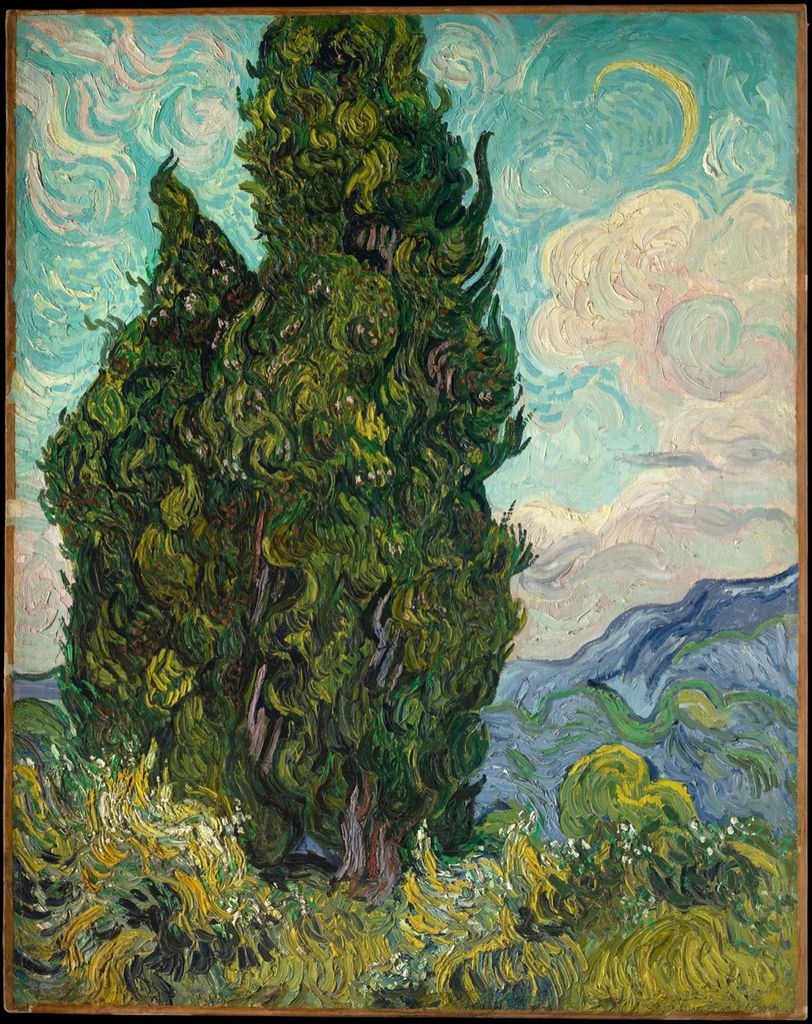
Stretched cotton, linen, synthetic or blended fabric can provide a relatively light support for a large image. It has a responsive feel and permits visible weave texture. It also depends on tension and an auxiliary frame. Impacts can dent or tear it, slackness and corner draws can develop, and the fabric, wooden frame, size, ground and paint may respond differently to environmental change.[1][2]
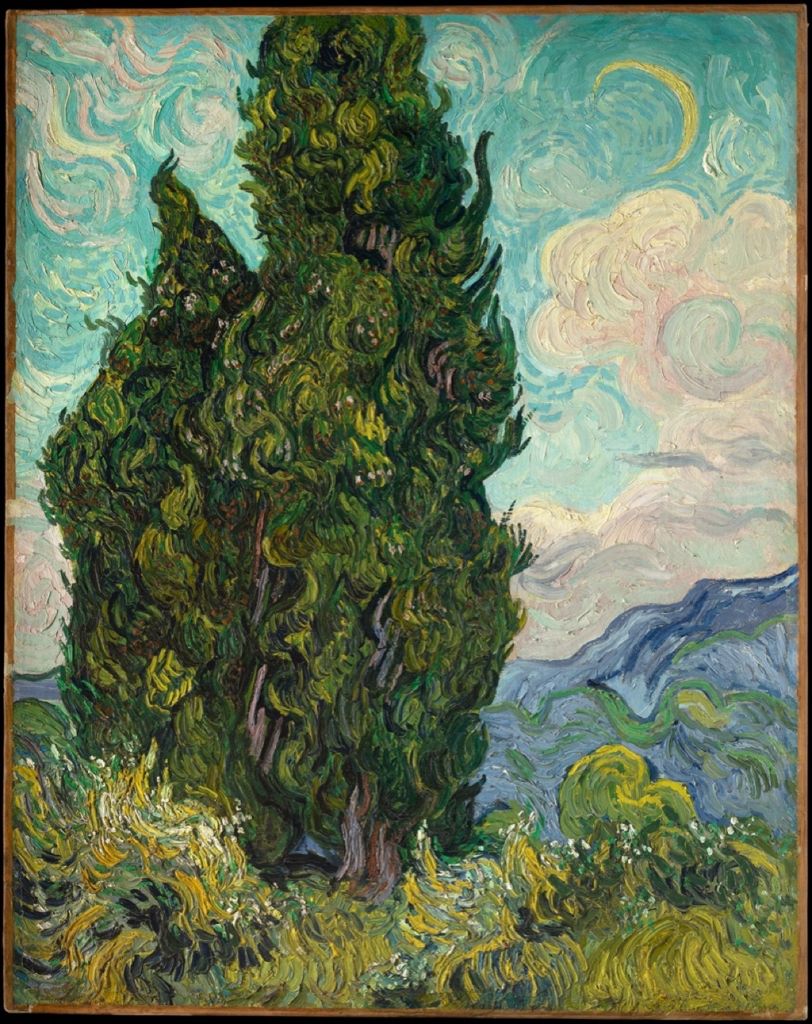
Vincent van Gogh, Cypresses, 1889. Oil on canvas. The woven fabric is a flexible support whose scale and tension depend on an auxiliary frame. Image: The Metropolitan Museum of Art, Open Access, public domain.
Rollable fabric is sometimes chosen for transport, but a completed painting should not be assumed safely rollable. Paint type, thickness, age, surface texture, rolling diameter and direction all matter. Valuable or complex work needs professional handling advice.
Paper
Paper is a sheet formed from fibres. It is available in many surfaces, thicknesses, weights and sizing systems and can support watercolour, ink, drawing media, acrylic and—when specifically prepared—some oil-paint systems. It is compact and familiar, but thinner sheets need backing during work and protection from creasing, puncture and edge damage.[4]

Winslow Homer, A Wall, Nassau, 1898. Watercolour and graphite on paper. The sheet is not passive: its tone, sizing, texture and response to water affect the visible image. Image: The Metropolitan Museum of Art, Open Access, public domain.
Paper responds to moisture and can cockle when wet unevenly. Heavy sheet, stretching, taping or a rigid working board may help for particular processes, but the correct method depends on paper and medium. Finished works often require an appropriate mount, glazing and backing; friable charcoal or pastel introduces additional surface-clearance needs.
Solid wood panels
Wood supplies rigidity and a firm painting response. Species, grain direction, cut, joins, thickness and construction matter. Wood is hygroscopic: it takes up and releases moisture and moves much more across grain than along it. Unequal movement between wood, ground and paint can contribute to warping, cracking or cleavage.[1][5]

Dieric Bouts, Virgin and Child, about 1455–60. Oil on wood. A rigid panel offers a different working response from stretched fabric, while grain direction, joins and environmental movement remain structural concerns. Image: The Metropolitan Museum of Art, Open Access, public domain.
Small well-constructed panels and large joined panels are different engineering propositions. Battens, cradles or restraints are not automatically beneficial; historical interventions intended to prevent movement have sometimes transferred stress and caused damage.[2] Do not treat a generic DIY board as equivalent to a documented artist panel.
Engineered wood and paper-based boards
Plywood, hardboard, medium-density fibreboard, paperboard, card and canvas board have different fibres, resins, laminations, faces and ageing characteristics. Engineered construction can reduce some directional movement compared with a solid plank, but it introduces adhesives, processing residues and vulnerable edges. CCI notes that some paperboards and wood-fibre boards are not durable, while other documented products can serve particular purposes.[1]
Inspect flatness, thickness, edge integrity, surface finish, emissions or residues, and the maker’s intended use. Seal or prime only with a system documented for that substrate and paint. Heavy panels need hanging hardware and frames designed for their actual mass.
Metal and other non-absorbent supports
Aluminium, copper and other metals are rigid at suitable thickness but have smooth, non-absorbent surfaces and different expansion, corrosion and adhesion risks. Alloy, surface treatment, grease removal, oxidation state, primer and paint chemistry all affect the system. A statement that paint “sticks to metal” is not enough for long-term planning.
Glass and plastics create comparable adhesion questions while adding brittleness, flexibility, static, solvent sensitivity or unknown additive behaviour. Use a documented system and test it. For work expected to last or enter a collection, consult current manufacturer and conservation guidance before adopting an unconventional composite.
A comparison without a winner
Fabric is comparatively light and flexible but needs tension and puncture protection. Paper offers varied absorbency and easy storage at modest scale but needs planar and surface protection. Wood and engineered panels give rigidity but add weight and moisture or construction concerns. Metal can provide a thin rigid plane but demands exact surface preparation. Composite supports can tune properties, yet every added layer creates another interface.
Scale can reverse an apparent advantage. A small panel is convenient; a very large one may be heavy and difficult to keep planar. A large stretched textile is lighter than a solid panel of the same face area, but requires adequate bars and bracing. A sheet that behaves well in a small watercolour may buckle under a different wet process or size.
Selection checklist
- Name the support precisely, including species, fibre, alloy, board construction or laminate where known.
- Decide whether a flexible support needs stretching, mounting or a temporary working board.
- Match size, seal and ground to both support and paint through current technical guidance.
- Test adhesion, absorbency, colour and mark response on a representative offcut.
- Account for overall dimensions, thickness, mass, edge vulnerability and hardware.
- Plan storage, transport, framing, glazing and backing as part of the object.
- Avoid assuming that rigid means inert, synthetic means stable, or traditional means universally compatible.
The most reliable choice is the one whose layers are known and whose risks fit the project. Record support, preparation and paint as a system. That record is more durable—and more useful—than any generic ranking of surfaces.
Wood panels are directional structures
Solid wood is anisotropic: its properties and dimensional response differ along and across the grain. Species, cut, growth-ring orientation, knots, joins, thickness and seasoning all matter. A quarter-sawn board and a flat-sawn board of the same species need not move or warp in the same way. Joined panels also concentrate questions at seams, where different boards and adhesive lines meet.[1][5]
Rigid does not mean motionless. Wood and many wood-derived boards exchange moisture with the air. Restraining that response too aggressively can transfer stress into joins, battens, ground or paint. Historical cradles added to panel backs were intended to control warping, yet conservation evidence shows that some restricted natural movement and caused damage.[2][5] This is a warning against universal bracing prescriptions, not an instruction to alter an existing panel.
When selecting a new solid panel, document species if known, cut, grain direction, joined construction, thickness, face preparation and reverse/edge treatment. For a valuable or unusually large work, panel design belongs with a knowledgeable fabricator or conservator because the consequences emerge across the whole layered object.
Engineered boards need a construction name
Hardboard, medium-density fibreboard, plywood, paperboard and aluminium-composite panels are not interchangeable “boards.” Hardboard is formed from compressed wood fibres; MDF uses fibres with a manufactured binder system; plywood stacks veneers with alternating grain directions; paperboard relies on paper fibres and plies; composite panels bond skins to a core. Density, edge behaviour, moisture response, fastener holding and added adhesives differ among them.[1][2]
The face may be smoother and more uniform than solid wood, but cut edges can be more porous or mechanically vulnerable than the factory face. Thin sheets can bow under their own weight or under unequal coatings. A laminate can remain flat overall while a local skin separates. Unknown reclaimed board may also contain coatings, waxes or contaminants that complicate adhesion.
Record the exact board type, thickness, manufacturer specification, core and skins where applicable, cut-edge condition and preparation on face, reverse and edges. “Wood panel” should be reserved for known wood construction rather than used as a catch-all for every brown rigid sheet.
Metal, glass and other non-porous supports
Metal avoids the humidity-driven swelling typical of paper and wood, but thin sheet can dent, buckle and transmit a crease into brittle paint. Different alloys form different oxide layers, and corrosion can stain or disrupt paint. Glass is dimensionally stable under ordinary humidity yet fragile, smooth and difficult for many coatings to grip. In reverse-glass painting the image is viewed through the support, reversing the usual layer order.[7]
Canadian Conservation Institute guidance documents both the dimensional advantages and the distinct risks of metal and glass supports. It also stresses that attempts to flatten a painted metal sheet or intervene in poorly adhered paint can trigger loss.[7] For new work, use a preparation system explicitly documented for the named alloy or glass application. For an existing damaged work, the appropriate action is professional assessment rather than studio experimentation.
Stone, plaster, masonry and walls introduce still other questions: alkaline substrates, salts, cracking, building moisture and immobility. Their inclusion in the support family does not mean a portable-panel preparation can be transferred to architecture. The substrate and environment must be named before compatibility can be judged.

Domenico Ghirlandaio, Saint Christopher and the Infant Christ. Fresco. Even as a surviving fragment, the work demonstrates that a plaster support can belong to an architectural structure rather than a portable frame. Image: The Metropolitan Museum of Art, Open Access, public domain.
Compare scale, failure and reversibility of decisions
At small scale, weight and flex may be modest; as dimensions increase, self-weight, leverage, vibration and transport access become structural questions. A very rigid but heavy panel can require stronger hanging and handling than a light fabric. A light sheet can need glazing and a supportive mount. A stretched textile may travel efficiently but remain vulnerable to puncture and pressure from behind.
Ask what failure would look like: cockling, planar distortion, split joins, delamination, corrosion, denting, puncture or edge crushing. Then ask whether the construction can be safely handled, framed and documented. This does not predict permanence, but it exposes costs and risks hidden by a simple material name.
Preparation must belong to the named support
“Prime before painting” is incomplete because sealing, adhesion and absorbency are different jobs. A porous paper or wood face may draw liquid from a coating; a non-porous metal or glass face presents an adhesion problem; a flexible fabric asks the preparation to bend with it. One ground can perform well on a rigid panel yet become unsuitable when transferred to a moving textile.
Read the preparation maker’s list of approved substrates and required cleaning, abrasion, sealing, coat thickness and drying conditions. Test the complete stack on an offcut from the same support. A successful short-term brush test proves handling, not long-term compatibility, so keep the product record and avoid extending the result to an unnamed surface.
Watch: Canvas, Panel and Paper as Material Structures
Choose a conservation-led view of wooden panels, works on paper, or Van Gogh’s canvas-based materials and process.
Overview of the Panel Paintings Initiative
See why wood species, joins, movement and structural treatment matter to panel paintings.
Watch on YouTubeFrequently Asked Questions
It is the structural surface or object that carries the preparation and image layers, such as fabric, paper, wood, board, metal or an architectural wall.
Not universally. Flexibility, rigidity, scale, weight, movement, preparation, handling and intended paint all change the trade-off.
No. Engineered boards have different fibres, particles, adhesives, faces and edge behaviour, and require a named construction plus compatible preparation.
Wood is directional and responds to moisture; species, grain, joins, thickness, restraint and environment affect warp and stress.
Compare structure, scale, weight, absorbency, preparation, environmental response, handling, display and whether later decisions remain reversible or repairable.
Discussion
Which support trade-off matters most for the work you are assessing: movement, weight, surface response, transport or future repair?
Reader Insights
“Board” and “panel” are not sufficiently precise material records.
Support, preparation and image film age together but do not respond identically.
A useful choice anticipates movement, handling and display rather than declaring one surface best.
Join the Conversation
Share one precise observation or a useful museum example below.
References
- Canadian Conservation Institute. Caring for paintings.
- Canadian Conservation Institute. Know Your Paintings: Structure, Materials and Aspects of Deterioration.
- Canadian Conservation Institute. Basic care — Paintings.
- Canadian Conservation Institute. Basic care — Works of art on paper.
- Getty Conservation Institute. Structural Conservation of Panel Paintings.
- Getty Conservation Institute. Glossary — Conserving Canvas.
- Canadian Conservation Institute. Care of Paintings on Ivory, Metal and Glass.