by Tom Gurney
Tom Gurney BSc (Hons) is an art history expert with over 20 years experience
Page created on September 3, 2026 / Page updated on September 13, 2026
Email: tomgurney1@gmail.com / Phone: +44 7429 011000
How Fibre, Sizing and Surface Change Every Wash
Watercolour paper controls how a wash moves, settles and dries. That response comes from a system: fibre furnish, sheet formation, sizing, surface finishing, grammage, colour and format. “Cotton, 300 gsm, cold pressed” is a useful start, but it is not a complete prediction. Two papers with that label can differ markedly in tooth, water resistance, lifting and drying edge.
Artist Paper Sizes, Weights and Formats explains ISO sizes, gsm, basis pounds and formats across media. This guide concentrates on watercolour manufacture and working surface. Watercolor Materials and Tools owns the broader setup.
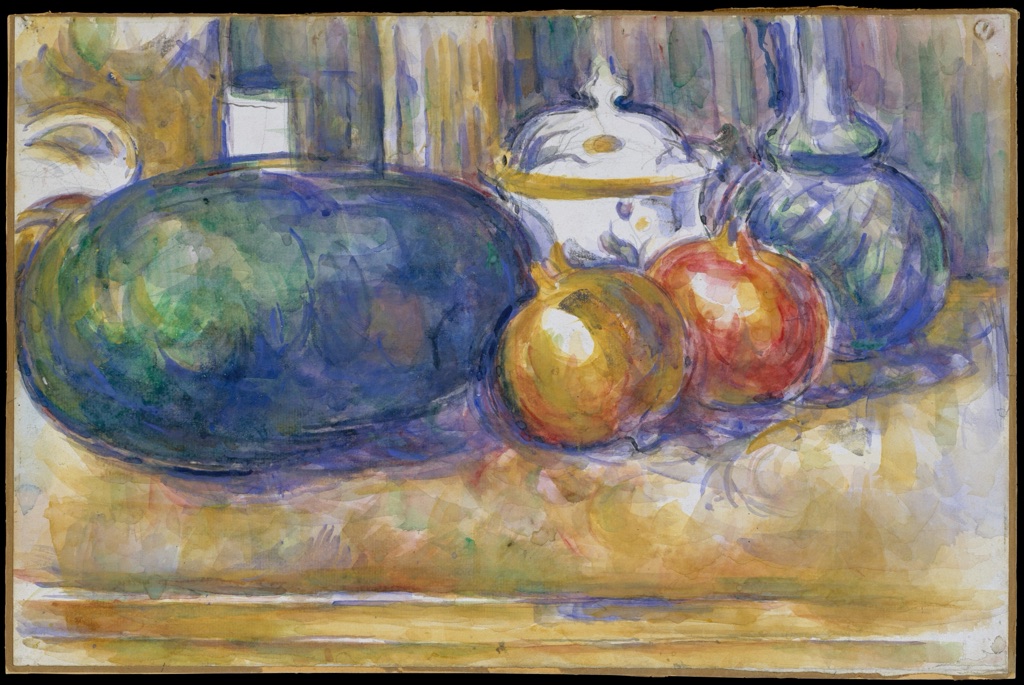
Paul Cézanne, Still-Life with a Watermelon and Pomegranates, 1900–1906, watercolour over graphite on laid paper. “Laid” records a formation pattern, not the fibre furnish or sizing recipe; the museum medium line therefore answers only part of a complete paper specification. Image: The Metropolitan Museum of Art, Open Access/public domain.
At a Glance
- Fibre furnishcotton, purified cellulose and blends identify ingredients, not a complete quality ranking.
- Formationhandmade, mould-made and machine-made sheets can differ in fibre distribution and direction.
- Sizinginternal and surface sizing regulate how water enters, moves through and can be lifted from a sheet.
- Surfacehot pressed, cold pressed or NOT, and rough are relative maker categories that require physical testing.
- Specificationrecord fibre, formation, sizing, surface, gsm, colour, side, batch and supplied format together.
Contents
- How Fibre, Sizing and Surface Change Every Wash
- Fibre furnish
- Handmade, mould-made and machine-made
- Sizing controls the encounter with water
- Hot pressed, cold pressed and rough
- Grammage, thickness and cockling
- White, natural white and optical brighteners
- Test before committing
- Storage and finished work
- Sizing is an interface, not a single ingredient
- Fibre furnish and formation must be read together
- Acid-free, buffered, permanent and archival
- Stretching, taping, blocks and boards
- Build a controlled paper test
- Paper colour, fluorescence and display
- Front, back, watermark and surface direction
- Art Materials reference pages
- Watch Watercolour Paper and Surface in Practice
Fibre furnish
Paper is a network of cellulose fibres. Watercolour sheets may be made from cotton, purified wood cellulose, other plant fibres or blends. Current manufacturer ranges include 100% cotton, 60% cotton and mixed cellulose products.[1][4][5] Percentage identifies furnish, not every property of the finished sheet.
Long, well-processed fibres can contribute strength, but formation, beating, additives, sizing, pressing and drying also matter. “Wood pulp” does not identify purification or lignin content. “Rag” is used historically and commercially in inconsistent ways. Prefer a maker’s exact fibre and permanence specification over a prestige phrase.
Animal ingredients can occur in gelatin-sized papers. Other papers use plant-derived or synthetic sizing and may be certified without animal ingredients.[2][4] Anyone selecting for ethical, religious or allergy reasons should verify the current product statement; the word cotton does not describe the size.
Handmade, mould-made and machine-made
Handmade sheets are formed individually on a hand-held mould. Cylinder mould-made paper uses an industrial rotating mould that can distribute fibres in varied directions and create characteristic felt surfaces and deckle edges.[1][4] It imitates some properties of handmade formation but is not literally handmade.
Faster continuous machines form paper differently and can create a stronger machine direction. None of the three labels guarantees a particular artistic result or permanence. The maker’s technical sheet should resolve fibre, grain direction, sizing, surface, pH or standard claims and optical brighteners.
Sizing controls the encounter with water
Sizing reduces uncontrolled liquid penetration. Internal size is incorporated through the sheet; surface size is applied at or after formation. A paper can use one or both. Arches describes gelatin sizing “to the core,” while St Cuthberts Mill specifies an internally sized, animal-free paper engineered for high water resistance.[1][2] These are distinct systems, not interchangeable recipes.
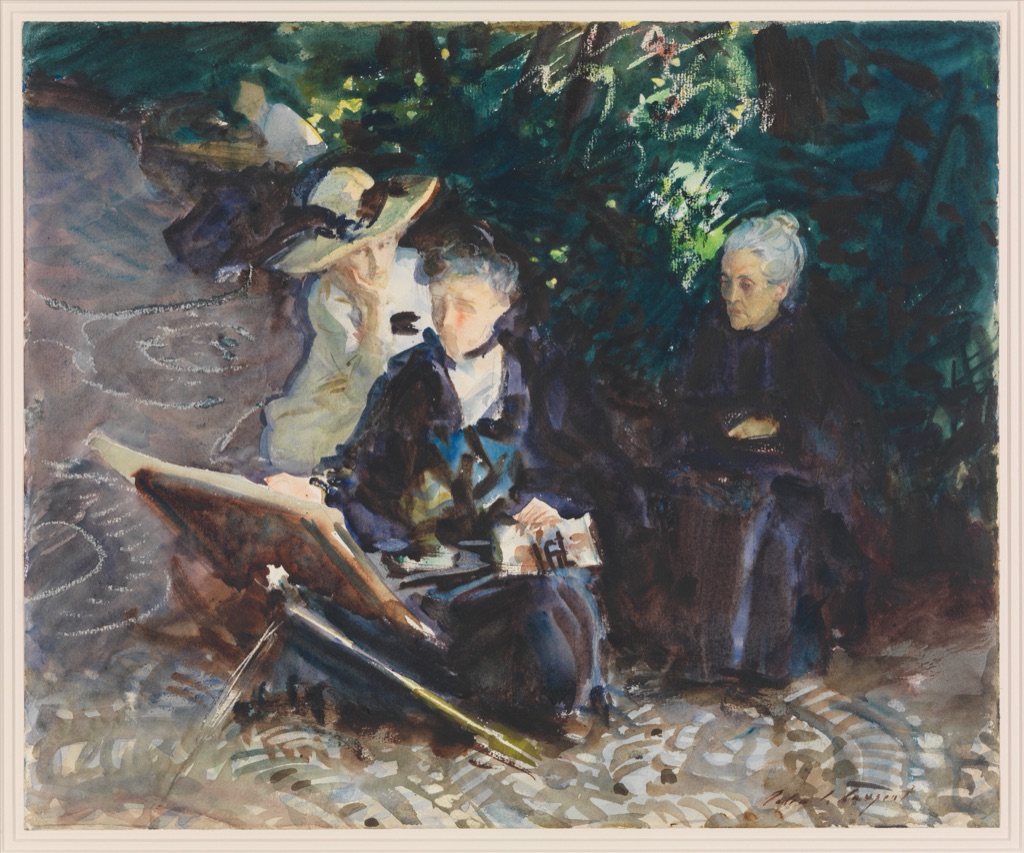
John Singer Sargent, In the Generalife, 1912, watercolour, wax crayon and graphite on white wove paper. The recorded support and mixed media are useful evidence, but the catalogue does not identify the paper’s sizing; that field should remain unknown rather than inferred from appearance. Image: The Metropolitan Museum of Art, Open Access/public domain.
A harder-sized surface can keep washes mobile for longer and permit more lifting. A less resistant or damaged size can absorb quickly, producing blossoms, dull passages or feathered edges before expected. Soap, skin oils, abrasion, prolonged soaking or masking removal can alter the surface. Manufacturer handling guidance warns that some gelatin surfaces are especially vulnerable while wet.[3]
Do not add a household sizing treatment to correct unfamiliar paper. Test the actual sheet, and use manufacturer advice if a batch behaves unexpectedly.
Hot pressed, cold pressed and rough
Hot pressed (HP) generally names the smoothest finish in a maker’s watercolour range. It supports small lines, controlled edges and combined pen work, while smoothness can make pooling or corrections more visible. Cold pressed (CP) has moderate tooth. In British usage, NOT means “not hot pressed” and commonly corresponds to cold pressed. Rough has a more pronounced relief that breaks dry-brush marks and lets washes settle across peaks and valleys.
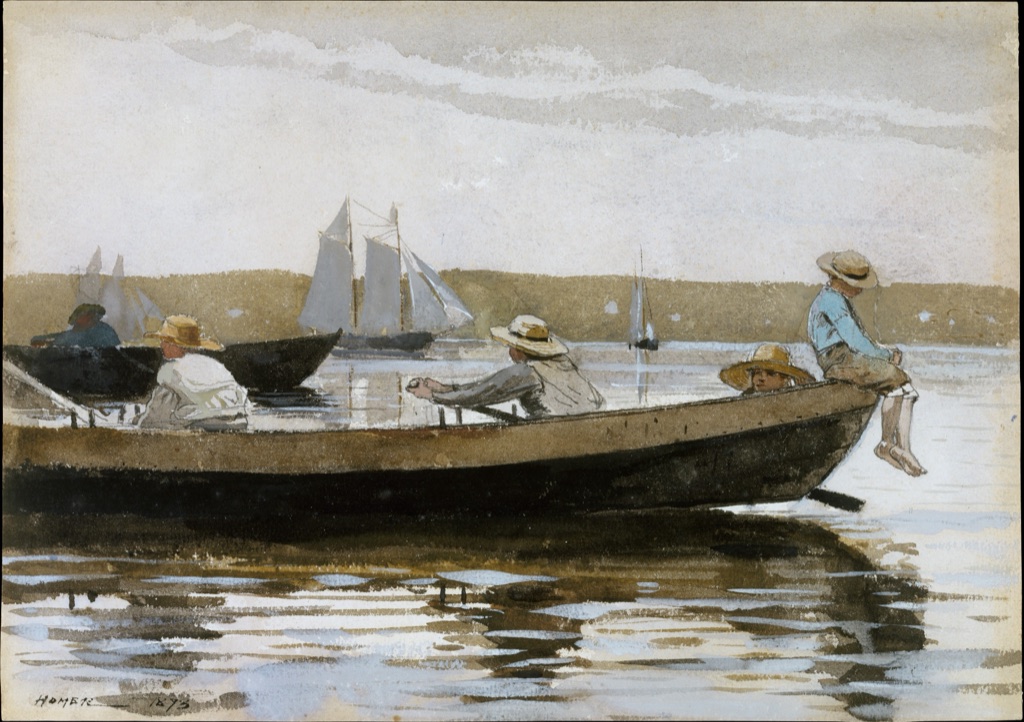
Winslow Homer, Boys in a Dory, 1873, watercolour washes and gouache over graphite on medium rough-textured white wove paper. The unusually detailed museum description demonstrates why texture, colour and formation should be recorded separately. Image: The Metropolitan Museum of Art, Open Access/public domain.
These are relative categories, not calibrated worldwide textures. One mill’s cold press may look rough beside another’s; one product may offer only CP and rough.[2][5] French and Italian catalogues may use grain fin, torchon, satinata or grana grossa. Compare a physical sample or a high-resolution maker swatch rather than assuming the translated word fixes roughness.
Surface also changes with sheet side, batch, stretching, soaking and abrasion. Some mould-made papers are usable on both sides but not visually identical. Mark which side was tested and inspect watermark orientation only as product identification, not as an automatic “correct side” rule.
Grammage, thickness and cockling
Grammage is mass per square metre, not thickness or water capacity. Common watercolour offerings include approximately 190, 300 and 640 gsm, with some specialist papers heavier.[1][3] A heavier sheet often supplies more bulk and may deform less under a given wash, but fibre, sizing, restraint, sheet size and water load remain decisive.
No grammage guarantees a perfectly flat wash. Lighter sheets may benefit from controlled stretching or edge restraint when the maker recommends it. Blocks bond the top sheet around several edges and can reduce movement during work, but they are not a promise of zero cockling. Very heavy paper brings longer wetting/drying and mounting considerations of its own.
White, natural white and optical brighteners
Paper colour changes perceived paint contrast because the unpainted sheet supplies light through transparent passages. Natural white, bright white and tinted sheets are not universal colour coordinates. Compare them under the lighting in which work will be made and displayed.
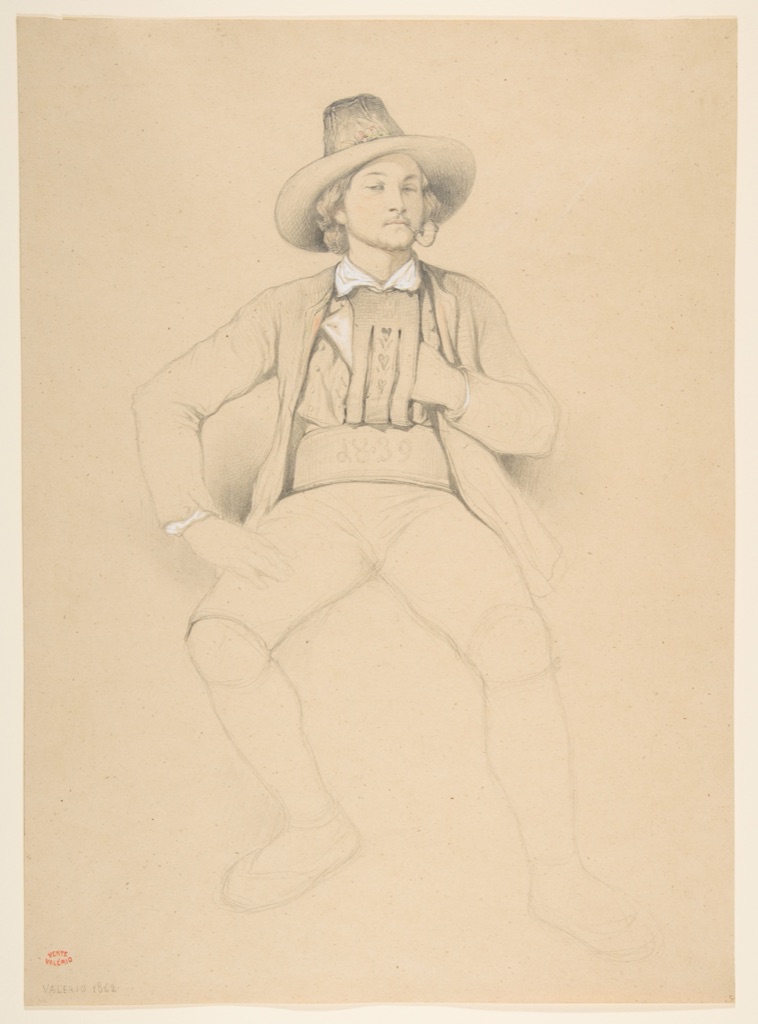
Théodore Valerio, A Man in Tyrolean Costume, Seated, Full Length, 1842, graphite with touches of watercolour and white on beige, textured, wove paper. The support colour is part of the drawing’s visible tonal system rather than a neutral absence behind it. Image: The Metropolitan Museum of Art, Open Access/public domain.
Optical brightening agents fluoresce under ultraviolet-rich light and can make paper appear cooler or brighter. Several current technical ranges explicitly state that they contain no optical brighteners.[2][4][5] That is a separate specification from acid-free, buffered or cotton. Avoid promising a fixed future colour from any single label; light, pollutants, materials and storage all contribute to change.[6]
Test before committing
- Draw a pencil line and erase once to observe surface disruption.
- Lay a graded wash and record working time, backrun tendency and dry edge.
- Add a second glaze only after the first is fully dry.
- Lift one wet and one dry passage with the intended brush and clean water.
- Try dry brush across the tooth in two directions.
- Test masking fluid for the maker’s recommended duration on a sacrificial strip.
- Record paper name, batch or watermark, side, fibre, gsm, surface, sizing claim and format.
Use the same paint concentration, brush, water, angle and drying conditions when comparing sheets. A single dramatic effect is not a general quality score. The useful paper is the one whose documented response supports the intended washes, edges, corrections and handling.
Storage and finished work
Keep unused paper clean, flat or correctly rolled, protected from direct light, moisture extremes and surface contact. Handle painting areas by edges or clean underside because skin oils can interrupt a wash.[3] Finished watercolours ordinarily need conservation-appropriate mounting, glazing with surface clearance and light-aware display.[6]
The complete specification should read like a layer of evidence: fibre furnish, formation, sizing, surface, grammage, colour, brightener statement, dimensions and format. That is more informative than “professional paper,” and it remains meaningful across regional names and changing catalogues.
Sizing is an interface, not a single ingredient
Internal sizing is introduced through the fibre furnish; surface sizing is applied after the sheet has formed. A paper can use one, both or several applications, and manufacturers may use gelatin, starch or synthetic systems. “Hard sized” is a relative description of resistance within a product context, not a globally calibrated quantity.[1][2][7]
The first wash encounters the surface size, fibre texture and any coating together. A strongly resisting surface can hold liquid near the top for longer and permit movement, but it may also encourage beading with some mixtures. A more absorbent surface can draw liquid inward sooner, reducing manipulation time. Subsequent washes may behave differently after abrasion, erasing, lifting or repeated wetting has disturbed the interface.
Sizing also interacts with pigment and binder. A staining observation made on one sheet cannot be assigned entirely to the pigment; fibre, sizing, surface, water load and drying time participated. Golden’s comparative technical work found meaningful variation even among papers described as hard sized.[7] Record the actual paper rather than treating the category as a controlled laboratory surface.
Fibre furnish and formation must be read together
Cotton, purified wood cellulose, linen, hemp, bamboo and other plant fibres can be processed into paper. Fibre source does not disclose fibre length after processing, refining, blending, fillers, sizing or sheet formation. Canadian Conservation Institute guidance notes that longevity depends partly on fibre and manufacture, and that modern highly processed chemical wood pulp can produce durable paper.[8]
Handmade, cylinder mould-made and Fourdrinier or other machine-made sheets organise fibres differently and produce different edge, surface and directional characteristics. Mould-made is an industrial category, not a synonym for handmade. A mould-made cotton sheet and a machine-made cellulose sheet can both be internally coherent products while offering different working responses.
Look for a complete furnish statement rather than a prestige percentage. “100% cotton” does not describe sizing or surface; “cellulose” does not reveal whether the pulp is mechanical, chemical, highly purified or blended. If those fields are absent, mark them unknown instead of filling the gap with a price-based assumption.
Acid-free, buffered, permanent and archival
Acid-free does not mean chemically unchanging. Cellulose can form acidic degradation products as it ages, while residual lignin, pollutants, light, metal contaminants, moisture and manufacturing additives can accelerate change.[8] A buffered paper contains an alkaline reserve intended to neutralise acid, but the amount and suitability for a particular medium are separate questions.
ISO 9706:2025 defines requirements for permanent unprinted document paper. It excludes boards and does not promise survival under high humidity, excessive heat, radiation, pollutants or water exposure.[9] An artist-paper label may instead cite another test or use “archival” without naming a standard. Preserve the exact claim and ask what property was measured.
For watercolour, permanence belongs to a system: paper, sizing, paint, mounting, glazing, light and environment. A compliant paper cannot make a fugitive colour stable, and a lightfast pigment cannot stop a poor sheet from discolouring. Avoid converting any one label into a lifespan.
Stretching, taping, blocks and boards
These methods restrain a sheet in different ways. Traditional pre-stretching wets a sheet, fixes it while expanded and allows it to dry under restraint. Dry taping attaches an unexpanded sheet and mainly controls edge movement. A four-side block restrains the top sheet through adhesive edges. Clips or pins create local rather than continuous restraint.[3]
Whether stretching is helpful depends on sheet, dimensions, gsm, water load and intended presentation. Heavy paper can still cockle; light paper can remain manageable under a controlled wash. Excessive soaking can disturb sizing, damage a watermark or make handling hazardous. Adhesive tape can tear or stain a surface, and removing a blocked sheet with the wrong tool can cut the sheet beneath.
Follow the paper maker’s current instructions for wetting time, water temperature, attachment and removal. Test on the same batch before committing important work. If a finished work needs flattening or has developed structural distortion, do not repeat a studio stretching method as a conservation treatment.
Build a controlled paper test
Divide a sample into labelled zones and keep paint concentration, brush, water, board angle and drying time as consistent as practical.
- Initial wash: time the visible wet sheen and observe flow, beading and edge formation.
- Glaze: add one controlled layer only after full drying; note disturbance of the first layer.
- Lift: compare a damp lift and a dry rewet without aggressive scrubbing.
- Dry brush: use the same low load across and with the dominant surface direction.
- Mask and erase: follow product timing and inspect the sheet under raking light afterward.
- Back and front: repeat a small wash on both sides if the maker permits use of both.
- Cockling: record sheet dimensions, restraint, water load and the profile after complete drying.
The test is descriptive, not a universal score. One paper may favour crisp lifting while another supports long flowing washes; neither result proves superior manufacture. The record lets an artist match a known surface response to a particular job.
Paper colour, fluorescence and display
Optical brighteners absorb ultraviolet or violet energy and emit blue light, changing perceived whiteness under different illumination.[6] A bright sheet can therefore look different under daylight, a UV-filtered display and a warm domestic lamp. This is an appearance variable as well as an ageing consideration.
Compare paper colour beside the intended mount under relevant lighting, and record whether the maker states natural white, bright white, tinted, buffered or OBA-free. Do not infer an optical-brightener formulation from visual whiteness alone. Finished transparent watercolour depends strongly on the paper’s reflected light, so a shift in support colour can alter the whole image even where pigment remains unchanged.
Front, back, watermark and surface direction
The two sides of a sheet can differ because one contacted a mould, felt, belt or finishing surface during manufacture. Texture, sizing distribution and embedded debris may not be identical. A watermark can help identify mill, range or orientation, but it does not establish a universally correct painting side. Some makers explicitly permit both sides; others describe a preferred face.[1][2][4]
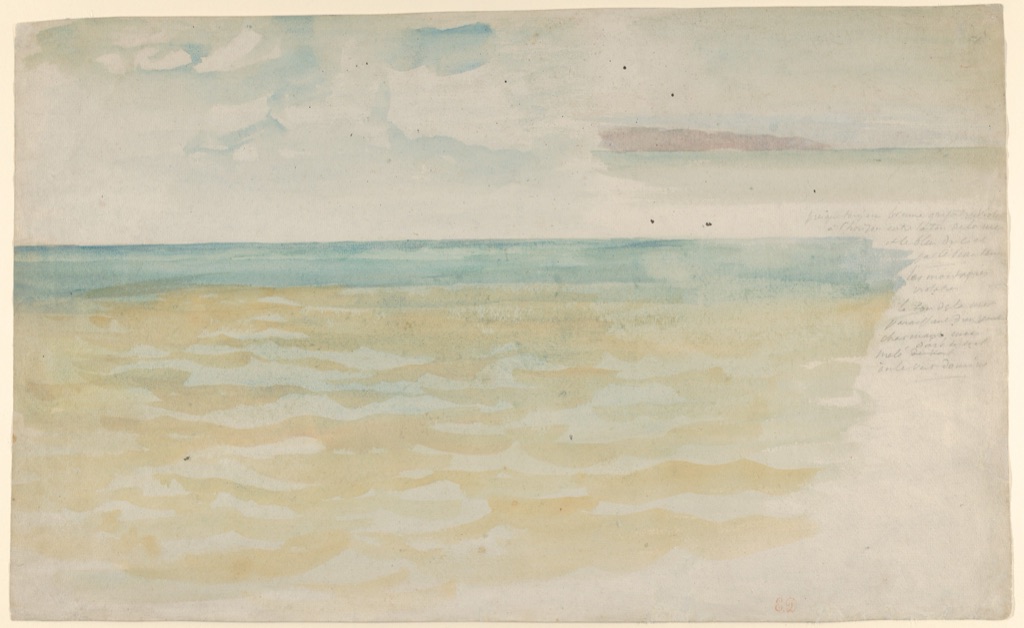
Eugène Delacroix, The Sea at Dieppe, about 1852–54, watercolour on laid paper. The catalogue identifies the formation pattern but not a universally “correct” face; side, watermark and direction still require observation of the actual sheet. Image: The Metropolitan Museum of Art, Open Access/public domain.
Inspect both sides in raking light and with magnification. Note regular mesh impressions, felt texture, watermark relief and any local sizing irregularity. Then repeat a small wash rather than judging by touch alone. If both sides perform well, choosing one is an artistic decision; if they differ, the test record explains why.
Surface direction can alter a dry-brush mark. Dragging across raised texture may produce a broken pattern, while moving along it can produce longer contacts. Rotate the same sample under the same brush before treating a texture name as a complete predictor.
Watch: Watercolour on Paper, from Sheet to Surface
Choose museum-led material history, a controlled studio lesson, or close study of Turner's altered paper surface.
Renaissance Watercolours: Materials and Techniques
Examine how water-based colour and drawing media meet prepared paper in historical objects.
Watch on YouTubeFrequently Asked Questions
There is no universal best sheet. Compare the intended water load, mark, correction, scale, mounting and permanence needs against the paper’s full specification and a controlled test.
Hot pressed is generally smoother, cold pressed or NOT has moderate tooth, and rough has more pronounced relief, but the categories are relative between makers.
Grammage alone cannot guarantee flatness. Fibre, sizing, sheet size, water load, restraint and drying conditions also affect cockling.
No. Fibre furnish matters, but formation, beating, sizing, pressing, surface and intended technique also influence performance.
Use the same paint, brush and water load to compare wash movement, dry edge, glazing, lifting, dry brush, erasing and masking on labelled samples from the actual sheet or batch.
Discussion
Which paper property most changes your own results: sizing, surface tooth, fibre, weight, colour or the way the sheet is restrained?
Reader Insights
No single fibre, weight or surface word predicts the complete sheet.
Use the same paint, brush, water load and drying conditions across samples.
A labelled dry result is stronger evidence than memory or a catalogue adjective.
Join the Conversation
Share one precise observation or a useful museum example below.
References
- Arches Papers. Arches Aquarelle.
- St Cuthberts Mill. Millford Watercolour Paper — Technical.
- St Cuthberts Mill. Saunders Waterford — Handling.
- Fabriano. Artistico Watercolor Paper.
- Canson. Aquarelle Canson.
- Canadian Conservation Institute. Basic care — Works of art on paper.
- Golden Artist Colors. Paint and Paper: Making a Watercolor.
- Canadian Conservation Institute. Caring for Paper Objects.
- International Organization for Standardization. ISO 9706:2025 — Paper for documents: Requirements for permanence.