by Tom Gurney
Tom Gurney BSc (Hons) is an art history expert with over 20 years experience
Page created on September 3, 2026 / Page updated on September 13, 2026
Email: tomgurney1@gmail.com / Phone: +44 7429 011000
How Head Shape, Fibre, Paint Load and Hand Pressure Work Together
Brush names describe head geometry, not a guaranteed mark. A round can make a fine line or a broad stroke; a flat can cover an area or turn on its edge; a filbert can leave a softened end or a crisp side. Paint viscosity, liquid load, pressure, angle, speed, filament behaviour and wear all change the result. Shape is therefore a vocabulary of possibilities rather than a set of fixed jobs.
This page maps the main shape families. Paintbrush Anatomy explains ferrule, handle, filament bundle and care. Product ranges use overlapping names differently, so compare the actual head silhouette and dimensions rather than buying from a name alone.[1]
At a Glance
- Shape is a tendencyhead geometry expands the marks available but never guarantees one result.
- Round and flata round combines point and belly; a flat offers broad face and chisel edge.
- Specialistsfilbert, rigger, fan, mop, angle and spalter shapes solve different handling problems.
- Material responsefibre, spring, capacity and paint body change what the same silhouette can do.
- Size cautionnumbers and names are series- and maker-specific; compare actual dimensions.
Contents
- How Head Shape, Fibre, Paint Load and Hand Pressure Work Together
- Round
- Flat and bright
- Filbert and cat's tongue
- Rigger, liner and script shapes
- Fan
- Mop, wash and hake-like brushes
- Angle, dagger and sword
- Spalter and broad-area brushes
- Hair, filament and paint body
- Build a functional brush set
- Four properties behind a brush mark
- Read brush dimensions as a set
- Match paint body to action
- How artist brushes are assembled
- Test marks should be repeatable
- Art Materials reference pages
- Watch Types of Paint Brushes in Practice
Round
A round brush has a circular ferrule and a bundle that usually narrows toward a point. A well-formed watercolour round combines a full belly, which holds fluid, with a fine tip that feeds from it.[1][2] Loaded fully and pressed, it can make a broad swelling stroke; held upright with light pressure, it can draw a narrow line or point. Larger rounds can lay washes while smaller ones can place details, but a printed number is meaningful only within that series.
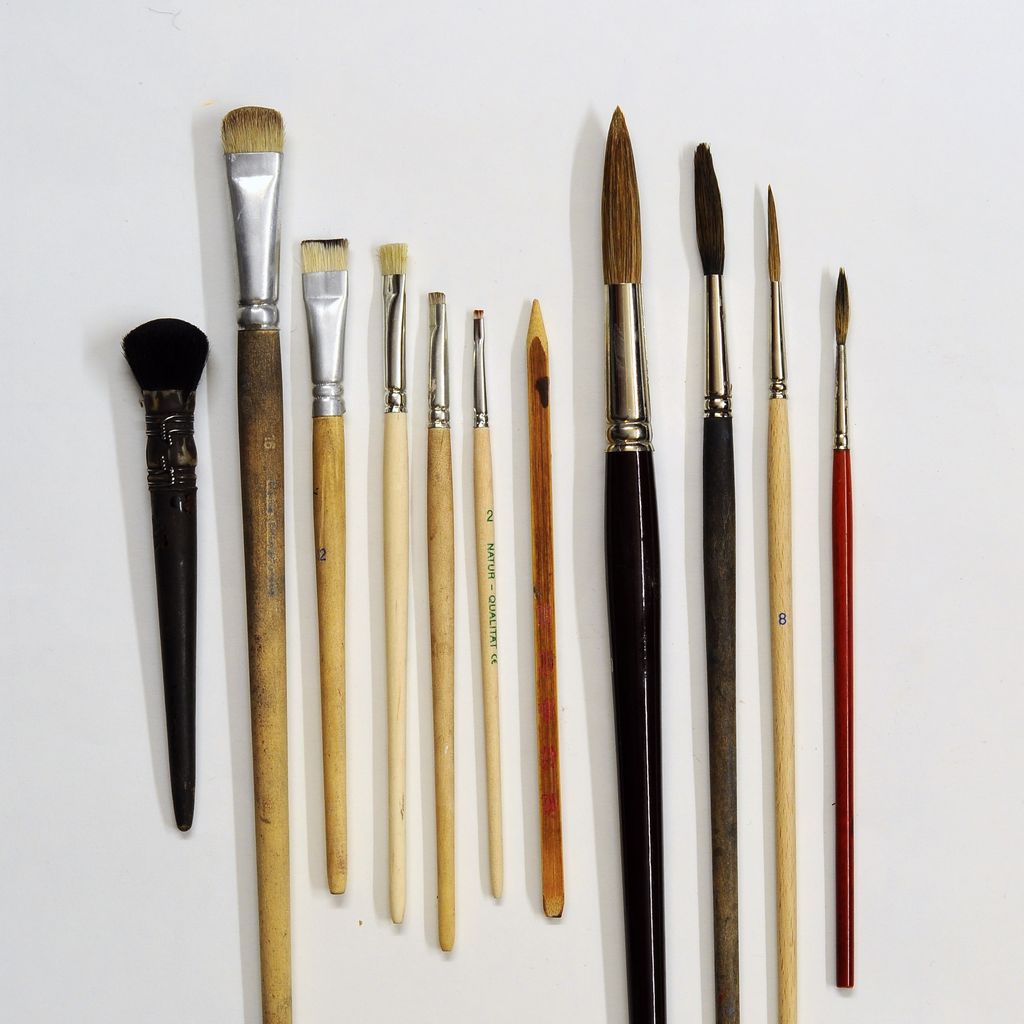
An array of brush heads makes clear that shape names describe working profiles, not identical marks: fibre, load, angle and pressure still change the result. Photograph by Hans Bernhard (Schnobby) via Wikimedia Commons, CC BY-SA 3.0; resized without cropping.
Some rounds are long and sharply pointed; others are short, blunt or worn. A spotter is typically a short, controlled round. A quill or mop-like round may have a larger soft belly. Those names are not perfectly standardised across manufacturers.
Flat and bright
A flat has a flattened ferrule and a straight or nearly straight edge. Used face-on, it deposits a broad rectangular stroke; turned on its narrow edge, it can make a line. Its corners can cut into angular shapes, and repeated parallel strokes can block an area efficiently. Current manufacturer specifications often give actual bundle width in millimetres, a more transferable measurement than series number.[3]
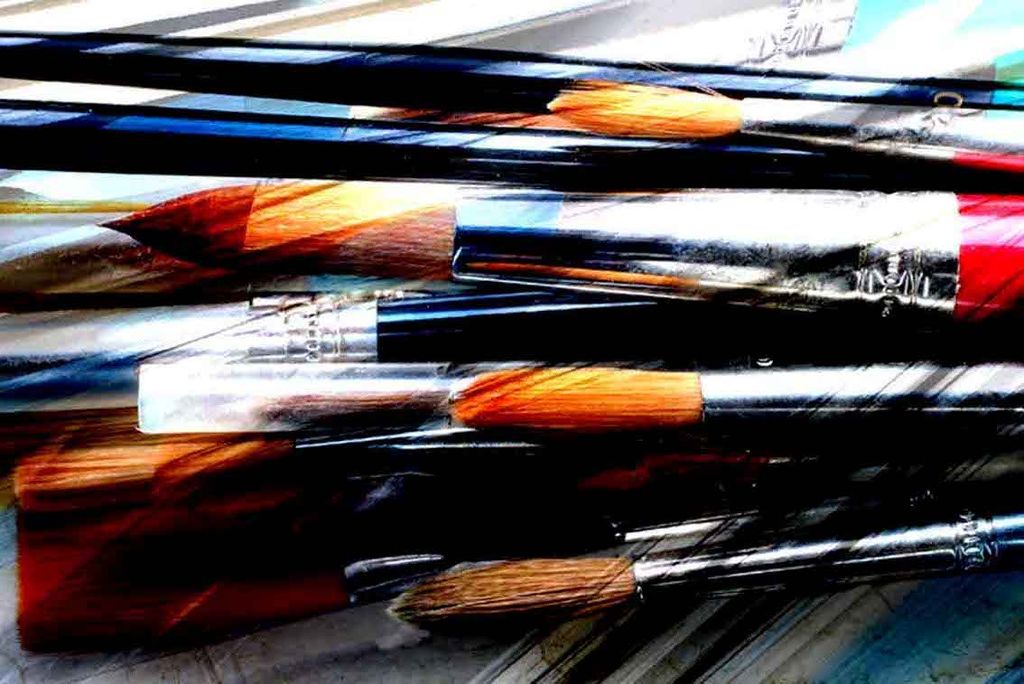
Flat and pointed profiles coexist in a working assortment, but the useful choice begins with the edge, coverage and stroke required. Photograph by Si Griffiths via Wikimedia Commons, CC BY-SA 3.0; resized without cropping.
A bright is a short flat: the shorter projection tends to feel firmer and offers controlled, shorter strokes. Some catalogues distinguish long flat, flat and bright; others use local names such as Gussow. A worn flat can round at the corners and behave differently from its original label.
Filbert and cat's tongue
A filbert combines a flattened body with a rounded or oval end. That curve can soften the beginning and end of a broad stroke while the side still produces a narrower edge. It is often useful when a square-cornered flat would leave an unwanted block-like boundary.[1][4]
“Cat's tongue” may mean a filbert-like head or an extra-long pointed oval, depending on range. Treat the silhouette as evidence. The same shape loaded with thin paint, buttery paint or a dry scumble produces very different edges.
Rigger, liner and script shapes
A rigger or liner is a small round with notably long filaments. Its length can carry a continuous load and flex through an extended line, making it useful for branches, rigging, lettering and calligraphic movement.[1] It rewards control of paint consistency: material that is too stiff will not flow, while an overloaded thin mixture may flood.
Script, lettering and pinstriping names overlap with this family. The correct test is whether the brush can hold the intended mixture and release a line at the required speed and curve.
Fan
A fan spreads filaments laterally into a thin arc. With a light load it can feather, soften or distribute repeated separated marks. With more pressure or paint it can merge into a broad textured passage. Fan strokes become conspicuous when repeated mechanically, so vary orientation and test on a scrap.[1][6]
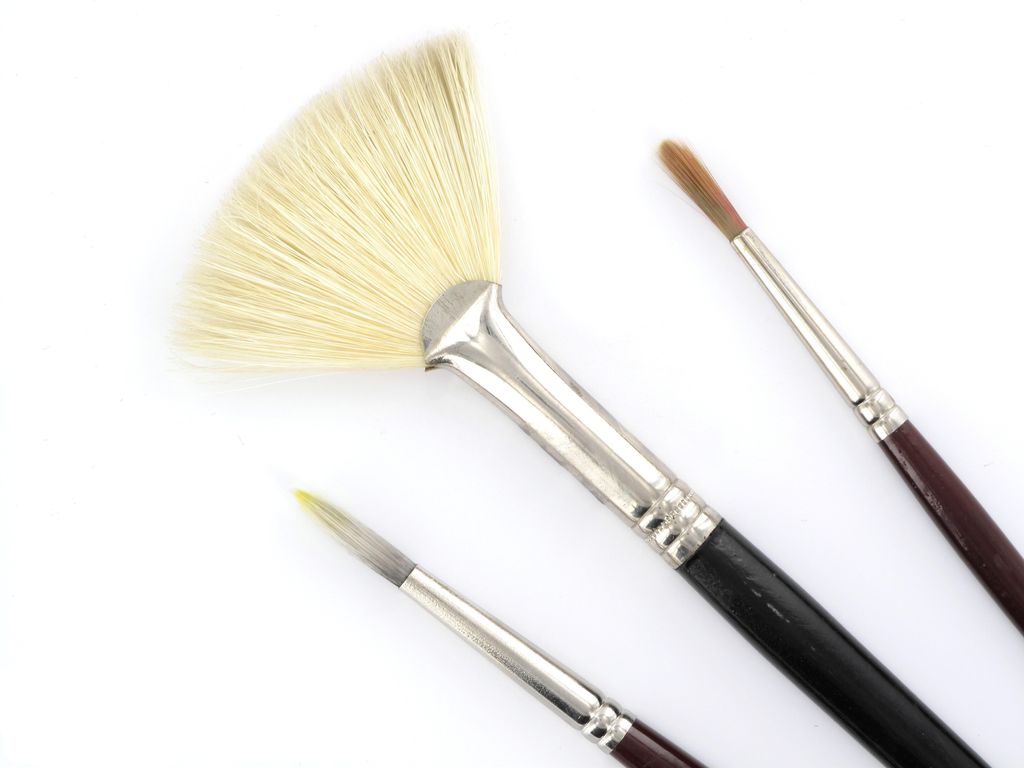
A fan head spreads fibres laterally, while flat, round and pointed bundles concentrate their edges differently. Shape suggests a range of actions rather than guaranteeing one texture. Photograph by Creative Tools via Wikimedia Commons, CC BY 2.0; resized without cropping.
The fan is not inherently a “foliage brush” or a blending solution. It is a head geometry that can separate, drag or diffuse marks according to paint and touch.
Mop, wash and hake-like brushes
A mop is a large soft rounded brush associated with carrying fluid, laying washes and softening edges.[1] Broad wash brushes use a flat or oval body to move liquid across paper. Hake-style brushes commonly have a broad flat head and soft hair or filament, but construction and naming vary.

A pointed watercolour brush must hold a useful liquid load while returning to a controllable tip. The same profile behaves differently with a thicker, less fluid paint. Photograph by Jennifer Rensel via Wikimedia Commons, CC BY 2.0; resized without cropping.
Softness can reduce visible brush ridges and accommodate delicate wet passages, while a very soft bundle may lack the spring needed to move viscous paint. Match the brush to paint body and surface rather than to medium name alone.
Angle, dagger and sword
An angle shader resembles a flat cut on a diagonal. Its long and short corners allow changes between broad stroke, chisel edge and controlled point. A dagger or sword liner has a longer slanted, tapered body designed for expressive lines that vary with rotation and pressure.[1]
These shapes can be valuable for botanical, sign, decorative and gestural work, but their mark depends on a practiced movement. A silhouette on a package cannot replace a loaded-stroke test.
Spalter and broad-area brushes
A spalter is a wide flat brush intended for broad coverage, grounds, glazes or coatings. Manufacturer descriptions emphasise large smooth areas and preparation work.[5] Varnish and mottler brushes occupy related broad-flat territory, but a brush used for final coatings should be reserved and maintained for that compatible material system.
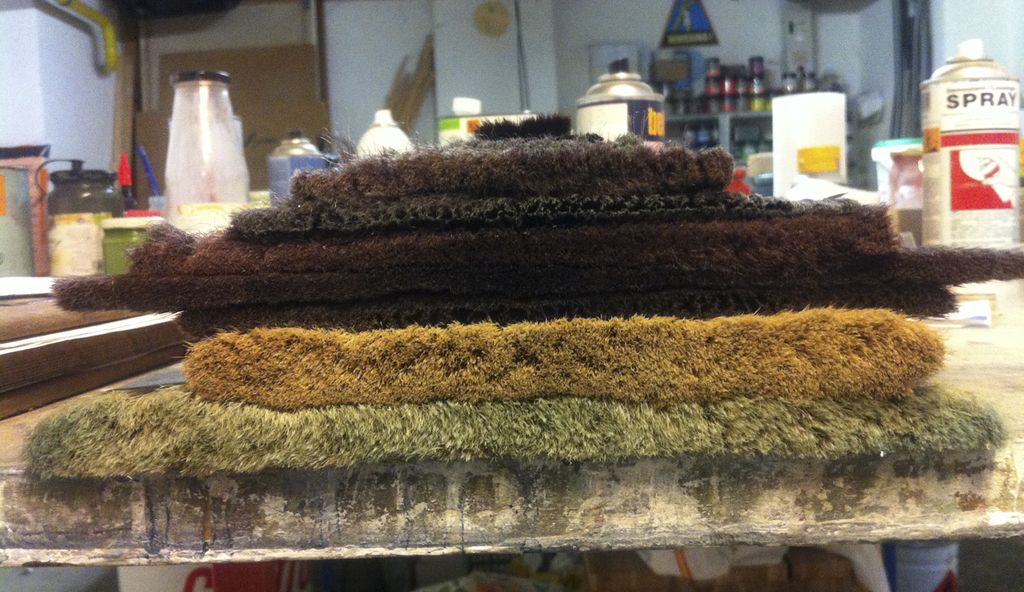
Large broad brushes are designed for area, long edges or sweeping applications; width, fibre stiffness, handle length and paint body still govern their control. Photograph by Susanne Schuster via Wikimedia Commons, CC BY-SA 4.0; resized without cropping.
House-painting brushes may appear similar yet use different filaments, adhesives and metal components. Suitability for an artist material should be verified rather than inferred from width.
Hair, filament and paint body
Natural hair, natural bristle, synthetic filament and blends occur in many shapes. The relevant working properties include stiffness, spring, softness, liquid capacity, edge formation, abrasion resistance and response to the chosen paint and cleaner. Species or synthetic status alone does not fix all of them.
Fluid watercolour often benefits from a bundle that carries liquid and returns to a point. Stiffer or resilient filaments can move heavier oil or acrylic. Softer brushes may glaze or blend with fewer ridges. These are tendencies; modern synthetic ranges cover wide property bands, and ethical, allergy and animal-origin considerations may influence selection.
Build a functional brush set
- Start from required marks: broad field, controlled edge, variable line, wash or texture.
- Compare actual head width, length, thickness and point rather than numeric size alone.
- Test the brush with the intended paint consistency and support.
- Use face, edge, tip, pressure and rotation before adding another shape.
- Keep incompatible paint and cleaning systems in separate, labelled brush groups.
- Replace a brush only when wear prevents its intended function; worn heads can become useful texturing tools.
A small set of contrasting geometries usually teaches more than a large collection of near-duplicates. Record the maker, series, stated size and measured head width for any brush whose mark you need to reproduce. Shape begins the description; a loaded test completes it.
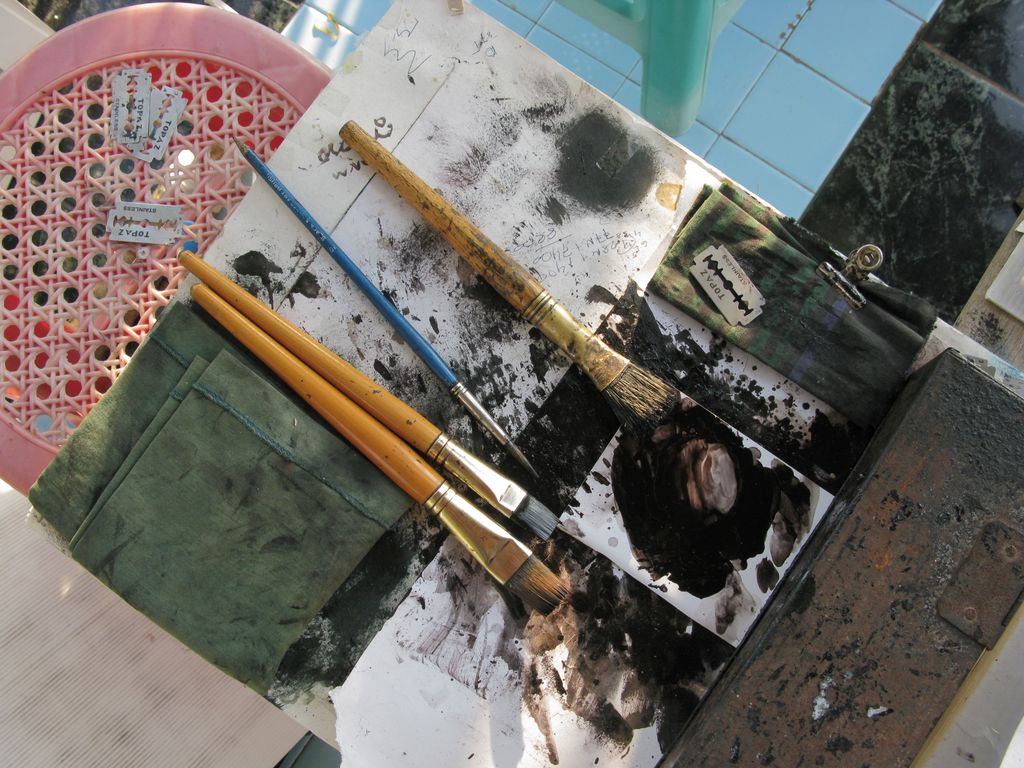
Brushes beside a working palette in Sagaing, Myanmar. A functional set is contextual: it should match the artist’s scale, paint, repeated marks and cleaning routine rather than a universal shopping list. Photograph by Vyacheslav Argenberg via Wikimedia Commons, CC BY 4.0; resized without cropping.
Four properties behind a brush mark
Shape becomes useful only when four working properties are considered with it. Capacity is how much liquid or paint the head can hold. Release is how steadily that load leaves the bundle. Spring is the tendency to return after bending. Stiffness is the resistance felt while the brush is displaced. These properties overlap but are not synonyms: a soft mop can have high capacity and low stiffness, while a short bright can have lower capacity and a firmer response.
Taper and flagging help create those behaviours. A tapered filament narrows toward the working end; a flagged end is split or divided. Brush-industry terminology describes flagging as a process that increases apparent volume and density, while manufacturers also mix filament diameters and lengths to tune carrying and release.[7][8] Natural hair and bristle arrive with different microscopic structures, whereas synthetic filaments can be extruded, tapered, textured or processed. None of these labels alone predicts the finished bundle.
The support participates too. A soft brush that forms a clean line on smooth paper may separate over coarse canvas. A stiff head that moves heavy paint can disturb a tender paper surface. Evaluate brush, paint body and support as a three-part test rather than assigning a permanent use to the brush name.
Read brush dimensions as a set
Head width is especially useful for flats, brights and broad brushes. Projection or visible hair length affects flexibility and reach. Thickness controls the volume behind a flat edge. Diameter is useful for rounds, though a round with the same ferrule diameter can have a different belly and point. Overall handle length affects working distance but does not measure the head.
A printed size number is an index inside a maker’s series. Even where a maker follows a traditional scale, two ranges may use different ferrules, hair quantities or projections. Record shape, series, stated size, measured width or diameter and projection. For a replacement, compare those values and a loaded test—not just “number 8.”
Very small sizes may be written with zeros, such as 0, 3/0 or 10/0, but that notation is not a universal metric scale. Large wash and mottler brushes may instead be labelled directly in millimetres or inches. Regional names and spelling also vary: mottler and spalter can overlap; bright can be called a short flat; rigger, liner and script can describe neighbouring long-round designs.
Match paint body to action
- For a broad fluid wash, prioritise capacity, predictable release and an edge that suits the passage.
- For a long line, test whether the head stores enough mixture to continue without flooding at the start.
- For viscous paint, choose sufficient stiffness to move the material without forcing the heel against the surface.
- For glazing or soft transitions, test whether the filaments release evenly without lifting the layer beneath.
- For dry-brush texture, use a controlled low load and observe whether the support abrades or separates the bundle.
- For varnish or another final coating, reserve a clean brush whose material compatibility and shedding behaviour are known.
These are test criteria, not shopping recommendations. The same shape can serve several actions, and a worn brush can move into a new role when its original edge is lost.
How artist brushes are assembled
In one documented hand-production method, hair is aligned in a shaped cup, gathered and tied, placed snugly into the ferrule, bonded with a measured adhesive and then joined to the handle.[7] Other factories use different combinations of manual forming and machinery. The key point is that a brush head is a constructed bundle: fill weight, alignment, taper, adhesive setting and ferrule attachment influence performance together.
Avoid assuming that “handmade” fixes every variable or that machine production is inherently inferior. Inspect the outcome: a coherent point or edge, secure filaments, a firm ferrule, an appropriate load and repeatable release. Construction evidence should explain performance rather than function as a prestige label.
Test marks should be repeatable
Compare brushes with the same paint mixture, support, load, stroke length and approximate pressure. Make a face stroke, edge stroke, tapering stroke and one pass after partial unloading. Note skips, flooding, filament separation and recovery. A dry silhouette cannot reveal these behaviours.
Label the test with date and measured head dimensions. When a brush wears, repeating the same four marks shows whether it has lost an essential function or merely developed a different useful edge.
Watch: Brush Fibres, Shapes and Care
Compare natural and synthetic fibres, see how acrylic brushes alter handling, and learn care practices that protect the brush assembly.
Natural vs Synthetic Brushes
Compare fibre behaviour and choose by paint, mark and handling rather than a universal hierarchy.
Watch on YouTubeFrequently Asked Questions
Common families include round, flat, bright, filbert, rigger or liner, fan, mop or wash, angle and spalter shapes, though names vary by maker and region.
Both have a flat head, but a bright is typically shorter; actual dimensions and proportions should be checked within the specific series.
Its rounded flat profile can produce broad passages, tapered turns and softer edges, depending on load, pressure and angle.
No. Numeric sizes are series-specific, so compare width, length, diameter and visible head shape rather than the number alone.
Choose brushes for distinct actions—such as broad coverage, controlled edge, fine line and soft wash—then run repeatable tests with the intended paint body.
Discussion
Which change alters a test mark most on your chosen brush: paint load, pressure, angle, speed or fibre spring?
Reader Insights
A shape name is more reliable when paired with width, length and profile.
Brush, paint body, support, load and hand movement all contribute.
Build a set around different actions rather than collecting names.
Join the Conversation
Share one precise observation or a useful museum example below.
References
- Jackson’s Art. A Guide to Brushes.
- Royal Talens. Van Gogh Watercolour Brush Series 191.
- Royal Talens. Amsterdam Brush Series 600.
- Royal Talens. Van Gogh Oil & Acrylic Brush Series 296.
- Royal Talens. Amsterdam Spalter Series 601.
- Liquitex. Basics Acrylic booklet.
- da Vinci Künstlerpinselfabrik. Production of Artist Brushes.
- American Brush Manufacturers Association. Brush Lingo.