by Tom Gurney
Tom Gurney BSc (Hons) is an art history expert with over 20 years experience
Page created on September 3, 2026 / Page updated on September 13, 2026
Email: tomgurney1@gmail.com / Phone: +44 7429 011000
Separating Face Size, Grammage, Caliper and Grain before Comparing Paper
Paper labels combine measurements that answer different questions. Dimensions describe the face. Grammage describes mass per area. Caliper describes thickness. A pad, block, roll or loose sheet describes packaging and edge restraint. None of these alone identifies fibre, sizing, surface or suitability for a medium.
Keeping those fields separate prevents two common mistakes: treating a heavier sheet as automatically better, and converting a US pound label to gsm without knowing the paper category’s basic size. Watercolor Paper examines fibre, sizing and surface in detail; this guide owns the cross-medium measurement system.
At a Glance
- Face sizethe sheet dimensions and orientation are independent of weight and thickness.
- Grammagegsm measures mass per square metre and supports direct mass-per-area comparison.
- Basis weightpounds are meaningful only with the paper grade and basic sheet size.
- Caliper and stiffnessheavier paper is not automatically thicker, stiffer or better.
- Formatloose sheet, pad, block and roll change workflow but do not prove intrinsic quality.
Contents
- Separating Face Size, Grammage, Caliper and Grain before Comparing Paper
- Face dimensions and orientation
- ISO A series
- Grammage in gsm
- Pound basis weight
- Caliper, stiffness and grain direction
- Deckle, cut and mould edges
- Loose sheets, pads, blocks and rolls
- A complete paper specification
- The standards behind grammage and caliper
- A worked basis-weight comparison
- Grain notation and cutting plans
- Permanent, acid-free and archival are different claims
- Art Materials reference pages
- Watch Artist Paper Sizes, Weights and Formats in Practice
Face dimensions and orientation
Write paper dimensions with units, and do not assume that the first number always means width. Turning a 297 × 420 mm sheet changes portrait to landscape but not its dimensions or aspect ratio. A finished work may be smaller than the purchased sheet because of trimming, deckle preservation, tape margins or mounting overlap.
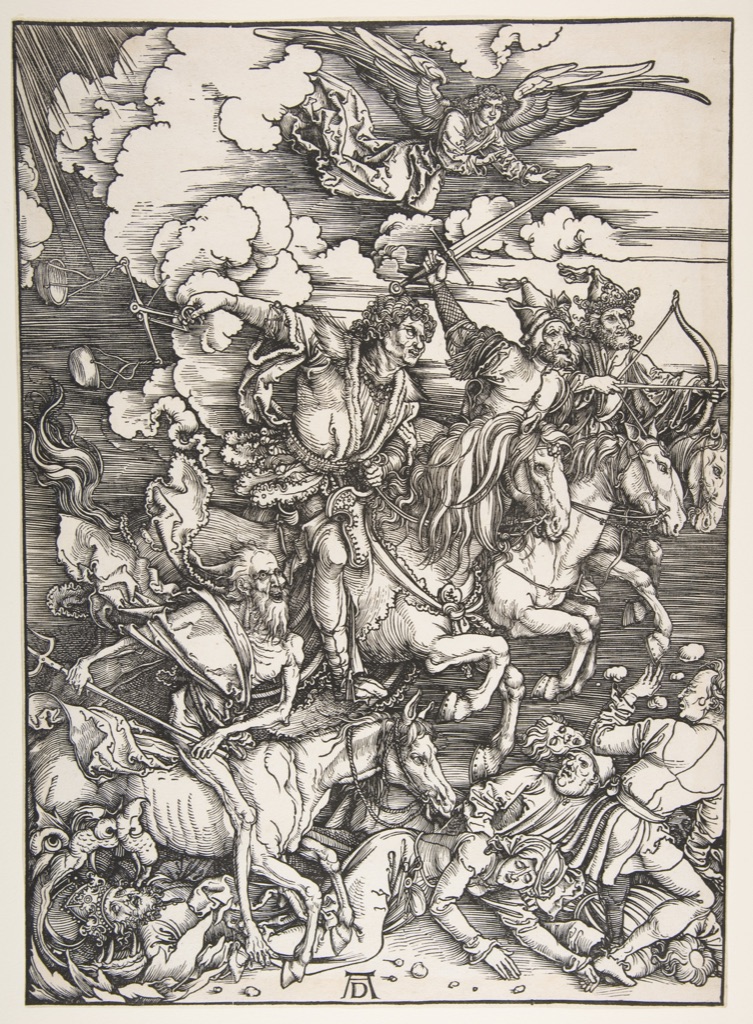
Albrecht Dürer, The Four Horsemen, 1498. Woodcut. The museum records the sheet as 38.8 × 29.1 cm and the printed image as 38.7 × 27.9 cm, demonstrating why sheet and image dimensions should be kept separate. Image: The Metropolitan Museum of Art, Open Access, public domain.
Artist papers are sold in metric, inch, traditional named and manufacturer-specific sizes. Full sheets, half sheets and quarter sheets are meaningful only when the parent sheet is known. “Imperial” can describe a traditional paper format in one catalogue and ordinary inch notation in another. Record actual millimetres as the transferable value.
ISO A series
ISO 216:2007 remains the current international standard for trimmed A and B writing-paper sizes and machine-direction indication.[1] It does not claim to govern every newspaper, book, poster or specialist artist sheet. The A series is useful because each next size is formed by halving the preceding long dimension while retaining approximately the same √2:1 proportion after dimensions are rounded to whole millimetres.
The standard metric dimensions are A0 841 × 1189 mm, A1 594 × 841 mm, A2 420 × 594 mm, A3 297 × 420 mm, A4 210 × 297 mm, A5 148 × 210 mm and A6 105 × 148 mm.[2] Halving A3 produces two A4 sheets; enlarging an A4 layout to A3 preserves the proportion. Cutting and printer tolerances still matter when edges must align exactly.
North American Letter, Legal and tabloid/ledger formats use different proportions and dimensions. Artist pads may borrow either office-paper families or ignore them. Never infer dimensions from a familiar name without checking the label.
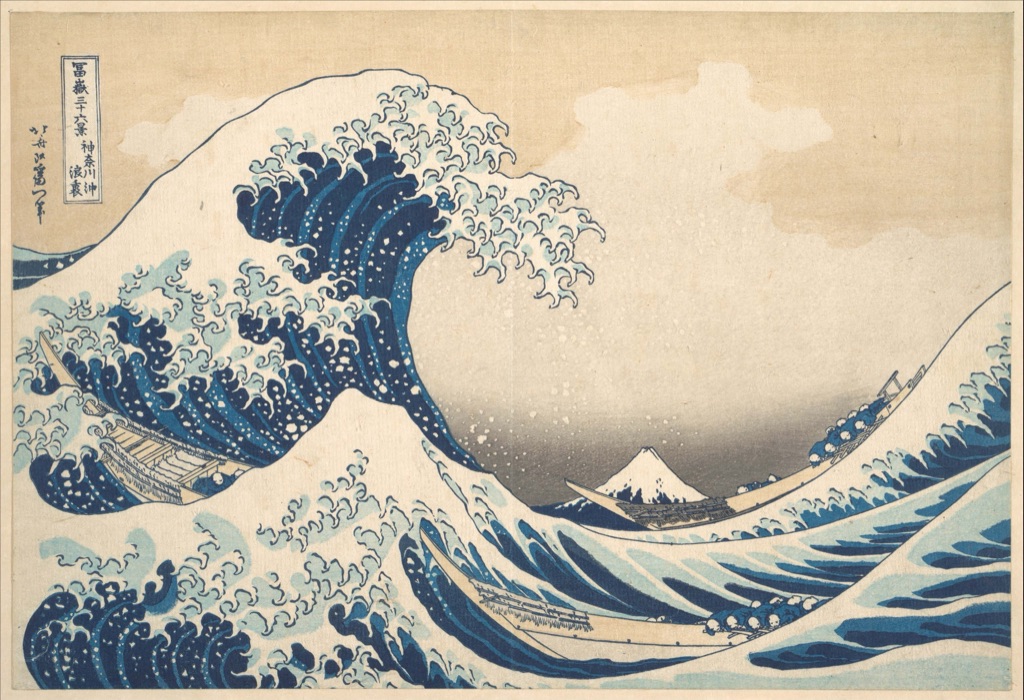
Katsushika Hokusai, Under the Wave off Kanagawa, about 1830–32. Woodblock print, ink and colour on paper, 25.4 × 38.1 cm. A familiar paper work may have a documented physical format without belonging to the ISO A series. Image: The Metropolitan Museum of Art, Open Access, public domain.
Grammage in gsm
Grammage is the mass of a square metre of paper, written g/m² and commonly abbreviated gsm.[4] Because it is mass per area, a 300 gsm paper has the same grammage whether sold as A4, a large sheet or a roll. A one-square-metre theoretical sample would have a mass of 300 grams.
Grammage is not thickness, stiffness, absorbency or quality. Two 300 gsm papers can have different caliper because fibres, pressing, fillers, sizing and surface compaction differ. A dense smooth sheet can be thinner than a bulkier sheet of the same grammage. Compare manufacturer caliper or a measured stack when physical thickness matters.
Heavier paper often resists handling and wetting differently from lighter paper, but technique and construction remain decisive. Current artist-paper ranges can span from 185 to 850 gsm within one watercolour family.[5] That is a choice of bulk and response, not an ascending artistic grade.
Pound basis weight
In the United States, a pound or “lb” label often expresses basis weight: the mass in pounds of a ream, usually 500 sheets, cut to the traditional basic size for that paper category. Bond/writing, text/book and cover papers use different basic dimensions.[3] Consequently, “90 lb” is incomplete for an exact gsm conversion unless the grade, basic sheet and ream convention are known.
Artist watercolour labels frequently print an established pairing such as 140 lb / 300 gsm. Use the maker’s paired specification for that product rather than a universal multiplier. Two papers with the same pound number but different basis categories may have different gsm; gsm is the clearer cross-category comparison.
Caliper, stiffness and grain direction
Caliper is physical thickness, usually measured in millimetres, micrometres or points/mils in some industries. Stiffness depends on caliper, fibre network, moisture and manufacture as well as grammage. A board-like sheet may resist bending yet still require support at large scale.
Machine-made paper tends to have a machine or grain direction created by fibre orientation and production. It can influence folding, tearing, expansion and book structures. ISO 216 includes a method for indicating machine direction on trimmed sheets.[1] Artist-paper labels do not always provide it; test a sacrificial strip or ask the maker when folding or dimensional movement is critical.
Deckle, cut and mould edges
A deckle edge is an irregular edge associated with sheet formation or deliberately reproduced by manufacture. It is not proof by itself of handmade origin or conservation quality. A watermark similarly identifies a mill or range but does not replace technical data.
Trimmed edges offer predictable dimensions. Deckled edges may be retained visibly, hidden under a window mount or removed. Measure the usable image area separately from the maximum irregular sheet. Tearing along a damp fold, cutting and sanding create different edge structures; choose deliberately and protect exposed fibres.
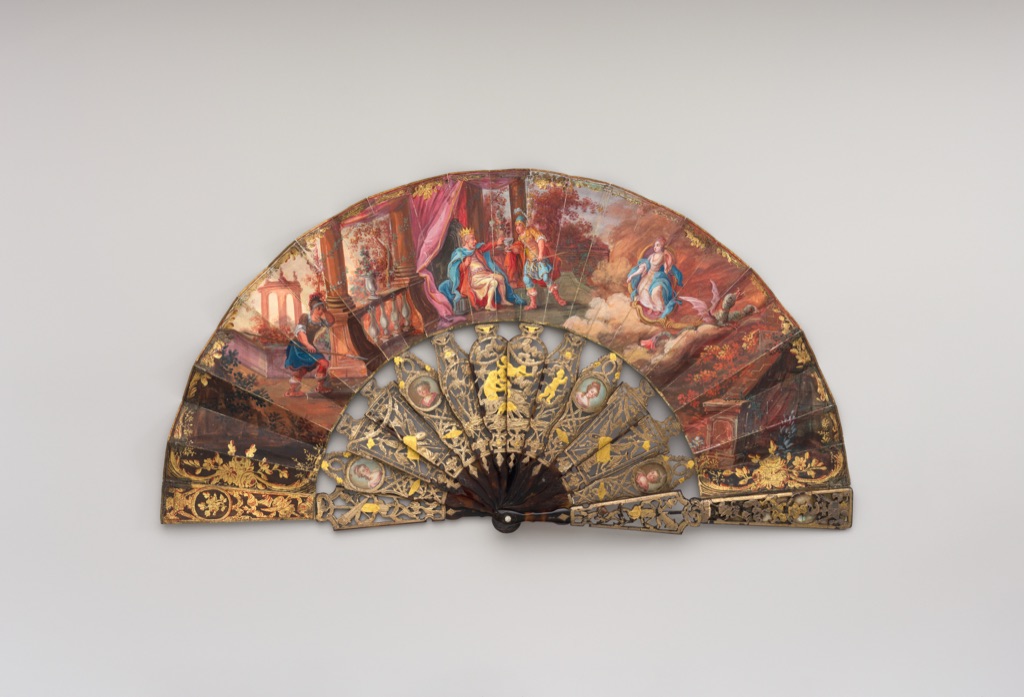
Folding fan, late eighteenth century. Paper, paint and gold are joined to a folding support; the open object measures 48.9 × 25.4 cm. Its curved edge and changing shape show why paper format is not always a fixed rectangle. Image: The Metropolitan Museum of Art, Open Access, public domain.
Loose sheets, pads, blocks and rolls
Loose sheets permit inspection, custom division and deckle retention. Pads bind sheets along one edge or in a spiral and are convenient for portable work. A watercolour block bonds sheets around multiple edges, temporarily restraining the top sheet while it is worked; it does not guarantee that no cockling will occur. Remove a finished sheet only by the maker’s indicated opening and method.
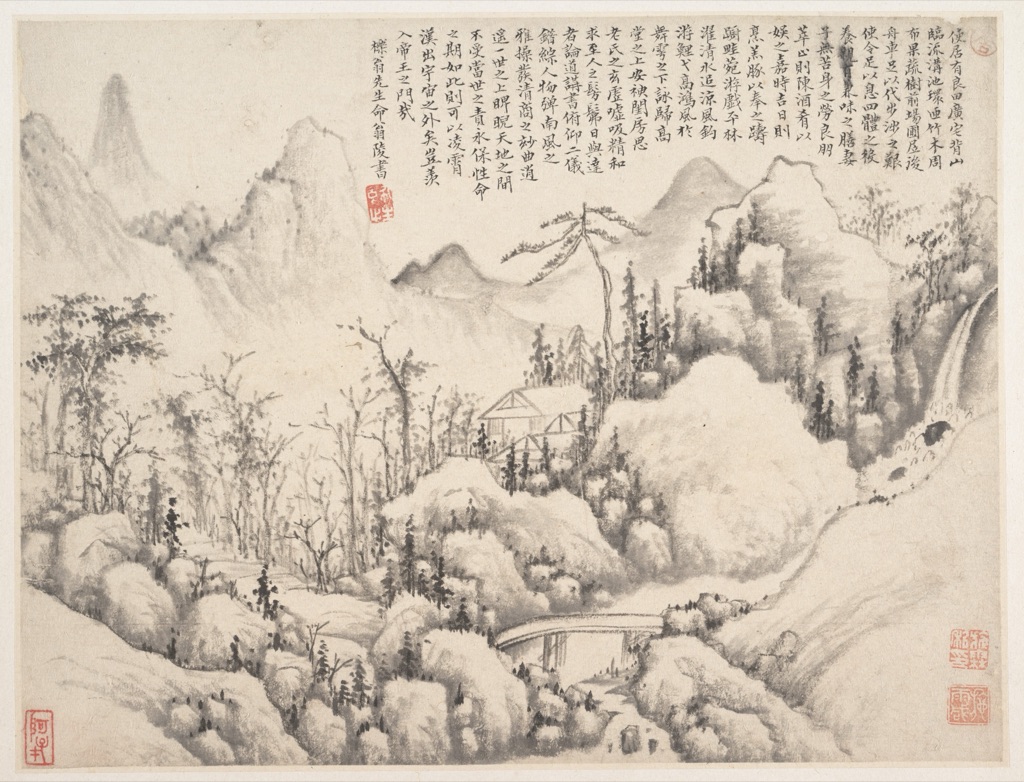
Shi Lin, Mountain Retreat, 1654–55. Ink and colour on paper, a leaf from a collective album. The image measures 25.1 × 33.3 cm, while the open mounting measures 60 × 35.9 cm: leaf, mount and album opening are related but distinct formats. Image: The Metropolitan Museum of Art, Open Access, public domain.
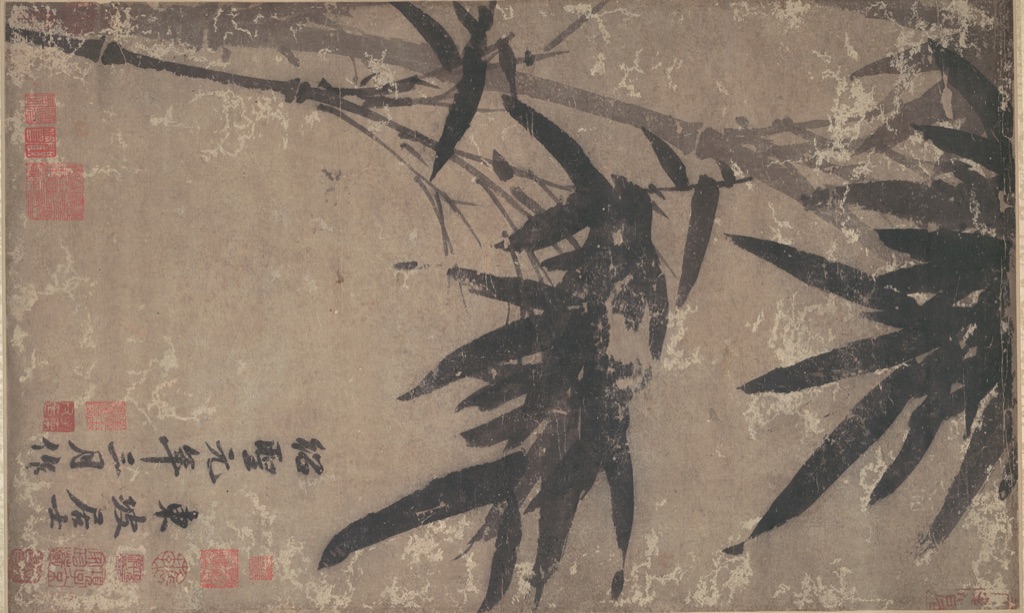
Bamboo, unidentified artist, after Su Shi. Ink on paper, a hanging scroll mounted as a handscroll. The painted image is 54.3 × 33 cm, but the complete mounting extends to 1,062.2 cm: object format can be much larger than the visible image field. Image: The Metropolitan Museum of Art, Open Access, public domain.
Rolls support panoramas and custom large formats but introduce curl, cutting and storage questions. Store according to the maker’s orientation and environmental instructions. Current technical ranges demonstrate that the same paper family may be offered as sheets, rolls, pads and four-side blocks.[5] Format changes workflow; it does not transform the paper’s fibre or grammage.
A complete paper specification
- Record exact face dimensions and units, not only A-size or traditional name.
- State gsm; if pounds are given, retain the product’s paired gsm or identify basis category.
- Record caliper separately when thickness or mounting clearance matters.
- Add fibre composition, sizing, surface, colour and grain/machine direction when known.
- Identify loose sheet, pad, block or roll and the usable area after margins.
- Distinguish natural or manufactured deckle from trimmed edge.
- Test the actual medium, water load, erasing, masking and mounting process on the same paper.
The result might read: “297 × 420 mm, 300 gsm, cold-pressed cotton watercolour paper, internally and surface sized, loose sheet.” That layered description can be compared across regions and suppliers without pretending that one weight number contains the whole paper.
The standards behind grammage and caliper
ISO 536 defines a method for determining paper and board grammage; the current 2019 edition was confirmed in 2025.[7] ISO 534 separately defines single-sheet and bulking methods for thickness, plus calculations for apparent density and specific volume.[8] The existence of separate standards reinforces a practical point: mass per area and thickness are independent observations.
Measurement conditions matter. Paper exchanges moisture with the air, and a small sample may not represent an irregular handmade or heavily textured sheet. A manufacturer’s nominal gsm or caliper is best treated as a stated specification with tolerances, not a promise that every point on every sheet is identical. Studio measurements should record the method, instrument and number of sheets rather than imply laboratory precision.
Bulk is thickness relative to grammage. Two sheets with the same gsm can differ in bulk because one network is more porous or less compressed. Apparent density is likewise derived from mass and volume, not visible smoothness. These terms describe structure; they do not rank suitability for charcoal, printmaking, watercolour or another medium.
A worked basis-weight comparison
Basis weight can be converted only when the basic sheet and ream convention are known. For a 500-sheet ream, a useful calculation is: gsm equals pounds multiplied by approximately 1,406, divided by the basic sheet area in square inches. The constant incorporates pounds-to-grams and inches-to-metres conversions.[3][7]
Using the common watercolour basic size of 22 × 30 inches, 140 lb calculates to about 298 gsm, conventionally labelled 300 gsm. But applying 140 lb to a 20 × 26 inch cover-paper basis produces about 379 gsm. The same pound number therefore describes different mass per area when the basic category changes.
This calculation explains labels; it does not override them. Ream counts, rounding and category conventions can vary, and an artist-paper maker’s paired lb/gsm value identifies its own product more reliably than an assumed category. Retain both printed units when documenting a sheet.
Grain notation and cutting plans
Machine direction may be indicated by underlining one dimension, placing it second, or adding terms such as long grain or short grain, but notation varies by industry. Long grain generally means the machine direction runs parallel to the longer sheet edge; short grain means it runs parallel to the shorter edge. Confirm the supplier’s convention before planning a fold or bound structure.[1]
Cutting changes both format and grain relationship. Halving an A-series sheet retains the proportional system, but the new long edge may cross the parent sheet differently. A quarter of a traditional artist sheet inherits the parent’s actual dimensions, not an ISO name. Record the cut plan, grain direction and usable margins when repeatability matters.
Permanent, acid-free and archival are different claims
ISO 9706:2025 specifies requirements for permanent unprinted document paper and explicitly excludes board.[9] It addresses defined properties; it does not certify that a sheet is suitable for every artist medium, mounting adhesive, wash load or display condition. “Acid-free” describes pH at a stated point or test, while an alkaline reserve, lignin content and strength add other information.
“Archival” has no single universal consumer definition. A paper may meet a permanence standard yet have a surface unsuitable for a technique; an excellent working paper may still need careful light, humidity and mounting control.[6] Ask which standard or test supports the claim, and preserve the exact wording rather than converting several labels into one promise of immortality.
Traditional names such as Imperial, Royal, Elephant and Double Elephant can also vary by trade, country and historical period. They are useful catalogue identifiers only when accompanied by actual dimensions. The same discipline applies to sketchbook labels such as landscape, portrait, square or panoramic: these describe orientation or proportion, not one fixed size.
Watch: Paper Structure, Handling and Conservation
Use conservation-led close views to connect sheet structure and handling with the paper specifications discussed in this guide.
Conservation of Works on Paper
See how paper structure and condition shape examination, handling and treatment decisions.
Watch on YouTubeFrequently Asked Questions
Grams per square metre measures mass per area, allowing papers to be compared without depending on one trade sheet size.
No. Grammage, caliper, density, fibre, sizing and compression are separate properties.
It is the mass of a stated number of sheets at a grade-specific basic size, so the grade and basis dimensions are required for comparison.
No. ISO A sizes are important trimmed formats with an approximate square-root-of-two proportion, but artists also use traditional, regional, mill and custom formats.
Record face dimensions, orientation, gsm or fully stated basis weight, caliper when relevant, fibre, surface, sizing, grain direction, edge and supplied format.
Discussion
Which omitted specification—basis size, grain, caliper, sizing or supplied format—would most change your reading of a paper label?
Reader Insights
Face dimensions, mass, thickness and stiffness answer different questions.
A pound value without paper grade and basic size is incomplete.
Grain, edge, block binding and roll memory can matter as much as nominal size.
Join the Conversation
Share one precise observation or a useful museum example below.
References
- International Organization for Standardization. ISO 216:2007.
- US Metric Association. Guide to the Use of the Metric System: ISO Paper Dimensions.
- Xerox. Paper Guide: Understanding basic size and basis weight.
- Legion Paper. Glossary of Terms.
- Arches Papers. Arches Aquarelle.
- Canadian Conservation Institute. Basic care — Works of art on paper.
- International Organization for Standardization. ISO 536:2019 — Paper and board: Determination of grammage.
- International Organization for Standardization. ISO 534:2011 — Paper and board: Determination of thickness, density and specific volume.
- International Organization for Standardization. ISO 9706:2025 — Paper for documents: Requirements for permanence.