by Tom Gurney
Tom Gurney BSc (Hons) is an art history expert with over 20 years experience
Page created on September 3, 2026 / Page updated on September 13, 2026
Email: tomgurney1@gmail.com / Phone: +44 7429 011000
Reading Fibre, Weave, Weight and Preparation as One Support System
Artist canvas is not a single material. It is a fabric support whose behaviour depends on several linked choices: fibre, yarn, weave, weight, preparation and the structure that holds it. A label that says only “canvas” leaves most of those choices unstated. Even “linen canvas” or “cotton canvas” identifies a fibre family, not a complete performance specification.
This guide explains the vocabulary needed to compare canvas without turning origin, price or fibre name into a quality ranking. Dimensions and proportions are covered in Standard Canvas Sizes and Aspect Ratios. Boards, paper, wood and other alternatives are compared separately in Painting Surfaces and Supports.
At a Glance
- Canvasa generic fabric-support term, not one fibre or quality grade.
- Constructionwarp, weft, yarn and binding system shape the textile.
- Weightmass per area does not by itself describe surface roughness or weave openness.
- Preparationraw, sized, primed and grounded identify different material states.
- Formatroll, stretcher, strainer, board or pad does not prove the fabric’s quality or composition.
Contents
- Reading Fibre, Weave, Weight and Preparation as One Support System
- Warp, weft and weave
- Weight is not texture
- Raw, sized, primed and grounded
- Rolls, stretchers, boards and pads
- How to compare two canvases
- Crimp, direction and restrained fabric
- What commercial priming can contain
- Stretcher, strainer and attachment are part of the type
- Art Materials reference pages
- Watch Types of Artist Canvas in Practice
Canvas is a fabric support
Conservation terminology uses canvas generically for a fabric painting support and sometimes, by extension, for the finished painting.[1] The textile may be natural, synthetic or blended. What matters structurally is not just the plant or polymer from which a fibre came, but how fibres became yarn, how yarns were woven, how dense and even that weave is, and what coatings were added. Getty conservation research explicitly cautions that naming the fibre alone is insufficient: yarn processing, weave density and coatings can change moisture response and mechanical behaviour.[2]
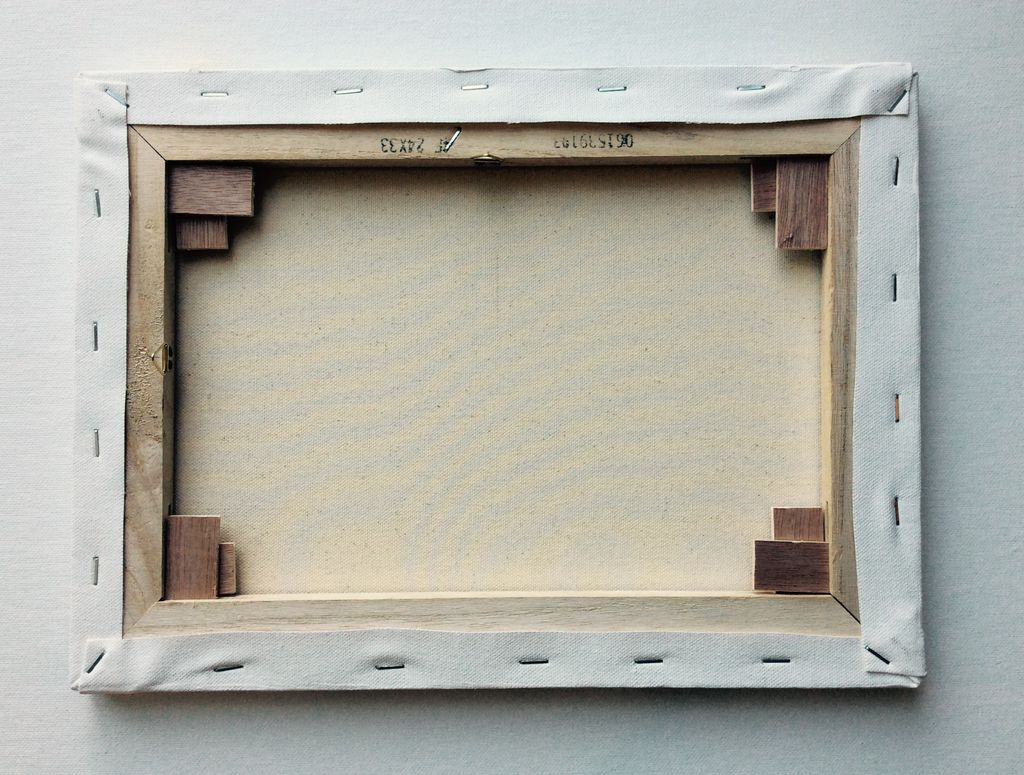
The reverse of a stretched canvas makes the system visible: woven fabric, folded corners, staples, wooden bars and corner keys all affect how the support is held. Photograph by JohanahoJ via Wikimedia Commons, CC BY-SA 4.0; resized without cropping.
Cotton canvas is made from plant seed fibres that are chiefly cellulose. “Cotton duck” usually means a robust plain-woven cotton fabric; duck describes construction rather than an animal-derived material.[1] Cotton became especially widespread as a prepared artists’ support during the twentieth century, with strong regional differences in adoption.[3]
Linen is woven from flax bast fibre. It has a long history as a painting and lining fabric, but linen products vary in yarn fineness, slubs, density, weave and preparation just as cotton products do.[1] A careful comparison is therefore between specified fabrics, not between idealised fibre names.
Synthetic canvases may use polyester or other manufactured fibres, alone or blended with natural fibres. They can be notably uniform, but “synthetic” still covers different yarns, weaves and coatings.[2][7] Blends combine fibres in proportions that should be stated by the maker. None of these families automatically fixes surface character, longevity or suitability for every paint system.
Warp, weft and weave
Warp threads run lengthwise on the loom under tension; weft threads cross them. The selvage, when present, runs parallel to the warp. Their interlacing pattern is the weave or binding system.[1] Plain weave—also called tabby—alternates over and under in the simplest repeating unit. Twill passes over and under in a shifted sequence that produces diagonal or patterned structures. Historical painting supports also include herringbone and other variations.
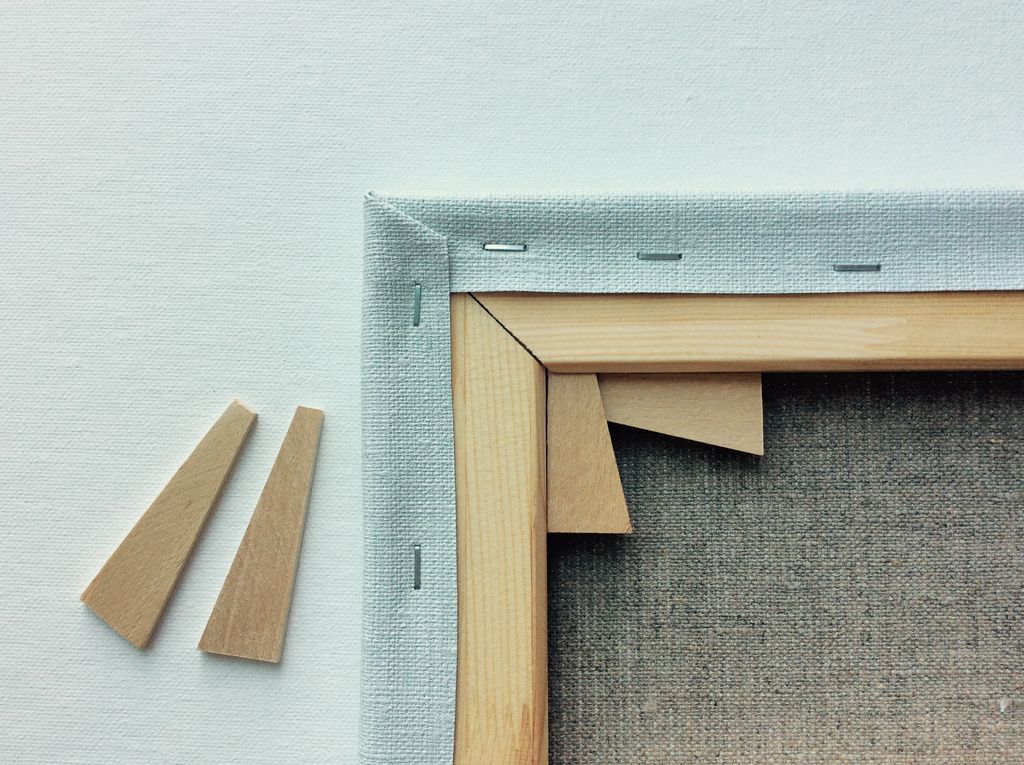
A close rear view separates the woven support from its attachment and auxiliary frame. The visible thread structure should not be confused with bar depth or corner construction. Photograph by JohanahoJ via Wikimedia Commons, CC BY-SA 4.0; resized without cropping.
Thread count describes how many warp and weft threads occur in a measured distance. It contributes to compactness but does not tell the whole story: thick yarn at a lower count can feel very different from fine yarn packed densely. Yarn twist, irregularity and finishing also alter the surface.
Artists often describe weave as fine, medium or coarse. These are useful relative descriptions within a seller’s range, not calibrated global grades. A fine, even weave can suit small marks and smooth passages; a more pronounced texture can remain visible through thin paint or disrupt an exact drawn edge. Neither is intrinsically better. The relevant question is whether the visible and tactile structure supports the intended marks and preparation.
Weight is not texture
Canvas weight is mass per area, commonly stated in grams per square metre (gsm) or ounces per square yard (oz/yd²). It reflects both yarn mass and how densely the textile is constructed. Trade guides sometimes group unprimed cloth around 140 gsm as light, 230 gsm as medium and 280 gsm or above as heavy, but those thresholds are conventions rather than standards.[6]
A rough surface need not be heavy: thick yarns can be loosely spaced. A fine surface need not be light: thin yarns can be densely packed. Priming adds mass, so a primed weight cannot be compared directly with an unprimed weight unless the specification says which state was measured.[6] Width, weave stability, flaws and suitability for the planned stretcher matter alongside the headline number.
Heavier cloth may tolerate more stretching force or prove useful at larger scale, yet weight alone does not guarantee a stable painting. Stretcher design, corner geometry, tension, humidity response, preparation and paint-film construction all interact. For ambitious dimensions or conservation-sensitive work, test the complete system and seek specialist advice.
Raw, sized, primed and grounded
Raw canvas is woven cloth without a preparation layer. Size is a sealing or isolating layer applied to a porous support. Ground is the paint-receiving preparation above the support or size; it can alter colour, texture, tooth and absorbency.[1] The everyday word “primed” may cover several commercial preparation systems, so the maker’s technical description matters more than the front label.
For oil painting on fabric, manufacturer guidance commonly distinguishes sealing the fibres from applying an oil or other ground.[4][5] Acrylic-dispersion grounds—often sold as acrylic gesso—form a different system from traditional glue-and-chalk gesso or oil ground. The same word does not make their chemistry interchangeable. Follow the paint and preparation manufacturer’s current compatibility instructions rather than improvising from a generic recipe.
Preparation changes the working surface. A smoother ground can reduce weave relief; a toothier one can grip a mark; a more absorbent layer can pull liquid from paint; a less absorbent layer leaves more binder at the surface. Colour may be white, tinted, clear or naturally textile-coloured. These are working properties, not a single ladder from amateur to professional.
Pre-primed cloth offers a documented ready surface when the coating is compatible with the intended paint. Raw cloth offers control but also transfers responsibility for sizing, grounding, drying and testing to the artist. Unknown vintage or reclaimed fabric may carry finishes, dirt, degradation or treatments that are difficult to predict.
Rolls, stretchers, boards and pads
Canvas by the roll is fabric supplied for cutting and stretching. Record usable width, fibre composition, weave, raw or prepared state, and whether folding could damage a brittle preparation. Stretched canvas is attached to a wooden or other frame; stretcher bars may permit later adjustment while a fixed strainer does not. The fabric specification and the frame specification should both be evaluated.
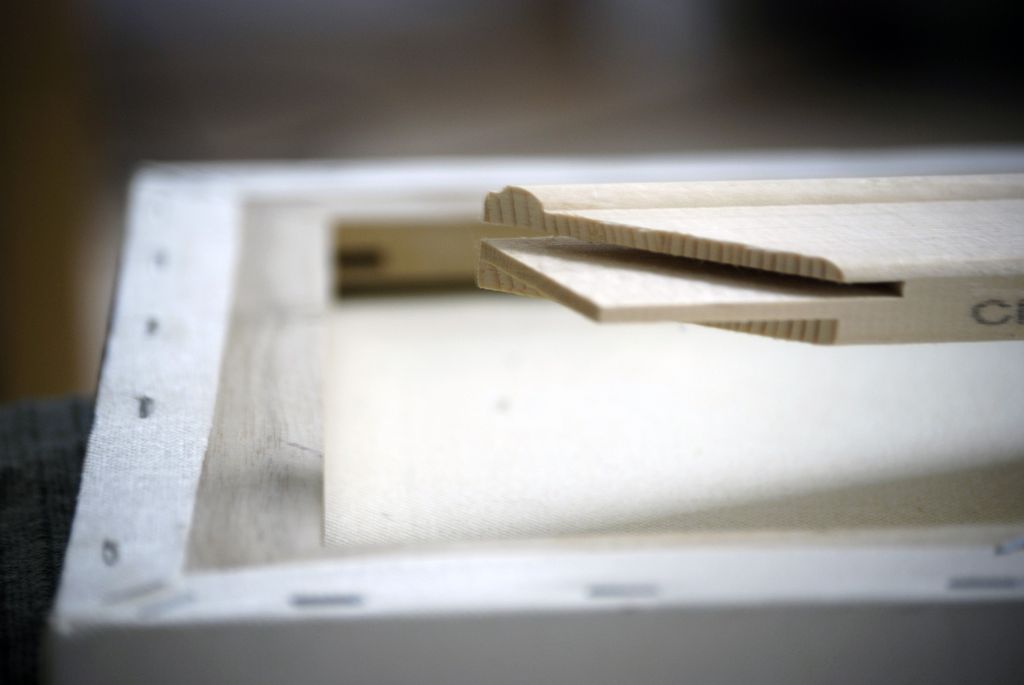
A stretcher-bar profile with a raised outer lip helps keep the broad face of the wood away from the painted fabric. Photograph by Alice Wiegand via Wikimedia Commons, CC BY-SA 3.0; resized without cropping.
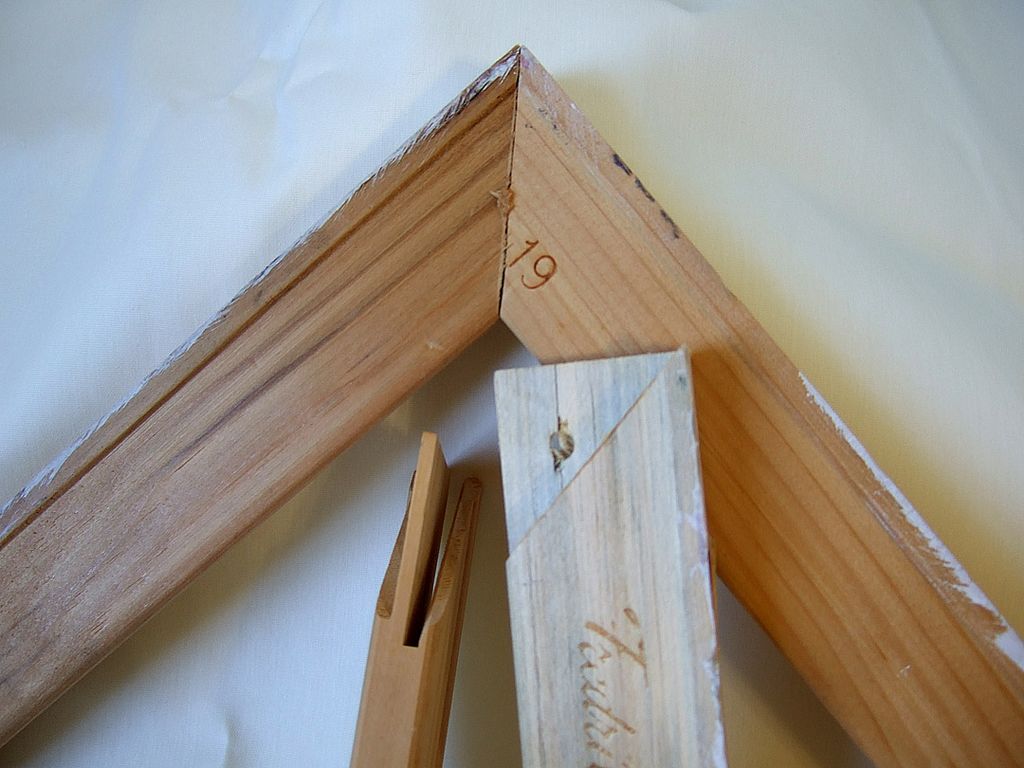
Assembled and disassembled light stretcher bars show how slotted corner joints differ from a fixed board or pad. Photograph by Mrs Scarborough via Wikimedia Commons, public domain; resized without cropping.
Canvas board usually combines a canvas or canvas-textured layer with a rigid board. Canvas paper or pads may reproduce a woven texture without being a woven fabric support. These compact formats can be useful for studies and storage, but the word “canvas” does not mean their layer structures are identical to stretched cloth.
Panels covered with fabric combine a textile surface with rigid backing. They behave differently from freely stretched canvas because the fabric cannot respond in the same way under tension. A format name therefore describes construction, not a universal level of quality or permanence.
How to compare two canvases
- Record fibre composition and whether it is single-fibre, blended or unspecified.
- Compare weave type, thread character, density and visible irregularity.
- Check whether weight is gsm or oz/yd² and whether it includes preparation.
- Identify raw, sized and grounded layers separately; confirm compatibility with the intended paint.
- Inspect surface absorbency, tooth and colour through a small documented test.
- Record roll width or face size, edge depth, stretcher construction and any bracing.
- Treat labels such as fine, medium, heavy, universal or professional as range-specific until the technical data explains them.
The best description is layered: for example, “plain-weave cotton, stated unprimed mass, acrylic-dispersion ground, stretched on adjustable bars.” That is more useful than a prestige label because it tells another reader what the support actually is. Canvas choice becomes clearer when fibre, construction, preparation and format remain separate questions.
Crimp, direction and restrained fabric
A woven support does not behave like a uniform plastic sheet. Yarn passes over and under neighbouring yarns, creating crimp: the small undulation built into the weave. Warp and weft can have different crimp, twist, diameter and tension histories. Under load or changing moisture, part of the early movement comes from yarns straightening and the weave reorganising, not simply from individual fibres stretching.[2][8]
That distinction matters once fabric is restrained on a stretcher. The attachments, corner construction and direction of the yarns make loading uneven. Getty’s canvas research notes that weave density, friction, pattern, coatings and warp–weft differences all affect strain distribution. A fibre label therefore cannot predict the tension of a complete prepared canvas.[2]
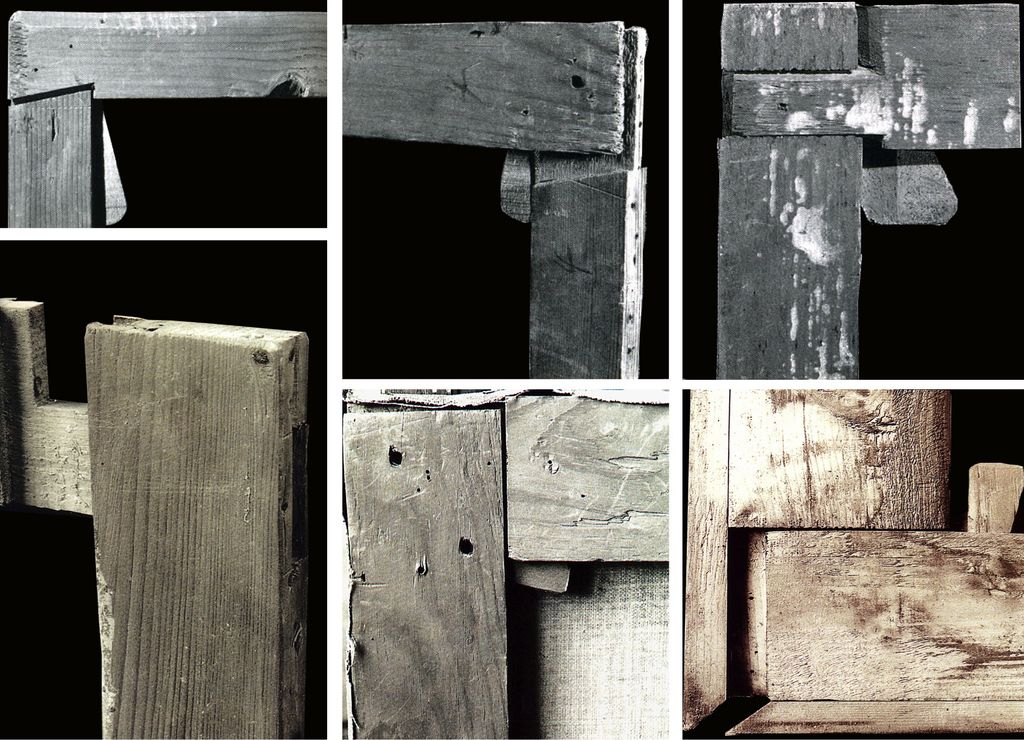
Different corner and attachment systems restrain fabric in different ways; “stretched canvas” is therefore not one invariant construction. Comparative image by Sven 1919 via Wikimedia Commons, CC BY-SA 4.0; resized without cropping.
Natural cellulosic fabrics respond to relative humidity, but the direction and magnitude depend on the full composite: textile, size, ground and paint. A primed canvas can even change tension differently from raw cloth because a moisture-responsive sizing layer participates in the system. This is why a generic claim that linen or cotton simply “loosens in damp air” is unreliable. Record the construction and avoid treating one laboratory result as a universal studio threshold.[2][9]
What commercial priming can contain
“Acrylic primed” identifies a binder family more clearly than the word “gesso,” but it still does not disclose a complete formulation. An institutional survey of 53 commercially prepared canvases found several synthetic-polymer types in priming layers, including acrylic, polyvinyl acetate and copolymers.[8] Fillers, pigment, number of coats and application method also affect colour, absorbency, texture and flexibility.
Oil-primed and acrylic-dispersion-primed canvases are therefore systems, not single recipes. Some preparations are formulated for both oil and acrylic paint; others have narrower instructions. A clear-primed fabric exposes weave and fibre colour but is not the same as raw cloth. “Universal priming” is a manufacturer compatibility claim that should be checked against its technical sheet, not expanded into permission for every paint or coating.
A small test can document practical response without pretending to identify chemistry. Record how quickly a fixed drop spreads, whether a thin stroke beads or sinks, how a dry edge forms and whether low-tack tape removes material from a sacrificial margin. Keep those observations separate from claims about long-term adhesion, which require appropriate testing and evidence.
Stretcher, strainer and attachment are part of the type
A stretcher has adjustable corner joints; a strainer is fixed. Crossbars can limit twisting or bowing at larger dimensions, but bar section, joinery and span matter more than the mere presence of wood behind the cloth. Excessive keying can also create local stress rather than “improve” a painting automatically.[9]
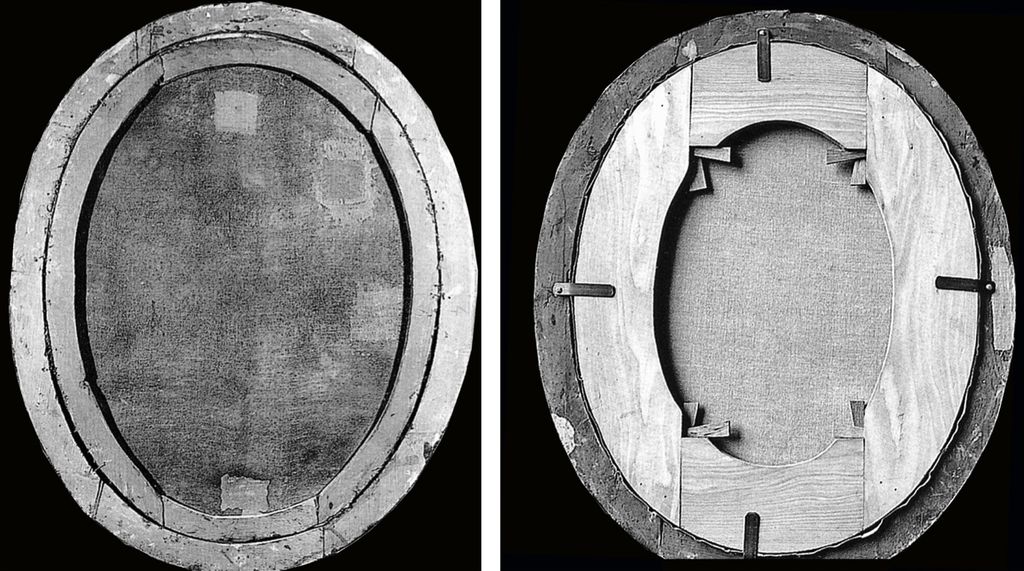
Rear views of two oval fabric supports compare a fixed strainer with an adjustable stretcher arrangement. The distinction belongs in the construction record, not merely the picture’s front-facing dimensions. Image by Sven 1919 via Wikimedia Commons, CC BY-SA 4.0; resized without cropping.
Attachment may use tacks, staples, lacing or other systems, placed on the side or reverse. Gallery-wrap describes an edge presentation and attachment arrangement, not fibre, weave or preparation quality. Folded corners add local thickness; closely spaced fasteners distribute load differently from sparse ones; and weak turnover margins can fail even when the face fabric appears sound.
For a complete comparison, add auxiliary-support construction to the material description: adjustable or fixed corners, bar depth and width, crossbars, attachment position, measured tension condition and visible deformation. That information explains more than the label “stretched canvas” alone.
Watch: Fibre, Weight and Stretched Canvas
Compare cotton with linen, distinguish weight from other properties, and see how fabric and stretcher construction work together.
Cotton vs. Linen Canvas
Compare two common canvas fibres without treating either one as universally superior.
Watch on YouTubeFrequently Asked Questions
Artist canvas is a woven fabric support for painting; it may use linen, cotton, synthetic fibres or blends and can be sold raw, prepared, stretched or mounted.
No. Fibre matters, but yarn, weave density, weight, preparation, attachment and intended use also determine performance.
No. Weight measures mass per area, while texture depends on yarn, weave, coatings and finishing.
Sizing regulates or isolates the fabric; a ground or primer creates the intended painting surface. Historical and commercial terminology can overlap, so check the actual product or object record.
Record fibre, yarn and weave, weight and width, preparation, format, edge depth, attachment and compatibility with the intended paint system.
Discussion
Which property would most change your choice between two canvases that share the same fibre label?
Reader Insights
Construction and coatings can outweigh a familiar material name.
Mass per area cannot stand in for surface character.
Fabric, size, ground, paint and attachment behave as a system.
Join the Conversation
Share one precise observation or a useful museum example below.
References
- Getty Conservation Institute. Glossary — Conserving Canvas.
- Getty Conservation Institute. Canvas Complexity.
- Getty Conservation Institute. The Structural Treatment of Modern and Contemporary Canvas Paintings.
- Gamblin Artists Colors. Sizes and Grounds.
- Winsor & Newton. A guide to sizing and priming canvas.
- Jackson’s Art. A Guide to Canvas.
- Liquitex. How to Prep Your Surface.
- Queensland Art Gallery | Gallery of Modern Art. Investigating Contemporary Artist Canvases.
- Canadian Conservation Institute. Know Your Paintings: Structure, Materials and Aspects of Deterioration.