by Tom Gurney
Tom Gurney BSc (Hons) is an art history expert with over 20 years experience
Page created on September 3, 2026 / Page updated on September 13, 2026
Email: tomgurney1@gmail.com / Phone: +44 7429 011000
How to Compare Canvas Labels without Mistaking Convention for a Universal Standard
Canvas sizes look simple until two catalogues describe nearly the same rectangle in different ways. An inch label may sit beside a rounded metric label; a French number may refer to one of several proportions; and the first dimension may not tell you whether the canvas is meant to hang upright or sideways. The useful question is therefore not “What is the standard canvas?” but “Which convention does this label use, and what proportion and physical dimensions will I actually receive?”
This guide separates exact measurement from trade convention. It shows how to read dimensions, calculate aspect ratio and compare recurring stocked sizes without treating a manufacturer’s range as a universal law. It also introduces the French F, P and M series and their use beyond France. Fibre, weave, weight and priming belong to the separate Types of Artist Canvas guide; comparisons with boards, paper and other supports belong to Painting Surfaces and Supports.
At a Glance
- Face dimensionsa two-number label describes the front plane; depth is a separate measurement.
- Exact conversionone inch equals exactly 2.54 centimetres, but retail pairings may be rounded.
- Aspect ratioproportion remains the same when portrait and landscape orientation are reversed.
- Regional systemsFrench F, P and M and Japanese adaptations require the relevant local table.
- Selectioncomposition, scale, transport, stretcher strength, framing and display all matter.
Contents
- How to Compare Canvas Labels without Mistaking Convention for a Universal Standard
- Inches, centimetres and rounded equivalents
- Common proportions at one scale
- Choose by proportion, then by physical scale
- French Figure, Landscape and Marine formats
- Custom, square and panoramic canvases
- A reliable comparison checklist
- A working size reference
- Area, perimeter and diagonal answer different questions
- Frames, stretchers and image dimensions
- Art Materials reference pages
- Watch Standard Canvas Sizes and Aspect Ratios in Practice
Read the label before comparing sizes
A conventional two-number label describes the dimensions of the picture face. A canvas marked 16 × 20 inches has one edge of 16 inches and another of 20 inches. Turning it from portrait to landscape changes the orientation, but neither the dimensions nor their proportion. Do not assume that every catalogue writes width before height: seller, country and product database conventions differ. Check the diagram, product specification or physical label when orientation matters.

El Greco, View of Toledo, about 1596–1600. Oil on canvas, 47 3/4 × 42 3/4 in (121.3 × 108.6 cm). The dimensions describe a physical object; neither the title nor the image alone supplies a standard canvas-size label. Image: The Metropolitan Museum of Art, Open Access, public domain.
Profile depth is a separate third dimension. A listing such as 40 × 50 × 2 centimetres normally distinguishes the rectangular face from the depth of the stretched edge, although the field order still needs checking. Depth affects projection from the wall, compatibility with some frames and the appearance of an unframed edge. It does not change the face’s aspect ratio.
Nominal and measured dimensions can also differ slightly. Textile tension, timber movement, manufacturing tolerance and the point from which a person measures can all matter. For a frame, transport case or tightly planned installation, measure the finished object rather than relying only on its name.
Inches, centimetres and rounded equivalents
One inch is exactly 2.54 centimetres. Multiply each inch dimension by 2.54 to make an exact conversion; divide centimetres by 2.54 to convert the other way. Thus 16 × 20 inches is exactly 40.64 × 50.8 centimetres. A manufacturer may market a corresponding format as 41 × 51 centimetres. That paired label is a practical rounded description, not a new definition of the inch.
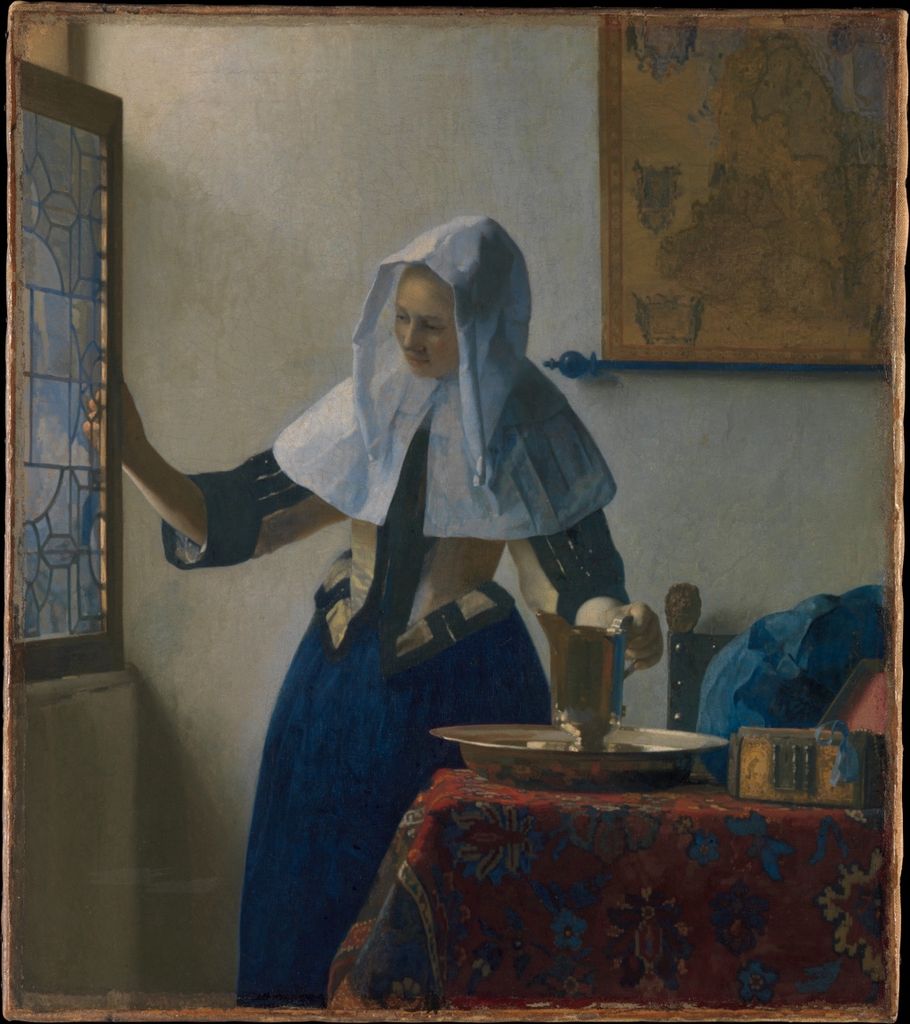
Johannes Vermeer, Young Woman with a Water Pitcher, about 1662. Oil on canvas, 18 × 16 in (45.7 × 40.6 cm). Exact imperial and metric records are more reliable than treating a rounded conversion as a second manufactured standard. Image: The Metropolitan Museum of Art, Open Access, public domain.
The distinction explains why apparently equivalent canvases do not always match. Current manufacturer sheets place labels such as 13 × 18 cm beside 5 × 7 in, 36 × 46 cm beside 14 × 18 in, and 46 × 61 cm beside 18 × 24 in.[1] Another range includes 41 × 51 cm / 16 × 20 in and 51 × 61 cm / 20 × 24 in.[2] Some regional ranges round more broadly. These are examples of products offered by particular makers, not a single conversion table imposed on the whole industry.
When interchangeability matters, compare actual centimetres or millimetres. This is especially important when a pre-made frame, glazing system, liner, shipping box or multi-panel alignment leaves little tolerance. Two products carrying familiar inch and metric names can be close without being identical.
Common proportions at one scale
| Inch label | Exact conversion | Observed rounded label |
|---|---|---|
| 5 × 7 in | 12.70 × 17.78 cm | 13 × 18 cm |
| 14 × 18 in | 35.56 × 45.72 cm | 36 × 46 cm |
| 16 × 20 in | 40.64 × 50.80 cm | 41 × 51 cm |
| 18 × 24 in | 45.72 × 60.96 cm | 46 × 61 cm |
| 20 × 24 in | 50.80 × 60.96 cm | 51 × 61 cm |
Aspect ratio describes shape independently of physical size. Divide both dimensions by a common factor to reduce the ratio: 8 × 10 becomes 4:5, 12 × 16 becomes 3:4, and 24 × 36 becomes 2:3. A 40 × 50 cm surface is also 4:5. Rotating 4:5 to 5:4 changes which edge is horizontal but preserves the same rectangular proportion.

Édouard Manet, Young Lady in 1866, 1866. Oil on canvas, 72 7/8 × 50 5/8 in (185.1 × 128.6 cm). This tall format shows why orientation and proportion should be compared separately from overall area. Image: The Metropolitan Museum of Art, Open Access, public domain.
Recurring stocked sizes often cluster around a few ratios. Squares are 1:1. Formats such as 8 × 10, 16 × 20 and 24 × 30 inches are 4:5; 9 × 12, 12 × 16, 18 × 24 and 30 × 40 are 3:4; 24 × 36 is 2:3; and 20 × 24 is 5:6. An 11 × 14 canvas retains the ratio 11:14 rather than reducing to one of those families. Manufacturer lists overlap but vary in their gaps, metric pairings, depth options and square or panoramic additions.[1][2][3]
Choose by proportion, then by physical scale
Begin with the composition’s broad geometry. A square can support balance around a centre or an evenly distributed field. A moderately rectangular 4:5 or 3:4 surface leaves more directional room while remaining compact. A longer 2:3 rectangle can accommodate a stronger horizontal or vertical movement. These are possibilities, not rules: subject matter does not prescribe a format, and no ratio guarantees a successful composition.
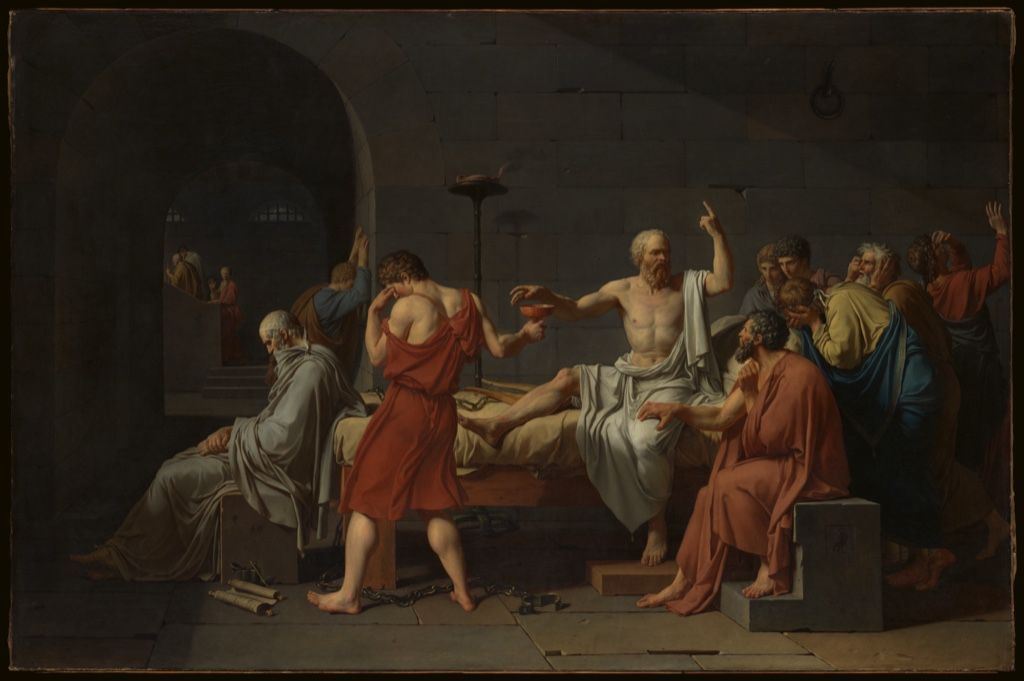
Jacques-Louis David, The Death of Socrates, 1787. Oil on canvas, 51 × 77 1/4 in (129.5 × 196.2 cm). A width-to-height relationship may suit an extended group, but the work’s large physical scale changes handling, framing and viewing distance. Image: The Metropolitan Museum of Art, Open Access, public domain.
Then consider real scale. The same 4:5 proportion can be a small 8 × 10 inch study or a much larger 40 × 50 inch work. Increasing both dimensions multiplies area quickly: doubling width and height produces four times the face area. That changes the quantity of ground and paint, the reach and movement needed to work, drying and handling space, support engineering, storage, transport and display demands.
A useful planning method is to make proportional paper thumbnails first. Mark the intended ratio, test several placements, and record the final face dimensions and profile depth separately. For a series, decide whether continuity comes from identical outer dimensions, identical ratios, aligned edges or a deliberate progression. Those are different systems and should not be conflated.
French Figure, Landscape and Marine formats
The French numbered system is not one ascending list of identical shapes. Each number may occur in three traditional rectangular series: Figure (F), Paysage or landscape (P), and Marine (M). At number 10, for example, a current specialist table gives 10F as 55 × 46 cm, 10P as 55 × 38 cm and 10M as 55 × 33 cm.[4] The long edge is shared while the short edge changes, so F is the fullest rectangle, P is longer and M longer again. A second current specialist source corroborates the categories and standard-format convention.[5]
The subject names are historical conventions, not instructions about what must be painted. An artist can use an F-format canvas for a landscape or an M-format canvas for an abstract work. The code identifies a size family; it does not classify the finished image.
French-derived numbered formats are also encountered in Japan, where tables may include F, P, M and an S square series.[6] Scholarly discussion traces the wider adoption and modification of these conventions in Europe and Japan.[7] Dimensions and available numbers can nevertheless vary by market, maker and table. Always resolve the letter as well as the number and check the stated centimetres. “10” alone is incomplete when multiple series are sold.
Custom, square and panoramic canvases
Standard stock is convenient because matching stretchers, frames and transport materials may be easier to locate, but it has no exclusive artistic authority. Custom stretching permits a dimension derived from an installation, architectural bay, existing frame, multi-panel scheme or particular composition. Manufacturers also offer squares, circles and elongated rectangles outside the most familiar inch lists.
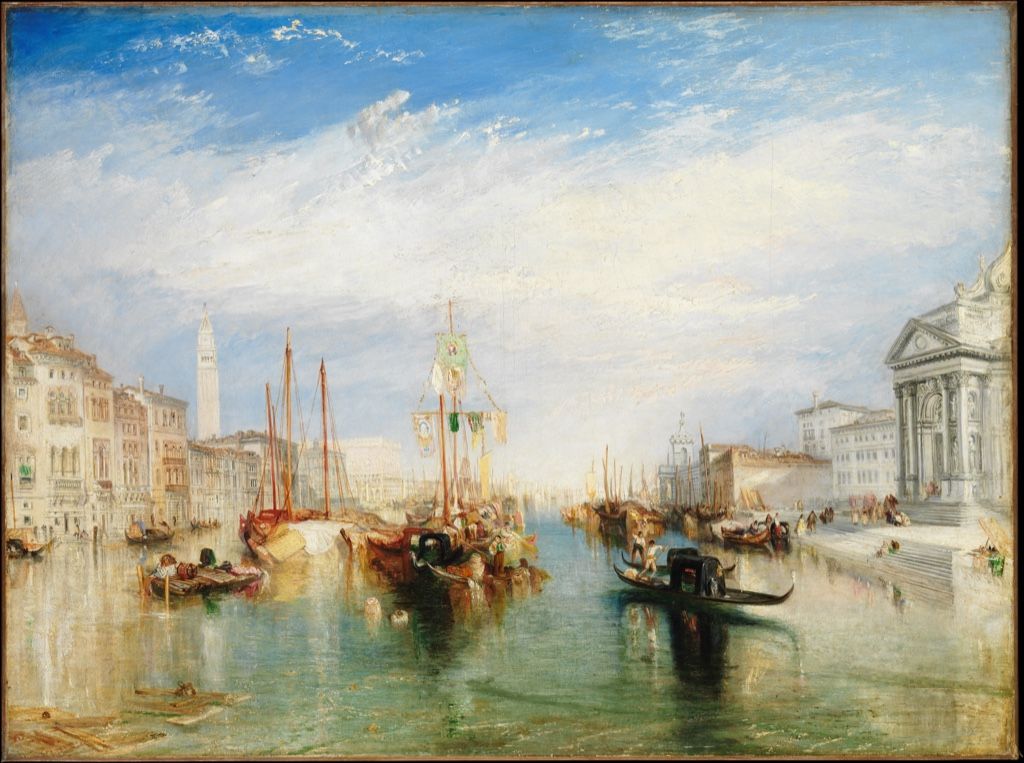
J. M. W. Turner, Venice, from the Porch of Madonna della Salute, about 1835. Oil on canvas, 36 × 48 1/8 in (91.4 × 122.2 cm). A broad landscape proportion can be described exactly without forcing it into a universal named series. Image: The Metropolitan Museum of Art, Open Access, public domain.
Unusual proportions need practical planning. Very long or large stretchers may require stronger sections, bracing and professional fabrication. A large textile support responds to tension and environmental change differently from a small one. These are construction and conservation questions rather than reasons to force every image into a stocked rectangle. If the work is substantial, valuable or structurally ambitious, consult an experienced fabricator or conservator rather than extrapolating from a small hobby canvas.
For framing, record the measured outer dimensions, diagonals and depth after the canvas is complete. For shipping, include protective clearance and hardware rather than using picture-face dimensions as the box size. For digital documentation, crop the reproduction to the artwork’s actual ratio; otherwise an online image may falsely suggest that two differently proportioned canvases match.
A reliable comparison checklist
- Identify the measurement unit and whether any paired unit is exact or rounded.
- Confirm which two values describe the face and which value, if present, describes depth.
- Reduce the face dimensions to an aspect ratio, then consider orientation separately.
- For a numbered regional size, record the complete code, such as 10F or 10M, and its stated centimetres.
- Compare measured dimensions when fitting a frame, case, multi-panel system or fixed display.
- Treat a current manufacturer range as evidence of availability, not a universal or permanent list.
- Choose physical scale after accounting for working reach, support construction, storage, transport and display.
- Keep custom formats available when the composition or site needs them.
The safest size record contains four pieces of information: measured face dimensions, unit, aspect ratio and profile depth. Add the manufacturer or regional code only as a secondary identifier. That small discipline makes comparisons clearer across catalogues and prevents a rounded equivalent or incomplete series number from becoming an expensive physical mismatch.
A working size reference
Because no single list governs every market, a useful size chart should group stocked examples by proportion rather than call them universal standards. In current inch-based ranges, 8 × 10, 16 × 20 and 24 × 30 inches share a 4:5 ratio. The 9 × 12, 12 × 16, 18 × 24 and 30 × 40 inch formats share 3:4. The 12 × 18, 20 × 30, 24 × 36 and 30 × 45 inch formats share 2:3. Squares remain 1:1, while 20 × 24 reduces to 5:6 and 11 × 14 remains 11:14.[1][2]
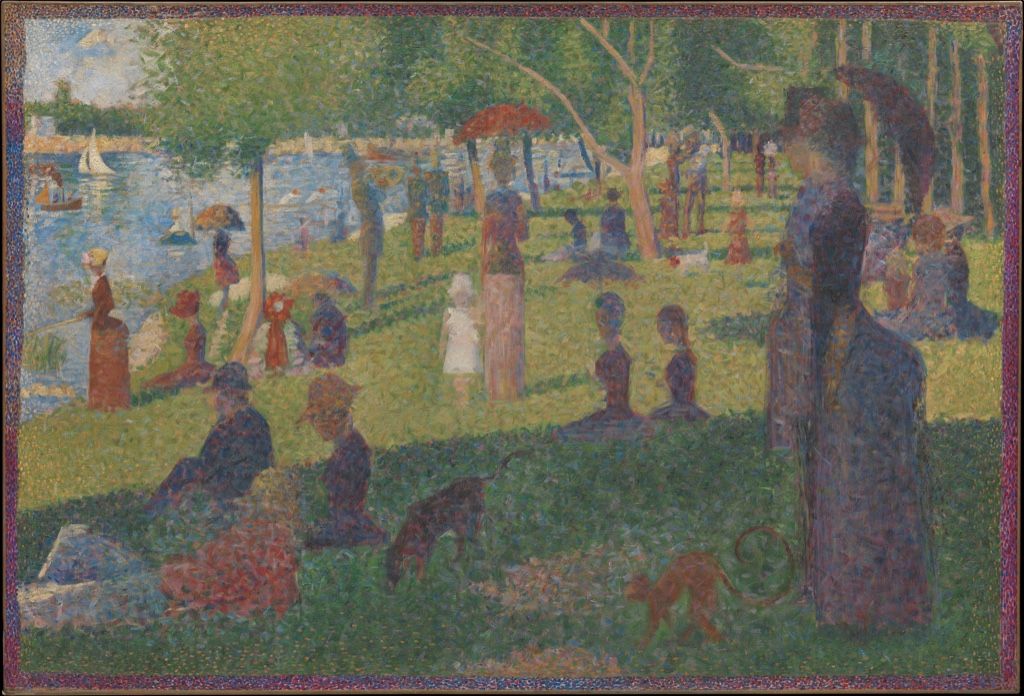
Georges Seurat, Study for “A Sunday on La Grande Jatte”, 1884. Oil on canvas, 27 3/4 × 41 in (70.5 × 104.1 cm). Recording both dimensions allows area, perimeter, diagonal and aspect ratio to be calculated for different practical questions. Image: The Metropolitan Museum of Art, Open Access, public domain.
This grouping makes substitution safer. If a 16 × 20 inch composition is moved to 24 × 30 inches, its 4:5 structure scales without cropping. Moving it to 18 × 24 inches changes the ratio to 3:4, so one edge must gain space, lose content or acquire a border. A familiar size is not necessarily a proportional match.
Metric ranges should be read independently. A 30 × 40 cm canvas is exactly 3:4, but a 40 × 50 cm canvas is 4:5. A 50 × 70 cm rectangle reduces to 5:7, not to 2:3. Where a catalogue prints inch and metric labels together, the exact conversion reveals whether the values name the same manufactured object or two nearby stock formats.[1][2][3]
Area, perimeter and diagonal answer different questions
Aspect ratio describes shape, but material and handling estimates depend on other measurements. Face area is width multiplied by height. A 16 × 20 inch canvas covers 320 square inches; a 32 × 40 inch canvas keeps the same ratio but covers 1,280 square inches—four times the area. Paint demand, working reach and exposed surface therefore rise faster than either edge alone suggests.
Perimeter is twice width plus twice height. It helps estimate the minimum linear span around the face, although stretching requires extra fabric for turnover and attachment. Diagonal is the square root of width squared plus height squared. Comparing the two diagonals of a finished rectangular stretcher is a practical way to detect whether it is out of square, but equality does not prove that every bar is straight or the stated face size is exact.
For multi-panel work, record both individual panels and the installed assembly. Three 40 × 50 cm canvases remain three 4:5 panels; hung with gaps, the overall installation has a different width and proportion. A triptych label should never collapse panel size, gap and complete span into one ambiguous pair of dimensions.
Frames, stretchers and image dimensions
Four dimensions may coexist around one work: nominal canvas size, measured outer stretcher size, visible image size and frame rebate or opening. They are not interchangeable. A frame opening can overlap the front edge; a float frame introduces a visible gap; a textile turnover continues around the side; and a prepared panel may be cut slightly away from its nominal catalogue size.
Before ordering or making a frame, measure the completed object at several points and record depth, squareness and any protruding keys or hardware. Before planning a reproduction, use the image boundary rather than the frame’s outside dimension. These checks solve different problems, but all begin by naming which rectangle was measured.
Watch: Canvas Specification, Scale and Construction
Compare canvas weight, stretching and artist-led judgments about support quality before treating a size label as a complete specification.
Canvas Weight Explained
Compare canvas weights and see why one numerical label does not describe the whole support.
Watch on YouTubeFrequently Asked Questions
No. Standard usually means a recurring stocked or regional convention, and manufacturer ranges overlap without being identical.
Multiply each inch dimension by exactly 2.54; treat a retailer’s rounded metric pairing as a product label rather than an exact conversion.
Not reliably. Check the seller or regional convention and confirm the intended orientation.
It is the proportional relationship between the two face dimensions, reduced independently of physical scale or orientation.
They are numbered Figure, Paysage and Marine format families; the same nominal number has different proportions in each family, so use a current regional table.
Discussion
Which comparison matters most for your intended work: proportion, physical area, edge depth, transport or frame availability?
Reader Insights
Exact conversions and rounded retail pairings answer different questions.
A simplified proportion makes unlike physical sizes comparable.
Face size, depth, stretcher, frame and usable painted area need not match.
Join the Conversation
Share one precise observation or a useful museum example below.
References
- Daler-Rowney. Simply Stretched Canvas FSC — Technical Data Sheet 515.
- Daler-Rowney. Simply Stretched Canvas — Technical Data Sheet 514.
- Kokuyo Camlin. Stretched Canvases.
- Encadrement Paris. Formats Figure, Paysage et Marine en cm.
- Le Géant des Beaux-Arts. Format standard.
- Yukio Takamori. Canvas size.
- Takamori, Y. et al. A proposal of new standard canvas sizes for contemporary art.