by Tom Gurney
Tom Gurney BSc (Hons) is an art history expert with over 20 years experience
Page created on September 3, 2026 / Page updated on September 13, 2026
Email: tomgurney1@gmail.com / Phone: +44 7429 011000
How Painters Resolve Colour and Form while the Surface Is Still Wet
Alla prima means painting “at the first attempt”: substantial parts of an image are resolved directly while the paint remains workable, rather than being constructed mainly through dried intermediate stages. Wet-in-wet describes the more specific act of applying paint beside or over paint that has not dried. The two often coincide, but they are not exact synonyms.[1]
A painter can use a wet-in-wet passage inside a work completed over many sessions. An alla prima portrait may also be adjusted on a later day. Direct painting is therefore better understood through the relationship between strokes and layers than through a stopwatch.
At a Glance
- Alla primasubstantial parts of a painting are resolved directly while paint remains workable.
- Wet-on-wetfresh colour is placed beside or over paint that has not dried, allowing edges and mixtures to mingle.
- Terms overlapa wet-on-wet passage can appear inside a painting completed across several sessions.
- Look forintermixed edges, decisive strokes, wet corrections and passages that retain direct handling.
- Cautionspeed and visible brushwork alone do not prove the full working sequence.
Contents
What wet paint makes possible
Fresh neighbouring colours can mingle, feather or pull into one another. A brush may deposit a light, pick up some of the wet dark beneath and carry a mixed edge forward. This produces transitions unavailable when every lower passage is dry. It can also muddy colour if the painter repeatedly disturbs the same area.[1]
Direct handling rewards decisions about placement, paint load and value. A stroke may describe shape, colour and texture at once. Corrections remain possible, but they often stay visible as scraped areas, redirected contours or thicker accents. The appearance can be loose, yet economy is not the same as carelessness.
Alla prima is not necessarily impasto. Direct paint may be thin and fluid; thick paint can be added over dried layers. Nor does the method require painting outdoors. Studios, portrait sittings and exhibition pictures all supported wet-into-wet work.
Four paintings to examine
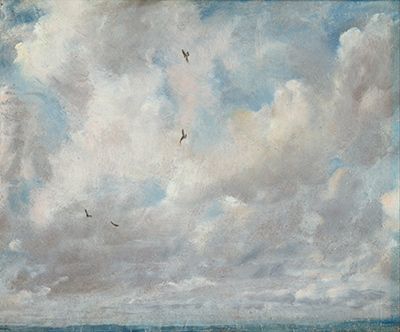
Cloud Study
John Constable's dated sky studies join observation with speed. The V&A explains that his oil sketches record changing weather and light through direct work from nature.[2] In Cloud Study, pale and grey strokes meet while still responsive, creating shifting vapor rather than a polished inventory of cloud edges.
The small support and concentrated subject encourage rapid decisions, but the study is not an accidental fragment. Constable selected a horizon, direction of light and relation between blue opening and denser cloud. Wet joins preserve the meteorological instability he was watching.
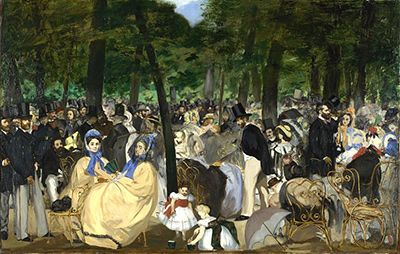
Music in the Tuileries Gardens
Manet's Music in the Tuileries Gardens compresses fashionable figures into a crowded public scene. The National Gallery describes the painting's modern subject, recognisable portraits and unconventional handling.[3] Faces and costumes are often established by a few placed touches rather than smoothly completed contours.
Dark shapes, pale accents and green foliage interlock across the surface. Some strokes sit into neighbouring colour; others remain decisive on top. The picture shows how directness can organise a complex crowd, not merely a single spontaneous motif.
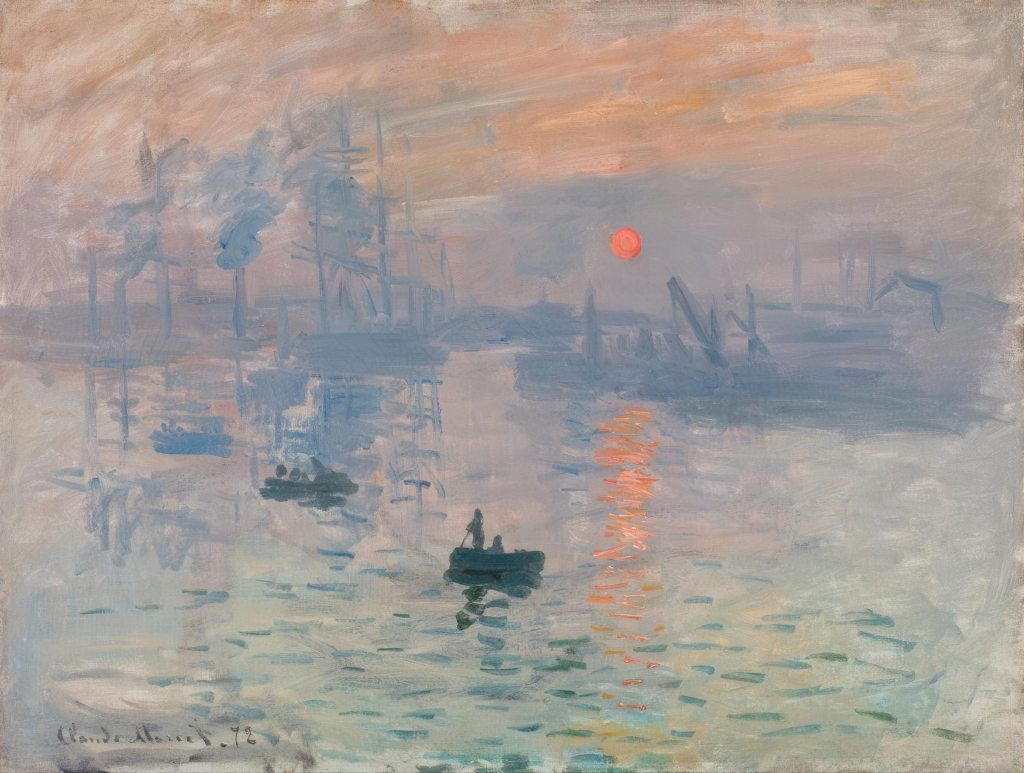
Impression Sunrise
Monet's Impression, Sunrise uses thin atmospheric fields and separate accents to evoke Le Havre harbour. The Musée Marmottan Monet identifies the 1872 work that supplied the name later applied to Impressionism.[4] A small orange sun and reflection operate against blue-grey haze with remarkable economy.
Its appearance suggests rapid, direct notation, but the title and loose surface do not prove a single uninterrupted sitting. The responsible observation is material: broad thin areas, wet-looking transitions and concise darker boats remain active rather than being concealed beneath a polished finish.
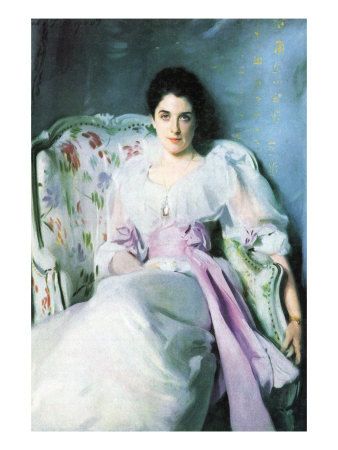
Lady Agnew of Lochnaw
Sargent's Lady Agnew of Lochnaw balances assured direct strokes with selective refinement. National Galleries Scotland describes the sitter's relaxed pose and the portrait's rapid critical success.[5] Her face receives controlled modelling, while sleeves, sash, chair and floral wall are stated with increasingly open handling.
The contrast creates focus. A broad stroke does not always mean it was made quickly, and a precise face does not exclude wet-in-wet work. Sargent's practice, documented through studies of his portrait technique, involved placement, revision and calculated variation rather than effortless improvisation.[7]
Alla prima versus layered painting
Layered construction allows a dried lower stage to support transparent glazes, opaque revisions and scumbles without being physically blended into the new paint. Alla prima keeps more decisions within the active paint film. These are endpoints on a continuum rather than opposing camps.
One painting can combine them. A dry preparation may receive a directly painted head; that passage can later receive a glaze or accent. The Getty survey of historical methods repeatedly demonstrates such mixed sequences.[8] Labels are most useful when attached to a passage and supported by evidence.
The Italian term became especially common in modern teaching, while related direct practices long predate it. Tate's account places alla prima within a history of completing a painting in one application or session, often associated with the possibilities of oil paint.[6] Actual objects complicate the neat definition through revision and return.
How to recognise direct handling
Look for strokes that retain their shape while also picking up neighbouring colour, edges formed by two wet masses meeting and corrections made within the same body of paint. Scraped or wiped zones can show that directness included subtraction as well as addition.
Then distinguish material evidence from style. Broken brushwork may be painted over a dry layer; a smooth passage may have been blended while wet. Studio records, technical imaging and close examination can establish more than a reproduction can.
Finally, ask what directness contributes. In Constable it keeps weather unstable; in Manet it makes urban vision fragmentary; in Monet it condenses atmosphere; in Sargent it separates attention from supporting surface. Alla prima is not merely faster painting. It is a way of letting decisions remain materially close to the moment they were made.
Watch: Direct Painting and Alla Prima Decisions
Choose two painter-led accounts of working wet into wet in one sitting or a museum study of Monet's palette and direct handling.
Alla Prima Painting Explained
Follow the planning and wet-into-wet decisions behind completing a realistic painting in one sitting.
Watch on YouTubeFrequently Asked Questions
Alla prima means “at the first attempt” and usually describes resolving substantial parts of a painting directly while the paint remains workable.
They overlap, but wet-on-wet names a local interaction of fresh paints, while alla prima more broadly describes a direct working approach.
Not necessarily. Definitions vary, and a painting may contain direct passages made in separate sessions.
Look for neighbouring colours that mingle, soft displaced edges, strokes pulled through fresh paint and revisions within the same paint body.
No. Appearance can suggest direct handling, but technical examination, documentary evidence and close surface study provide stronger support.
Discussion
Which of the four paintings makes direct wet handling most visible, and which specific edge or stroke provides the evidence?
Reader Insights
Wet contact often softens, pushes or carries neighbouring colour.
One wet-on-wet area does not prove the entire painting was made in a single session.
Direct corrections can remain embedded within the same workable paint layer.
Join the Conversation
Share one precise observation or a useful museum example below.
References
- National Gallery, “Wet in wet.” https://www.nationalgallery.org.uk/paintings/glossary/wet-in-wet
- Victoria and Albert Museum, “Constable's oil sketches.” https://www.vam.ac.uk/articles/constables-oil-sketches
- National Gallery, “Édouard Manet, Music in the Tuileries Gardens.” https://www.nationalgallery.org.uk/paintings/edouard-manet-music-in-the-tuileries-gardens
- Musée Marmottan Monet, “Impression, soleil levant.” https://www.marmottan.fr/en/collections/claude-monet/
- National Galleries of Scotland, “Lady Agnew of Lochnaw.” https://www.nationalgalleries.org/art-and-artists/5396
- Tate, “Alla prima.” https://www.tate.org.uk/art/art-terms/a/alla-prima
- Metropolitan Museum of Art, “John Singer Sargent (1856–1925).” https://www.metmuseum.org/essays/john-singer-sargent-1856-1925
- Getty Conservation Institute, Historical Painting Techniques, Materials, and Studio Practice. https://www.getty.edu/conservation/publications_resources/pdf_publications/pdf/historical_paintings.pdf