by Tom Gurney
Tom Gurney BSc (Hons) is an art history expert with over 20 years experience
Page created on September 3, 2026 / Page updated on September 13, 2026
Email: tomgurney1@gmail.com / Phone: +44 7429 011000
When Restricted Colour Makes Relief, Structure and Material Illusion More Visible
Grisaille is painting in grey or a closely limited range of neutral tones. The word comes from the French gris, grey. By restricting hue, a painter can concentrate attention on value, volume and relief. Grisaille may imitate stone sculpture, cover the exterior of an altarpiece, serve as a preparatory stage for colour or exist as an independent finished work.[1]
Those functions are related but not interchangeable. A monochrome image visible to its intended audience is not “only an underpainting.” A lower grey stage later covered by colour has a different material position and purpose. Identifying grisaille begins with what the limited palette does in a particular object.
At a Glance
- Core ideagrisaille is painting in grey or a tightly restricted neutral range.
- Possible functionsfinished image, sculptural illusion, altarpiece exterior, decorative scheme or preparatory stage.
- Not automatically underpaintinga monochrome work can be the visible destination rather than a layer awaiting colour.
- Not identical to achromaticachromatic describes colour range; grisaille also carries historical technique and function.
- Look fortonal modelling, simulated relief, material cues and evidence of the object’s intended use.
Contents
Why painters used grisaille
One powerful use is illusion. Carefully modelled highlights and shadows can make painted figures resemble carved stone, especially when they occupy simulated niches or stand on fictive bases. Colour restraint supports the deception, but drawing, cast shadow and the relationship to the frame complete it. The National Gallery notes grisaille's long association with the imitation of sculpture and architectural decoration.[2]
On polyptych and triptych exteriors, subdued monochrome could contrast with a brilliant interior revealed when shutters opened. The difference could mark liturgical time, material hierarchy or the passage from an everyday closed state to a festive image. The Prado's Netherlandish triptych attributed to the Master of the Collins Hours pairs a grisaille Annunciation outside with densely coloured scenes within.[6]
Grisaille can also guide later colour. A painter may establish value and form in a neutral stage before adding translucent films. Yet historical methods vary, and surviving preparatory work is not proof that every finished painting followed the same sequence. The Getty survey shows that workshop practice changed across place, date and material.[8]
Three paintings to study
Annunciation Diptych
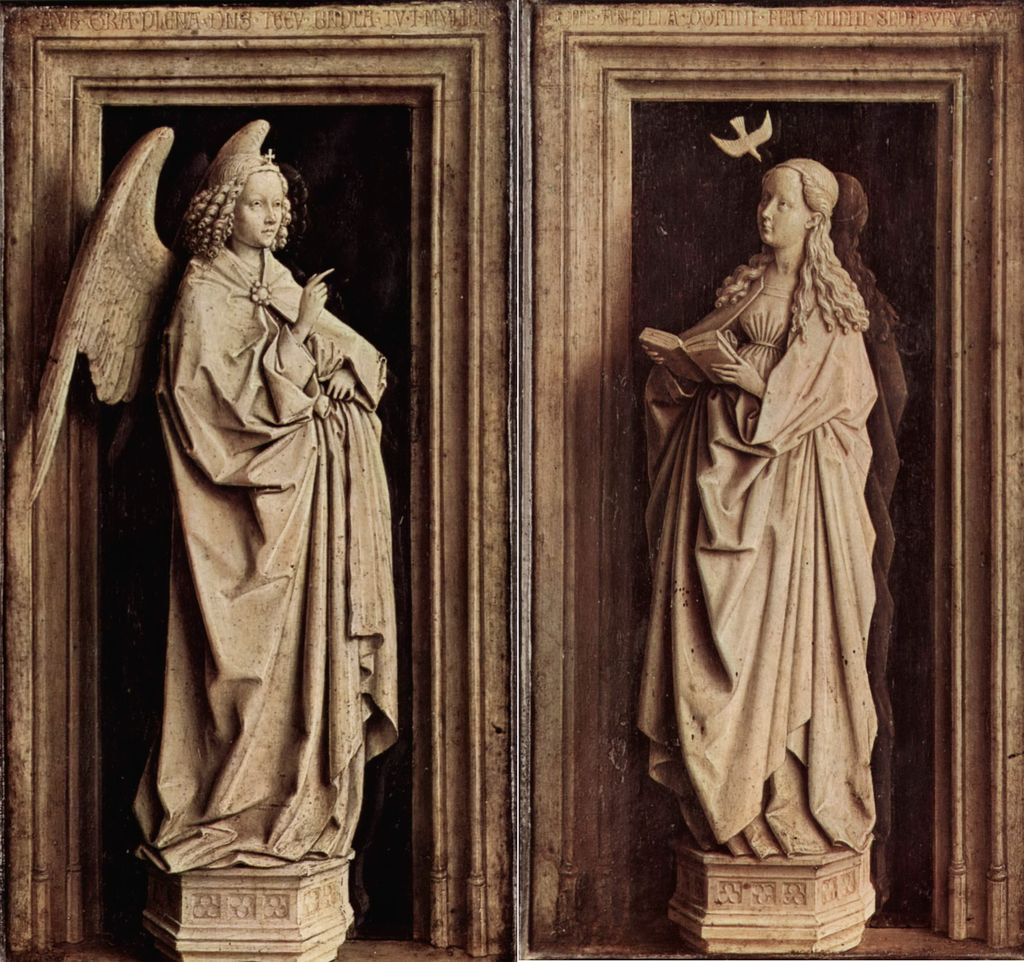
Jan van Eyck's small Annunciation Diptych presents Gabriel and Mary as pale statues in dark niches. Painted bases, mouldings and inscriptions interact with the figures to make the panels resemble precious carved objects. The Thyssen-Bornemisza Museum emphasises both the grisaille technique and the diptych's deliberate fiction of sculpture.[3]
Look at how folds project through narrow value changes while the black field throws pale forms forward. The figures are clearly paint, yet the simulated supports and reflected details make the imagined material uncertain. Grisaille here is the finished language of the devotional image, not an incomplete colour scheme.
Saint John the Baptist
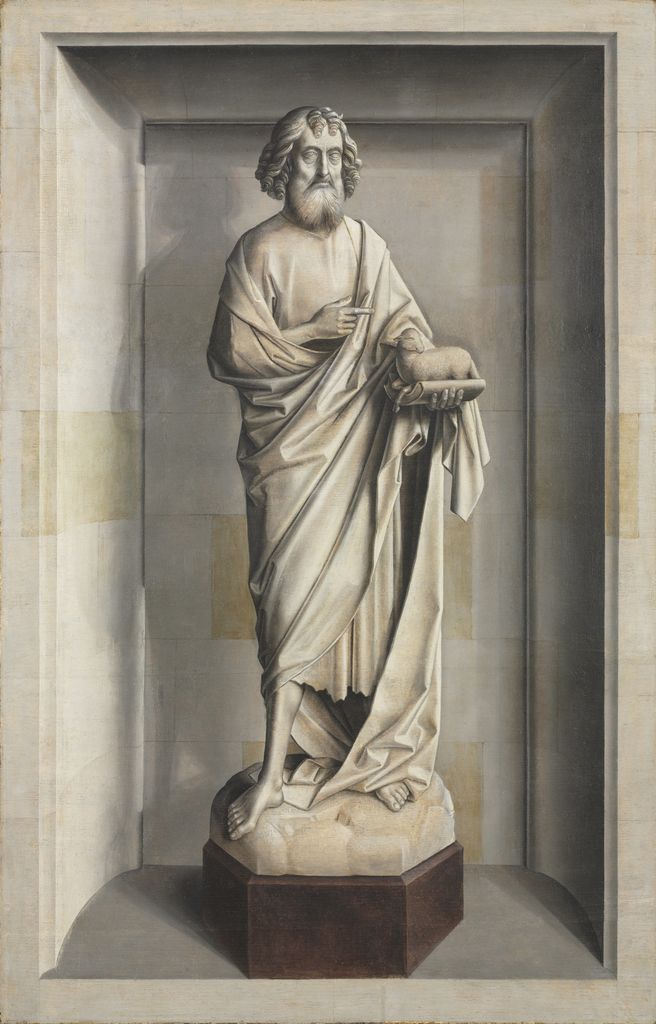
The Bouts-circle Saint John the Baptist at the Cleveland Museum of Art places the saint and lamb in a shallow niche. Grey modelling makes flesh, hair, drapery and stone appear to share one material, while slight tonal differences preserve their identities. The museum records the work as oil on wood and identifies its sculptural presentation.[4]
This is a useful test of recognition. Monochrome alone does not create a statue illusion: pose, ledge, niche, shadow and restrained surface all contribute. The painting demonstrates how grisaille can convert a living sacred figure into the visual register of carved devotional sculpture.
The Introduction of the Cult of Cybele at Rome
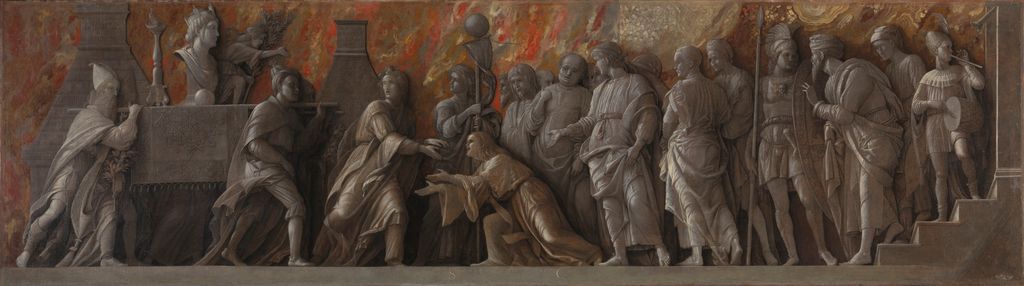
Andrea Mantegna's long canvas evokes an ancient relief. Figures process across a shallow zone, their pale bodies and draperies set against a darker simulated stone ground. The National Gallery describes the work's tempera medium, unusual horizontal format and relationship to a planned cycle celebrating Roman history.[5]
Mantegna's restricted palette supports his archaeological imagination. Overlap, inscription and profile pose create the cadence of a frieze, while painted highlights give the “stone” bodily projection. The effect is not colourless poverty; it is a calculated transfer between painting and antiquarian sculpture.
Finished work and preparatory stage
Ingres's Odalisque in Grisaille shows how monochrome could become an independent reconsideration of a coloured composition. The Metropolitan Museum identifies it as a smaller monochrome version related to the Grande Odalisque, with its own material presence and history.[7] Its status cannot be reduced to a sketch merely because hue is restricted.
Preparatory grisaille, by contrast, occupies an earlier stage. Value masses can clarify a composition before glazes or opaque colours are added. In some workshop settings, monochrome models also communicated designs to assistants, patrons, engravers or tapestry makers. Each case needs evidence about function and sequence.
The term dead colouring sometimes overlaps with monochrome preparatory painting, but historical vocabularies are unstable. Underpainting is the safer broad term for a lower painted stage; grisaille specifies its grey or neutral appearance. A warm brown underlayer is underpainting but not normally grisaille.
Grisaille, monochrome and achromatic colour
Monochrome means an image organised around one colour family and can therefore be blue, red or brown. Grisaille conventionally points to grey, though museum usage can include tightly restricted neutral or stone-like ranges. An achromatic image uses white, grey and black without chromatic hue; real paintings often include slightly warm or cool mixtures even when they read as grey.[1][2]
That distinction matters when examining reproductions. A warm varnish, altered pigment or photographic white balance may make neutral paint appear coloured. Conversely, a desaturated digital file can erase restrained hues. Object records and technical examination help determine whether a grey effect belongs to original intention, later change or reproduction.
How to read a grisaille painting
First ask whether limited colour is the visible destination. If the surface presents a complete devotional figure, sculptural fiction or autonomous reinterpretation, treat that completion seriously. If coloured layers cover most of the monochrome stage and technical images expose it underneath, the grisaille functions as preparation.
Then identify the material being imitated. Stone-like figures usually rely on shallow value modelling, fictive architecture and cast shadow; relief-like processions may suppress deep spatial recession. Note any deliberate contrast between an exterior and a coloured interior.
Finally, avoid treating grey as neutral in meaning. Grisaille can signal restraint, antiquity, sculpture, mourning, distance, process or transformation. Its significance comes from placement and function. Even a narrow palette can contain warm and cool inflections that distinguish skin, stone, cloth and atmosphere without breaking the dominant monochrome impression. The most useful question is not simply “is this grey?” but “what does the restriction allow the painting to become?”
Watch: Grisaille from Monochrome Study to Colour Layer
Choose a complete grisaille demonstration, a Renaissance-focused account, or a museum lesson on tempera underpainting.
Grisaille: Oil Painting Tutorial
See a monochrome value structure developed before colour and finishing decisions.
Watch on YouTubeFrequently Asked Questions
Grisaille is painting executed in grey or a tightly restricted neutral range, often using tonal modelling to suggest form or relief.
No. Grisaille may be a finished work, altarpiece exterior, sculptural imitation, decorative scheme or a preparatory stage.
Monochrome broadly describes a restricted colour range; grisaille is a historically specific painting practice usually centred on greys and tonal modelling.
Painted relief could connect panels to architectural settings, distinguish exterior from interior states, and display the painter’s ability to simulate another material.
Identify the object’s function, inspect tonal range and material illusion, and use technical or historical evidence before calling it an underpainting.
Discussion
Which work on this page most convincingly makes paint behave like another material, and which tonal cues create the illusion?
Reader Insights
Do not assume restricted colour means an incomplete stage.
Panel position, hinges, framing and original use help explain the grey palette.
Highlights, cast shadows and shallow depth can simulate sculpture.
Join the Conversation
Share one precise observation or a useful museum example below.
References
- National Galleries of Scotland, “Grisaille.” https://www.nationalgalleries.org/art-and-artists/glossary-terms/grisaille
- National Gallery, “Grisaille.” https://www.nationalgallery.org.uk/paintings/glossary/grisaille
- Museo Nacional Thyssen-Bornemisza, “The Annunciation Diptych.” https://www.museothyssen.org/en/collection/artists/eyck-jan-van/annunciation-diptych
- Cleveland Museum of Art, “Saint John the Baptist.” https://www.clevelandart.org/art/1951.354
- National Gallery, “The Introduction of the Cult of Cybele at Rome.” https://www.nationalgallery.org.uk/paintings/andrea-mantegna-the-introduction-of-the-cult-of-cybele-at-rome
- Museo Nacional del Prado, “Triptych with Scenes from the Life of Christ and Mary.” https://www.museodelprado.es/en/the-collection/art-work/triptych-with-scenes-from-the-life-of-christ/39740f98-336b-4d80-8120-bd6e0c4bd96f
- Metropolitan Museum of Art, “Odalisque in Grisaille.” https://www.metmuseum.org/art/collection/search/438145
- Getty Conservation Institute, Historical Painting Techniques, Materials, and Studio Practice. https://www.getty.edu/conservation/publications_resources/pdf_publications/pdf/historical_paintings.pdf