by Tom Gurney
Tom Gurney BSc (Hons) is an art history expert with over 20 years experience
Page created on September 3, 2026 / Page updated on September 13, 2026
Email: tomgurney1@gmail.com / Phone: +44 7429 011000
How Minute Tonal Transitions Let Forms Emerge without Hard Contours
Sfumato is the painting of form through transitions so gradual that a hard boundary seems to dissolve. The word derives from the Italian sfumare, associated with smoke or fading away. In a face painted this way, the turn from cheek to shadow is not enclosed by a dark contour. Minute shifts of tone and colour let the form emerge, recede and remain slightly indeterminate. The National Gallery describes precisely this smoky quality: figures come from darkness through modulation rather than harsh outline.[1]
Leonardo da Vinci made sfumato central to his mature painting, yet it is more than a signature blur. It joins observation, tonal modelling and the controlled translucency of oil paint. It also asks something of the viewer. An edge can be legible without being drawn, and an expression can feel mobile because its decisive transitions refuse to settle into a single line.
At a Glance
- Core effectcontours and tonal steps dissolve into extremely gradual transitions while form remains controlled.
- Not ordinary blursfumato preserves modelling and spatial relationships rather than merely softening an image.
- Layer evidenceLeonardo’s mature surfaces are associated with exceptionally fine translucent paint applications.
- Close neighbourschiaroscuro organises form through light and dark; glazing describes a transparent layer; sfumato concerns the smoky transition.
- Reproduction limitsmall images and soft focus can imitate the appearance without proving the technique.
Contents
What sfumato does
Sfumato replaces abrupt changes with finely graduated ones. Around a nose, eyelid or mouth, it reduces the visual certainty of the boundary while preserving the three-dimensional form. Leonardo's writings repeatedly oppose crude outlines in nature: the visible limit of a body changes with light, atmosphere and the relation between figure and ground.[8] Paint could approximate that experience through successions of almost imperceptible tones.
The effect is local as well as atmospheric. Soft distant mountains may use aerial perspective, in which contrast and colour weaken with distance, but sfumato can operate within the nearest face. Conversely, not every hazy landscape is sfumato. The term is most useful when it identifies the deliberate fusion of contours and tonal stages in painted modelling.
Oil paint gave Leonardo unusual scope for this work. Its slow handling and capacity for thin films allowed transitions to be adjusted without the visibly hatched boundaries common in faster-drying tempera. The NGA notes that the medium let him build shadows and distant haze in Ginevra de' Benci; fingerprints show that he also blended selected passages with his hands.[5] That evidence warns against imagining one single brush recipe.
How the surface was built
Technical accounts emphasise superimposed fine translucent layers. The National Gallery's conservation study of The Virgin of the Rocks relates Leonardo's subtle transitions to many particularly thin films.[2] The Louvre similarly explains the Mona Lisa face through scarcely pigmented oily glazes that move between shadow and light.[3] Each film modifies what lies beneath; a sequence can deepen shadow or soften an interval without laying down one blunt opaque boundary.
This does not mean the whole picture is uniformly glazed. Light grounds, opaque body colour, underdrawing, revisions and translucent passages can coexist. The Getty's broad survey of historical practice shows why a fixed modern formula is misleading: workshop procedure varied by support, pigment, binder, desired effect and stage of execution.[7] Sfumato names the resulting mode of transition, not a complete layer-by-layer system applicable to every square centimetre.
The surface should therefore be read at two distances. From nearby, a well-preserved passage may reveal tiny tonal changes or thin dark veils. From farther away, those changes fuse into flesh, atmosphere and volume. Reproduction complicates the task: compression, glare, varnish and conservation history can either exaggerate softness or erase it. Institutional technical imaging is firmer evidence than a small digital image alone.
Four paintings to study
The Virgin of the Rocks
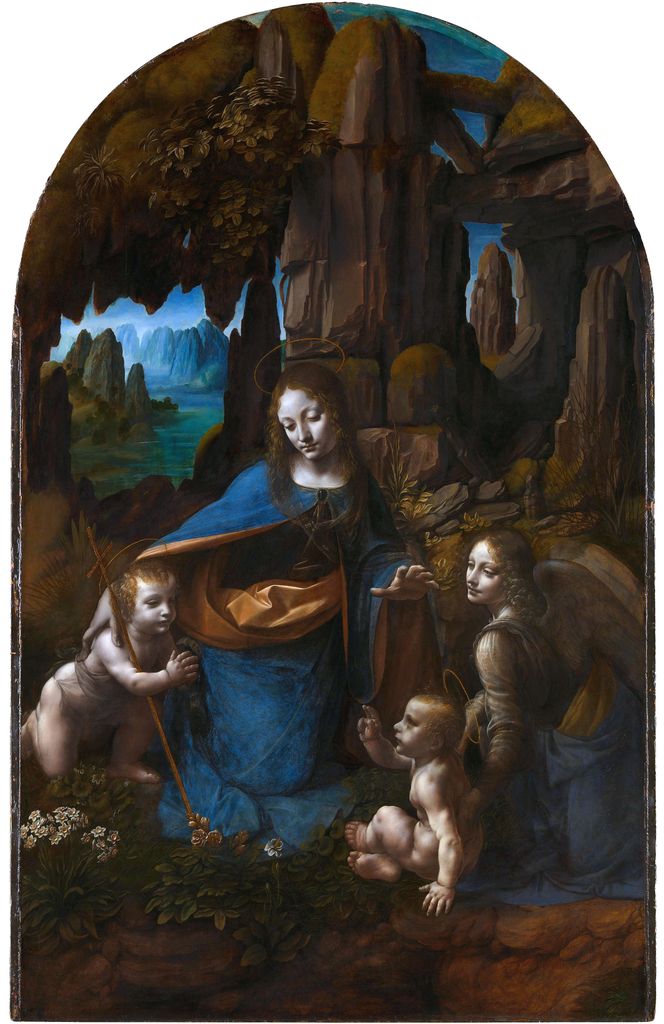
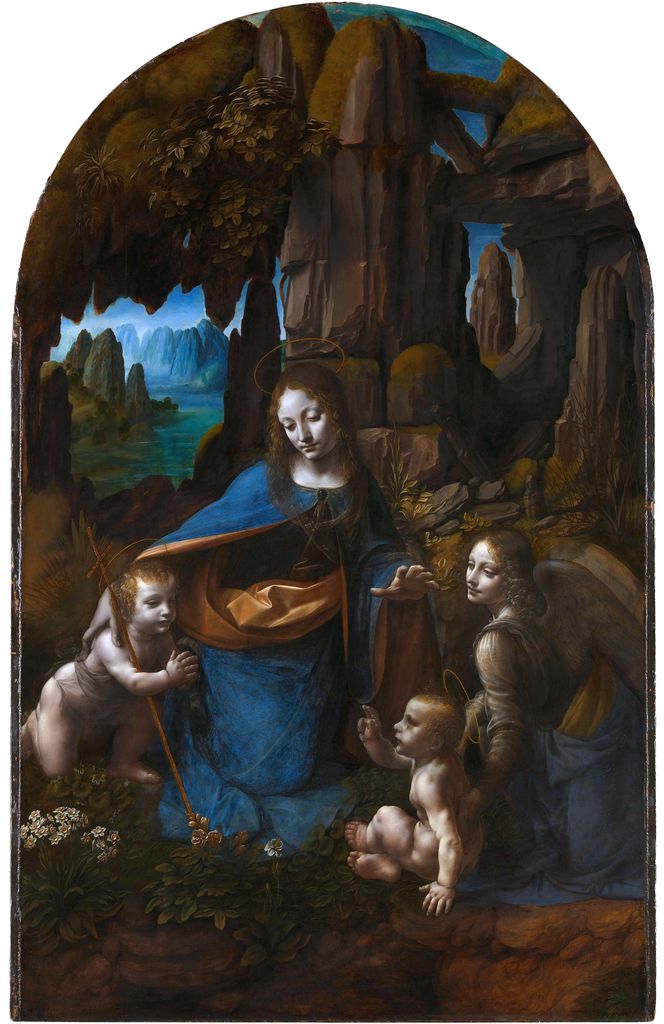
In the London Virgin of the Rocks, faces, hands and bodies emerge from a grotto whose dark hollows surround them. At the Virgin's temple and nose, no enclosing line separates flesh from shadow. The National Gallery connects this controlled disappearance of edges to Leonardo's wish to make forms emerge subtly from darkness.[1][4] The technique works with chiaroscuro, but the two terms describe different things: chiaroscuro supplies the light-dark structure; sfumato governs how many of its transitions occur.
The group's unity depends on related softness. Fingers point and bless with clarity, yet their contours are not uniformly cut out. Rocks and plants can become more descriptive while skin remains delicately modulated. This variation matters. Sfumato is selective, placed where atmospheric continuity and living flesh require it rather than spread as a filter over the entire painting.
Mona Lisa
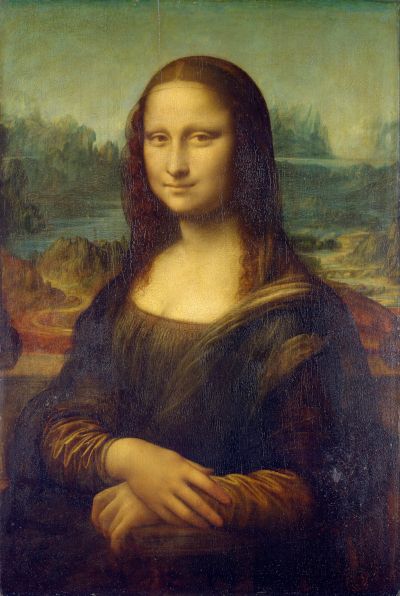
The Mona Lisa makes tiny changes around the eyes and mouth carry unusual expressive weight. The Louvre describes the face as built from imperceptible shadow-to-light transitions created with fine glazes.[3] Because the corners of the mouth do not resolve into fixed dark lines, the smile appears to change as attention shifts. The effect belongs to painted structure, not to a hidden symbol or optical trick added after the fact.
Softness also connects sitter and landscape. Hair, veil, shadow and distant terrain pass through differing degrees of definition. The Louvre's account notes the poplar support and its conservation needs, reminders that the famous surface is a material object rather than a disembodied image.[4] Sfumato makes the sitter present, but it also refuses the crisp separation that would freeze her against the world behind.
Saint John the Baptist
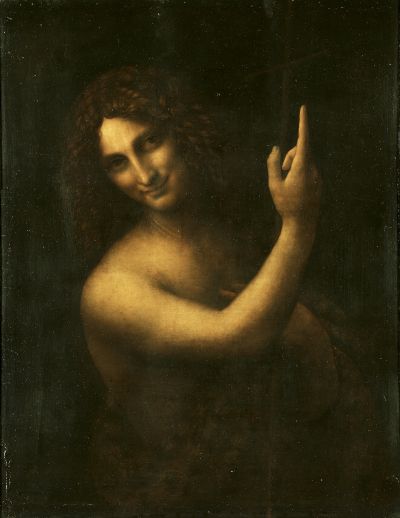
In Saint John the Baptist, a half-length figure appears from an almost continuous dark field. The raised hand and illuminated face are easy to locate, but shoulder, hair and fur merge into surrounding shadow. The Met's account of Leonardo defines sfumato as seamless movement between light and dark without hard contours, a description especially apt here.[6]
The pointing gesture remains precise because Leonardo does not soften every edge equally. Brighter fingertips carry firmer distinctions; the torso is allowed to fade. This hierarchy directs the eye from face to hand while keeping the body mysteriously unbounded. Tenebrism also uses figures against deep darkness, but usually with more forceful contrast and theatrical illumination. Here the dominant sensation is gradual emergence.
The Virgin and Child with Saint Anne
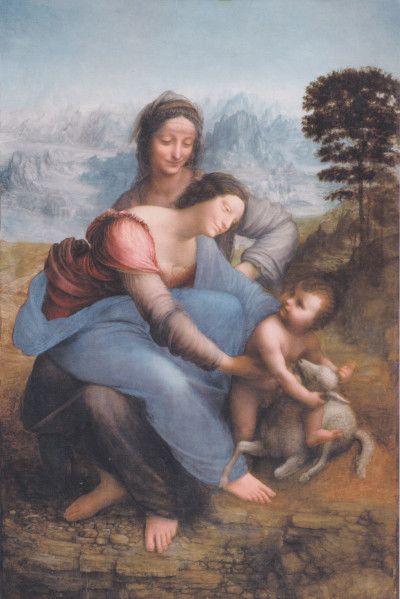
The Louvre's Virgin and Child with Saint Anne sets several bodies into a linked, turning group. Faces and limbs remain readable, yet their modelling flows through delicately joined half-tones. Leonardo had developed the composition through drawings, and the surviving painting joins careful design to a surface whose transitions suppress the rigidity of that preparation.[4][6]
Look at the Virgin's cheek and the passage from her neck into shadow, then compare the sharper folds and landscape forms. Sfumato does not destroy structure. It moderates selected boundaries so that flesh appears rounded and the figures' emotional exchange feels continuous. The painting also demonstrates why the technique cannot be reduced to portraiture: it can bind a complex sacred narrative as effectively as a single sitter.
Sfumato compared with nearby techniques
Chiaroscuro concerns the organisation and modelling produced by light and dark. Sfumato can be one way of moving between those values, but chiaroscuro may be abrupt and sharply edged. Glazing is a material operation—placing a transparent or translucent film over dried paint. Such films helped create sfumato, but a glaze can also produce a jewel-like colour with a clear contour.
Atmospheric perspective makes distant forms paler, cooler or lower in contrast to suggest depth. Leonardo uses it in landscapes, yet sfumato also shapes nearby skin. Blending is broader still: any softened junction may be blended, while sfumato implies a sustained, smoke-like suppression of edges and tonal steps. Finally, an out-of-focus photograph is not proof of the technique. Recognition has to rest on relationships within the painted surface.
How to recognise sfumato
Start at high-information edges: eyelids, lips, nostrils, jawlines and fingers against shadow. Ask whether a dark contour encloses the form or whether neighbouring tones gradually take over its job. Then compare nearby materials. If hair, stone and cloth are all equally fuzzy, the reproduction may be soft; if flesh receives especially subtle modulation while selected accents remain firm, the effect is more likely intentional.
Follow the transition rather than the subject. A famous Leonardo attribution is not enough, and another artist can use sfumato. The National Gallery notes Giorgione's related Venetian tonal transitions.[1] Conversely, a Leonardo painting can contain incisive drawing, bright opaque paint and hard accents alongside smoky modelling. Technique is not a label pasted onto an entire object.
The most responsible conclusion may be limited: “this passage shows sfumato-like gradual modelling” rather than a claim about the complete making process. When cross-sections, infrared examination or conservation reports exist, they can connect what the eye sees to the sequence beneath. Looking carefully begins with the visible edge; explaining it well ends with evidence proportionate to the claim.
Watch: Leonardo, Sfumato and Soft Transitions
Choose a National Gallery technique introduction, a close reading of the Virgin of the Rocks, or a broader film about Leonardo's painting.
Leonardo's Techniques: A 30-Second Introduction
Begin with the museum's compact guide to Leonardo's distinctive handling and visual effects.
Watch on YouTubeFrequently Asked Questions
Sfumato is a painting method associated especially with Leonardo in which contours and tonal steps dissolve through minute transitions while forms remain modelled.
No. Blur loses definition indiscriminately; sfumato controls transitions so volume, atmosphere and focus remain purposeful.
Technical studies associate his mature effects with very fine translucent applications and close tonal adjustment, though methods vary across works and passages.
Chiaroscuro broadly models or organises through light-dark contrast, while sfumato describes the smoky character of extremely gradual transitions.
Only cautiously. Image softness can imitate the effect, so high-resolution details and technical records provide stronger evidence.
Discussion
Which Leonardo painting on this page uses gradual transition most effectively to connect a figure with atmosphere?
Reader Insights
Look for a controlled tonal passage rather than a drawn boundary.
Sfumato softens transition without surrendering volume.
Focus, scale and compression can manufacture false softness.
Join the Conversation
Share one precise observation or a useful museum example below.
References
- National Gallery, “Sfumato.” https://www.nationalgallery.org.uk/paintings/glossary/sfumato
- National Gallery, “Leonardo da Vinci's Virgin of the Rocks: Treatment, Technique and Display.” https://www.nationalgallery.org.uk/media/15698/keith_roy_morrison_schade2011.pdf
- Musée du Louvre, “Portrait de Lisa Gherardini, épouse de Francesco del Giocondo.” https://collections.louvre.fr/ark:/53355/cl010062370
- Musée du Louvre, “Leonardo da Vinci: English exhibition publication.” https://mini-site.louvre.fr/trimestriel/2019/l%C3%A9onard_de_vinciGB/files/assets/common/downloads/publication.pdf
- National Gallery of Art, “10 Surprising Facts About Leonardo da Vinci's Ginevra de' Benci.” https://www.nga.gov/stories/articles/10-surprising-facts-about-leonardo-da-vincis-ginevra-de-benci
- Metropolitan Museum of Art, “Leonardo da Vinci (1452–1519).” https://www.metmuseum.org/essays/leonardo-da-vinci-1452-1519
- Getty Conservation Institute, Historical Painting Techniques, Materials, and Studio Practice. https://www.getty.edu/conservation/publications_resources/pdf_publications/pdf/historical_paintings.pdf
- Leonardo da Vinci, A Treatise on Painting, trans. John Francis Rigaud, Project Gutenberg. https://www.gutenberg.org/ebooks/46915