by Tom Gurney
Tom Gurney BSc (Hons) is an art history expert with over 20 years experience
Page created on September 3, 2026 / Page updated on September 13, 2026
Email: tomgurney1@gmail.com / Phone: +44 7429 011000
How Partial Concealment Makes Light Hover over a Darker Layer
Scumbling applies a thin, lighter, relatively opaque or semi-opaque paint film over a darker layer. The upper colour does not fully hide what lies beneath, so the two create a broken, hazy or cool optical effect. The National Gallery contrasts this with a glaze, which is typically a darker transparent film over lighter paint.[1]
A scumble can be dragged with a low-load brush, softly rubbed, feathered or touched across a surface. Dry-brush handling may create it, but the terms are not identical: dry brush describes the deposition mechanism, while scumbling describes the lighter veil and its relation to a darker underlayer.
At a Glance
- Core actiona thin, lighter, relatively opaque or semi-opaque layer is worked over a darker dry passage.
- Visible effectthe lower colour remains present through gaps or a broken veil, producing haze, coolness or trembling light.
- Not glazinga glaze modifies a lower layer through transparency and often deepens colour; a scumble usually brings lighter matter across darkness.
- Not identical to dry brushdry brush names a low-load broken stroke; scumbling describes a layer relationship and visual effect.
- Look forpartial concealment, broken upper colour and lower darkness remaining active beneath it.
Contents
How scumbling changes colour
Because the upper film is thin rather than inherently transparent, gaps and variations let the lower dark remain active. A pale mixture over deep blue may appear cooler and more atmospheric than the same mixture over white. The National Gallery compares the optical effect to smoke seen against dark trees.[1]
Film thickness is rarely uniform. A brush catches on texture, leaving more paint on raised points and less in hollows. Soft application can make cloud or flesh; broken dragging can suggest foliage, water or worn fabric. The layer may be almost flat or retain small ridges, but substantial relief is not required.
Scumbling normally assumes a lower paint that is sufficiently set to resist unwanted mixing. If the colours physically mingle while both are wet, wet-in-wet is the clearer description. Historical works may combine all these conditions across different passages.[8]
Four paintings to examine
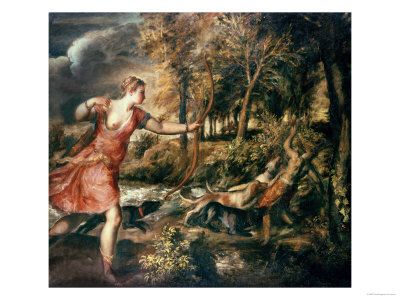
The Death of Actaeon
The National Gallery explicitly identifies scumbling in Titian's The Death of Actaeon: pale paint lies over blue-grey tones to suggest turbulent water.[2] The surface turns a stable layer relationship into movement. Broken light seems to skim the stream while darker colour continues through it.
Titian's late technique extends the effect elsewhere. The Gallery's catalogue describes rose and blue scumbles that can appear to float across forms, sometimes applied with fingers.[3] Incomplete-looking passages, exposed canvas texture and final light touches make the painting's status complex, but the scumbled water is a well-supported material claim.
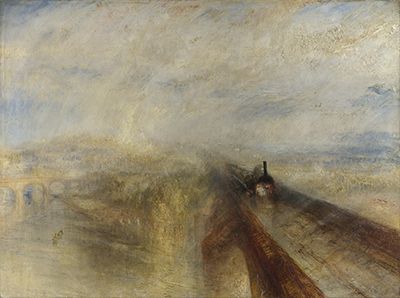
Rain Steam and Speed
Turner's Rain, Steam, and Speed sends a locomotive through gold, brown and blue atmosphere. The National Gallery describes the train's emergence from rain and light, while technical study of Turner's methods shows his use of layered, wiped and broken paint.[4]
Pale veils across darker structure help rain and steam remain both material and insubstantial. The engine and bridge are not simply blurred; their partial concealment creates speed. Scumbling participates in a larger system of washes, opaque strokes, scraping and accents rather than operating alone.
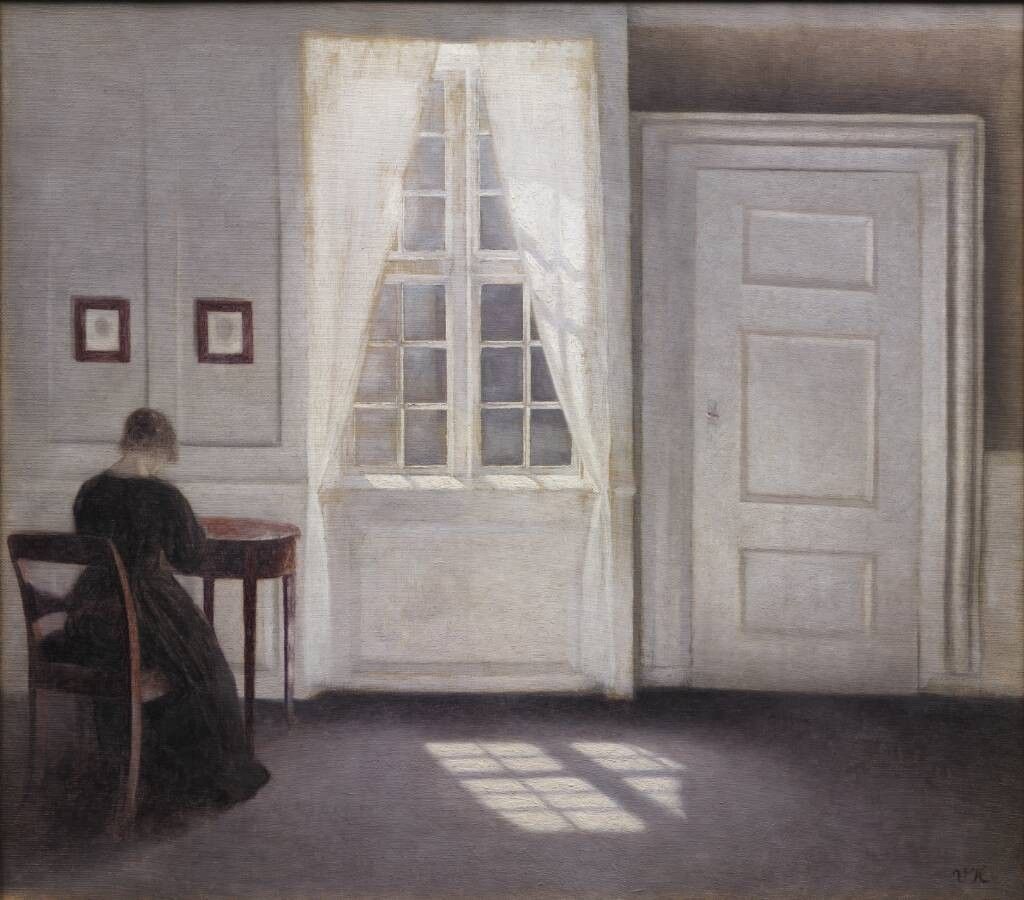
Interior in Strandgade Sunlight on the Floor
Hammershøi's Strandgade interior limits colour to cool greys, warm browns and restrained light. Thin pale passages soften doors, wall and sunlit floor while darker construction remains visible beneath. SMK's technical archive documents scumbling as part of Hammershøi's painting vocabulary in related interiors.[5]
The effect is quieter than Titian's water or Turner's weather. Partial veiling makes the room's light seem suspended and turns minor value differences into atmosphere. This shows that scumbling can clarify stillness as effectively as motion.
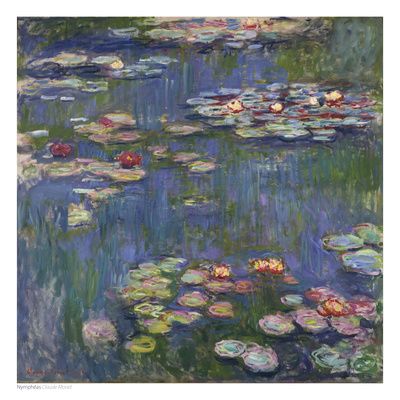
Water Lilies
Monet's late Water Lilies distributes pale lavender, blue, green and white across darker water. The Musée de l'Orangerie describes the horizonless environment created by the great decorative cycle.[6] Broken upper colour can read simultaneously as lily, reflected cloud and light on the pond.
Some passages are thick, others thin and veil-like. Scumbling is most useful where lighter matter partly covers darker paint without becoming a continuous opaque shape. The changing application prevents a single label from swallowing the whole surface.
Scumble, glaze and dry brush
A glaze relies on a transparent or translucent darker film through which a lighter base remains optically active. A scumble reverses the value relationship: lighter, more opaque matter partially covers darkness. Painters can alternate them, restoring lights with a scumble after deepening colour with glaze.
Dry brush often leaves a broken deposit because scant paint catches raised texture. That deposit becomes a scumble when it forms a lighter veil over darker paint. A dark dry-brush twig over a pale sky is not a scumble. One term names handling; the other names layer relationship and optical role.
The Rijksmuseum's technical study of a Van Everdingen painting shows how scumbling can allow an underpainted tone to glimmer through an upper layer.[7] Such cross-sections and close examination ground distinctions that reproductions alone cannot settle.
What scumbling can represent
Smoke, cloud, mist and spray suit the technique because partial concealment resembles suspended matter. It can cool distant landscape, soften flesh, break reflected light or unify a varied surface. A pale scumble may also correct a passage without erasing it completely.
Its expressive range comes from control. Broad haze reduces contrast; intermittent touches animate it. Directional dragging can suggest weather, while soft circular application produces bloom. The lower dark always participates, preventing the light from becoming a flat pasted shape.
How to recognise scumbling
First find a lighter passage through which darker paint remains irregularly visible. Compare it with a nearby opaque highlight: the scumble should behave more like a veil or broken film than a solid replacement.
Then inspect edges and texture. Brush drag may reveal the relief beneath, but softly rubbed scumbles can lack obvious broken strokes. Check whether the effect belongs to original paint rather than blanching varnish, abrasion or old restoration.
Finally, keep the claim local. A painting can contain one scumbled stream, several glazed shadows and thick final highlights. Technical imaging and conservation records establish layer order most securely. Scumbling is powerful precisely because it leaves darkness present—light laid across a surface without fully closing it.
Watch: Scumbling, Broken Veils and Layered Colour
Choose two focused explanations of scumbling and glazing or a MoMA studio reconstruction of Rothko's layered surface.
Scumbling Explained: A Simple Technique for Paintings
See a light, broken application modify a dry layer without behaving like a continuous transparent glaze.
Watch on YouTubeFrequently Asked Questions
Scumbling places a thin, lighter, relatively opaque or semi-opaque film over a darker dry layer so the lower colour remains partly visible.
A glaze works through transparency and often darkens or shifts colour, while a scumble usually brings lighter matter across a darker base.
Not exactly. Dry brush describes a low-load broken stroke; scumbling describes a lighter-over-darker layer relationship that may be dragged, feathered or touched.
It can suggest haze, smoke, cloud, worn fabric, distance or light vibrating across foliage and water.
Look for partial concealment and broken lighter paint over a dry dark layer, then seek close or technical evidence rather than relying on a compressed image.
Discussion
Which painting on this page makes the darker lower layer most active through its lighter veil?
Reader Insights
The lower darkness should remain visually active through the upper paint.
Ask whether the upper film is transparent and darkening or lighter and relatively opaque.
Dragged, feathered and touched deposits can reveal how the veil was built.
Join the Conversation
Share one precise observation or a useful museum example below.
References
- National Gallery, “Scumble.” https://www.nationalgallery.org.uk/paintings/glossary/scumble
- National Gallery, “Titian, The Death of Actaeon.” https://www.nationalgallery.org.uk/paintings/titian-the-death-of-actaeon
- National Gallery, “The Death of Actaeon,” collection catalogue. https://www.nationalgallery.org.uk/paintings/catalogues/penny-2008/the-death-of-actaeon
- National Gallery, “Turner, Rain, Steam, and Speed.” https://www.nationalgallery.org.uk/paintings/joseph-mallord-william-turner-rain-steam-and-speed-the-great-western-railway
- SMK, Vilhelm Hammershøi Digital Archive, “From the British Museum, London—Winter.” https://hammershoi.smk.dk/artwork/from-the-british-museum-london-winter/
- Musée de l'Orangerie, “The Water Lilies.” https://www.musee-orangerie.fr/en/node/197502
- Rijksmuseum Bulletin, “Painting Technique and Restoration of the Van Everdingen.” https://bulletin.rijksmuseum.nl/article/download/11603/13148
- Getty Conservation Institute, Historical Painting Techniques, Materials, and Studio Practice. https://www.getty.edu/conservation/publications_resources/pdf_publications/pdf/historical_paintings.pdf